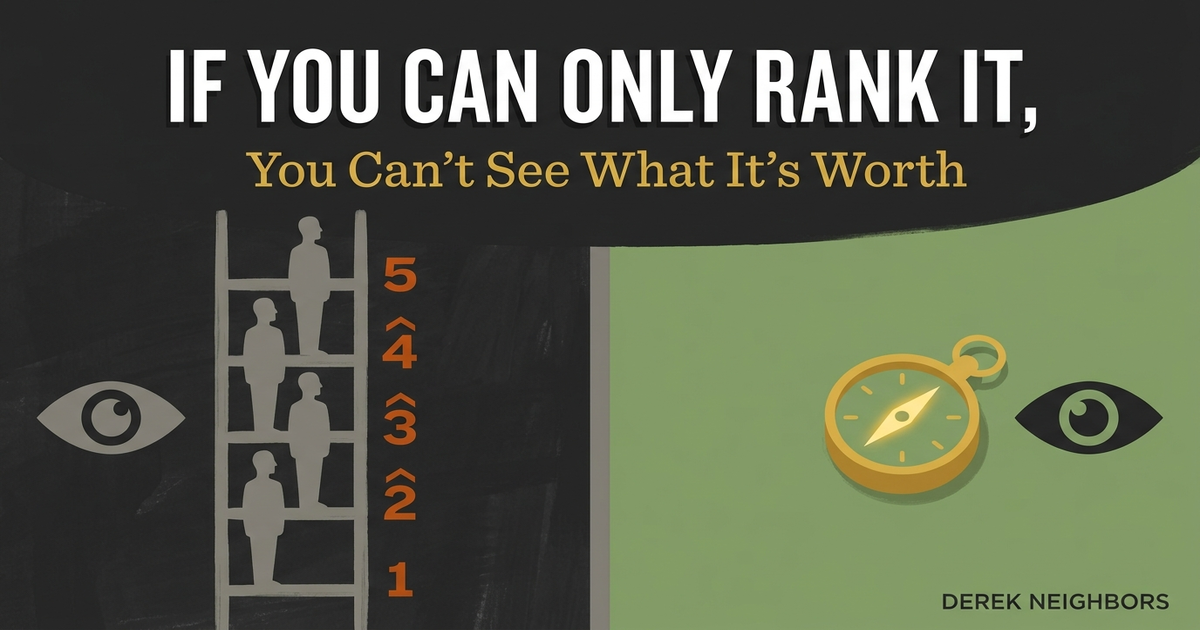
If You Can Only Rank It, You Can't See What It's Worth
By Derek Neighbors on August 9, 2026
You can lose the ability to see a good while still talking about excellence all day.
It usually does not feel like a moral failure. It feels like being sharp. You walk into a room and instantly place people. You open a feed and instantly place yourself. You look at your own work and cannot feel the craft until you know where it sits on someone else’s scoreboard. The eyes still work. The organ that perceives worth has been replaced by a ranking machine.
Path A: Rank as Vision
In Path A, comparison is not a tool you pick up. It is how you see.
A teammate ships something clean and your first thought is not “that solved the problem.” Your first thought is where it puts them relative to you. A friend gets stronger and you feel the ladder move under your feet before you feel any gladness. A quiet morning of real work feels empty until you can convert it into a status update. The good never arrives as itself. It arrives as position.
I have run this path for stretches of my life without naming it. Desert trail miles used to be enough as miles. Then they became a private contest with people who were not even there. Writing used to be enough as the sentence that finally told the truth. Then it became a quiet check against who was louder that week. Parenting can go the same way. A child’s ordinary courage becomes a comparison to other families before it becomes a moment you actually witnessed. The work did not get worse first. The seeing did.
Path A also trains silence. People stop bringing unfinished work into the open because unfinished work loses the ladder. Teams get quieter polish and fewer honest drafts. Friendships get curated highlight reels. You asked for excellence and received artifacts built to climb.
The Greeks named the sting that lives here phthonos: envy that does not only want the good, but feels pained that another has it. Path A does not always look like open spite. Often it looks like relentless benchmarking that people treat as standards. philotimia, the love of honor and recognition, can turn from fuel into the only light in the room. Once honor is the eye, every unranked good looks like a waste of time.
Path B: Price as Vision
Path B is the cousin that sounds more adult.
Here money, metrics, or a single scoreboard becomes the common unit. If it cannot be priced, counted, or converted, it starts to feel unreal. A conversation that healed a team gets ignored because it will not show up in the dashboard. A craft skill that took years gets treated as interchangeable because the market rate flattened it. A life with margin looks foolish next to a life with a larger number.
Aristotle’s pleonexia is the grasping for more than is due. In Path B the grasping is not always for a larger pile. Sometimes it is for a larger index: one number that can compare unlike goods so you never have to see them on their own terms. Pay can clear panic and still leave judgment thin. Price-as-vision goes further. It teaches your eyes that worth is the index.
I have watched companies kill beautiful work this way. The work did not fail customers. It lost an internal ranking game against flashier projects with cleaner charts. I have watched people leave marriages, teams, and crafts that were alive because the comparable resume looked taller. Ambition can stay while an eye that can no longer recognize a good that refuses to convert still ruins the choosing.
What Both Paths Share
Max Scheler called the deeper pattern ressentiment: a wound that cannot discharge, then becomes a lasting posture of comparison and denigration. Values stop being seen as themselves. They become reactions to other values, often status or money. You do not have to accept Scheler’s whole system to recognize the modern habit. Something hurts or feels scarce. Ranking and pricing arrive as relief. Then they stay as the only way of looking.
This is different from bitterness after a fall. That piece is about the second wound you author after injury. Value blindness can grow from a wound, and it can also grow from ordinary status training with no dramatic betrayal. It is also different from the frog pond, where relative rank is the temporary cost of entering a harder game. Frog-pond pain can still serve growth. Value blindness makes rank or price the permanent organ of perception.
axia is worth: the weight of a thing as itself. Path A and Path B both dissolve axia into relation. One dissolves it into ladder position. The other dissolves it into exchange rate. Either way, you lose contact with the good you claimed to pursue.
The character cost is practical. You cannot enjoy your own craft on a day it does not move the ladder. You cannot praise someone without secretly placing them. You cannot choose a hard good that loses the visible game. arete needs eyes that can still recognize excellence when the room is not scoring it.
The Third Stance: See First, Rank Later
The third stance is not the fantasy of never comparing. That is another soft story. Humans notice difference. Markets exist. Ranking work against a clear standard can be craft. Making relative status the first look at a good is the blindness. The ladder is easy to mistake for the good itself. Appearance of position is not axia.
The third stance puts seeing before ranking. The duty binds private life and self-talk, not only teams and markets. A person with no org chart still ranks friends, siblings, and yesterday’s self.
You control the first look and whether praise needs a ladder. You do not control other people’s scoreboards or whether the room ranks you anyway.
phronesis decides when comparison is data and when it has stolen the eye. Rational choice needs true perception of goods. If rank is the only organ, deliberation aims at position rather than the good, and arete starves. You can ask how your work stands against a standard without needing that question to be the only way the work becomes real. You can use money as a tool for tradeoffs without letting money tell you what a friendship, a rest day, or a hard true sentence is for.
In practice it looks like this.
First, run a see-first audit for one week. Once a day, name one good you encountered without a ladder sentence. Not “better than last quarter.” Not “ahead of them.” The clean commit. The honest apology. The mile you actually ran. If you cannot do it, the ranking machine is hungrier than you thought.
Second, praise without a ladder. Tell someone what was good in the work. Do not place them above a peer to make the praise land. If your compliments require a demotion elsewhere, you are still ranking.
Third, keep one unranked good on purpose. A practice, relationship, or hour that is not allowed to justify itself by status or price this month. Protect it when the old eye calls it inefficient.
Fourth, put money back in its lane. Use it for decisions that need tradeoffs. Refuse it as the way you look at every human good. If the first question is always “what is it worth on the market,” you are not seeing yet. You are converting.
None of this bans standards. A clear bar for quality is how craft stays craft. The bar asks whether the work meets the requirement. The ladder asks who is winning the room. Confuse those two and you will punish the honest draft that still needs work while rewarding the flashy artifact that climbs.
Then notice what returns. Often it is simple gladness, clearer standards, and better choices. Rank can still inform. It stops ruling.
The Test
Five questions. Answer them somewhere honest.
When something good happens to someone near you, is your first move gladness or placement?
Can you describe your own best work this month without mentioning where it ranks?
What have you stopped loving because it lost a comparison game it was never meant to enter?
Where does money or status function as your eye rather than your tool?
If the scoreboard vanished for ninety days, which goods would you still recognize?
Final Thoughts
Comparison can serve excellence. As a permanent way of seeing, it blinds. Price can serve justice in trade. As a permanent way of seeing, it flattens. Recover axia: the capacity to perceive worth without needing a ladder to make the good real. That recovery is not soft. It is one of the hard eyes arete still requires.
If you want a forge where standards stay high without turning every day into a ranking contest, MasteryLab is where we train that kind of sight.