You're Not a Blank Slate. You're a Block of Marble.
By Derek Neighbors on June 11, 2026
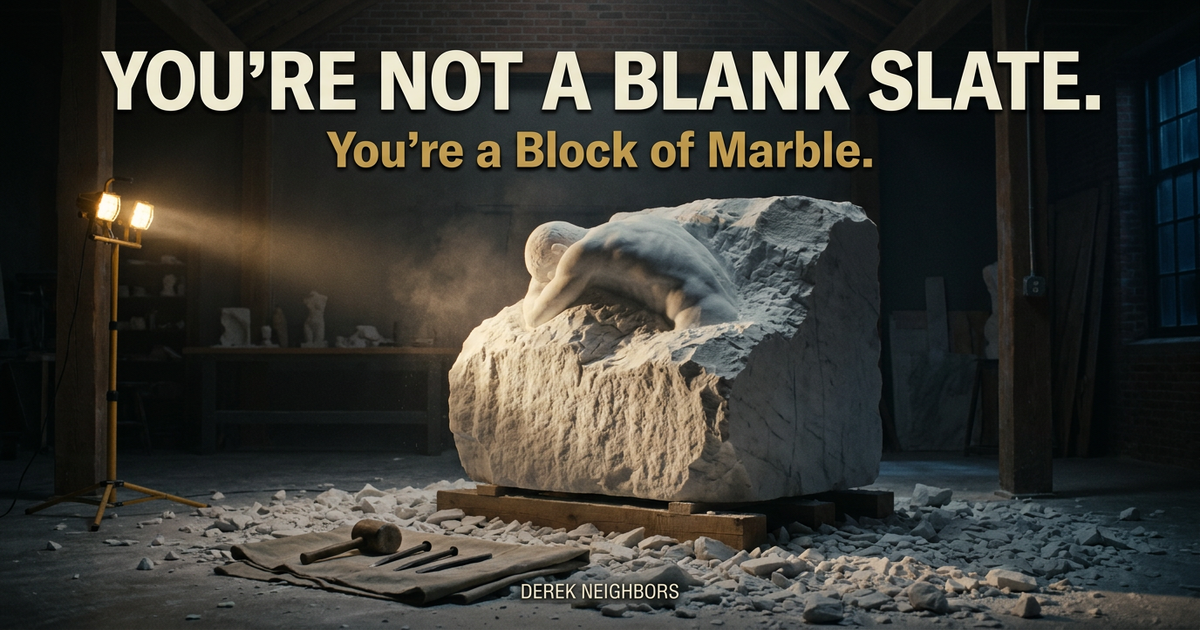
There’s a sonnet Michelangelo wrote for Vittoria Colonna that working sculptors still quote to each other. The best artist, he says, has no concept that a single block of marble does not already contain inside itself. The hand’s only job is to find it. The famous version of the idea, the one about seeing the angel in the marble and carving until he set it free, is probably something he never said. The sonnet is enough. The figure is in the stone before the chisel arrives. The work is removal.
Now look at what the self-development industry hands you. A blank slate. You are nothing in particular, it says, which is great news, because it means you can become anything. Here’s the blueprint of a person who wakes at five, here’s the morning routine of a billionaire, here’s the identity stack of someone you watched for eleven minutes. Pick a design and start building.
I spent years building. Most driven people do. And I want to name the specific exhaustion that comes from it, because it has a cause nobody talks about: you can’t build on a slate that was never blank. There’s already a figure in the stone. Every blueprint you stack on top of it is fighting the grain of what’s underneath.
The Symptoms Nobody Connects
Run the checklist. Any two of these should get your attention.
You’ve reinvented yourself every eighteen months for a decade, and none of the versions stuck. Each one launched with real conviction. Each one quietly dissolved, and the dissolving felt like personal failure, so you answered it with another launch.
Your goals look suspiciously like the goals of whoever you most recently admired. Trace any of your current ambitions backward and you find a person, not a reason. A colleague who got the title. An author with good cheekbones and a strong newsletter.
Hitting a goal leaves you feeling less like yourself, not more. This is the symptom people hide, because it sounds ungrateful. You got the thing. The thing arrived. And standing in the middle of the achievement you had the strange sensation that the win belonged to somebody else, like you’d accomplished it on another person’s behalf.
The new identity requires constant willpower to keep running. Native capacities don’t work this way. The work itself can be brutal, and the daily sessions inside it can demand everything you have; Darwin spent eight years dissecting barnacles to finish one book. What native work doesn’t ask for is force to stay pointed at it. You white-knuckle the labor, never the direction. If your entire life is maintenance, if every habit needs an accountability system and every system needs a reboot, the load itself is information.
And the last one, the quiet one: you can’t remember what you liked before there was an audience.
The Questions That Find the Grain
A good diagnostician doesn’t start with treatment. She starts with better questions. These are the ones that locate the figure in the stone.
What did you do before anyone was watching or paying? Childhood obsessions are unfashionable data, but they’re nearly incorruptible, because no one was rewarding you yet. Robert Greene built the opening of Mastery on this: the primal inclinations that show up early, get buried under social pressure, and wait.
Which work feels like relief when you do it? Not pleasure, and not ease; the work itself can be punishing. Relief is the click of a joint going back into place, the friction between intention and action falling away even while the task stays hard. Test the feeling before you trust it, because avoidance manufactures a convincing fake. The relief of alignment survives effort and deepens through it. The relief of escape vanishes the moment the work resumes. Most people feel the real thing now and then and discount it, because they were taught that anything that doesn’t feel like force can’t count.
What do people repeatedly come to you for that you keep waving off? Others often see the figure in your stone before you do. The thing you do so naturally you assume anyone could.
What did you abandon because it didn’t look impressive? Somewhere in the pile of things you quit is usually one thing you quit for a bad reason: not because it was dead, but because it didn’t photograph well next to the borrowed blueprint.
Where does effort compound, and where does effort only maintain? This is the woodworker’s test. Cut with the grain and the work gets easier as you go. Cut against it and you fight the same fight every day, forever.
The Diagnosis: You Imported a Blueprint
The root cause sits underneath all of it, and it’s philosophical before it’s practical. You accepted the blank-slate premise. And if you’re blank, any design will do, so you borrowed the most admired one in view. Imitation rushes in exactly where self-knowledge is missing.
The Greeks worked from the opposite premise. Pindar compressed it into a line in his Second Pythian Ode, twenty-five centuries before Nietzsche borrowed it for a subtitle: become such as you are, having learned it. Read that carefully. The becoming has a target, the target already exists, and there’s a learning clause in the middle that everyone skips. You can’t become who you are until you’ve done the work of finding out.
The Stoics turned that line into a developmental theory, and they gave it a name: oikeiosis. Usually translated as appropriation, it starts from an observation about newborn creatures. The first thing any animal does is orient toward its own constitution. It recognizes, without instruction, what belongs to its nature and what doesn’t. The Stoics argued that human maturity is that same recognition, progressively widened and refined. Growth means coming to know your actual nature, your physis, more accurately, and bringing your life into alignment with it. On this account, development unfolds something already structurally present rather than imposing an ideal from outside.
Notice what this does to the standard self-help question. “Who should I become?” still smuggles in the blank slate; it sends you shopping for blueprints. I’ve argued before that it beats “what should I do?”, and it does. But there’s an older question under both: who is already here, underneath the imitation?
Aristotle gives the diagnosis its teeth. His function argument says the excellence of a thing, its arete, is excellence at that thing’s specific work, its ergon. A knife’s excellence is cutting. An eye’s excellence is seeing. Underneath all the individual functions there’s a shared human one, reason exercised well, and it’s owed by everyone alike; your particular grain is the shape that common work takes in you, not a private exemption from it. But you still cannot pursue excellence generically, because excellence is always excellence at something, and that means the first task is knowing what kind of instrument you’re holding. A whole industry wants to sell you whetstones before anyone has checked whether you’re a knife.
If the whole premise sounds like poetry instead of fact, use the evidence you already carry. Hold conditions roughly equal and the same person’s effort compounds in one domain and only maintains in another, year after year. A truly blank slate would convert effort into skill at about the same rate wherever you applied it. It doesn’t, and anyone who has worked seriously at two different things knows it doesn’t. That asymmetry is the grain leaving its fingerprint.
The Treatment: Subtract Before You Add
If the diagnosis is an imported blueprint, the treatment can’t be a better blueprint. It has to be a chisel.
Start with one removal. Take your current goals and find the one with another person’s fingerprints on it, the one you can trace to admiration rather than to anything in your own grain. Drop it for a quarter. Don’t replace it. The point of the exercise is to watch what grows into the cleared space, because what volunteers is usually native.
Run the abandonment audit. Write down what you’ve quit over the past ten years, and next to each one, the honest reason. Most of the list is dead wood and belongs in the pile. You’re looking for the one or two entries you killed for image reasons. That’s live wood. It gets a second look.
Redirect effort to where it compounds. You have limited chisel strokes in a day. The borrowed identity spends them fighting the grain and calls the struggle virtue. Spend them where the stone is already shaped like something.
And judge the work by relief, not applause, the durable relief that outlasts the effort and not the cheap kind that comes from setting the tool down. Applause tells you what the audience wants carved. Relief tells you what was in the stone.
One warning, because this is where the idea gets abused. Discovery is not passivity, and unearthing is not lying back and “honoring your journey.” Be precise about what sits in the stone, too. It is not a finished statue waiting to be uncovered; that would make carving nothing more than dusting. What’s there is potential under constraint: the block rules out most figures and allows only a few, and which one finally stands depends on ten thousand deliberate strokes. That’s why Michelangelo’s marble didn’t carve itself, and why oikeiosis was a discipline, not a hammock. The Stoics still demanded askesis, daily deliberate training. Discovery sets the direction. The digging is still yours, and the digging is brutal. You’re not excused from the work. You’re excused from doing the work on somebody else’s statue.
The Prevention: Keep Finding the Stone
Relapse is the default, because the supply of impressive strangers is infinite and the algorithm delivers a new one every morning. Prevention has to be structural.
Schedule real solitude. I do mine on desert trails, two or three hours with no signal, and I can report the reliable sequence: the borrowed ambitions get loud first, because they’re used to being fed, and then somewhere past the first hour they go quiet and what’s left is recognizably mine. Notice what does the recognizing once the noise drops. It isn’t a talent, and the lottery doesn’t ration it. Talents differ wildly from one person to the next; the capacity to tell a borrowed want from a native one is standard issue. The natural lottery sets the size of the figure in your stone, but it never touches the eyes that find it, which is why this work is owed by everyone and closed to no one. You can’t hear the grain of your own nature in a room full of other people’s voices, and the feed is a room full of other people’s voices.
Steal methods, never identities. This is the line between apprenticeship and self-erasure, and it’s worth drawing carefully, because earlier I said imitation rushes in where self-knowledge is missing. Both hold. Copy how a master works, their hours, their drills, their recovery from failure, and you’re an apprentice; that’s how every skill has ever passed from one person to the next. Copy what a master is for, their ends and their ambitions, and you’ve given away the one thing that was supposed to be yours to find. Method transfers. Purpose doesn’t. The moment you catch yourself importing who they are rather than how they operate, put the biography down.
Re-read your own record. Old journals, old work, the projects you return to without being asked. You already have years of evidence about where your effort compounds. Most people have never once reviewed it. Your history is a quarry map, and it’s sitting in a drawer.
Frequently Asked Questions
These short answers double as the article’s structured FAQ data; they exist in the page text so AI search engines and human skimmers can pull them directly.
What is oikeiosis in Stoic philosophy?
Oikeiosis is the Stoic theory of moral development, usually translated as appropriation or familiarization. The Stoics observed that from birth, every creature’s first attachment is to its own constitution: it instinctively recognizes what belongs to its nature and orients toward it. Human development, on this view, is a progressive widening and refinement of that recognition. You mature by coming to understand your actual nature more accurately and aligning your life with it, not by imposing an external ideal on yourself. Cicero preserved the fullest account in Book III of De Finibus, and Diogenes Laertius attributes the doctrine to Chrysippus.
What did Pindar mean by become who you are?
The line comes from Pindar’s Second Pythian Ode, written in the fifth century BCE, and the full phrase matters: become such as you are, having learned what that is. Pindar wasn’t endorsing self-acceptance or following your feelings. The learning clause carries the weight. He meant that you have a specific nature and excellence, that most people never do the work of finding out what theirs is, and that becoming it requires first discovering it. Nietzsche later borrowed the line as the subtitle of Ecce Homo, which is how it entered modern self-development vocabulary.
Did Michelangelo really say the statue is already in the marble?
The popular version, about seeing an angel in the marble and carving to set it free, has no reliable source and is almost certainly apocryphal. But Michelangelo did write the idea himself in a sonnet addressed to Vittoria Colonna: the best artist has no concept that a single block of marble does not already contain within itself, and the hand’s job is to find it. His unfinished Prisoners sculptures in Florence, where figures strain half-formed out of raw stone, are the idea made visible.
What is the difference between self-discovery and self-improvement?
Self-improvement starts from a deficit: you are not enough, here is a blueprint, build yourself into it. Self-discovery starts from a premise the Stoics held, that you already have a specific nature with a specific excellence, and the work is uncovering and aligning with it. The practical difference shows up in where effort goes. Improvement effort often fights your grain and requires constant willpower to maintain. Discovery-aligned effort compounds, because you’re developing capacities that were already native. Both involve discipline; they point the chisel in different directions.
Final Thoughts
The blank slate was always a sales pitch. Blankness is what makes you a customer for blueprints, and there will never be a shortage of people selling them. The marble was never blank. A block doesn’t get to choose its figure, but it holds one, and every year you spend building someone else’s design on top of it is a year the actual figure waits under the surface.
Pindar’s line survives because it refuses both easy errors. Not “accept yourself,” which skips the learning. Not “reinvent yourself,” which skips the you. Become who you are, having learned it. The learning is the chisel work, and nobody can hold the chisel for you.
The figure is in the stone. Stop designing. Start removing.
Ready to find out what’s actually in your stone? MasteryLab is where leaders do the chisel work: stripping borrowed ambitions and building excellence on their real grain instead.