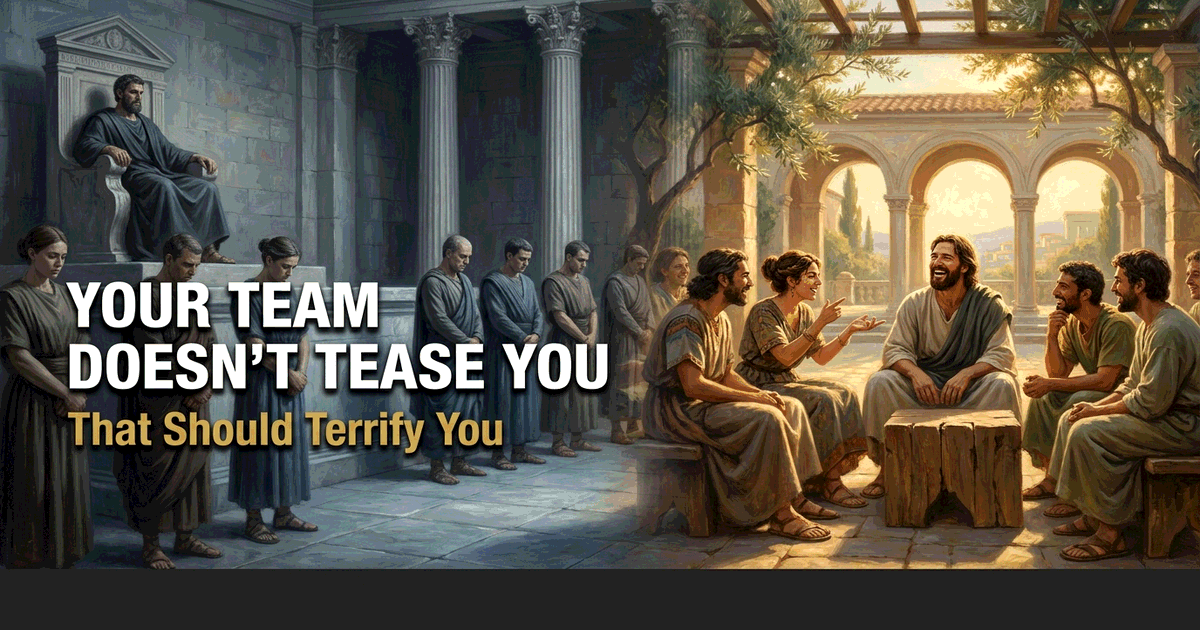
Your Team Doesn't Tease You. That Should Terrify You.
By Derek Neighbors on April 15, 2026
There is a diagnostic most leaders never run, and it reveals more about their character than any 360 review or personality assessment.
Watch what happens when someone on the team cracks a joke at the leader’s expense. Not a mean-spirited attack or passive-aggressive jab disguised as humor. Those signal contempt, not safety. The diagnostic only works with genuine teasing, the kind that happens naturally between people who respect each other and know the relationship can absorb it.
Does the room go quiet? Does the leader’s smile tighten? Does someone change the subject?
Or does the leader laugh, fire one back, and keep moving?
That moment tells you everything about the health of the team. And most leaders would not like what it reveals.
Two Leaders, Two Outcomes
Picture two leaders with identical resumes. Same track record. Same direct communication style. Same high standards. Both deliver sharp, honest feedback without apology. Both hold their teams accountable.
The difference is invisible until you watch what happens when the feedback flows in reverse.
Leader A gives a pointed critique in a meeting. Someone on the team pushes back. “I hear you, but I think you are wrong on this one. Here is why.” Leader A’s posture shifts. The jaw tightens. The response comes fast and sharp. Not angry exactly, but the temperature in the room drops two degrees. Everyone notices. Nobody mentions it afterward. But the lesson lands: challenge the boss and you will pay a price, even if the price is small.
Leader B gives the same pointed critique. Someone pushes back the same way. Leader B pauses. Leans in. “Walk me through it.” The challenge gets a genuine hearing. Maybe Leader B changes their mind. Maybe they do not. But the process of being challenged did not trigger a defensive response. It triggered curiosity.
Same feedback skills. Same high standards. Completely different teams within six months.
Leader A’s team will optimize for safety. They will learn what the boss wants to hear and deliver it with increasing precision. Leader B’s team will optimize for truth. They will learn that the best way to earn the boss’s respect is to make the boss’s thinking better, even when that means telling the boss something uncomfortable.
The gap compounds. In a year, Leader A is running an organization that confirms their worldview. Leader B is running one that challenges it. One of them is getting smarter. The other has no idea they are getting dumber.
The One-Way Street
The one-way leader runs a tight ship. People perform. Meetings stay focused. Decisions get made quickly, because nobody slows the process down with dissent.
This looks like effective leadership. It is not.
What it looks like from the inside: people rehearsing what they will say before meetings. Running their ideas past each other first to see if the boss will react badly. Bringing problems late, after they have metastasized, because raising them early means being the person who “created” the problem. Watching the leader crack jokes about the team’s quirks while knowing that reciprocating would be career suicide.
The ancient Greeks had a specific word for this asymmetry. hubris. Not the modern definition of excessive pride, but the original meaning: treating others as less than yourself. Demanding a standard of deference you would never accept from above. The person who insists on dishing it out while remaining untouchable is not demonstrating strength. They are revealing the precise location of their insecurity. And the damage is not only organizational. The leader who cannot face honest scrutiny is corroding their own capacity for self-knowledge, slowly walling themselves off from the truth about who they are. That erosion happens whether the team suffers visibly or not.
The information cost alone should be alarming. A study published in the Academy of Management Journal found that teams with low psychological safety systematically withhold concerns about risks, errors, and process failures. The leader in this environment is making decisions with curated data. They are the last person to know when something is going wrong, because everyone around them has learned that delivering bad news has a personal cost. This is the same dynamic behind why teams that appear aligned are often too scared to speak up. Silence masquerades as consensus.
The Reciprocal Leader
The reciprocal leader holds the same high standards but adds one element the one-way leader cannot: they make the exchange bidirectional.
They give feedback and receive it. They challenge the team and get challenged back. They tease and get teased. The flow goes both ways because the leader has done the character work that makes both directions safe.
This requires something the one-way leader lacks. sophrosyne, the Greek virtue of temperance and self-mastery, works alongside phronesis (practical wisdom) to produce genuine self-knowledge. Together they mean knowing yourself well enough that someone pointing out your flaws feels like information rather than an attack. You already knew the weakness was there. The team member did not reveal it. They confirmed it. And confirmation is useful, not threatening.
Aristotle argued in the Nicomachean Ethics that eutrapelia, the virtue of appropriate wit, was a genuine mark of character. The person who can neither make a joke nor take one is deficient. Humor requires the same skills as honest feedback: reading the room, calibrating intensity, trusting the relationship enough to take a risk. A team that teases its leader has built mutual respect that no policy manual can manufacture. They are willing to be real with each other, and that willingness extends in every direction.
The practical results follow the character. Teams with reciprocal leaders surface problems earlier, because the cost of honesty is low. Innovation increases, because proposing an idea that might be wrong does not feel dangerous. Retention improves, because people stay where they feel treated as full adults, not managed as fragile subordinates.
There is also a compounding effect that rarely gets discussed. When a leader models the ability to receive challenge gracefully, it gives permission for the entire team to do the same. Peers start challenging each other more openly. Junior members start contributing ideas without the usual hedging and disclaimers. The reciprocity spreads laterally, not because anyone mandated it, but because the leader demonstrated that directness and respect can coexist. Culture is set by what leaders tolerate being done to them, not by what they do to others.
The Character Map
Here is where the diagnostic gets precise.
Character asymmetry is the gap between what you demand of others and what you tolerate being demanded of you. It is the distance between the standard you impose outward and the standard you accept inward. The specific topics a leader cannot handle being challenged on reveal where that gap is widest and where their identity is most fragile. A leader who takes feedback on strategy but bristles at feedback on communication style has located the insecurity for you. A leader who laughs at jokes about their fashion sense but shuts down jokes about their decision-making has drawn you a map.
The one-way leader is not one-way about everything. They have selective armor. And the pattern of that armor tells you exactly which parts of their self-concept depend on external validation rather than internal knowledge.
Isegoria, the Athenian principle of equal speech, held that every citizen had the right to address the assembly regardless of status. It is the same principle behind why staying silent is the most expensive thing a leader can do. The healthiest organizations practice a version of this: the newest hire can challenge the CEO’s reasoning, and the CEO treats it as a contribution rather than an affront. Not because hierarchy does not exist, but because the quality of thinking matters more than the rank of the thinker.
The one-way leader inverts this. The quality of the idea matters less than who delivered it and whether it challenged the right person.
Building the Capacity
If you recognized yourself in the one-way description, here is the uncomfortable news: reading about it will not fix it. This is character work, not a technique. And it is not optional. The inability to receive what you give is a deficiency in your character whether you lead a team of fifty or answer to no one but yourself. Anyone in relationship with other human beings owes this work.
Start by noticing your body’s response when someone pushes back. The tightened shoulders. The impulse to respond before you have fully listened. The mental search for why they are wrong before you have considered that they might be right. That physical response is the gap between who you think you are and who you actually are in that moment.
Then practice the pause. When someone challenges you, let two full seconds pass before responding. That small gap is where the choice lives: defend, or learn.
Then invite it deliberately. Not with the generic “my door is always open.” That means nothing. Try something specific: “I think my plan for this quarter has a blind spot I cannot see. What am I missing?” Then respond to whatever comes with genuine engagement, not with the subtle retaliation that teaches people never to answer honestly again.
Here is what is in your control: your character, your response, and whether you do the work. Here is what is not: whether your team decides to trust you with honesty. You cannot demand the second without earning it through the first.
Over time, this stops being an exercise and starts being identity. The leader who has practiced receiving challenge for long enough stops flinching. Not because they suppressed the flinch, but because the self-knowledge became deep enough that challenges land differently. They feel like data, not danger.
Final Thoughts
The simplest leadership diagnostic costs nothing and takes thirty seconds. Does your team laugh with you, or only when you tell them to? Do they challenge your ideas in real time, or only agree and then complain to each other afterward? Do they bring you bad news early, or late?
One distinction matters here. A leader who gets teased because they have no standards and no one takes them seriously has not passed this test. The diagnostic reveals something meaningful only when the teasing comes from people who respect the leader and choose honesty because it is safe, not because authority is absent. The leader who can be teased while still commanding genuine respect has earned something the untouchable leader never will: a team that tells them the truth before the market forces the conversation.
sophrosyne teaches that the person who knows themselves has nothing to protect from scrutiny. The leader who welcomes challenge is not weak. They have simply done the work that makes deference unnecessary.
That distinction matters more than any strategy or system. The leader who can take what they dish out builds something that outlasts them. The one who cannot builds something that depends on nobody ever saying what they actually think.
Ready to build leadership rooted in character, not deference? MasteryLab provides frameworks and community for leaders who understand that the capacity to receive honest feedback is the foundation everything else depends on.