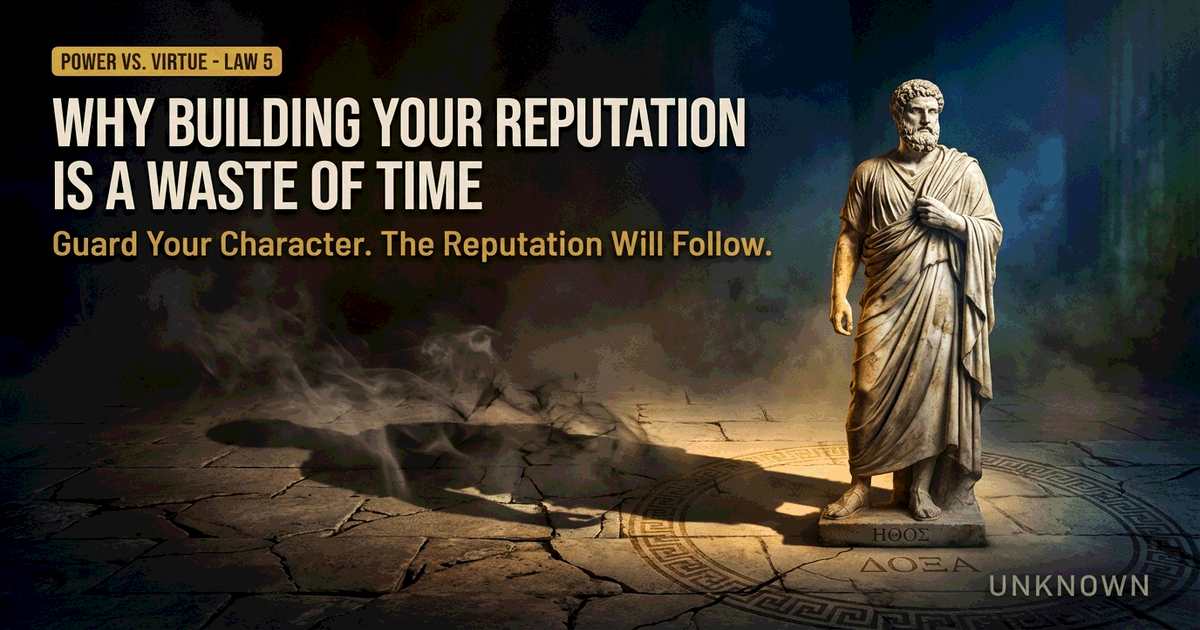
Why Building Your Reputation Is a Waste of Time
By Derek Neighbors on February 19, 2026
Power vs. Virtue: The 48 Laws Examined
A year-long examination of Robert Greene's 48 Laws of Power through the lens of ancient virtue ethics. Some laws we affirm, some we reframe, some we reject entirely.
Law 5 of Robert Greene’s The 48 Laws of Power:
So much depends on reputation. Guard it with your life. Reputation is the cornerstone of power. Through reputation alone, you can intimidate and win; once it slips, however, you are vulnerable, and will be attacked on all sides. Make your reputation unassailable. Always be alert to potential attacks and thwart them before they happen. Meanwhile, learn to destroy your enemies by opening holes in their own reputations. Then stand aside and let public opinion hang them.
Greene wants you to treat reputation like a fortress wall. Build it high, defend it constantly, and use it as a weapon against others. It’s tactical advice. It also points your attention in exactly the wrong direction.
The Tactical Truth
Reputation carries weight. A strong reputation precedes you into rooms you haven’t entered yet. It does work you’d otherwise have to do yourself. Teams follow people with earned authority. The person with a reputation for excellence gets the benefit of the doubt. Greene is right that reputation creates leverage. The real question is what you’re leveraging, and where you’re pointing your effort.
This isn’t limited to executives and founders. The mechanic whose customers come back for twenty years has a reputation. The neighbor who shows up when it matters has a reputation. The colleague who tells the truth when lying would be easier has a reputation. Reputation operates at every level of human interaction, which means the ethos/doxa distinction applies to everyone, not as career advice but as a fact about how character and perception relate.
When someone’s reputation precedes them because their work consistently delivers, because their word has proven reliable, because their judgment has been tested and validated through results, that reputation is a natural consequence of something deeper. It wasn’t constructed. It accumulated.
When someone’s reputation precedes them because they’ve carefully cultivated relationships, managed perceptions, curated their public image, and suppressed anything that might tarnish the narrative, that reputation is a performance. And performances require an audience, a stage, and constant rehearsal.
Both look the same from the outside. The difference surfaces under pressure.
The Character Cost
The moment reputation becomes the priority, a subtle corruption begins.
You start filtering decisions through a new question: how will this look? Not whether it’s right. Not whether it serves the mission. Not whether it develops your capability. Whether it looks good. Whether it protects the narrative. Whether it maintains the image.
This filter changes everything.
Leaders who guard reputation avoid necessary confrontations because conflict looks messy. They stop giving honest feedback because candor risks the relationship capital they’ve banked on. They surround themselves with people who reinforce the story rather than challenge it. They choose silence over truth, not out of sophrosyne but out of self-protection.
Reputation does shape behavior. When people treat you as trustworthy, the social pressure reinforces trustworthy action. When they treat you as unreliable, maintaining character against that current requires extraordinary effort. The influence runs both ways. But the question is which one you build from. Starting with character and letting reputation follow produces a stable foundation. Starting with reputation and hoping character catches up produces a performance with an expiration date.
The deeper damage is that reputation-guarding stops growth. ethos develops through honesty about your failures, openness to criticism, willingness to be wrong publicly, and the discipline to change when the evidence demands it. Every one of these character-building actions poses a risk to reputation. The person guarding their image treats vulnerability as a threat. The person building character treats vulnerability as a tool.
Consider what happens when a leader makes a significant mistake. The reputation-guarder’s instinct is damage control: spin the narrative, shift blame, minimize exposure. The character-builder’s instinct is accountability: own it, learn from it, change. One protects the image. The other develops the person. And over years, the gap between the two compounds until the reputation-guarder is performing a version of competence they stopped developing long ago.
Greene tells you to “learn to destroy your enemies by opening holes in their own reputations.” This is the logical endpoint of treating reputation as primary. When reputation is the asset, attacking others’ reputations becomes strategy. You stop competing on substance and start competing on narrative. That competition has no natural end point. It escalates until your primary skill is perception management, and your primary product is image.
The ARETE Alternative
The Greeks made a distinction that English collapses into a single word.
ethos is your actual character: the stable disposition of your soul toward virtue or vice. It’s who you are when no one is evaluating. It’s the pattern of your choices over time, the cumulative weight of thousands of small decisions about what kind of person you’re becoming.
doxa is opinion: what others believe about you, your reputation, the narrative that exists in other people’s minds. It’s shaped by perception, subject to manipulation, and dependent on information that may or may not be accurate.
Greene’s Law 5 treats doxa as the priority. Guard it. Build it. Weaponize it. The entire framework assumes that what people think of you matters more than what you actually are.
Ancient virtue ethics inverts this completely. arete, excellence, is a quality of character, not a quality of perception. You don’t become excellent by appearing excellent. You become excellent through the relentless practice of virtue, the daily repetition of right action, and the willingness to fail publicly while developing privately.
The arete alternative to reputation-building isn’t ignoring reputation. It’s recognizing that reputation is a trailing indicator. It follows character the way a shadow follows a body. You can manipulate the shadow, adjust the lighting, choose your angles. But the moment someone walks behind you, they see the real shape.
Build character worthy of reputation, and the reputation usually arrives. Not because you engineered it. Because consistent character creates patterns that others can’t help but notice. Authenticity isn’t a brand strategy. It’s the natural consequence of internal consistency.
A necessary honesty: reputation doesn’t always follow character. Prejudice distorts the signal. Injustice buries it. Epictetus was a slave whose character was world-class while his reputation was “property.” The obligation to build ethos doesn’t depend on whether the world notices. If you’d only build character when recognition is guaranteed, you’ve proven you’re building reputation, not character.
Ancient Wisdom Connection
Aristotle taught that ethos develops through repeated action. You don’t become honest by deciding to value honesty. You become honest by telling the truth when lying would be easier, and then doing it again, and again, until honesty becomes a stable feature of who you are, a hexis, a settled disposition that operates without deliberation.
This is fundamentally different from reputation management. Reputation management is external: what do people think? Character development is internal: what am I becoming? The first can be faked for longer than most people realize, but performance under sustained pressure eventually reveals the gap. The second cannot be faked at all, because it lives in the distance between what you do when people are watching and what you do when they’re not.
Character also doesn’t form in isolation. Aristotle understood that ethos develops within community, through honest friendships, through being held to account by people who care more about your character than your comfort. This is the deepest irony of reputation-guarding: the more you protect your image, the more you isolate yourself from the honest relationships that character requires. You cut off the feedback that would actually develop the thing you’re pretending to have.
Socrates demonstrated the ultimate test of this distinction. Sentenced to death by an Athenian jury, he was offered the chance to escape. His friend Crito arranged everything: the guards were bribed, the boat was ready, exile was waiting. Socrates refused.
Not because he wanted to die. Because fleeing would have contradicted everything he’d spent his life teaching about justice, courage, and the examined life. His reputation, the doxa that had made him the most respected philosopher in Athens, was already destroyed by the trial. The jury had voted to kill him. Public opinion had turned.
What survived wasn’t his reputation. It was his character. Twenty-four hundred years later, we don’t remember what the Athenian public thought of Socrates. We remember what Socrates thought of himself, and the integrity that wouldn’t bend even when it cost him everything.
A strategic reader might argue Socrates played the longest reputation game in history. He died, and his character became immortal. Greene could absorb this example: sacrifice your life, secure eternal fame. But that reading misses what happened in the cell. Socrates wasn’t calculating legacy. He was being consistent. The difference between choosing death for legacy and choosing death for philosophical consistency is precisely the ethos/doxa distinction this article is arguing. One is strategy. The other is character. They look identical from the outside. The person making the choice knows the difference. His integrity wasn’t holding him back. It was the only thing holding him together.
The Test
Ask yourself these questions:
-
If no one would ever find out, would you still make the same decision? The gap between your answer and your behavior is the distance between your character and your reputation. When they match, you don’t need to guard anything.
-
When was the last time you chose what was right over what looked good? If you can’t remember, your ethos and your doxa may have merged in the wrong direction. You may be living for the narrative instead of the truth.
-
Are you building something real, or curating how something appears? There’s a difference between doing excellent work and making sure people know you do excellent work. The first feeds character. The second feeds anxiety.
-
Would the people who know you best say your public reputation matches the private person? If the answer is yes, your reputation is a natural extension of your character. If the answer is no, your reputation is a performance, and performances eventually close.
-
What would survive if your reputation were destroyed tomorrow? If the answer is “nothing,” you’ve been investing in the wrong asset. If the answer is “everything that matters,” you understand the difference between ethos and doxa.
Final Thoughts
Greene says guard your reputation with your life. The Greeks say build character worth remembering, and the reputation will follow.
The distinction matters because reputation is fragile by design. It depends on other people’s perception, which you can influence but never control. One viral moment, one misquote, one enemy with a platform, and years of careful reputation management evaporate. The person whose identity is built on doxa collapses when doxa shifts. The person whose identity is built on ethos weathers it, because their foundation was never external in the first place.
This doesn’t mean reputation is irrelevant. It means reputation is a byproduct, not a project. Character produces reputation the way a fire produces heat. You don’t improve the heat by polishing the flames. You improve the heat by feeding the fire.
But the deepest argument for character over reputation isn’t practical. It’s philosophical. Character isn’t valuable because it produces better reputation over time. Character is valuable because it IS the substance of a life well-lived. The person of genuine virtue who dies unrecognized hasn’t failed. They’ve lived in accordance with what is real rather than what is perceived. Reputation is temporary by nature. Character is the only thing you take with you when the lights go out.
Greene looks at reputation and sees a wall to defend. The Greeks look at reputation and see a shadow cast by something more real. Reputation tells you what your character is broadcasting. When the signal is good, the reputation takes care of itself. When it isn’t, no amount of guarding will save it.
Stop building your reputation. Start building the kind of character that makes reputation management unnecessary. The fortress Greene wants you to defend was never the real asset. The person standing inside it is.
If you’re done performing excellence and ready to practice it, MasteryLab.co is where leaders develop ethos, the stable character that makes reputation management obsolete.