Why Arguing Your Point Is Always a Losing Strategy
By Derek Neighbors on March 17, 2026
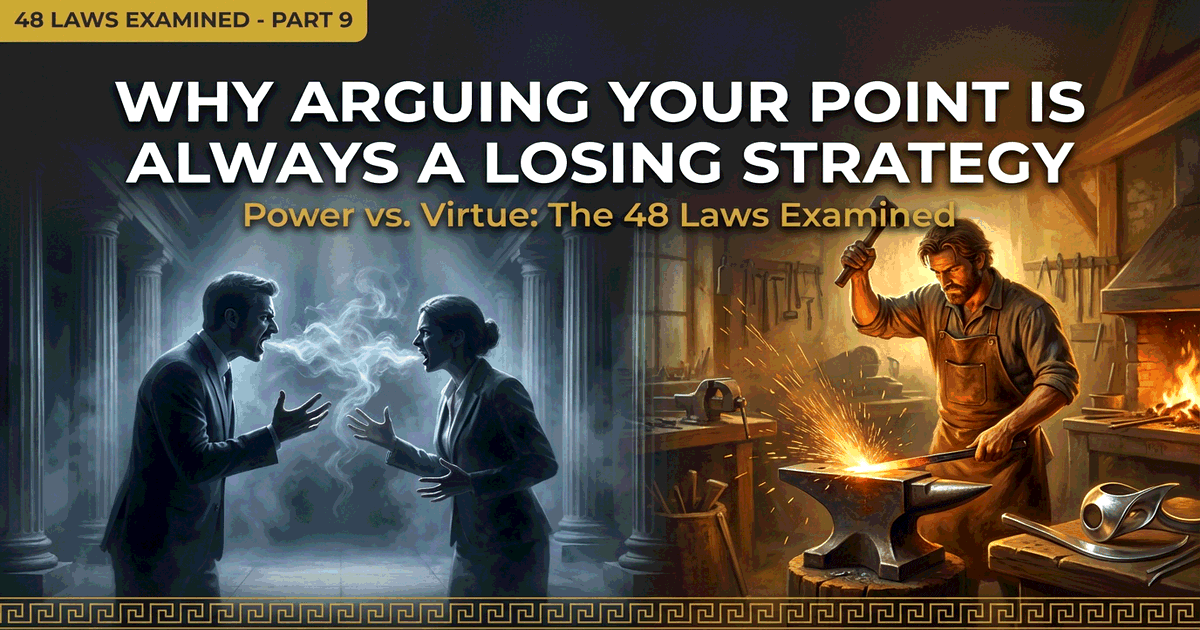
Power vs. Virtue: The 48 Laws Examined
A year-long examination of Robert Greene's 48 Laws of Power through the lens of ancient virtue ethics. Some laws we affirm, some we reframe, some we reject entirely.
Law 9 of Robert Greene’s The 48 Laws of Power:
Win through your actions, never through argument. Any momentary triumph you think you have gained through argument is really a Pyrrhic victory: The resentment and ill will you stir up is stronger and lasts longer than any momentary change of opinion. It is much more powerful to get others to agree with you through your actions, without saying a word. Demonstrate, do not explicate.
For the second time in this series, Greene’s recommendation aligns with ancient virtue. Arguing your way to respect, influence, or authority has never worked. The first alignment was Law 4, where silence as discipline matched sophrosyne. Here the alignment cuts even deeper. The Greeks didn’t treat this as tactical advice. They treated it as a description of how reality works.
The Tactical Truth
Greene is right about the mechanics, and the data supports him.
Arguments trigger ego defense. The moment you tell someone they’re wrong, their brain shifts from processing your logic to protecting their position. Neuroscience calls this the backfire effect. People presented with evidence against their beliefs don’t update. They dig in harder. The stronger your argument, the more entrenched your opponent becomes.
Winning an argument creates a resentful opponent, not a converted ally. Greene’s word “Pyrrhic” is precise. King Pyrrhus won every battle against Rome and lost the war because each victory cost him more than the victory was worth. Arguments work the same way. You score a point. You lose a relationship. The math never favors the winner.
Demonstration bypasses all of this. Results are not debatable the way words are. When someone sees your work performing, they don’t need to be persuaded. Their own eyes have already done the work that your best argument never could.
Greene frames this as tactical superiority, a way to maintain power without creating enemies. That’s accurate as far as it goes. But the deeper reason this works has nothing to do with strategy. It works because a thing IS what it does. No argument changes that. No explanation substitutes for it.
The Cost of Ignoring This
The habit of arguing does something corrosive that most people never notice. It trains you to seek validation from the people least positioned to give it.
Think about who you argue with. Usually it’s someone who already disagrees with you, someone whose approval you don’t have, someone who has signaled that your current output hasn’t convinced them. So you switch from producing to persuading. You stop building and start explaining. You redirect energy from the work that would speak for itself toward the words you hope will speak for it instead.
This is a losing trade every time.
Chronic arguers develop an expensive dependency. They need agreement before they can feel confident in their own direction. Without consensus, they stall. Without acknowledgment, they doubt. The muscle they build is persuasion. The muscle that atrophies is execution. Over time, they become people who can describe excellence fluently but produce it inconsistently.
There’s an organizational cost too. Teams led by arguers develop a culture where the most articulate voice wins, regardless of whether that voice has done the work to earn authority on the subject. Politics replaces performance. Meetings multiply. The people who would rather build than debate quietly disengage or leave, taking their competence somewhere it will be valued.
The deepest cost is personal. Every hour spent constructing an argument is an hour not spent constructing proof. The energy is finite. The person who writes a rebuttal email at 2 AM could have spent that same hour advancing the project that would make the rebuttal unnecessary. Arguments are consumption. Execution is investment. One depreciates the moment it’s sent. The other compounds.
The ARETE Alternative
For Laws 1 through 8, the arete alternative has mostly offered a different path from Greene’s recommendation. Law 9 is different, the same way Law 4 was different. This IS the path of arete.
Aristotle built his entire ethics around a concept called ergon, the proper function or characteristic work of a thing. A knife’s ergon is cutting. An eye’s ergon is seeing. A flute player’s ergon is playing the flute well. Excellence, for Aristotle, meant fulfilling your ergon with skill and consistency.
Notice what’s absent from that framework. Nowhere does Aristotle suggest that a knife proves itself by explaining its sharpness. The knife cuts. That IS the proof. The musician plays. The work speaks.
Human ergon works the same way. Aristotle argued that our proper function is activity of the soul in accordance with virtue. Not description of virtue. Not defense of virtue. Activity. praxis. The doing of it.
The Greeks drew a sharp line between logos (speech, argument, reason) and ergon (deed, work, action). When these two diverged, when someone’s words said one thing and their work said another, the Greeks trusted the work. Thucydides built his entire history around this tension. Leaders whose logos was magnificent and whose ergon was hollow always came to ruin.
This isn’t anti-intellectual. Socrates, arguably history’s greatest arguer, understood this better than anyone. His most powerful argument wasn’t a syllogism. It was his death. When Athens condemned him and he chose to drink the hemlock rather than flee, he demonstrated everything he’d spent decades saying about virtue, courage, and the examined life. His arguments survive because his life proved them. Had he fled to save himself, the Socratic dialogues would read as clever theory from a man who abandoned his own principles when they became inconvenient.
Ancient Wisdom Connection
Aristotle distinguished between dynamis (potentiality) and energeia (actuality). A seed has the dynamis to become a tree. The tree is the energeia. The person who argues what they could accomplish remains in dynamis. The person who goes and accomplishes it moves into energeia.
Arguments live in potential. Results live in actuality. The entire trajectory of Greek philosophy privileges actuality over potential because potential is only valuable insofar as it becomes real. “I could build this” means nothing. “I built this” means everything.
Epictetus compressed this into a single instruction: “Don’t explain your philosophy. Embody it.” Five words that make Greene’s Law 9 unnecessary for anyone willing to hear them. The Stoics didn’t develop elaborate arguments for why demonstration beats debate. They considered it obvious. The person who needs to argue their virtue doesn’t have it. The person who has it doesn’t need the argument.
Heraclitus said “character is destiny.” Not “argument is destiny.” Not “explanation is destiny.” Character, expressed through ergon, through the work, through the pattern of choices made when no one is constructing a case for why those choices matter.
The Stoic practice of prosoche, the attentive self-awareness we explored with Law 4, applies here too. prosoche means catching the impulse before it becomes action. When someone challenges you and the urge rises to defend, to explain, to argue your competence, prosoche is the pause where you ask: would my energy be better spent responding with words or responding with work?
The answer is almost always work.
The Test
Ask yourself these questions:
-
Think about your last significant argument at work. How many hours did it consume, including the mental replay afterward? What could you have built with those hours instead?
-
When someone questions your competence, what’s your first instinct? Is it to explain your qualifications, or to go produce something that renders the question irrelevant? The instinct reveals whether you’ve internalized ergon or still operate in logos.
-
How much of your recent energy has gone toward describing what you plan to do versus doing it? Proposals, strategy decks, status updates, explanations. Compare that to the time spent on the actual work those documents describe.
-
If you stopped defending your decisions for 30 days and let results speak exclusively, what would change? Would the silence terrify you? Would the results hold up? Both answers tell you something important.
-
Who in your professional life never argues their value and never needs to? Study what they do instead. The pattern will be obvious. They build. They ship. They produce. The work creates an authority that no argument can replicate and no critic can dismantle.
Final Thoughts
Greene and the Greeks agree again. Demonstrate. Don’t argue.
Greene arrives at this through game theory. Arguments create enemies. Demonstrations create believers. The tactical calculus favors action because action is harder to contest and generates less resistance.
The Greeks arrive at it through metaphysics. A thing IS what it does. ergon isn’t a communication strategy. It’s how reality works. The tree doesn’t argue that it’s a tree. It grows, produces shade, bears fruit. The proof and the function are the same thing. Human excellence operates identically. You don’t prove arete through debate. You practice it until the debate becomes irrelevant.
Greene says stop arguing because you’ll win more. The Greeks say stop arguing because who you are was never determined by what you said about yourself. It was determined by what you did.
One is strategy. The other is truth.
The next time someone challenges your work, your competence, or your direction, notice the impulse to argue. Then redirect that energy into the work itself. Let the ergon answer. It always speaks louder, lasts longer, and convinces more completely than anything you could say.
Your work is the only argument that matters. And if the work isn’t strong enough to speak for itself, no argument will save it.
If you’re ready to stop arguing about excellence and start practicing it, MasteryLab.co is where leaders develop the discipline of *ergon, letting their work speak louder than any words ever could.*