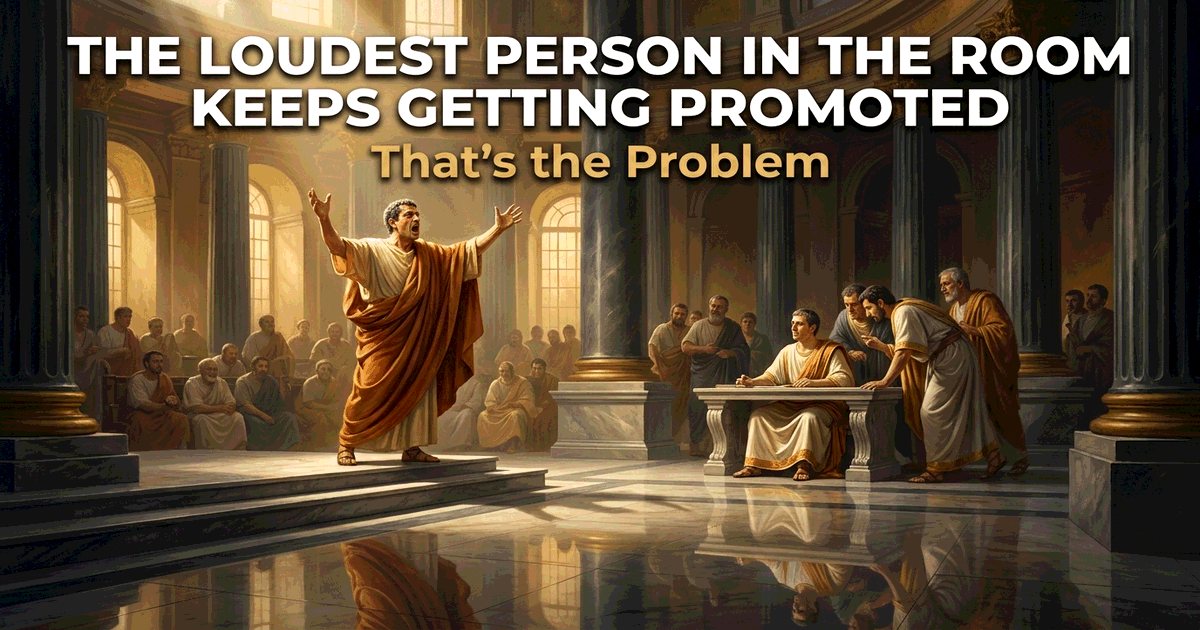
The Loudest Person in the Room Keeps Getting Promoted. That's the Problem.
By Derek Neighbors on April 25, 2026
You have seen this meeting before.
Someone walks in, takes the seat nearest the front, and starts talking before the agenda begins. They have opinions on every topic. They speak with certainty even when the data is thin. They fill silences that other people were still thinking inside of. When a decision needs to happen, they make it. When credit is available, they absorb it.
Six months later, they get the promotion.
And six months after that, three of the best people on the team start looking for jobs somewhere else.
This is not a personality quirk. It is a systemic failure in how organizations identify leadership, and the ancient Greeks diagnosed the root cause twenty-four centuries before your last all-hands meeting.
The Pattern Nobody Questions
There is a trait that organizations select for when making promotion decisions, over and over. It is not competence. It is not results. It is not even experience.
It is dominance.
Dominance is a behavioral pattern, not a leadership skill. It emerges early and operates as a default setting, not a deliberate response to circumstances. (A surgeon who asserts authority during an operation or a commander who takes charge in crisis is doing something different. That is contextual assertion, chosen deliberately and released when the situation passes. The pattern described here is habitual. It does not turn off.) The kid who always picked the teams. The student who answered every question first, not because they knew more but because waiting felt like losing. The colleague who reframes your idea as their own and genuinely believes they improved it.
Organizational psychologist Cameron Anderson’s research at UC Berkeley found that dominant individuals are perceived as more competent by their peers, even when objective measures of ability show no difference. The perception gap is enormous. People who spoke more frequently in group settings were rated as more intelligent, more capable, and more “leadership material” regardless of the actual quality of their contributions.
This means your promotion pipeline is filtering for a personality trait and calling it leadership potential. (This connects to a deeper problem: most organizations build leadership development backwards, training skills before selecting for character.)
The military figured this out decades ago. After-action reviews show that the officers soldiers trust most under fire are not the ones who bark orders with the most authority. They are the ones who listen, adapt, and demonstrate competence through preparation rather than projection. The loudest voice in the briefing room is rarely the one soldiers follow when it matters.
Sports reveal the same pattern. The best team captains are almost never the most vocal players. They are the ones who show up early, prepare relentlessly, and hold themselves to standards they never need to announce. Their authority comes from what the team witnesses, not from what the captain declares.
The evidence points in one direction: dominance and leadership are different traits, and organizations keep confusing them.
The Ancient Diagnosis
The Greeks identified two opposing forces in community life that map precisely onto this organizational failure.
pleonexia means greedy overreach. It describes the drive to take more than your share, to expand into space that does not belong to you, to consume attention and credit and influence disproportionately. Aristotle considered it one of the most destructive forces in any group because it is self-reinforcing. The more a pleonexic person takes, the more normal it becomes, until the entire system reorganizes around feeding their appetite.
Dominant personalities in organizations exhibit pleonexia constantly. They consume meeting airtime. They absorb credit for collaborative work. They fill silences that belong to someone else. They expand into every decision space available. None of this requires malice. Most dominant people genuinely believe they are helping. The behavioral pattern itself is morally neutral; dominance becomes pleonexia when it goes unexamined and unmoderated. The vice is not the trait. The vice is the failure to develop sophrosyne as a counterweight. And because the pattern operates below conscious awareness, most dominant people never realize there is something to examine.
The opposing virtue is sophrosyne, self-mastery, knowing your measure, the discipline of proportionality. A leader with sophrosyne restrains the impulse to fill a room so that other people can think. They ask questions instead of asserting answers. They hold power lightly enough that others are willing to share honest information with them. This takes more strength than dominating a conversation, not less.
Real leadership requires sophrosyne because leadership, at its core, is about producing flourishing in a group, not in a single individual. A leader consumed by pleonexia creates conditions where other people can watch them do theirs.
The Greeks understood this. pleonexia was the primary threat to the polis, the political community. sophrosyne was the virtue that held groups together. When Plato described the ideal leader in the Republic, he did not describe someone who dominated the room. He described someone who governed themselves first.
What Happens When You Promote Pleonexia
When an organization promotes someone whose primary trait is dominance, it sends a message that is received clearly by everyone who watched the decision.
The message is: this is what we value.
The consequences follow predictably.
Teams under dominant leaders generate fewer ideas. A 2012 study in the Journal of Personality and Social Psychology found that groups led by dominant individuals produce less novel thinking because team members learn to self-censor. Why offer a half-formed thought when you know it will either be dismissed or absorbed and repackaged as someone else’s insight?
Reporting decreases. When the leader fills every space, bad news learns to hide. Problems that could have been caught early go underground because raising them means competing for airtime with someone who treats disagreement as a challenge to their authority.
Mistakes get covered. In a culture of dominance, admitting an error feels like exposing a vulnerability that will be exploited. So errors compound. Small problems become expensive ones because the environment punished honesty.
The quietest cost is the one that never appears on any dashboard. The people with sophrosyne, the ones who actually build the culture and solve problems without needing credit for it, learn that the system does not value what they do. Some stay and continue leading without the title, because virtue does not require a promotion to function. Others leave. Either way, the organization forfeits what it failed to recognize. And it never connects the decline to the promotion that caused it.
What to Actually Look For
If dominance is the wrong signal, what is the right one?
Start with a question: when something breaks, who does the team go to?
Not who speaks up in the debrief. Not who offers the loudest opinion about what went wrong. Who do people seek out in the hallway, at their desk, in the Slack DM? That person has earned something that dominance cannot manufacture: trust built through repeated demonstration of competence and honest judgment. (Not agreeability. The person everyone goes to because they avoid conflict is not demonstrating sophrosyne. They are demonstrating something else entirely. The signal you want is the person trusted for their candor, not their comfort.)
There is a test rooted in sophrosyne that reveals genuine leadership capacity. Can this person make a room smarter by listening more than they talk? Leaders with sophrosyne create space that pulls information toward them. They ask questions that unlock what other people know. They sit with ambiguity long enough for the best answer to surface rather than forcing a premature conclusion because silence makes them uncomfortable.
Redefine what you mean by “executive presence.” In most organizations, this phrase is code for “projects confidence in a way that makes senior leaders comfortable.” That is a description of dominance. Replace it with: “creates an environment where other people produce their best thinking.” That is a description of leadership. Real authority comes from example, not position.
Making this shift takes andreia, courage. Promoting the quiet builder over the impressive performer when your board wants someone who “commands a room” is the correct bet. Telling the dominant personality that their certainty is the problem, not their asset, requires a conversation most executives avoid. But the alternative is continuing to invest in leaders who look good in the boardroom and empty out the team beneath them.
Frequently Asked Questions
Why do organizations keep promoting the wrong people into leadership?
Organizations confuse dominance with leadership. Cameron Anderson’s research at UC Berkeley found that dominant individuals are perceived as more competent by peers even when objective ability measures show no difference. People who speak more frequently in groups get rated as more intelligent and more “leadership material” regardless of contribution quality. Promotion pipelines end up filtering for a personality trait and calling it leadership potential.
What is the difference between dominance and leadership?
Dominance is a behavioral pattern that emerges early in life: taking charge, speaking first, filling silences, projecting certainty. Leadership is the ability to create conditions where other people do their best work. The ancient Greeks distinguished between pleonexia (greedy overreach, consuming more than your share of attention and credit) and sophrosyne (self-mastery, the discipline to create space for others).
What is sophrosyne and how does it relate to leadership?
Sophrosyne is an ancient Greek virtue meaning self-mastery, knowing your measure, and the discipline of proportionality. In leadership, it manifests as restraining the impulse to fill a room so others can think, asking questions instead of asserting answers, and holding power lightly enough that others share honest information. Aristotle and Plato both considered it essential to good governance.
Final Thoughts
Every organization claims to value leadership. Very few have promotion criteria that actually select for it.
The loud, certain, dominant personality keeps getting the corner office because organizations confuse taking charge with being in charge. pleonexia looks like ambition. sophrosyne looks like passivity. And so the system keeps selecting for the trait that will eventually hollow it out.
sophrosyne is not merely the more effective leadership strategy. It is what leadership actually is when you strip away the performance. A person exercising sophrosyne on behalf of a group IS leading, whether or not they hold a title. A person exercising pleonexia from a corner office is not leading, regardless of what the org chart says. The Greeks knew that restraint requires more strength than assertion, and that creating space for others requires more security than filling every room with your own presence.
If your promotion criteria rewards the person who takes the most space, you are not developing leaders. You are developing the conditions for your best people to leave.
The fix is not complicated. Look at who your organization promoted last quarter and ask: did we select for the person who made themselves visible, or the person who made everyone around them better?
The answer will tell you exactly what kind of organization you are building.
If you want to build leadership that lasts, MasteryLab.co helps leaders develop the character-first approach that creates real followership, not forced compliance.