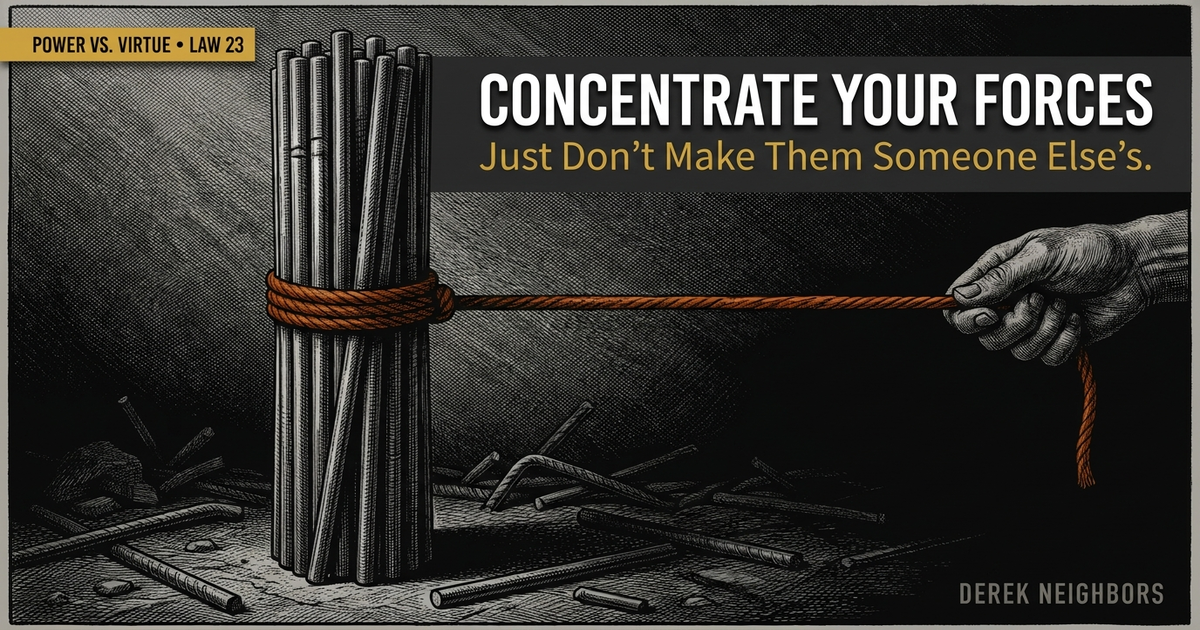
Concentrate Your Forces. Just Don't Make Them Someone Else's.
By Derek Neighbors on June 8, 2026
Power vs. Virtue: The 48 Laws Examined
A year-long examination of Robert Greene's 48 Laws of Power through the lens of ancient virtue ethics. Some laws we affirm, some we reframe, some we reject entirely.
There is a person in almost every organization who looks like the most focused operator in the building. They are not spread across six projects. They are not chasing every opening. They have found the one thing that matters and poured everything into it. Everyone reads it as discipline.
Look closer and the one thing is often a person. One boss who champions them. One rainmaker whose deals they ride. One platform, one client, one patron whose favor is the whole foundation. The focus is real. What it is focused on is a single relationship, and the entire structure of their working life is balanced on whether that relationship holds.
It reads as concentration. It is actually the most fragile position in the room, and the person standing in it will not feel the fragility until the day the source moves.
That is the seam in Robert Greene’s twenty-third law. Half of it is some of the best advice in the book. The other half is a trap welded to the first half so smoothly that most readers swallow both as one idea.
The Law
Greene’s Law 23 is “Concentrate Your Forces.” Conserve your energy and resources by keeping them concentrated at their strongest point. You gain more by finding a rich mine and digging it deep than by flitting from one shallow mine to another. Intensity defeats extensity every time.
Then comes the part most readers skim past. When you look for sources of power to elevate you, Greene writes, find the one key patron, the fat cow who will give you milk for a long time to come. Concentrate your attachment on a single powerful benefactor rather than spreading yourself across many weaker ones. The law fuses two different moves into a single instruction: concentrate your effort, and concentrate your dependence.
The first move is sophrosyne. The second move is a leash.
The Tactical Truth
I will give Greene the kernel cleanly, because the kernel is true, and it is one of the oldest truths there is.
Dispersed effort across ten fronts produces ten mediocrities. The person spread across everything feels productive every single day and stays completely replaceable for years. Depth compounds. Breadth dissipates. This is the same case I made for protecting deep work as the rarest competitive advantage left, reached from a different direction. The work that turns into mastery is always the work someone refused to stop doing long after it stopped being novel. Concentration is the mechanism behind every form of excellence I have ever watched up close, and prosoche, the Stoic discipline of sustained attention, is its ancient name.
The patron version even works for a while, and I am not going to pretend otherwise. Proximity to a single source of power can raise you faster than building your own base ever could. The right benefactor opens doors that a decade of independent effort would not. People who attach early to a rising figure often rise with them, and they rise fast. The tactic is not a fantasy. That is exactly why it is dangerous. A trap that never worked would not catch anyone.
So the concentration is right, and the attachment pays early. The question is what the attachment costs by the time the bill comes due, and whether the same concentration could have been pointed somewhere that did not hand your foundation to another person.
The Character Cost
The cost lives entirely in the second half of the law, and it has three layers.
First, the patron model inverts the strength it promises. Concentration is supposed to make you formidable. Concentrated dependence makes you brittle. You have built a single point of failure into the center of your life and labeled it discipline. Anyone who has designed anything that needs to survive knows the rule: the load-bearing parts get redundancy precisely because they are load-bearing. The patron model does the opposite on purpose. It removes every backup and ties the whole structure to one relationship, then calls the absence of alternatives “focus.” It is focus the way standing on one leg is balance.
Second, it trains you to read one face instead of build one craft. The energy that should compound into skill gets spent managing the benefactor. You learn their moods. You protect your access. You stay useful to one person in the specific ways that person rewards. This is polypragmosyne turned inside out. The usual version of that vice scatters you across too many things. The patron version concentrates you obsessively on one person, which is the same waste of a life wearing a more disciplined costume. You are not idle. You are extremely busy. You are busy with someone else’s preferences instead of your own work.
Third, and worst, it transfers ownership of your telos. When your forces are concentrated on a patron, your aim stops being yours. You no longer optimize for the work or for who you are becoming. You optimize for what keeps the milk flowing. Greene’s own metaphor gives the game away. A fat cow is something you extract from, and pleonexia, the grasping appetite for more at another’s expense, is the engine of the whole arrangement. The relationship becomes a supply line, and you become the thing that maintains it. Then one day the source moves. The patron retires, dies, sours, gets eclipsed, or simply decides you are no longer useful. And the person who concentrated everything there discovers they spent years building someone else’s position and called it their own.
The ARETE Alternative
The alternative is not to scatter. Scattering is the failure Greene correctly diagnosed, and the answer to a leash is not to cut your own legs out from under you by chasing everything at once. Keep the concentration. Move the target.
Concentrate your forces the way sophrosyne prescribes, through ruthless subtraction. Marcus Aurelius reduced it to a sentence: do less, do what is essential. The strength of concentration comes from what you refuse, not from what you pile on. Most of what fills a week is not load-bearing, and the discipline is the willingness to let it fall away so the few things that matter get everything you have.
Then aim that concentrated force at a telos you actually own. A craft. A body of work. A standard you hold regardless of who is watching. And aim it at autarkeia, a foundation that does not collapse when any single relationship does. autarkeia is not isolation, a distinction worth keeping straight, and one I have drawn before in this series. It is the quality of standing on ground you built, so that connection becomes a choice rather than a necessity.
This does not mean patrons, mentors, and rainmakers stop mattering. They matter enormously. The move is to concentrate your gratitude and your contribution on them while refusing to concentrate your survival there. phronesis, practical wisdom, is what tells the difference between a relationship that multiplies something you already own and a relationship that is the only thing holding you up. Build so that proximity to power is leverage on top of a base that stands without it. Then the benefactor is a gift, not a lifeline, and you can give to that relationship freely precisely because you are not trapped inside it. The leader who builds this in the people around them, rather than making the team dependent on a single irreplaceable figure, is running the same principle at scale.
Ancient Wisdom
The Stoics prized concentration every bit as highly as Greene does. They simply never told you to concentrate it on a person who could drop you.
Marcus Aurelius, Meditations IV.24: “If you seek tranquillity, do less. Or, more accurately, do what is essential. Most of what we do and say is not essential. Eliminate it, and you will have more time and more tranquillity. Ask yourself at every moment, is this necessary?” That is concentration defined as the disciplined elimination of the inessential. It is the same instruction Greene gives about mines and forces, arriving from the side of character rather than strategy.
The vice it stands against has a name the ancients used without flinching: polypragmosyne, the overreaching, meddling, scattered busyness of the person who is involved in everything and master of nothing. Marcus warns himself against it on nearly every page of the journal, which tells you how seriously the Stoics took focus. To them it was not a productivity tip. It was a moral discipline, the difference between a life concentrated toward something and a life dispersed across everything.
And there is a distinction that does the final piece of work here. The Stoics separated the telos, the goal of living well, from the skopos, the target an archer aims at. The archer concentrates everything on the skopos. Stance, breath, draw, release, total intensity poured into the aim. But the archer holds the outcome loosely, because once the arrow leaves, where it lands belongs partly to the wind. This is the whole answer in one image. Pour total concentration into a target you chose. Do not stake your peace on a source you do not control. Concentrate your forces on the skopos you aimed at, not on a patron who aimed you.
That is the line Greene’s law steps over. Concentration of effort toward your own aim builds arete and, over time, the eudaimonia that follows from a life that is genuinely yours. Concentration of dependence on a benefactor builds a comfortable cage you do not notice until the door is already shut.
The Test
Run this the next time you catch yourself pouring everything into a single relationship and calling it focus.
Ask one question. If the person I am most counting on disappeared tomorrow, fired me, left, died, or fell out of power, what would I still have?
If the answer is a craft, a body of work, a foundation that stands on its own, then your forces are concentrated on a telos you own, and the relationship is a multiplier on top of something real. Keep going. You are doing the thing Greene got right and avoiding the thing he got wrong.
If the answer is nothing, that you would be starting over from zero, then hear this plainly. That intensity is a loan of your forces to someone who can walk away, mistaken for ownership. The intensity is real. The discipline is real. They are pointed at a target that can leave. The fix is not to scatter. The fix is to take that exact same concentration and re-aim it at something that is actually yours, starting now, while you still have the choice.
Final Thoughts
Keep the first half of Law 23 and keep it without apology. Find the rich vein and dig it deep. Refuse the scattered life that feels productive and builds nothing. Concentrate your forces. The Stoics would have signed their names to that, and so would anyone who has ever built something that lasted.
Throw out the second half. The instruction to find the one fat cow and concentrate your attachment there is the relocation of your power into a hand that is not yours. It is the same trade the previous law in this series examined, short-term leverage bought against long-term ownership of yourself. It pays early and it fails late, and the failure arrives on a day you do not get to choose, decided by a person whose interests were never identical to yours. You set out to rise by attaching to someone rising. You wake up to find your foundation was always on loan, and the loan has been called.
Concentrate everything. Just make sure the thing you are concentrating on is yours. Pour your forces into a target you chose, a craft you own, and a foundation that holds when any single relationship gives way. That is the difference between focus and a leash, and it is the difference between arete and a borrowed seat at someone else’s table.
Excellence requires concentration aimed at what you own, not attachment to what can drop you. MasteryLab.co is where leaders build the foundation that makes every other relationship a choice instead of a lifeline.