Autarkeia (αὐτάρκεια): Meaning, Definition & Modern Application
ow-TAR-kay-ah
Self-sufficiency. The capacity to stand on your own capability, meeting challenges through developed competence rather than chronic dependency on external support.
Etymology
From autos (self) and arkein (to suffice, to be enough), literally “self-sufficiency” or “being enough for oneself.” Aristotle considered autarkeia a defining feature of eudaimonia: the flourishing life lacks nothing essential. For the Stoics and Cynics, self-sufficiency meant independence from external goods. Diogenes the Cynic demonstrated radical autarkeia by living with virtually no possessions, showing that genuine freedom comes from needing less rather than acquiring more.
Deep Analysis
Aristotle’s definition of autarkeia in the Nicomachean Ethics frames the concept as a condition of eudaimonia itself. The flourishing life, he argued, must be self-sufficient in the sense that it “lacks nothing.” This does not mean the flourishing person needs no one else. Aristotle explicitly argued that friendship is necessary for eudaimonia. Self-sufficiency in the Aristotelian sense means that the essential components of your wellbeing are within your own capacity to provide. You do not depend on fortune, on others’ approval, or on circumstances beyond your control for the core of your satisfaction.
The Cynic tradition, exemplified by Diogenes of Sinope, pushed autarkeia to its radical extreme. Diogenes famously lived in a large ceramic jar, owned almost nothing, and publicly rejected every social convention that struck him as unnecessary. When Alexander the Great reportedly visited Diogenes and asked what he could do for him, Diogenes replied, “Stand out of my sunlight.” The anecdote, recorded by Plutarch, illustrates the Cynic argument: the truly self-sufficient person needs so little that even the most powerful man in the world has nothing to offer them. This radical version of autarkeia equates freedom with the reduction of needs rather than the accumulation of resources.
The Stoics adopted a more moderate position. Stoic autarkeia did not require renouncing possessions or living in poverty. It required that your inner equilibrium not depend on possessing them. Seneca, who was enormously wealthy, argued that the wise person uses external goods without becoming dependent on them. The test is not whether you have resources but whether losing them would destroy your capacity to function. The Stoic sage could be rich or poor with equal equanimity because their wellbeing was rooted in the quality of their character, which no external event could remove.
The relationship between autarkeia and eleutheria (freedom) is structural. You cannot be genuinely free if you are dependent on things outside your control for your basic functioning. The person who cannot make a decision without their manager’s approval, who cannot spend an evening alone without distraction, who cannot face a challenge without immediately seeking reassurance, has not developed the self-sufficiency that freedom requires. Enkrateia, self-mastery, is the specific virtue that builds the internal foundation for autarkeia. When you can govern your own impulses, resist your own appetites, and sustain effort without external motivation, you possess the inner resources that make external dependency unnecessary.
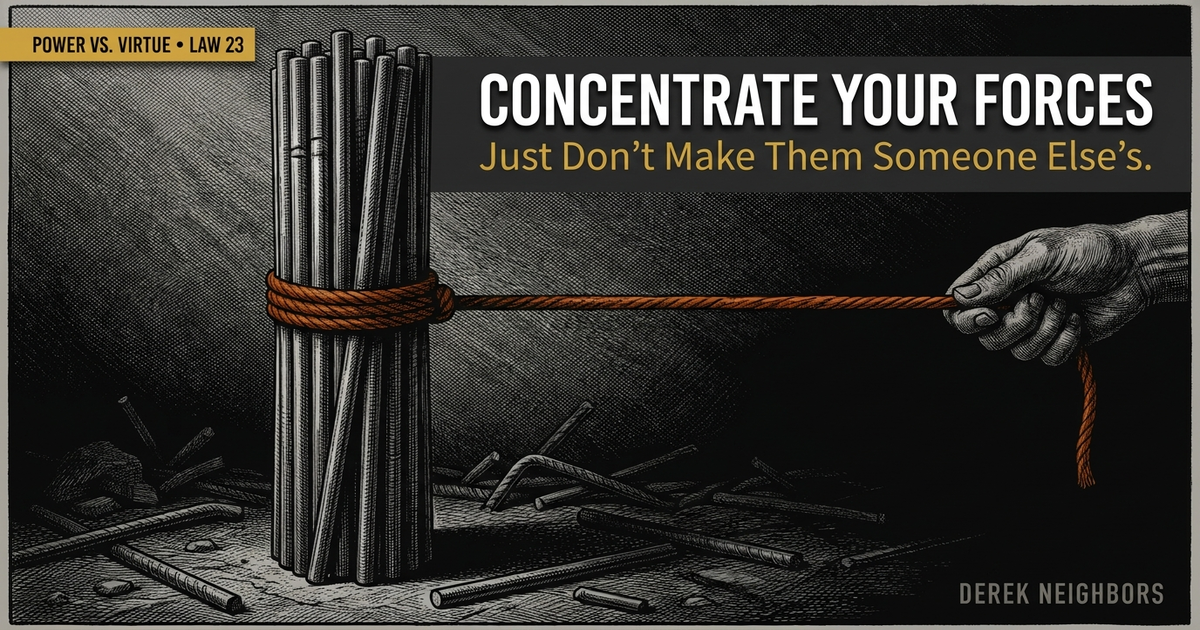
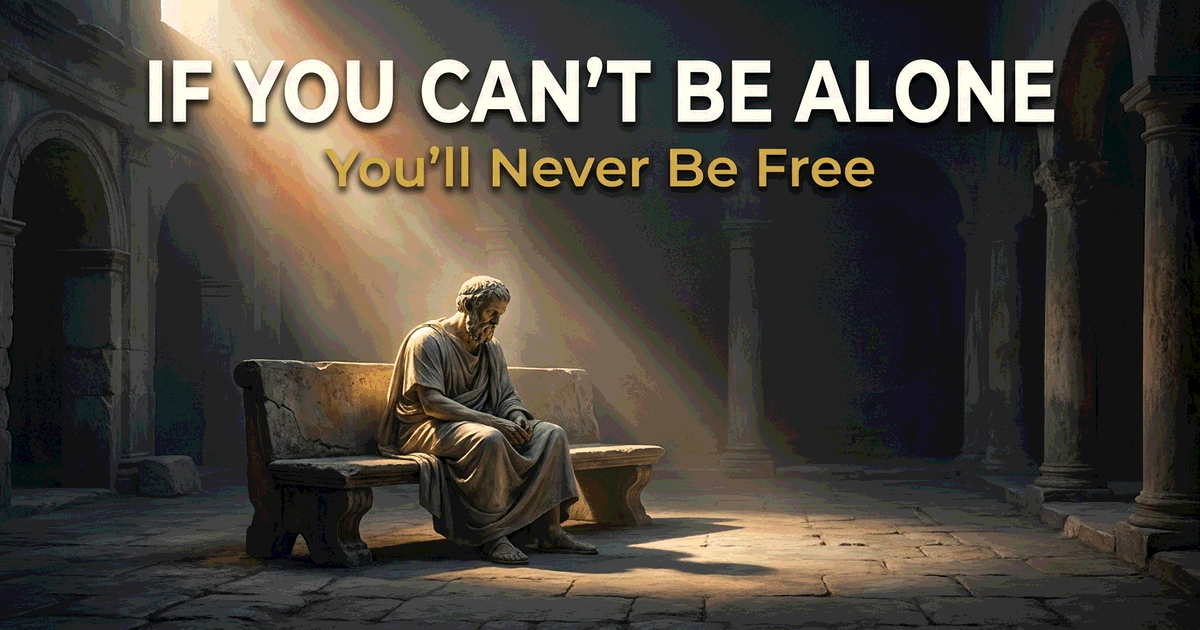
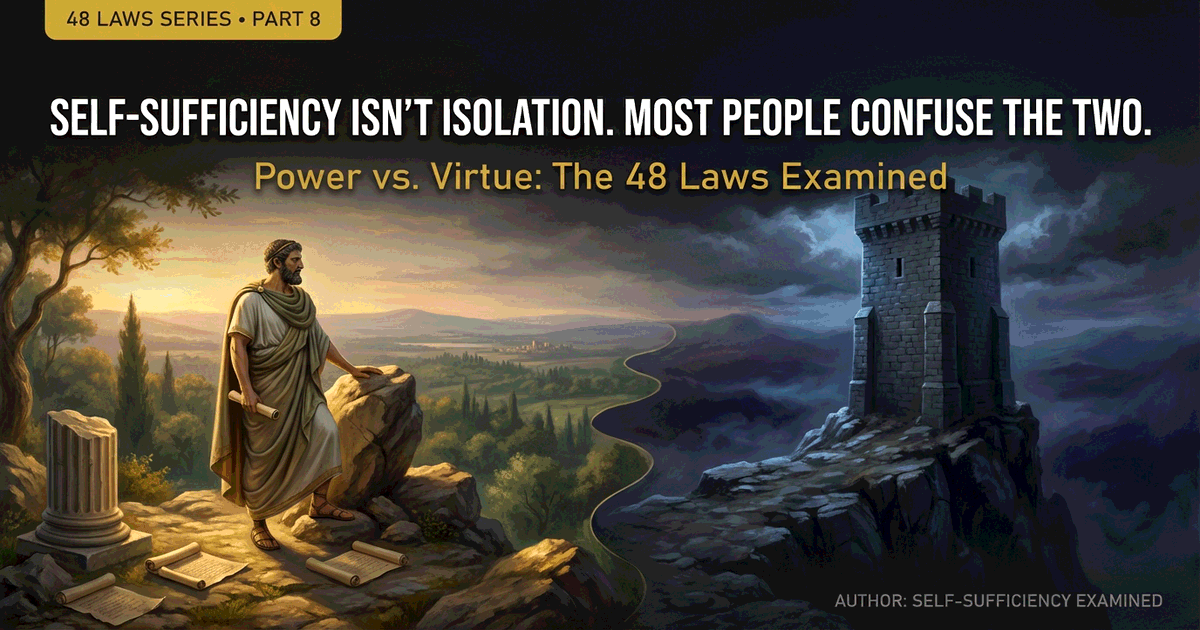
The modern application of autarkeia requires distinguishing self-sufficiency from isolation. The Cynics sometimes blurred this line, but Aristotle was clear: autarkeia does not mean refusing help or operating alone. It means developing the baseline of competence and resourcefulness that ensures your collaboration with others comes from genuine partnership rather than chronic dependency. The self-sufficient person brings something to every relationship. The dependent person extracts from every relationship. The quality of your collaborations depends on which position you operate from.
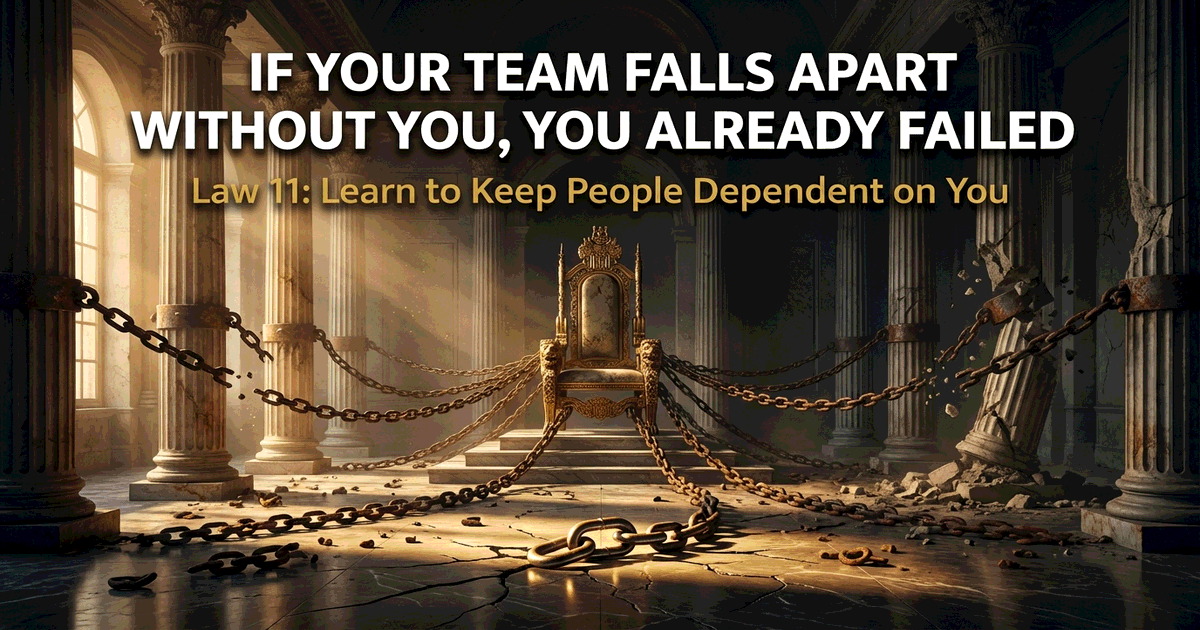
Autarkeia also has an organizational dimension. A team that cannot function without its leader’s constant presence is not self-sufficient. A company that cannot survive the departure of its founder has not developed institutional autarkeia. Leaders who build genuine self-sufficiency in their teams and organizations create structures that outlast their own involvement. This requires the difficult discipline of developing others’ capabilities rather than making yourself indispensable, which is its own form of self-sufficiency: the willingness to derive your value from building capacity in others rather than from being needed.
The deeper challenge of autarkeia in modern life is cultural. Consumer culture and the platform economy are designed to create dependency: dependency on convenience, on algorithmic recommendation, on instant access to goods and services that previous generations produced for themselves. Each dependency, individually, may be harmless. Collectively, they erode the baseline of self-sufficiency that makes you resilient under pressure. The person who has never cooked a meal, fixed a broken object, sat with boredom, or navigated uncertainty without external guidance has a thin layer of capability that fractures under stress.
Modern Application
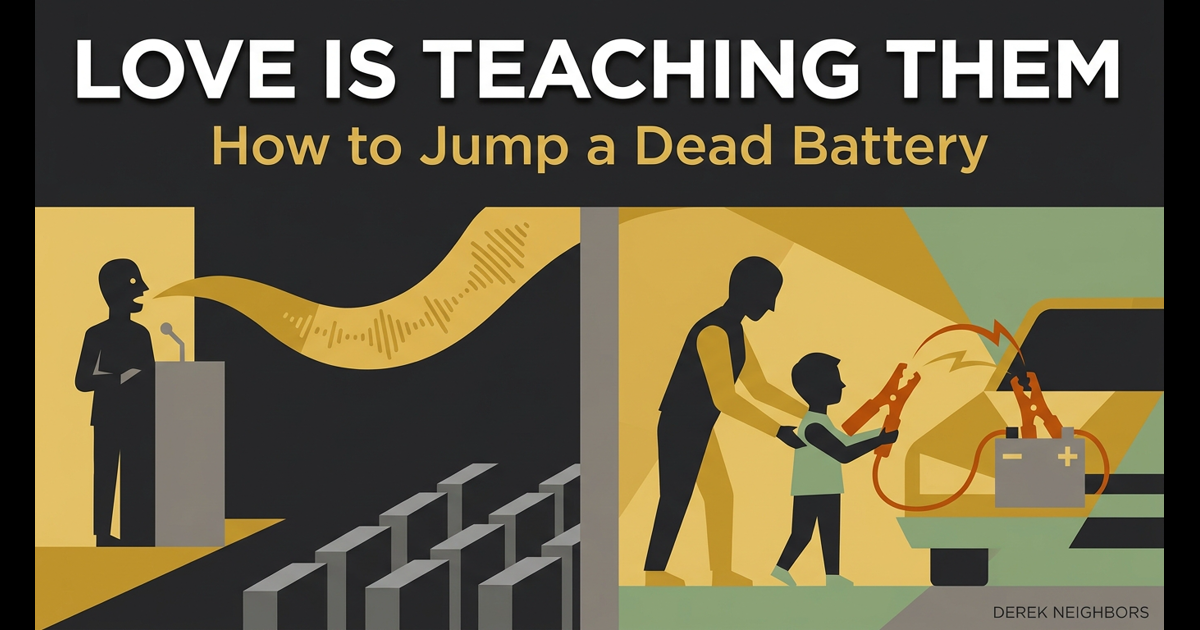
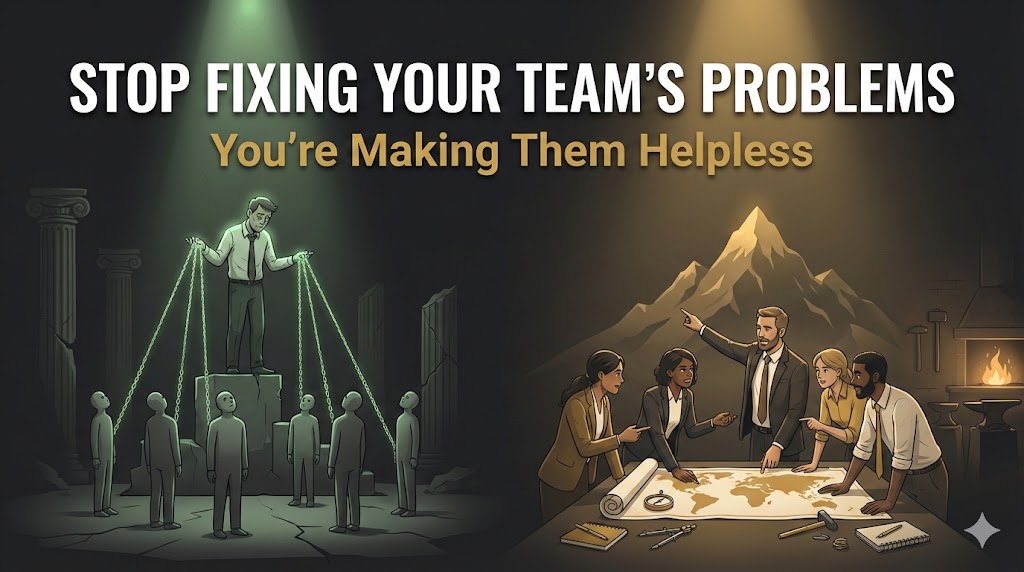
You develop autarkeia by building skills and judgment that don't require constant rescue. In leadership, your job is to cultivate this quality in others. Every problem you solve for your team is capability they never develop. Every struggle you let them work through builds the self-sufficiency that makes them genuinely capable.
Historical Examples
Diogenes of Sinope, the most famous Cynic philosopher, lived a life of radical autarkeia that challenged every assumption Athenian society held about what a person needs. According to Diogenes Laertius, when Diogenes saw a child drinking water from his cupped hands, he threw away his cup, saying, “A child has beaten me in simplicity of living.” The story illustrates the Cynic method: observe what you actually need versus what convention tells you that you need, and discard the excess. Diogenes demonstrated that a person of exceptional intellect and influence could live with almost nothing and remain one of the most sought-after conversationalists in Athens. His self-sufficiency was not deprivation. It was the elimination of everything that did not serve his essential function.
Henry David Thoreau’s experiment at Walden Pond from 1845 to 1847 was an explicit test of autarkeia in an American context. Thoreau built his own shelter, grew his own food, and lived on minimal resources to determine what was genuinely necessary for a good life. His conclusion, articulated in Walden, was that “most of the luxuries, and many of the so-called comforts of life, are not only not indispensable, but positive hindrances to the elevation of mankind.” While Thoreau’s experiment had its limitations, including his proximity to Concord and his reliance on friends for occasional provisions, the project demonstrated that reducing external dependency clarifies what actually matters.
Epictetus built his entire philosophical school on the foundation of autarkeia. Born a slave, physically disabled, and eventually exiled from Rome by the Emperor Domitian, Epictetus had every external prop removed at various points in his life. His teaching, preserved in the Discourses by his student Arrian, returns consistently to the theme that your faculty of choice is the only thing genuinely yours, and developing it fully is the only form of self-sufficiency that cannot be taken from you. His school at Nicopolis attracted students from across the Roman world, including, according to tradition, the young Marcus Aurelius through his teacher Rusticus. The irony of a former slave teaching the future emperor about self-sufficiency captures something essential about the concept: autarkeia is not determined by your external circumstances but by what you have built internally.
How to Practice Autarkeia
Identify one area where you chronically depend on others for what you should be able to handle yourself. Develop that capability over the next sixty days through deliberate practice. When tempted to ask for help prematurely, first exhaust your own resources and attempt a solution. As a leader, resist the urge to rescue your team from productive struggle. When someone brings you a problem, ask what solutions they have considered before offering yours. Build the habit of developing competence in advance of needing it. Self-sufficiency is not isolation; it is the baseline of capability from which genuine collaboration becomes possible. Each week, take on one task you would normally delegate or avoid, and work through it completely on your own. Track where you feel most dependent and design a specific learning plan to close that gap. Diogenes demonstrated that freedom increases as your needs decrease. Audit your current dependencies and ask which ones serve your growth and which ones enable avoidance. The goal is not to refuse all help but to ensure that when you do collaborate, you bring genuine capability to the partnership rather than transferring your burden to someone else.
Application Examples
A product team relies on a single senior engineer who holds all the institutional knowledge for their critical system. When that engineer takes an extended leave, the team discovers they cannot ship features, debug issues, or respond to outages. The dependency was invisible when the engineer was present and catastrophic when she was absent.
Organizational autarkeia requires distributing knowledge and capability broadly enough that no single person’s absence creates paralysis. The self-sufficient team has redundancy in critical capabilities, not because individuals are interchangeable but because the team has invested in developing capability beyond any one contributor.
After a divorce, a man realizes that his ex-wife managed every logistical dimension of their shared life: finances, healthcare, household maintenance, social scheduling. He is professionally successful but personally helpless. The first six months of solo living are a crash course in building the basic self-sufficiency he outsourced for twenty years.
Autarkeia in personal life means maintaining competence across the basic domains of living, regardless of whether someone else currently handles them. The person who outsources every non-professional function becomes fragile in ways that are invisible until the support structure changes.
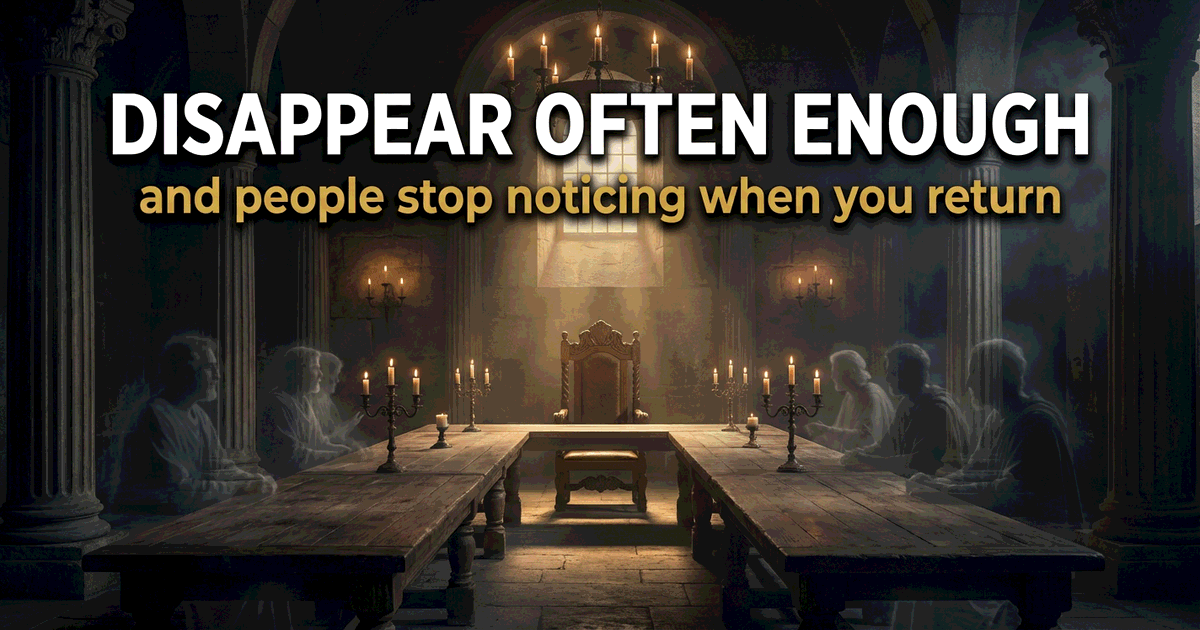
A founder builds a company where every significant decision flows through her. The team is talented but trained to escalate rather than decide. When the founder takes a two-week vacation, the company stalls. Decisions queue up, projects pause, and clients notice the absence. The founder returns to discover that the team’s dependency on her is the company’s single biggest vulnerability.
The leader who builds autarkeia in their organization makes themselves less necessary over time, which is the opposite of what most leaders instinctively pursue. True leadership self-sufficiency means building a team that can operate at a high level without you, which requires systematically transferring judgment, not merely tasks.
A college student who has always had a tutor, a study group, and parental oversight for academic work arrives at graduate school and collapses. Without the external support system, she cannot organize her time, prioritize readings, or sustain focus without accountability from someone else. Her academic capability was real, but it was propped up by scaffolding that graduate school removed.
Educational autarkeia means building the capacity for self-directed learning and self-managed effort. The student who can only perform with external structure has not yet developed the self-sufficiency that advanced work demands. The scaffolding must be removed gradually and deliberately, not all at once.
Common Misconceptions
Does self-sufficiency mean you need no one? The Greek answer was no. Aristotle, who valued autarkeia highly, simultaneously argued that humans are social animals who require friendship for flourishing. Self-sufficiency does not mean operating alone. It means ensuring that your participation in relationships and communities is driven by genuine contribution rather than chronic need. Another misconception is that autarkeia requires material austerity. The Stoics demonstrated that you can possess wealth while maintaining self-sufficiency, as long as your wellbeing does not depend on the wealth. The test is not what you own but what would happen to your inner stability if you lost it. A third error is treating autarkeia as a permanent achievement rather than an ongoing practice. Dependencies develop constantly as circumstances change. The person who was self-sufficient at thirty may have accumulated new dependencies by forty. Regular auditing of what you cannot function without is the maintenance practice that keeps autarkeia alive.
I learned the value of autarkeia through its absence. In my twenties, I built a career that depended entirely on other people: a business partner who handled operations while I handled clients, an assistant who managed my schedule, a mentor who guided my strategic thinking. When all three of those relationships changed within the same year, I discovered that I had skills but not self-sufficiency. I could perform my core function, but I could not manage the infrastructure of my own professional life.
The rebuilding process was humbling. I spent six months learning to do things I had always delegated: financial management, administrative coordination, strategic planning without a sounding board. Each skill I developed reduced my dependency on external support. The result was not isolation. It was the ability to collaborate from a position of competence rather than need.
The practice I maintain now is what I call a “dependency audit.” Quarterly, I list every person, system, or resource I cannot function without. For each item, I ask whether the dependency is healthy (genuine collaboration that makes us both better) or unhealthy (a crutch that prevents me from developing my own capability). The unhealthy dependencies get a development plan. I do not eliminate all external support. I ensure that I could function, at least at a basic level, if any single support were removed.
I apply the same principle to teams I lead. When someone brings me a problem, my first question is not “how can I help?” but “what have you tried?” Not because I am unwilling to help, but because solving problems for people trains dependency. Asking what they have tried trains self-sufficiency. The temporary discomfort of working through a problem without rescue is the price of developing the capability to handle the next one independently.
Frequently Asked Questions
What is autarkeia in Greek philosophy?
Autarkeia is the Greek concept of self-sufficiency, the capacity to meet challenges through developed competence rather than chronic dependency. Aristotle considered it a defining feature of *eudaimonia*, arguing that the flourishing life lacks nothing essential. The Stoics and Cynics valued it as the foundation of genuine freedom. Diogenes the Cynic demonstrated radical autarkeia by living with virtually no possessions, illustrating that true independence comes from reducing your needs rather than increasing your resources.
What does autarkeia mean?
Autarkeia means self-sufficiency or being enough for oneself, from *autos* (self) and *arkein* (to suffice). It describes the developed competence that allows you to stand on your own capability without constant external support. The term carries a connotation of completeness and contentment, not deprivation. To possess autarkeia is to have built enough internal capability and resourcefulness that external circumstances cannot destabilize your ability to function and contribute.
How do you practice autarkeia?
You develop autarkeia by identifying areas of chronic dependency and building the capability to handle them yourself. Exhaust your own resources before seeking help. As a leader, resist rescuing others from productive struggle that builds their competence. Start by auditing the areas where you consistently rely on others and design a sixty-day plan to develop that skill independently. The Stoics practiced voluntary discomfort to strengthen their self-sufficiency, and you can apply the same principle by periodically taking on challenges without your usual support systems.
What is the difference between autarkeia and autonomy?
Autarkeia is self-sufficiency, the practical capability to handle challenges without external dependency. Autonomy is self-governance, the capacity to set and follow your own principles. Autarkeia means you can take care of yourself; autonomy means you determine your own direction. In practice, the two reinforce each other: self-sufficiency gives you the practical foundation to exercise genuine self-governance, while autonomy gives you the clarity of purpose that makes self-sufficiency meaningful rather than mere survivalism.