Why Getting Better Feels Like Getting Worse
By Derek Neighbors on July 22, 2026
You joined the harder room on purpose. Better team. Sharper peers. Within a few weeks you feel slower and less impressive than you were three months ago in a weaker place.
Your brain reaches for the obvious story: something broke. You got worse.
I have told myself that story more times than I want to admit. It was almost always wrong.
The Assumption
Most people treat rank like a thermometer for quality. Rising rank means growth. Falling rank means decline. Feeling elite gets read as evidence of excellence. Feeling ordinary gets read as evidence something failed.
That assumption quietly runs careers. People stay where they look strong. They avoid rooms that would demote them. They confuse being the best person in a small comparison set with being good at the work.
The assumption feels rational because local rank is visible and absolute quality is not. Your nervous system can feel “top of this room” in an afternoon. It cannot feel “objectively excellent” the same way. So it substitutes.
The Crack
Hold the person constant and change only the pond.
In the first room, they feel sharp. Questions come easy. Peers ask them for the answer. In the second room, same skills and same hours, they feel behind. Questions get harder. Peers stop looking their way.
Nothing about the person dropped overnight. The comparison set did.
I see this constantly in coaching: the operator who looked elite on a mid-market team joins a sharper org and suddenly rates themselves as average. The writer who dominated a local scene publishes into a national one and feels invisible. The runner who won local races joins a serious training group and spends months packing up cones while faster people finish. The people who keep getting better keep reporting the same temporary collapse in how they rate themselves. That pattern alone should make the “I got worse” story suspicious.
If ability were the only variable, the feeling would track the work. It tracks the room.
I have felt the crack in my own body. On desert trails I know well, I can feel competent for miles. Drop into a race or a training group with people who live at a higher pace and the same fitness suddenly feels thin. Nothing magical happened to my legs overnight. The pond changed. My ego still tried to file it as decline.
The Investigation
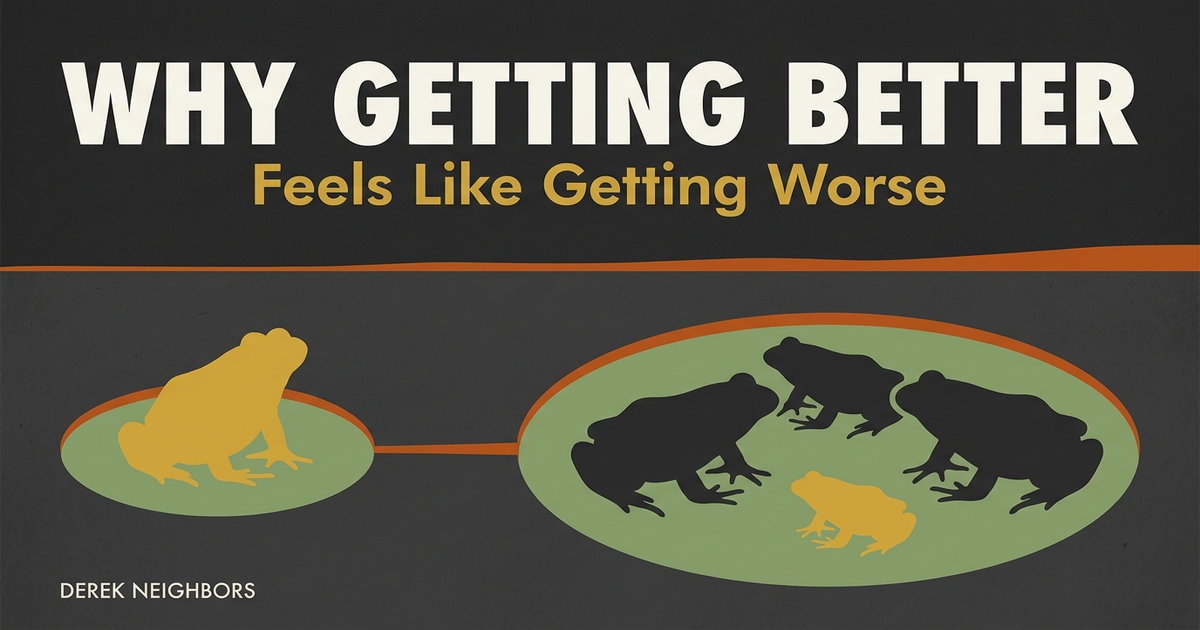
In 1966, sociologist James Davis published “The Campus as a Frog Pond” in the American Journal of Sociology. His finding was blunt: students’ aspirations and self-evaluations tracked relative rank on campus more than absolute ability. Put identical talent in different ponds and you get different stories about the self. Big frog in a little pond feels destined. Little frog in a big pond feels ordinary, even when the absolute work is stronger.
Here is why the feeling lies. The brain uses local rank as a proxy for quality because local rank is available. Absolute quality is harder to see, so the proxy wins.
This is different from the mastery-gap shock of meeting someone operating at another level. That encounter is reactive. Someone walks into your field of vision and your identity flinches. The frog pond problem is structural. You changed the scoreboard on purpose, then misread the re-rank as personal decline.
Modern life keeps reproducing Davis’s campus. Join a stronger engineering org and your pull requests look average. Move from regional sales into a national team and your close rate feels soft. Leave a company where you were the systems person and join one where systems thinking is table stakes. The work may already be better. The standing got worse first.
Parents and managers often make the same mistake. A strong local student moves into a harder program, looks ordinary, and adults panic for the old ranking. The better question is whether the new room raised the standard.
agon, the Greek idea of productive contest, only becomes real in rooms where losing is possible. Ceremonial contests protect ego. Real contests educate.
The Revelation
Getting better often feels like getting worse when growth includes a change of comparison set. Rank falls before standing on the new scoreboard recovers. Inside one pond, skill can rise and the feeling can stay quiet. The demotion sting shows up especially when you change rooms, or when you raise the standard you measure against.
That sting is the entry fee of a larger game. It does not mean you failed the smaller one.
paideia, formation through education, happens against demanding standards. Soft rooms flatter. Hard rooms form. Comfort as a life aim is not a neutral preference. It is a refusal to pursue arete, excellence as a way of being. If you want arete, you will spend seasons as a little frog on purpose. This is also distinct from the internal verdict of feeling not enough. That piece is about a wound underneath the reaching. This one is about the scoreboard changing when the comparison set changes.
You do not control where you rank once the room is set. You control whether rank is your thermometer for quality, and whether you keep seeking a harder standard.
Staying the biggest frog in a pond that stopped teaching is the quietest form of quitting. Nobody announces it. There is no resignation letter. There is only a long stretch of being impressive against a standard that no longer forms you.
I have watched talented people do this for an entire decade and still call it loyalty to their craft. It was loyalty to their ranking. The trophies stayed shiny. The growth curve flattened.
The obligation is not “change zip codes.” It is to stop treating local applause as the measure of the work. If you can enter a stronger room, do it. If you cannot, raise the standard inside the room you have: compare the work to its own demands, to your prior output, to the known canons of the craft. A stuck body does not get an exemption from arete. Only the instruments change.
There is a second trap on the other side. Some people romanticize suffering in hard rooms and refuse to leave toxic ones. Being the little frog only counts as tuition when the pond itself raises the craft. Humiliation for sport is not formation. Neither is a hierarchy built on politics instead of standards.
phronesis, practical wisdom, shows up here as standard selection. Not every hard room is the right hard room. Toxicity is not tuition. Misalignment is not growth. The question is whether the comparison set raises the standard of the work, or merely humiliates you for sport. You owe the harder standard because arete is the actualization of capacity in the work. Local ranking that flatters without forming leaves that capacity unactualized.
The turn, metanoia, is simple once you see it. Stop asking “why do I feel worse?” First ask “did the comparison set change?”
What Changes Once You See It
Demotion feeling is not a signal to reverse the move. “I feel less impressive” stops being an automatic reason to retreat to the old room.
Relative rank becomes weather. Absolute craft becomes climate. Absolute craft means quality judged against the demands of the work, against your prior work, and against the known standards of the craft, not against today’s peer ranking. Weather changes when you move. Climate is what you are actually building.
You also get a cleaner read on other people. The colleague who looks insecure after a promotion into a stronger org may not be fragile. They may be correctly registering a new scoreboard. The friend who keeps winning the same local contest may not be plateaued by accident. They may be protecting a ranking that feels like identity.
Leaders who understand this stop overreacting when a strong hire looks less confident for a quarter. They ask whether the work is improving under a harder standard. If yes, they protect the season instead of rescuing the ego.
The Practice
-
Run a pond audit. Name the five people your brain currently uses as the scoreboard. If those five have not changed in a year, your pond may have gone still.
-
Use the demotion test before you quit. Ask: did my absolute work get worse, or did my relative rank drop? Absolute decline needs a response. Relative demotion after entering a stronger room is often the point. Answer before you reverse the move.
-
Schedule little-frog seasons. Enter rooms where you expect to rank near the bottom for a stretch. Treat the identity pain as tuition. Decide the length in advance so the feeling cannot renegotiate every Monday.
-
Set a biggest-frog alarm. If you have been the smartest or most experienced person in the room for more than a year, raise the standard before the pond finishes teaching you nothing. Change rooms when you can. When you cannot, stop letting the current room’s ranking define the work.
Final Thoughts
The scoreboard people feel was never absolute. It was always the room. The real measure is the standard of the work. Bigger ponds matter when they disclose that standard more honestly. Ranking remains a shadow either way, in a famous pond or a forgotten one.
Choose harder standards, including rooms that make you feel temporarily worse when you can reach them. arete is not a local ranking. It is the quality of the work under a standard that does not shrink to protect your feelings.
Same frog. Harder standard. Sometimes that means a bigger pond. Always it means refusing to confuse applause with excellence. That is what growth looks like from the inside.
Frequently Asked Questions
Why does getting better feel like getting worse?
Because aspiration tracks relative rank more than absolute ability. Change the comparison set and the same skill that once ranked near the top can rank near the bottom. The work can improve while your local standing drops. Inside one pond, skill can rise without that sting. The demotion feeling attaches especially when the scoreboard changes.
What is the frog pond effect?
James Davis’s 1966 study “The Campus as a Frog Pond” found that students’ aspirations and self-evaluations tracked relative campus rank more than absolute ability. Identical talent produced different self-assessments depending on whether someone was a big frog in a little pond or a little frog in a big one. The scoreboard people feel is local.
Should I leave a room where I feel like a beginner again?
Not automatically. Ask whether your absolute work got worse, or whether your relative rank dropped after you changed comparison sets. Absolute decline needs a response. Relative demotion after entering a stronger pond is often the entry fee of growth. Leave toxic or misaligned rooms. Stay when the only thing that fell is your standing among stronger peers.
What is paideia and how does it relate to choosing harder environments?
Paideia is formation through education and upbringing. Hard standards educate the self. Soft environments protect relative standing and starve that formation. Choosing a bigger pond is one move. Raising the comparison to the work itself when you cannot change rooms is another. The obligation is to the standard, not to mobility.
Ready to stop protecting local rank and start chasing the standard that forms you? MasteryLab is where people practice excellence with others who refuse the small pond.


