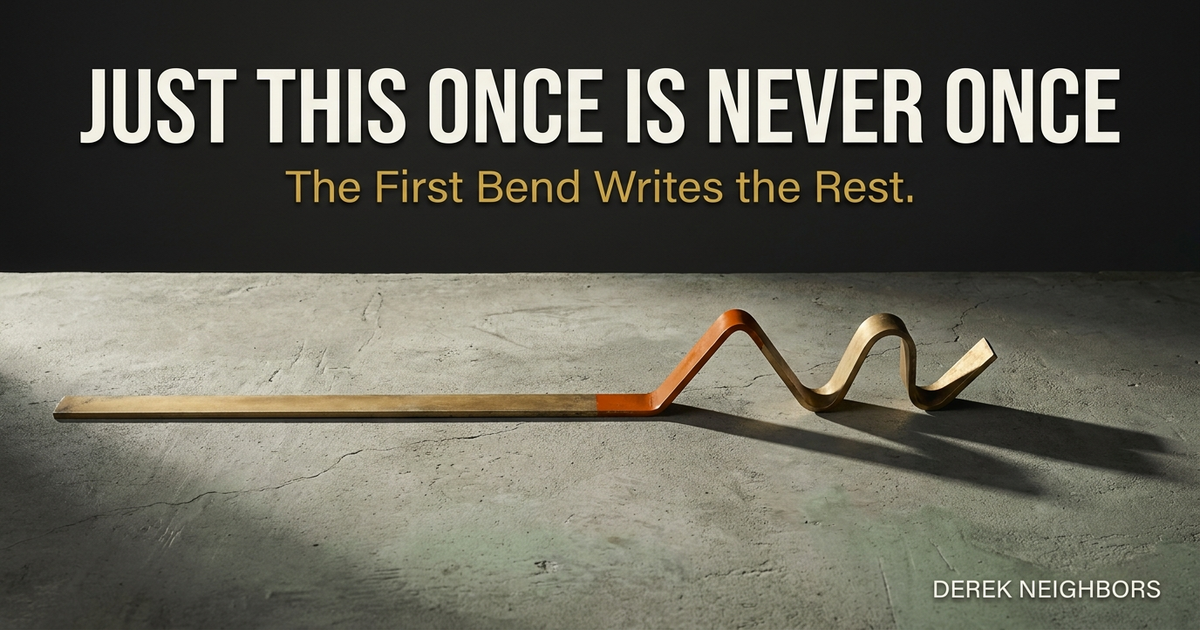
Just This Once Is Never Once
By Derek Neighbors on July 23, 2026
You said yes to the small ask.
One muted objection in the meeting. One signature that “doesn’t really change anything.” One introduction you would not make in daylight, sold as relationship capital. You called it pragmatism. Access. Politics. Keeping the door open so you could steer later.
I have told myself that story. It never stayed temporary.
The Beginning State
The first bend always arrives framed as reversible.
The ask is soft on purpose. Soft asks recruit people who still have a line. If the first request were unconscionable, you would refuse and walk. So the opening move is almost reasonable. Sit closer. Stay quiet this once. Sign the narrow exception. The promise underneath is ancient and addictive: proximity will become influence. Get near the decision, then shape it.
I still remember early rooms where I made that bargain with myself. Keep the seat. Stay useful. Earn the right to push later. The later rarely arrived on my terms. What arrived was a warmer invitation to the next small ask.
Plato learned a version of this at the court of Dionysius. The philosopher shows up believing wisdom can tutor power. Power learns faster than wisdom teaches. Modern executive suites rerun the same experiment every quarter. An invitation feels like leverage. Often it is an apprenticeship in agreement.
At this stage, prohairesis is still intact. That Greek word names the faculty of moral choice, the part of you that can still refuse without needing a speech. The first ask is soft because that faculty still works. The people making the ask know it. Soft compliance is cheaper to obtain than a public conversion.
The Progression
Then the exception becomes the baseline.
Yesterday’s “just this once” is today’s normal. The room remembers what you already allowed. You remember the story you told yourself to allow it. Refusing the second ask now costs something the first ask did not: you have to admit the first yes was a mistake. Most people will take another small bend before they will take that admission.
Aristotle called the mechanism hexis: a disposition built by repeated acts. You do not wake up as a different person after one compromise. You practice. Folding practiced becomes a folding person. The character change is almost boring while it happens. A forecast everyone knows is theater. A hiring exception “for this role only.” Silence in the room where silence equals consent. No single moment feels like the fall, which is why the fall completes.
This is where “political skill” gets romanticized. People congratulate the operator who can navigate every ask. What they are often watching is staged surrender that learned how to sound strategic. The operator is not steering the table. The table is training the operator.
I have watched strong leaders lose the ability to draw a hard line in under a year of “strategic” yeses. Not because they became stupid. Because each yes narrowed the next option set until the only remaining move that preserved their seat was another yes. The scary part is how reasonable each step sounded in isolation. Reasonable steps stacked into a person who could no longer afford an unreasonable no.
If you want the quieter cousin of this pattern, silence has its own invoice. This piece is about the fold that happens when refusal itself gets trained out of you.
The Advanced State
Seneca is the case study people prefer to skip.
He returned from exile to tutor Nero. The pitch was virtue at the center of power. Teach the young emperor. Shape the regime from inside. Access as influence. For a while the story even looked plausible. Advisors always look plausible in the early chapters. Then Nero’s court did what courts do when appetite outruns restraint. Seneca wrote the defense after Agrippina’s murder. He stood by as senators were forced into spectacles that would have been unthinkable at the beginning. The man who could write about virtue with surgical clarity ended up managing the optics of vice.
James Romm puts the diagnosis in one line worth stealing: we think we are being pragmatic, in actuality we are being humiliated.
That line stings because it names the gap between the story and the receipt. The story says: I am close enough to reduce harm. The receipt says: my closeness is now part of the machinery. You can still write elegant letters about character while your calendar proves you have been domesticated by invitation.
That humiliation has a Greek name when you still have enough conscience to feel it: aidos, moral shame, the reverence that flinches when you betray a standard you still recognize. The pragmatist learns to talk over that flinch. The clever explanation arrives first. The flush of shame arrives second. Ignore the second long enough and it stops arriving on time. When the flinch dies, people call what remains “seasoning” or “realism.” I call it evidence the training worked.
Advanced-state markers are ugly and ordinary. The ask no longer requests permission. It assumes compliance. Exit feels more expensive than another bend. Your calendar is full of rooms you once hoped to elevate, and those rooms now treat your presence as proof you already agreed. Influence was the story you needed. Capture was the result.
This is adjacent to, and distinct from, the styrofoam cup problem. That piece is about mistaking the trappings of the chair for the measure of the self. This piece is about what happens to your choices when access becomes the thing you cannot afford to lose. Different disease. Same hospital wing. One confuses perks with identity. The other confuses proximity with power over outcomes.
The Integration
The stages are not destiny. They are a map of how capture works so you can exit earlier.
sophrosyne is the adult virtue here. Temperance, sound-minded restraint, the refusal that protects the line before you need a heroic speech. Clever navigation of every ask is not wisdom. phronesis shows up as the capacity to tell access from influence before your seat depends on confusing them.
arete does not survive a character trained to fold. Excellence is not a brand you keep while your prohairesis quietly outsources itself to whoever holds the invitation list. If your leadership style is allergic to hard lines, you are already rehearsing the progression. Nice leadership has its own wreckage. Softness that cannot refuse becomes complicity that still gets called courtesy.
Four practices that interrupt the cascade:
1. The precedent test. Before any temporary yes, ask one question out loud: if this becomes the new normal, can I still respect myself? If the honest answer is no, the temporary framing is a lie. Say the question in the room if you can. Private honesty that never becomes speech is how Stage 1 keeps looking harmless.
2. The access vs influence audit. Every ninety days, list what your proximity actually changed. Decisions reversed. Standards raised. Harms prevented. Truths that stuck. If the main product of your seat is your silence and continued invitation, you do not have influence. You have a membership. Membership feels like status. It functions like a leash.
3. The shame ledger. When aidos flares after a “pragmatic” choice, write the ask and the story you told yourself. Patterns beat anecdotes. The ledger is how you catch Stage 2 while you still have Stage 1 options. If you cannot remember the last time shame showed up after a compromise, that absence is data too.
4. The pre-committed no. Name three lines you will not cross before you need courage in the room. Write them when you are calm. Share one of them with someone who will ask you about it later. The no said early is cheaper than the no said late, and late nos are the ones people imagine they will find when the ask finally becomes outrageous. By then the person who could say them is often gone.
Stop congratulating “political skill” that is actually staged surrender. Support the colleague who refuses early. That person looks difficult in Stage 1 and looks like the only adult left in Stage 3.
Final Thoughts
“Just this once” is a recruitment pitch for a character you will not choose in daylight.
I used to believe in the cinematic refusal, the moment the ask finally becomes too ugly to swallow. That fantasy is how Stage 1 survives. The ugly ask arrives after the training is done. The useful refusal is the boring one, spoken early, when the cost is warmth and the gain is still owning your own line.
The first bend is never priced as the last bend. That is the whole trick. Refuse while refusal still belongs to you, or spend years explaining how a string of reasonable exceptions delivered you somewhere you swore you would never go.
Frequently Asked Questions
Why does “just this once” rarely stay once?
Because a temporary exception becomes the new baseline. Other people remember what you already allowed, and you remember the story you told yourself to allow it. Refusing the second ask requires admitting the first yes was a mistake. That cost is higher than another small bend, so the bends accumulate. Aristotle called the result hexis: a disposition built by repeated acts. Compromise practiced becomes a person trained to fold.
What happened with Seneca and Nero?
Seneca returned from exile to tutor the young Nero and believed proximity would let him shape virtue at the center of power. Over time he wrote Nero’s defense after Agrippina’s murder and stood by as senators were forced into degrading spectacles. James Romm summarizes the pattern: people think they are being pragmatic when they are being humiliated. Access did not become influence. It became a narrowing set of options until refusal felt more expensive than compliance.
How do you tell access from influence?
Run a ninety-day change audit. List what your proximity actually altered: decisions reversed, standards raised, harms prevented, truths that stuck. If the main product of your seat is your silence, warmer relationships, or continued invitation, you have access without influence. Influence changes the work. Access changes your willingness to object.
What is hexis and how does it relate to moral compromise?
Hexis is a stable disposition formed by what you repeatedly do. Aristotle argued that we become just by doing just acts and unjust by doing unjust ones. Each “temporary” yes is practice. Over enough reps, the faculty of choice still exists in theory, but the trained response is to fold. That is why the first no matters more than the dramatic refusal you imagine making later.
If you want a community that treats hard lines as adult practice rather than brand damage, MasteryLab.co is where people train the kind of character that can still say no when access gets expensive.