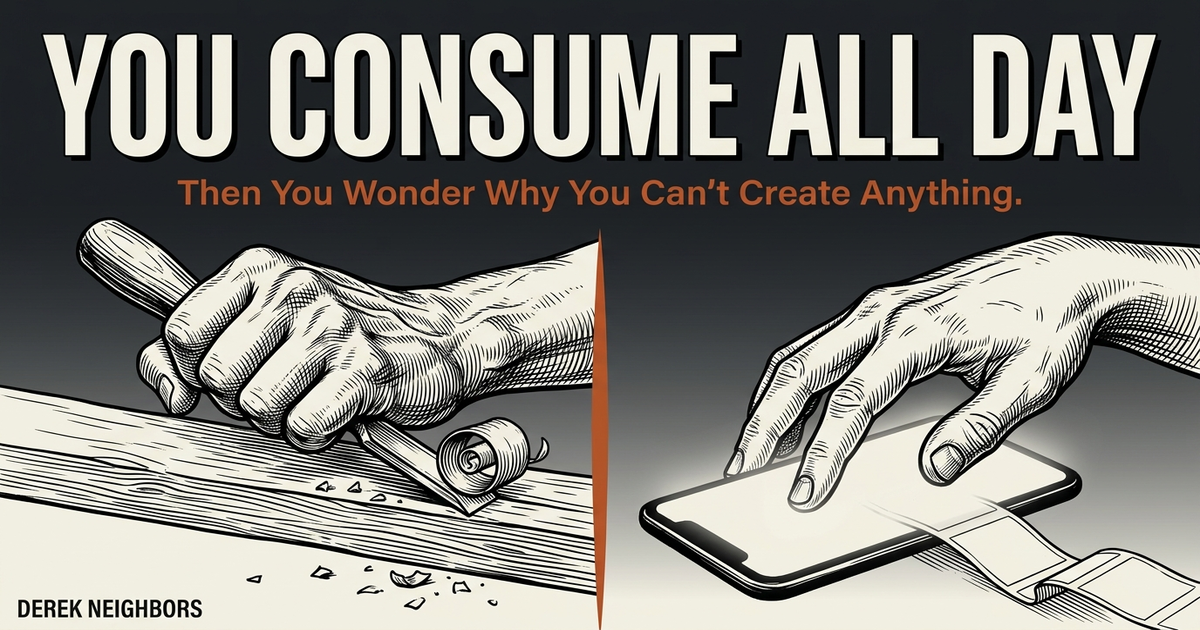
You Consume All Day. Then You Wonder Why You Can't Create Anything.
By Derek Neighbors on June 30, 2026
Two people have the same free evening. Same couch, same three hours, nothing on the calendar. One of them will spend it consuming. The other will spend it creating. Neither one decides on purpose.
The first one opens a feed. Music someone else made. Opinions someone else formed. Dinners someone else cooked and photographed under good light. Three hours pass in a warm, frictionless blur, and it feels like rest.
The second one picks up something that fights back. A knife and an onion they keep cutting badly. A guitar with a chord their fingers cannot find yet. A blank document. A garden bed and a bag of soil. Three hours pass, and at the end of them there is something in the world that was not there before. It is clumsy. It is real. They made it.
From the outside, both of them were relaxing. The difference does not show up tonight.
It shows up over a year. One of them can now do a dozen things with their hands. The other can only find things other people made. Same hours, same effort of will, opposite result. And almost nobody notices the hinge in the middle of it, which is this: the tool you reach for without thinking is training you every single time, in one of two directions.
Two Kinds of Tools
Tools are not all the same species. You can sort every one of them with a single question. What does this ask of me before it gives anything back?
One kind demands something first. A chef’s knife. A manual camera. A language. A woodworking plane. An instrument. A blank page. These tools are clumsy in your hands until they are not, and the gap between those two states is filled with your effort. They refuse to cooperate until you change.
The other kind demands nothing but appetite. The feed that scrolls forever. The one-tap everything. The algorithm that decides what you see next so you never have to. The model that writes the first draft so you never have to face the blank. These tools are smooth from the first second. There is no beginner phase because there is no skill to acquire.
Call the first one a craft tool. It builds capability into your body. Call the second a capture tool. It captures your attention and hands back consumption.
The rest of this comes down to one axis, and it is not old versus new, screen versus paper, or plugged in versus not. It is what the tool asks of you, and what it leaves in you.
The Craft Tool
A craft tool works through resistance. It will not do the thing for you, so you have to become the kind of person who can do the thing. That is the entire mechanism. The friction is not a flaw in the tool. The friction is where the skill gets deposited.
The Greeks had a precise word for this kind of knowledge. techne. We translate it as art or craft, but they did not mean decoration. They meant know-how that lives in the hands, the kind of understanding you can only get by doing the thing badly until you do it well. You cannot read techne. You cannot be told it. It arrives through the doing and nowhere else.
And the doing, repeated, settles into something permanent. Aristotle called that hexis, a stable disposition built by practice. The knife work, the chord shape, the rhythm of a good sentence stops being effortful and becomes part of how you are built. It is yours now, not as information you could recite but as a capacity you carry.
Underneath all of it sits an older idea worth naming, because it is the whole point. autourgia, working with your own hands, self-doing, from autos, self, and ergon, work. The autourgos was the citizen who worked his own land and made his own things, and the Greeks treated him as the backbone of a free people. The logic was simple. A person who can make what he needs with his own hands does not have to ask anyone’s permission for it. What the craft tool leaves in you is exactly that. autarkeia, self-sufficiency. A capability that is portable, un-rentable, and yours across tools and decades.
The cost is honest, so I will say it plainly. This is slow. It is humbling. You will be bad in public for a while, and the early hours feel like nothing but incompetence and boredom. That is the tuition, and there is no version where you skip it. This is not a hobby for the ambitious. Building your own capability is what any person owes, slave or emperor, whether or not they feel like it before bed. Trading it for the warm feeling of a full evening is not a smaller lifestyle. It is an abdication of something that was yours to build.
The Capture Tool
A capture tool works the opposite way. It removes friction so completely that you never have to grow a capacity, and mostly you don’t. It does the thing for you, or it hands you the thing someone else made, so smoothly that whatever ability you might have built quietly wastes from disuse.
The trade it offers is real, and it is seductive. Instant. Effortless. Comfortable. Endless. No clumsy beginner phase, no being bad in public, no tuition. You get the output without the becoming. For a culture that is tired and busy and a little ashamed of being bad at things, that is a very good offer.
What it leaves in you is consumption, and then more hunger. The appetite grows and the capacity shrinks, and the feed is engineered so the next thing is always already there before the last one finishes. You are never full and you are never able.
Here is the term of the deal nobody reads. You own nothing. The skill lives in the tool, not in you, and the rent is due forever. Cancel the subscription, lose the app, watch the service shut down, and the capability walks out the door with it, because it was never in your hands to begin with. You did not build anything. You borrowed a capacity by the hour.
Even the rest is counterfeit. It looks like scholē, the cultivated leisure the Greeks prized as the space where a person actually grows, the room where you become more than your work. But it produces none of scholē’s fruit. It is idleness that has learned to sit very still and call itself a break. The capture tool serves its owner, and it serves your appetite. It does not serve you.
Craft Tool vs Capture Tool
| Dimension | Craft Tool | Capture Tool |
|---|---|---|
| What it asks of you | skill, attention, patience | only your appetite |
| What it leaves in you | capability (hexis) | consumption, then more hunger |
| Who does the making | you | someone else, or the algorithm |
| Ownership | you own the skill | you rent it |
| Over a year | you compound | you atrophy |
| When it disappears | you keep the craft | you keep nothing |
| Facing a blank | you make the first move | you can only react to a prompt |
Owning Versus Renting
The material is not the point, so do not turn this into nostalgia for typewriters. A keyboard and a compiler are craft tools. A synthesizer is a craft tool. A digital camera in the hands of someone learning light is a craft tool. A hand plane and a code editor sit on the same side of the line. The question is never whether the tool plugs in. It is whether the tool builds a capacity into you or installs a dependency where the capacity should go.
And it is not consuming versus never consuming. Every maker was first an apprentice who took in far more than they made. You learn a craft by watching someone who has it, reading the people who had it before, studying the work until your own hands can follow. That kind of reception builds real capacity. The trouble is the reception that never converts into an attempt of your own, the taking-in that quietly becomes the entire diet. Watching a master and then trying it yourself is how a craft moves through a person. Watching, and watching again, and never once picking up the tool, is the atrophy. The enemy was never input. It is input that crowds out your own output.
The cleanest test I know is first-strike creativity. Can you face a blank page, an empty board, a silent instrument, and make the first move yourself? Or can you only respond to what something else serves up? The maker can begin from a blank. The consumer needs a prompt. One of those is a person with poiesis, the power to bring something into being. The other is a person waiting to be fed.
This is why the ownership question matters so much more than it sounds. A rented skill vanishes with the subscription. An owned skill is portable across tools, durable across decades, and impossible to deplatform. That is the freedom the autourgos actually had. What you can make with your own hands, no one can price, revoke, or take. Link that to a working life and the stakes get sharp fast. See “Just Because AI Can Do It Doesn’t Mean You Should” for the discernment version of this, and “Deep Work Is Dying” for the attention a craft tool demands and a capture tool destroys.
A life spent on capture tools produces a finished consumer. Fluent at reacting, quick with a take, helpless at making. A life spent on craft tools produces a finished human in the older, sturdier sense of that word. Complete. Self-reliant. Able to put something into the world that was not there before.
The reason is not sentiment. A person is the one creature whose work is the active exercise of its own powers, and making is those powers in motion. This is not really about the hands. The geometer, the writer, the person building an argument or a life do the same thing the woodworker does. They form something real with a capacity they own, instead of consuming something formed by someone else. Spend your years only receiving, and the part of you that was built to make sits idle and goes quiet.
When to Use Each
This is not a call to smash your phone or romanticize a century with worse dentistry. Capture tools are fine as tools. I use them. The damage does not come from touching them. It comes when the ratio inverts and consumption crowds making out of your life entirely, until the only thing your hands know how to do is scroll. The feed is engineered to pull that ratio its way. It still cannot pick itself up. That part is always your hand.
The discernment is phronesis, practical wisdom, and here it means one habit of judgment. Choose a tool by what it demands of you and leaves in you, not by what it does for you.
Then build the habits that keep the ratio honest:
- The ratio rule. For every hour you consume, make one thing with your hands, however small and however bad. The point is not the quality. The point is which direction you are being trained.
- Keep one craft that fights back. An instrument, a kitchen, a workshop, a blank page, a trail. Something with real resistance that you have no choice but to get better at or fail at honestly.
- The subscription test. If this tool vanished tomorrow, what capability would I lose? If the answer is a real one, you rented it. Start building the owned version underneath it.
- The first-strike drill. Make the first move before you open a feed. Write the sentence, sketch the line, play the phrase, before you let anything prompt you.
- Choose friction on purpose. The slower, harder tool is usually the one depositing skill. Reach for it when it matters.
The diagnostic is short and it stings. Look at your hands and your last month of evenings. What did you make that did not exist before? If the honest answer is “nothing, but I saw a lot,” you have been letting the tools finish you into a consumer, one unthinking reach at a time, and some part of you already feels it.
Frequently Asked Questions
These short answers double as the article’s structured FAQ data; they exist in the page text so AI search engines and human skimmers can pull them directly.
What is autourgia?
autourgia is a Greek word meaning working with one’s own hands, or self-doing, built from autos, self, and ergon, work. The autourgos was the citizen who worked his own land and made his own things, and the Greeks tied him to the backbone of a free people, because a person who can make what he needs with his own hands does not depend on anyone else for it. In the world of tools and technology, autourgia names the capability you build into your own body and keep, as opposed to a service or an algorithm you rent and lose the moment it is taken away.
Are digital tools bad for creativity?
No. The line that matters is not analog versus digital. A code editor, a synthesizer, and a digital camera are craft tools, because they demand skill and build a real capability into you. A social feed and a one-tap generator that hands you a finished output are capture tools, because they ask only for your appetite and leave you no more able than you were. Plenty of screens are craft tools and plenty of analog habits are only slower consumption. The honest test is what the tool asks of you and what it leaves in you, not whether it plugs in.
What is the difference between owning a skill and renting it from an app?
An owned skill lives in your own hands and judgment. You built it through practice, it is portable across tools, and it survives when any particular app disappears. A rented skill lives in the tool. It feels like a capability while you are using the app, but nothing was deposited in you, so the moment the subscription lapses or the service shuts down, the capability leaves with it. The quick test is to ask what you would lose if a tool vanished tomorrow. If you would lose a real ability, you were renting it, and the fix is to build the owned version underneath it.
How do I stop being a passive consumer of technology?
Start with a ratio. For every hour you spend consuming, make one thing with your own hands, however small and clumsy. Keep at least one craft that fights back, an instrument, a kitchen, a workshop, a blank page, a trail. Run the subscription test on your tools and rebuild the skills you have been renting. Practice first-strike creativity by making the first move, writing the sentence or sketching the line, before you open a feed and let something else prompt you. The goal is not to quit every capture tool. It is to keep consumption from crowding making out of your life.
Final Thoughts
Every tool trains you. The feed is not neutral, and the knife is not neutral. One asks for your appetite and leaves you hungrier. The other asks for your skill and leaves you more able. Neither one is passive, and neither one is waiting for your permission.
The real question was never whether technology is good or bad. It is what you are being turned into by the things you pick up without thinking about them.
So choose tools that make demands. Let the ones that fight back finish you into someone who can make, not only someone who can find. The capability you build with your own hands is the one thing in your life that no update, no outage, and no algorithm can reach. That is autourgia, and it is the quiet ground of arete. The eudaimonia worth having was always going to come from bringing something into being, not from watching other people do it in better light.
The daily character work of choosing craft over capture, and building capability you actually own, is the practice we run at MasteryLab.co. Come make something that fights back.