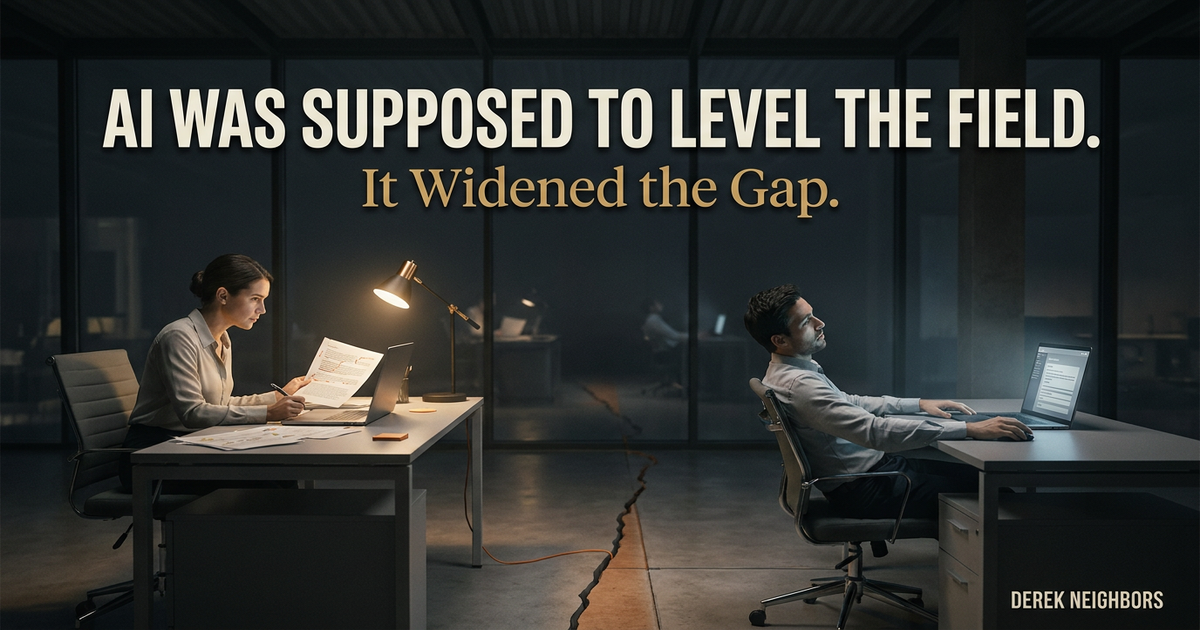
AI Was Supposed to Level the Field. It Widened the Gap.
By Derek Neighbors on July 19, 2026
The pitch landed because it flattered a democratic hope.
Give every worker the same model. Watch the bottom rise. Watch the mediocre become competent and the competent become extraordinary. Watch inequality of skill soften because the tool finally did what schools and managers could not: put a genius in every pocket.
That is not what happened.
The Apparent Contradiction
Two things are both true, and they refuse to sit next to each other politely.
Access equalized. A junior analyst and a twenty-year operator can open the same chat window, type the same prompt shape, and get output that looks professionally finished. On paper, the playing field leveled.
Outcomes did not. In team after team, the people who were already sharp got sharper. They ship cleaner strategy, catch risk earlier, and turn a four-hour research slog into forty minutes of judgment. The people who were already fuzzy got faster at producing fuzzy work that now arrives with a confident tone and a bibliography that may or may not be real.
This confuses leaders who still think tools work like spellcheck. Spellcheck raised the floor. Calculators raised the floor. Generative AI looks like that family of inventions and behaves like a different animal. It does not enforce a standard. It mirrors the standard you bring to it.
So the either/or thinking takes over. Either AI is a democratizing miracle, or it is a scam that only helps elites. Both frames miss the mechanism. The tool is real. The leveling was the fantasy.
The Deeper Truth
AI is a multiplier, not a substitute.
I have watched this for a few years in the same rooms. Two people get the same model. One treats it like a junior analyst worth interrogating. The other treats it like an oracle worth obeying. Six months later, their output quality has diverged further than it had before either of them typed a prompt.
The strong pattern looks ordinary from the outside. They ask for three options and kill two. They demand the case against their own idea. They check citations. They rewrite the middle because the cadence sounds right and the logic does not. They use the machine to expand the surface area of their thinking, then they do the part the machine cannot do: decide.
The weak pattern also looks ordinary, which is why it spreads. They paste the brief. They accept the first fluent draft. They polish the adjectives. They confuse the feeling of completion with the fact of correctness. The tool did not make them stupid. It removed the friction that used to expose the stupidity before it shipped.
I already named a cousin of this problem when I wrote about what to automate and what to keep in your own hands. That piece was about protecting the work that forms you. This one is about what happens when the same tool hits unequal judgment. The people who needed a leveler most are often the ones it harms first, because it lets them produce volume without building the faculty that would let them evaluate the volume.
The Greeks had a word for that faculty. phronesis is practical wisdom: the capacity to discern the right move in this situation, including knowing what not to do. Aristotle insisted you cannot download it. It grows through lived particulars. techne can make something well. Without phronesis, you still cannot tell whether the well-made thing should exist, ship today, or be thrown out.
AI flooded the world with cheap techne-shaped output. It did not flood the world with phronesis. That is why polish got cheap while trust got expensive, and why performance gaps widen under the same login screen.
The settled habit matters too. hexis is a disposition built by repetition. Interrogate the model every day and you train a hexis of scrutiny. Defer to the model every day and you train a hexis of surrender. Same tool. Opposite character deposits. prohairesis, the faculty of moral choice, is still yours when you decide which habit to feed.
Ease made the trap feel kind. When AI makes life easier, the relief can hide the atrophy. Widening gaps do not always look like failure. They often look like productivity dashboards that glow green while judgment quietly leaves the building.
The Integration
Hold both truths without lying to yourself.
Yes, AI can raise absolute output for almost anyone who uses it. No, that does not make relative excellence more equal. The practical move is to stop managing AI as a fairness story and start managing it as a judgment story.
Treat the model like a junior analyst. It drafts. It lists. It challenges. It does not own the call. If you catch yourself saying “the AI said” as if that settles a dispute, you inverted the hierarchy. Put the decision back in a human seat with a name.
Charge a second-answer tax. Never ship the first completion. Force one adversarial pass: generate the strongest objection, the missing stakeholder, the way this fails in month three. High performers already do this instinctively. Make it a rule for everyone else so the floor rises for real.
Hunt error before you hunt polish. Ask what would make this wrong before you ask how to make it prettier. Fluency is the cheap layer. Correctness is the expensive one. If your review process rewards tone and formatting, you are training people to decorate confident mistakes.
Protect a skill floor on purpose. Each quarter, name one judgment you still need to form by hand: pricing taste, customer diagnosis, architectural tradeoffs, hiring reads. Keep enough of that work unautomated that your phronesis keeps getting reps. Explaining everything to people hollows them out. Letting a model do all the hard thinking hollows you out the same way.
Lean hard on AI when you already know what good looks like and you need breadth, structure, or speed through known terrain. Slow down when the stakes are novel, when you cannot yet detect a confident lie, and when the output is symbolic enough that your presence is the product. The tool choice is not only about interfaces and operating systems, though the machines have opinions about those too. The deeper choice is whether you are building a loop that sharpens you or a loop that replaces you before you are ready.
The Mastery
Mastery here is not prompt cleverness. Prompt cleverness expires.
Mastery is using AI to increase your surface area for truth-seeking without outsourcing the seeking. You get faster research and slower self-deception at the same time. You let the machine widen the map, then you walk the ground.
The leaders who will compound through this era are not the ones with the biggest seat licenses. They are the ones whose people can look at fluent output and still say, out loud, “this is wrong, and here is why.” That sentence is phronesis under pressure. It is also becoming rare, because disagreeing with a polished machine feels ruder than disagreeing with a junior human.
The gap is not a tooling problem wearing a character costume. It is a character problem wearing a tooling costume. Access equalized. Discernment did not. Training judgment is the only durable equalizer, and it still takes the long way: reps, consequences, and the refusal to let a fluent answer end the thinking.
FAQ
Does AI make everyone more productive equally?
No. Shared access is not shared gain. Strong judgment uses the tool to stress-test thinking. Weak judgment uses it to accelerate first drafts into finished work. Absolute output can rise for both groups while the relative gap gets worse.
What is phronesis and why does AI make it more important?
phronesis is practical wisdom: knowing the right action in a concrete situation. AI makes information and fluent options cheap. That raises the value of the faculty that can tell which option is fit for this moment, and which one only sounds like it is.
How should high performers use AI differently from beginners?
High performers interrogate. They demand alternatives, check claims, and keep ownership of the decision. Beginners should borrow structure after they have a standard for quality in a domain, not before. If you cannot detect a bad answer, you are not ready to automate the thinking that would teach you to detect it.
Is the AI performance gap permanent?
The access gap can close overnight. The judgment gap closes only as fast as people practice discernment under real consequences. Tools will keep getting better. That makes practiced phronesis more decisive, not less.
Final Thoughts
The dream of a level field was never going to survive contact with unequal judgment. AI did not invent that inequality. It removed the friction that used to hide it, then handed everyone a louder microphone.
If you want a fairer outcome, stop waiting for the model update that equalizes character. Build the habit of interrogation. Protect the work that still forms your taste. Make “the AI said” an unacceptable closing argument in your shop.
The tool multiplies. What it multiplies is up to you.
If you want to train the judgment that AI cannot replace, MasteryLab is where leaders practice excellence under real standards, not fluent shortcuts.