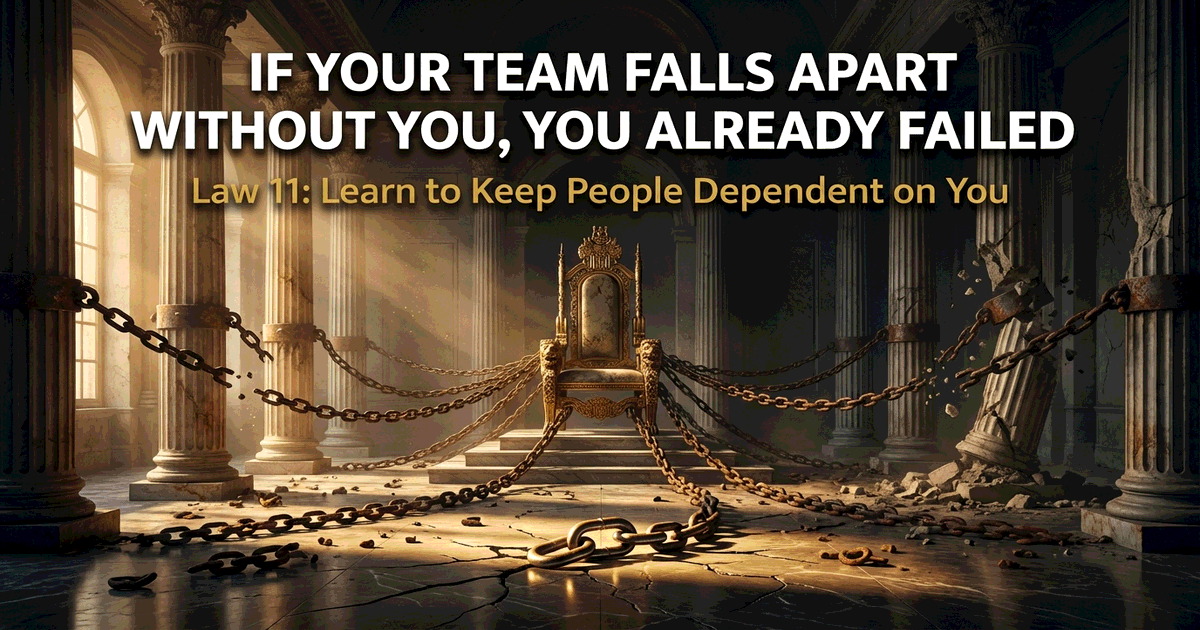
If Your Team Falls Apart Without You, You Already Failed
By Derek Neighbors on March 30, 2026
Power vs. Virtue: The 48 Laws Examined
A year-long examination of Robert Greene's 48 Laws of Power through the lens of ancient virtue ethics. Some laws we affirm, some we reframe, some we reject entirely.
Law 11 of Robert Greene’s The 48 Laws of Power:
To maintain your independence you must always be needed and wanted. The more you are relied on, the more freedom you have. Make people depend on you for their happiness and prosperity and you have nothing to fear. Never teach them enough so that they can do without you.
Greene wants you to become the only source of something essential, then restrict supply. Hold the knowledge and control the access. Keep people tethered to you by ensuring they can’t function on their own. This is the law where Greene stops talking about power dynamics and starts recommending organizational hostage-taking.
The Tactical Truth
Greene sees something real about leverage. People who can be easily replaced often are. In organizations, the person who holds critical knowledge, owns key relationships, or understands systems nobody else can navigate has genuine protection. The “bus factor,” that dark joke about what happens if someone gets hit by a bus, reveals an uncomfortable truth. If only one person understands something critical, that person has power.
The tactical version works. Hoarding information creates leverage. So does being the only point of contact for a major client, or keeping processes opaque and undocumented. Plenty of people have survived layoffs, negotiated raises, and maintained influence through manufactured indispensability.
I’ve seen this play out firsthand. A director who spent three years becoming the only person who understood a critical integration. He held the vendor relationships, kept the documentation sparse, attended every call personally. When layoffs hit, he survived. When reorganizations happened, his role was untouchable. By Greene’s metric, a perfect execution of Law 11.
Then a VP role opened. He was the obvious candidate. Except they couldn’t promote him. Nobody could backfill his position because he’d spent three years making sure of exactly that. The person who got the VP job had spent those same years building three people who could each run her department without her. She was promotable because she was replaceable. He was stuck because he was essential.
Greene makes a common error here. He confuses job security with leadership. Leverage with strength. The ability to hold an organization hostage with the ability to build one. These are different things operating on completely different timelines.
The Character Cost
The first thing that breaks is your mobility. You engineered yourself into a position nobody else can fill, and now you can’t leave it. A promotion opens up. You’re the obvious candidate. Except they can’t move you because the function you control would collapse. You wanted to be irreplaceable, and you got your wish. Now you’re permanently assigned to the role you outgrew two years ago. The dependency you built for protection became the wall that blocks your advancement.
The second cost lands on the people around you. When you hoard knowledge and control access, the team stops developing. People can’t build skills they’re never allowed to practice. They can’t develop judgment if every decision routes through your desk. You’ve created learned helplessness at an organizational scale, and over time, the gap between what your team could become and what they actually are widens into something irreversible. The dynamis of everyone around you, their latent capability, gets suppressed because your power depends on keeping it dormant.
Third: resentment. People aren’t grateful for their dependency. They’re aware of it. They feel controlled, not supported. They notice when you answer questions with enough information to complete the task but not enough to understand the system. They see the difference between mentoring and rationing. They talk about it with each other. A quiet consensus forms long before anyone acts on it. When they finally get the chance to leave or work around you, they will, and they’ll do it without warning because they learned early that transparency with you is a losing strategy.
The final cost is fragility. A structure built on one person’s presence has no resilience. You get sick for two weeks and projects stall. You take vacation and decisions queue up until your return. You leave for a new opportunity and the organization enters crisis. The organization didn’t miss you because you mattered. It stalled because you designed it to stall. You built something that can’t survive contact with the most ordinary events: illness, travel, departure. Real leaders create systems that produce leaders, not systems that produce dependents.
The ARETE Alternative
The Greeks had a concept for what Greene’s law corrupts: autarkeia, self-sufficiency. The Stoics considered it foundational. A genuinely excellent person develops the capacity to stand on their own. Applied to leadership, the principle inverts Greene’s entire framework. Leadership under this principle means building people who don’t need you.
This sounds like career suicide to anyone raised on “make yourself indispensable” advice. It’s the opposite. Leaders who make themselves replaceable in their current role become the most valued people in any organization. Because the ability to build self-sustaining teams is far rarer and far more valuable than the ability to hoard knowledge. Companies have thousands of people who can hold information. They have very few who can systematically develop capability in others.
The measure of your leadership is what happens when you leave the room. If everything continues or accelerates, you’ve built something real. If it stalls or collapses, you built a monument to yourself that nobody else can maintain.
I’ve watched both versions play out across decades of working with organizations. The leader who hoards gets short-term security and long-term isolation. The leader who builds capability gets something better: a track record of organizations that work. That track record follows you everywhere. It becomes the reputation you never have to manufacture because it precedes you into every room.
Teach people what you know. Share the relationships and document the processes. Every piece of knowledge you transfer is an investment in organizational strength and your own freedom. The best leaders aren’t appointed. They’re developed, and development requires that someone stopped hoarding and started teaching.
Ancient Wisdom Connection
Aristotle’s view of education was that the teacher’s purpose is to make the student independent of the teacher. A student who permanently needs the instructor has not been educated. They’ve been captured. The relationship has failed its essential function, which is to produce capability that stands on its own.
dynamis in Aristotle’s framework means potential, the latent capability within a person or system. Creating dependency suppresses dynamis everywhere it touches. You’re not accumulating power. You’re capping the potential of everyone around you so that your own contribution appears larger by comparison. You’re manufacturing the appearance of strength by weakening everyone within reach.
The contrast with Greene is total. Greene sees people as resources to control. The Greeks saw people as capacities to develop. One creates extraction. The other creates abundance. Extraction depletes over time because every person who develops enough capability to leave will leave. Abundance compounds because every person you develop becomes someone who develops others.
Marcus Aurelius governed an empire and spent his private reflections, his Meditations, examining how to develop the people around him rather than how to keep them dependent. He understood that an emperor who needs to be needed is an emperor who will eventually be overthrown by the resentment he cultivated.
The Test
Four questions worth sitting with:
- If you disappeared for a month, would your team function or freeze?
- Is critical knowledge documented and shared, or stored exclusively in your head?
- When was the last time you deliberately trained someone to do something only you currently do?
- Do people come to you because you’re genuinely helpful, or because you’ve made yourself the only option?
The honest answers reveal whether you’ve built organizational strength or manufactured fragility dressed as importance.
Final Thoughts
Greene says make people dependent on you. The Greeks say build people who stand without you. Dependency requires constant maintenance, and it turns the people you need most into the people who resent you most. It’s the weakest form of power because it only survives as long as nobody finds an alternative, and they always find an alternative.
The leader whose team collapses without them didn’t build a strong team. They built a reflection of their own insecurity, an organization shaped around the need to be needed rather than the drive to be excellent. And eventually, the people who depend on them will find another option. They always do. The only question is how much damage accumulates before that happens.
autarkeia applied to leadership means measuring your success by what thrives in your absence. Build that, and you’ll never worry about being replaced. Because the person who builds self-sustaining teams is the person every organization is looking for.
Ready to build the kind of leadership that creates capability instead of dependency? MasteryLab provides frameworks and community for leaders who measure their impact by what survives their absence.