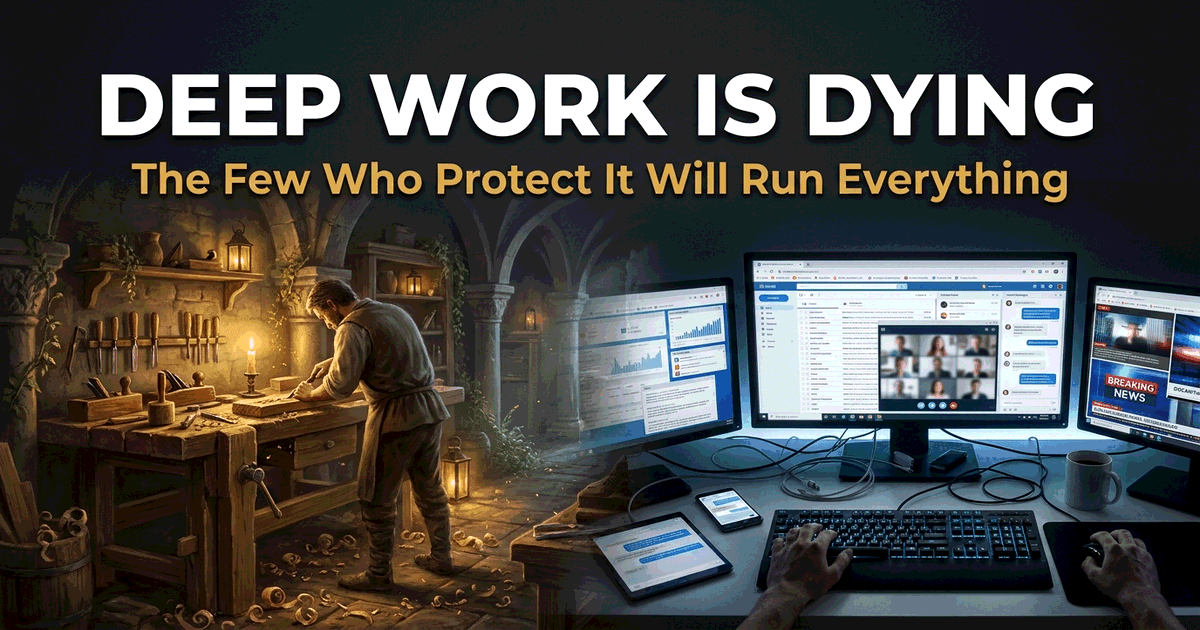
Deep Work Is Dying. The Few Who Protect It Will Run Everything.
By Derek Neighbors on April 24, 2026
You sit down to do the kind of work that actually matters. Deep work. Genuine, substantive thinking that produces something you can point to afterward and say: that was worth the time.
Three minutes pass. A notification slides in from the edge of your screen. You glance at it. Not because it’s urgent, but because your nervous system has been trained to respond to any stimulus faster than your conscious mind can override it.
You return to the problem. Where were you? Right. The thing. The important thing. You re-read your last sentence. You start to build the thread back. Another notification. A colleague pings you on Slack. “Quick question.” You answer. Twenty seconds. No big deal.
But the thread is gone. Not the topic. The depth. The place in your thinking where connections start forming between ideas that don’t obviously belong together. That space is where original work lives, and you lost access to it for the third time in ten minutes.
This is an extinction event.
When Depth Was the Default
The ancient Greek word for the kind of mastery that only sustained engagement produces is techne.
We translate it as “craft” or “skill” or “art,” but those translations miss what made technē distinctive. Technē wasn’t knowing how to do something. It was the integrated understanding that emerges only after you’ve done the same thing so many times that your hands know what your mind hasn’t yet articulated.
A shipwright in ancient Athens didn’t build boats by following instructions. He built them through years of apprenticeship where his understanding of wood grain, water resistance, and structural integrity fused into a single capacity that looked, from the outside, like intuition. It wasn’t intuition. It was technē: knowledge so deeply practiced it no longer required conscious effort.
The Greeks distinguished this from empeiria, mere experience. Empeiria is what you accumulate by being present while things happen. Technē is what you develop by being engaged while things happen. The difference is attention. Sustained, unbroken attention applied to a single domain long enough for genuine understanding to crystallize.
For most of human history, this kind of attention was unremarkable. It was the default. A potter at the wheel had no incoming messages. A stonemason cutting marble faced no notifications. The conditions for depth existed automatically because the infrastructure for distraction didn’t exist yet.
Concentration wasn’t a skill you developed. It was the ambient condition of doing anything at all. That changed the moment alternatives arrived. In a world full of competing stimuli, sustaining attention became something you had to fight for. What was once a default became a discipline.
How We Killed Depth
The erosion happened in stages.
The Industrial Revolution was the first blow. It took the craftsman’s integrated work and fragmented it into specialized, interchangeable tasks. The person who once saw a project from raw material to finished product now handled one step in a sequence. Depth became optional because the system no longer required any individual to understand the whole.
Open-plan offices were the second blow. Designed to increase collaboration, they instead created environments where the average knowledge worker is interrupted every six minutes. Research from the University of California, Irvine found that it takes an average of twenty-three minutes to fully recover focus after an interruption. Do the math. In a standard open-plan day, you never fully recover focus at all.
The attention economy was the third and most devastating blow. Every application on your phone, every platform you use, every feed you scroll was designed by teams of engineers whose explicit goal was to capture and hold your attention. Not to help you focus. To prevent you from focusing on anything else.
This created something cognitive scientists call attention residue. When you switch from one task to another, your brain doesn’t switch cleanly. Fragments of the previous task linger, consuming processing capacity you need for the current one. The more frequently you switch, the more residue accumulates. By mid-afternoon, most knowledge workers are operating with so much cognitive residue they’re functionally unable to do the deep thinking their job descriptions claim to require.
The result: we’ve built an entire professional culture around shallow work. Responding to email. Attending meetings. Participating in chat channels. Performing visibility. Productive-looking activity that produces almost nothing of lasting value.
And we’ve done it so thoroughly that the alternative, sitting alone with one problem for two uninterrupted hours, now feels abnormal. Uncomfortable. Almost suspicious. What are you doing in there? Why aren’t you responding?
None of this excuses anyone. These forces explain why depth is harder now. They do not make depth impossible. Epictetus developed directed attention as a slave. He had no environment to optimize, no calendar to protect, no phone to put in another room. He had his will. The external world sets the difficulty level. Your response to it is still yours.
The Renaissance
Here is where the asymmetry appears.
In a world where nearly everyone operates in perpetual shallow mode, the rare person who can sustain genuine depth produces disproportionate results. Not incrementally better. Categorically different. The gap between high performers and the rest is not talent. It’s focus.
The programmer who protects four hours of uninterrupted morning focus ships work that entire teams of context-switchers spend weeks debating. The strategist who thinks through a problem completely before speaking produces insights the reactive meeting-goer never reaches. The writer who sits with an idea until it yields its real structure, not the obvious first structure, creates work that outlasts the news cycle.
Conditions matter, but they’re not the whole story. The same person who produces mediocre output in a fragmented environment produces exceptional output when given the space to concentrate. And the person who chooses to create that space, who fights for it when the world offers none, is exercising the faculty that makes depth possible in the first place. The bottleneck was always attention, and attention is a choice before it’s a condition.
The Stoic philosopher Marcus Aurelius understood this. His daily practice centered on prosoche, directed attention, the discipline of choosing what deserves your focus and protecting that choice against every competing demand. prosoche looked nothing like modern mindfulness. Marcus treated it as combat: an active refusal to let the urgent consume the important.
Marcus governed an empire. He fought wars, managed a plague, adjudicated disputes that affected millions. And he still wrote the Meditations. Not because he had more time than you do. Because he understood that the quality of his attention determined the quality of his rule.
The ancient craft tradition operated on the same principle. A master craftsman didn’t produce excellent work because of superior tools or genetic advantage. He produced it because his environment and daily rhythm were organized around sustained engagement with the material. The workshop was designed for concentration. So was the apprenticeship system. The whole culture of craft valued depth over breadth.
That culture is available to you. The knowledge hasn’t been lost. The practice has.
Reclaiming Deep Work
Deep work and technē aren’t identical. Technē is domain-specific mastery built over years within a craft tradition. Deep work is sustained concentration applied to any cognitively demanding task. But they share the same prerequisite: unbroken attention long enough for genuine understanding to form. Technē is the ancestor. Deep work is the descendant. And rebuilding the descendant follows the same logic: start where you are, protect what you build, and design your conditions to support the practice.
The craftsman’s workshop placed every tool within reach and every distraction out of sight. Your workspace should do the same. Phone in another room. Notifications disabled. Browser tabs closed. If your environment makes distraction the path of least resistance, distraction wins most of the time. Not because you lack willpower. Because focus is something you train, not something you track, and training works better when the environment fights alongside you instead of against you.
Then protect blocks, not minutes. A two-hour block of uninterrupted focus is not twice as valuable as two one-hour blocks with a meeting in between. It’s exponentially more valuable, because the connections that form in the second hour depend entirely on the unbroken continuity of the first. Treating focus time the way you treat a doctor’s appointment, as something that cannot be moved because a “quick sync” appeared, is the minimum viable respect for the work.
If you haven’t done sustained deep work in years, don’t start with four-hour blocks. Your attention capacity has atrophied the same way a muscle atrophies without use. Start with what you can actually sustain. Forty minutes. Maybe sixty. Increase by ten minutes per week. The capacity rebuilds through consistent practice. Technē takes time. So does the concentration technē requires.
The most important change, though, is how you see yourself. Stop thinking “knowledge worker” and start thinking “craftsperson.” A knowledge worker processes information. A craftsperson produces something of quality. That distinction shapes every decision you make about how to spend your hours. When you see your work as craft, shallow engagement stops being acceptable. Not because someone told you to focus, but because the work deserves better and you know it.
Final Thoughts
The original Renaissance didn’t happen because scholars suddenly got smarter. It happened because a critical mass of people returned to the disciplined depth that had produced civilization’s most significant achievements. They retrieved methods that had been abandoned, not because those methods stopped working, but because the surrounding culture had drifted toward easier, shallower alternatives.
The deep work renaissance operates on the same principle. The methods aren’t gone. The conditions aren’t impossible to recreate. And the reason to reclaim depth goes beyond professional results. Sustained attention is what rational beings owe themselves. It is the faculty that separates considered action from mere reaction, and a life lived deliberately from one lived on autopilot. The career advantages are real, but they’re incidental. You protect depth because it’s what your mind was built for.
The only question is whether you’ll do the work of protecting depth in a world that profits from your distraction.
The few who do will produce the work that sets the standard. Not because they’re smarter or more disciplined. Because they were willing to be present when the rest of the world settled for being busy.
Ready to build the craft discipline that turns sustained depth into professional advantage? MasteryLab.co helps you design the focused practice systems that separate masters from multitaskers.