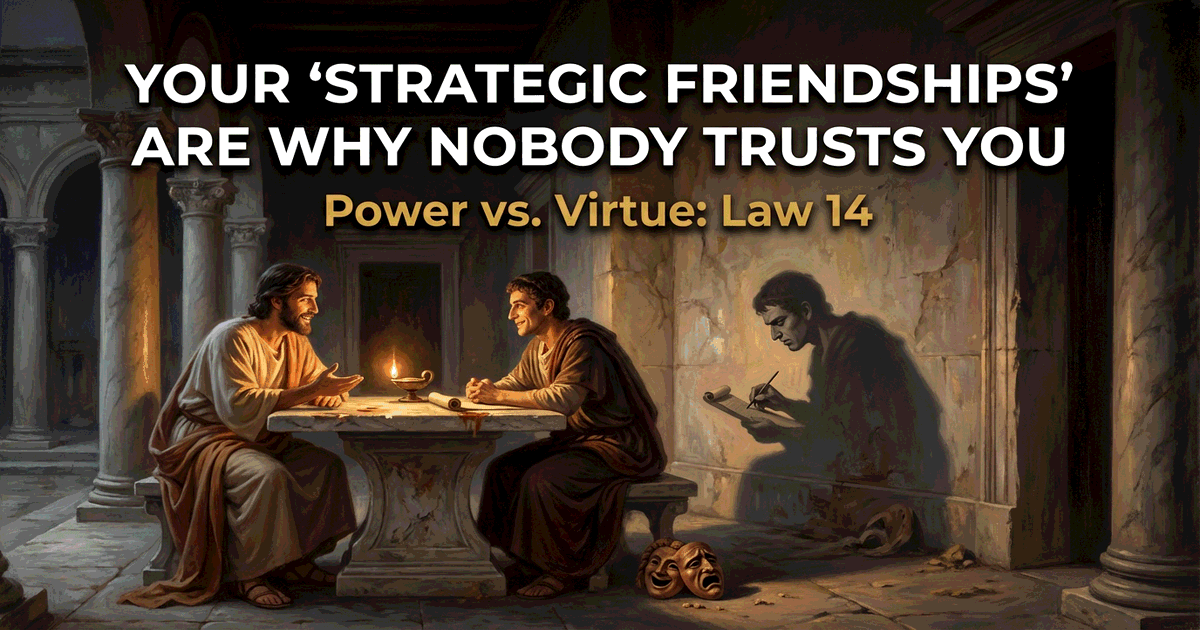
Your 'Strategic Friendships' Are Why Nobody Trusts You
By Derek Neighbors on April 17, 2026
Power vs. Virtue: The 48 Laws Examined
A year-long examination of Robert Greene's 48 Laws of Power through the lens of ancient virtue ethics. Some laws we affirm, some we reframe, some we reject entirely.
Law 14 of Robert Greene’s The 48 Laws of Power:
Knowing about your rival is critical. Use friendly fronts to gather information. Pose as a friend while you work as a spy. Every social encounter is a chance to probe and discover useful knowledge.
Greene’s logic is straightforward. Formal interrogation produces formal answers. But buy someone dinner, laugh at their stories, ask about their weekend, and they’ll hand you the playbook voluntarily. The corporate lunch reveals more than the quarterly report. The after-work drink produces better intelligence than any market research firm.
Greene wants you to treat every relationship as a listening post with a human face on it.
The Tactical Truth
This works because of how trust operates in the brain. Formal settings activate defensive processing. People rehearse what they say in meetings, interviews, and negotiations. Switch the context to personal, friendly, casual, and the rehearsal stops. The prefrontal cortex relaxes its editorial function.
Intelligence agencies have understood this for decades. The most productive espionage in history didn’t come from dead drops and coded messages. It came from asset recruitment: building genuine-seeming relationships with people who had access to secrets. The handler poses as a friend, someone who gets it. The asset talks because they feel connected to someone who understands them. The information flows because the relationship feels real even when it isn’t.
In business, this operates everywhere. The executive who socializes with competitors’ employees at industry events. The manager who befriends team members specifically to monitor their loyalty. The colleague who asks about your weekend to calibrate your stress level and identify vulnerability windows. The information advantage is real and measurable. People who know what others are thinking before they announce it operate with significant strategic clarity.
Acknowledge this plainly: the person with better information makes better decisions. And friendly, personal channels produce better information than formal ones. The law works. But whether something works tells you nothing about whether it’s worth doing. Steroids work too.
The Character Cost
The first cost is invisible because it happens inside you. When every conversation becomes a collection exercise, you lose the ability to simply be present with another person. A friend tells you they’re struggling at work. Your first processing cycle isn’t empathy. It’s assessment: what does this mean about the department’s stability, their availability, their decision-making under pressure. You’ve built a filter between yourself and every human interaction. The filter can be dismantled, but not easily, and not without recognizing it exists first. Most people who run this program don’t know it’s running. It operates at dinner with the people they actually care about the same way it operates at work.
The Greeks called this hypokrisis: playing a role on stage. The word that gave English the term “hypocrisy” started as theater vocabulary. An actor in ancient Greek drama wore a mask and performed emotions they didn’t feel for an audience that knew the difference between performance and reality. Law 14 turns your entire social life into theater, except the audience doesn’t know they’re watching a performance. And over time, neither does the performer. The mask fuses to the face. You forget what your actual expressions feel like.
The second cost lands on your capacity for real connection. philia in the Greek sense requires reciprocal vulnerability. You share something real. They share something real. Both of you risk something by being known. The spy can never complete this exchange because vulnerability would compromise the operation. So every relationship becomes one-directional: they expose, you collect. They risk, you catalog. The asymmetry is invisible at first. Over years, it hollows out your ability to form the kind of relationships that sustain a human life through difficulty, loss, and the moments where you need someone who actually knows you rather than someone who knows your strategic profile.
The third cost arrives quietly, and it’s the least important of the three, because it depends on detection. Some people never get caught. But most do. People sense it. Not immediately, not consciously, but the person who treats every interaction as data collection carries a specific frequency. The questions feel slightly too precise. The interest feels calibrated rather than curious. The warmth has form but no weight behind it. When people detect this frequency, even if they can’t name it, they respond the same way: they stop sharing anything real. Conversations stay on the surface. The spy’s cover holds, but the intelligence pipeline dries up because nobody in the room trusts them with information worth collecting.
You end up with a wide network and a shallow life. And the sequence matters: the strategy doesn’t fail and then damage your character. Your character erodes first, and then the strategy fails because there’s nothing left behind the performance worth connecting to.
The ARETE Alternative
The alternative is not naivete. It’s eunoia, the Greek concept of goodwill directed at others without strings attached. The person who practices eunoia asks questions because people are interesting, not because their vulnerabilities are useful. They listen to understand, not to catalog.
Genuine interest produces better intelligence than calculated friendship. People who feel actually seen and cared about share more honestly than people who sense they’re being managed. The person practicing eunoia learns things the spy never will because they’ve created conditions where honesty feels safe rather than risky.
And before the obvious objection: no, you can’t adopt genuine friendship because this article convinced you it’s more effective. Adopting “genuine” friendship because it converts better is still strategy, not care. eunoia either comes from actual care or it doesn’t come at all. You can’t fake your way into not faking.
I’ve watched this play out in organizations for years. The strategic networker knows everyone’s name and role and current project status. The real leader knows who’s struggling at home, who’s considering leaving, who has an idea they’re afraid to share because the last person they shared with used it without credit. Nobody walks into a strategic networker’s office and says “I think we’re about to lose our biggest client and here’s why.” They walk into the office of the person they trust. The first type collects facts. The second type earns truth. And truth is what makes decisions wise rather than merely informed.
The arete path isn’t about abandoning situational awareness. Reading a room is phronesis, practical wisdom applied to social situations. Every good leader does it. The line is deception: when you fabricate closeness to extract information you couldn’t get honestly, you’ve crossed from observation into espionage. It’s about building the kind of character that makes people want to share with you because they experience you as someone who will use what they learn in service of something larger than personal advantage. Your friends aren’t your weakness. Your inability to trust them is. The same principle works in reverse: your inability to be a real friend is what limits your influence to surfaces and transactions.
Ancient Wisdom Connection
Aristotle identified three types of friendship in the Nicomachean Ethics: friendships of utility, friendships of pleasure, and friendships of virtue. Friendships of utility exist for what each party extracts from the other. Friendships of pleasure exist for shared enjoyment. Friendships of virtue exist because each person recognizes and values the character of the other.
Law 14 converts every friendship into the first type while performing the second or third. You’re extracting utility while simulating virtue. Aristotle would identify the structural problem immediately: friendships of utility are the most fragile because they dissolve the moment the usefulness ends. The person who builds their entire network on utility while performing virtue has no foundation that survives a single honest test.
The Greeks also understood philia as requiring eunoia, goodwill directed at the other person for their own sake. For who they are, not for what they provide or the access they represent. This is structural engineering for human relationships, not sentimentality. Goodwill creates conditions where reciprocity emerges naturally rather than being manufactured through strategic performance.
Concealing your intentions creates exhaustion and isolation. Posing as a friend while working as a spy compounds both problems. The concealment is deeper because you’re hiding inside the most intimate form of human connection. The isolation is more complete because you’ve corrupted the one channel, genuine philia, that could repair it.
Marcus Aurelius maintained real relationships throughout his career despite leading an empire where paranoia would have been the rational response to constant threat. He chose trust because he understood something Greene does not: the person who treats everyone as a potential spy creates exactly the environment where actual betrayal becomes inevitable. Suspicion is self-fulfilling. Monitor everyone, and you teach them they are not trusted. People who know they aren’t trusted have no incentive to be trustworthy.
The Test
Four questions that reveal whether Law 14 has shaped you:
- In your last important conversation, was your first internal response connection or calculation?
- Do you have relationships where the other person knows more about your vulnerabilities than you know about theirs?
- When someone confides in you, is your first thought about them or about how what they’ve shared changes your position?
- Could the people closest to you describe your real struggles, fears, and uncertainties, or do they only know the version you’ve decided to present?
If you find more calculation than connection, the law has already shaped you whether you intended it to or not.
Final Thoughts
Greene says treat every social encounter as an intelligence opportunity. The Greeks say every social encounter is a character test. The spy collects information that expires. The person with actual character builds trust that compounds across decades. One approach produces tactical advantage measured in quarters. The other produces relationships that sustain careers, organizations, and lives through seasons that no amount of intelligence can navigate alone.
The deepest irony of Law 14 is that it fails on its own terms. The best intelligence comes from people who share willingly, and people share willingly with those they actually trust. Fake friendship produces thin information because the source never fully opens up. Real friendship, grounded in eunoia and mutual philia, produces the deep understanding that makes wise action possible.
But even if it didn’t, genuine friendship would still be worth choosing. Not because it produces better outcomes, but because of what it makes you. The spy who is never detected still lives as a spy. The person who practices eunoia without any strategic benefit still lives as someone capable of real connection. The question was never which approach works better. The question is what kind of person you become by practicing each one.
Pose as a friend and you’ll learn what people say. Be a friend and you’ll learn what they mean. The most dangerous liars tell the truth, and the most dangerous spies tell you they’re your friend. The pattern is the same: using something genuine as a delivery mechanism for something false. Both strategies work until they don’t, and they always stop working.
Ready to build leadership grounded in genuine trust rather than strategic performance? MasteryLab provides frameworks and community for leaders who understand that relationships built on character outlast those built on calculation.