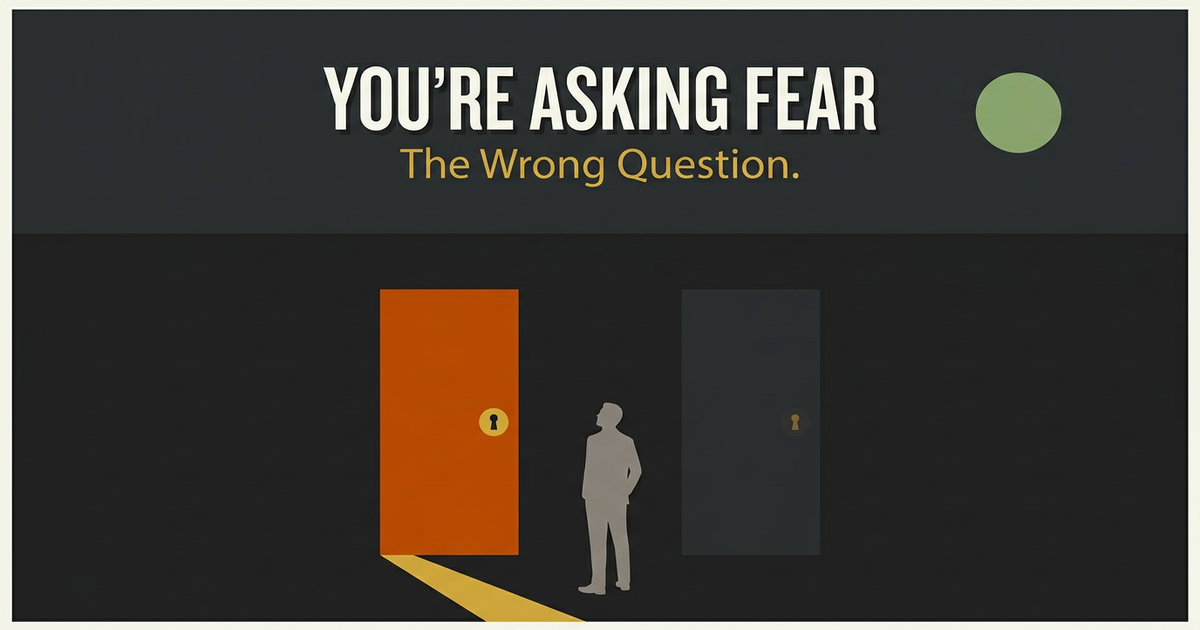
You're Asking Fear the Wrong Question.
By Derek Neighbors on May 31, 2026
There is a decision you have been circling for months. A project you have not started. A move you have not made. A conversation you have rehearsed twenty times and never had. A leaving you have been about to commit to since last spring.
Two voices are arguing in your head about it. You can hear them if you stop and listen.
The first voice is fear, and fear’s question is composed, articulate, and reasonable. Will this be worth what it costs? What if it does not work? What do I lose if I am wrong? The question sounds adult. The question sounds prudent. Every responsible person in your life would nod through the question and recognize themselves in it.
The second voice is quieter. The second voice is regret, and regret has exactly one question. What does my life look like in twenty years if I never attempt this?
Notice the asymmetry. Fear’s question gets answered every day, in numbers, with spreadsheets, with the polite agreement of everyone around you. Regret’s question almost never gets answered at the moment a decision is live. By the time it finally gets asked, typically at a deathbed or a divorce or a fortieth birthday alone in a hotel room, the answer is no longer a question. It is the inventory of an actual life, and the person doing the inventory is not the person who can change anything about it anymore.
This is not a self-help observation. The Stoic tradition built an entire decision discipline around the fact that human beings systematically ask the wrong question at the moment a choice is live. Epictetus had a precise name for the faculty where this gets decided. The Greeks called it the only domain that actually matters.
Why Fear’s Question Sounds Like Wisdom
Fear is not lying when it asks will it be worth it. The question feels grown. The question feels prudent. The question gets validated by every adult around you who has chosen the same caution.
There are three structural reasons fear’s question loads the answer toward inaction, and once you can name them, the question loses most of its authority.
The first is that the price of trying is concrete and the price of not trying is abstract. You can name what it costs to leave the job, take the call, write the book, end the relationship. You cannot name what it costs not to. Kahneman’s loss aversion finding is robust across forty years of replication: concrete losses get weighted roughly twice as heavily as equivalent abstract gains. Fear’s question loads concrete on one side of the comparison and abstract on the other. The math is rigged toward inaction before the deliberation even starts.
The second is that fear borrows the vocabulary of responsibility. I have a family. I have a mortgage. I have responsibilities. All true, none of them dispositive. None of these answer the question of what your family inherits when the parent at the table is the one who never attempted the thing he wanted, sat with a small low-grade resentment for forty years about the unattempted thing, and quietly passed the resentment down to children who learned, by watching him, that the prudent move was the move adults are supposed to make.
There is a clean test for telling genuine duty from fear-in-the-clothes-of-duty. Imagine the fear is gone. The financial cushion is doubled. The social cost is zero. Now look at the duty. If it is still there, it is duty. If it evaporates the moment the fear evaporates, it was fear all along, doing its work in the costume of the responsible thing.
The third is that inaction is socially invisible. Failed attempts are visible and get cataloged. The cost of never attempting at all is private and unscored. The culture rewards the appearance of prudence and quietly forgets to count the cost of the life not lived. There is no LinkedIn post about the company you never started. There is no public obituary for the conversation you never had.
What is actually happening underneath the three reasons is something the Greeks already had a word for. akrasia, weakness of will, the condition in which a person acts against his own better judgment. The modern version has learned to perform deliberation while it does it. We have polished akrasia into something that looks, to other people and to ourselves, like adult reasoning.
What Regret Actually Asks
Bronnie Ware spent eight years working palliative care. She kept a log of what dying patients told her about their lives. The book The Top Five Regrets of the Dying turned the log into data.
The number-one regret, by a wide margin, was this: I wish I’d had the courage to live a life true to myself, not the life others expected of me.
Read the structure of that regret carefully. The dying are not regretting failed attempts. The dying are regretting unattempted attempts. The mistake their entire generation cannot stop confessing is the same mistake: at the moment a real choice was live, they asked fear’s question instead of regret’s, and the answer fear’s question produced turned out to be the wrong answer for the life they actually wanted to have lived.
This is not the only kind of regret a person can carry. Some attempts were errors and the people who made them know it. The lens that follows corrects for fear’s structural distortion in the moment a choice is live. It does not pretend that all attempts are equal or that no attempt has ever earned a regret. The corrective is asymmetric because the bias is asymmetric. Most ambitious people undercount the cost of not attempting and overcount the cost of attempting. Some, occasionally, do the opposite. The lens is for the first error, which is the common one.
The Greek tradition had a sharper word for what is missing from the lives the dying are auditing. eudaimonia is usually mistranslated as “happiness.” Aristotle’s definition is more demanding: energeia psyches kat’ areten, activity of the soul in accordance with virtue. The standard is not the verdict at the end. The standard is the character lived in this present moment, in accordance with what reason names as good. The deathbed audit is not the test. The deathbed audit is where the moments add up and become legible to the person who lived them.
The regret lens is eudaimonia used backward as a check on the present moment. It is a heuristic against fear’s distortion, not the standard of the good life. The standard is the action in accordance with virtue, right now, regardless of which passion is loudest. The lens helps a fear-bound chooser remember that. What does the verdict look like if I do not do this thing? Can I live with that verdict? If the answer is no, the decision is settled, no matter what fear’s accounting says.
Epictetus Interrupts Your Accounting
The Stoics knew the fear-question / regret-question asymmetry as well as Bronnie Ware did, and they had a more precise diagnosis. They located the entire problem inside a single faculty: prohairesis, the faculty of moral choice.
Epictetus’ claim, which still sounds radical twenty centuries later, was that there is exactly one domain in which vice and virtue actually develop, and it is the faculty of choice itself. Not the circumstance you are choosing about. Not the outcome the choice produces. The faculty itself, the move of choosing, is the only territory where character is formed.
Run the dialogue in your head. You bring Epictetus your accounting. The salary, the kids’ school, the mortgage, the market conditions, the safety. You ask him the question you have been asking yourself for six months. Will it be worth it? He does not answer. He notes, calmly, that the question you have asked is not a question about your prohairesis. It is a question about externals. The externals are not where character lives. You can spend the rest of your life optimizing externals and arrive at the end of it with a perfectly preserved set of circumstances and a faculty of choice that has been used exactly zero times for its actual purpose.
What he would put in your hand instead is the only question that touches the faculty itself: Will the move I am about to make build or weaken the part of me that chooses? The question is not about whether the venture works. The question is whether the act of attempting is consistent with the character you are trying to become. Most “responsible” inaction fails that test the moment the test is applied to it.
The other half of the test, the half the Stoics never separated from the first, is whether the attempt is toward what is actually noble. The Greeks called the noble to kalon. An attempt at something foolish, unjust, or vicious is not andreia. It is thrasos, rashness, the failure that looks like courage from the outside and is its opposite from the inside. The regret lens does not valorize every venture. It corrects fear’s distortion at the moment a choice is live between a noble attempt and a fear-shrunken refusal. The discrimination is part of the doctrine, not an afterthought to it.
Courage in the Greek frame was never the feeling of fearlessness. It was the trained capacity to act in accordance with phronesis, practical wisdom, when the body and the social field were both voting against it. andreia is the muscle that gets exercised in the act of choosing in accordance with the noble. It is also the muscle that atrophies in the act of postponing such a choice.
Three Trainings for the Working Regret Lens
The reframe is simple to state and difficult to practice. Three trainings, run patiently, eventually move the asymmetry.
The first training is the twenty-year imaginative test, written down on paper. When a real choice is live, write two paragraphs, each one page maximum. Paragraph one: the life you are living in twenty years if you take this action and it goes badly. Paragraph two: the life you are living in twenty years if you do not take the action at all. Most people only ever write paragraph one. Fear loads that paragraph with vivid loss. Writing paragraph two forces the comparison fear refuses to make. Often, for the ambitious person who has been hesitating for months on a real and noble choice, paragraph two is the worse outcome and the writer knew it before he started writing. Not always. Sometimes paragraph one is the worse outcome and the hesitation was wisdom. The point of the exercise is the comparison, not the conclusion. The conclusion is yours.
The second training is to convert the question at the moment you catch yourself asking. Notice the next time you hear yourself ask will it be worth what it costs? Stop. Substitute the regret question. What does my life look like in twenty years if I never attempt this? Sit with the answer for ninety seconds. Most “responsible” hesitations dissolve inside ninety seconds. The substitution has to be trained until fear’s question stops feeling like the natural one to ask.
The third training is to practice memento mori on a calendar, not as a philosophy poster. Once a week, write down three decisions you are actively avoiding and assess each one against the regret question with a clear-eyed assumption that your remaining time is finite and not refundable. The Stoics held the contemplation of death up close not as morbid theater but as the cleanest available test of which present action actually matters. Memento mori is regret’s question delivered by the deadline. kairos, the opportune moment, has a closing window. The calendar is the place where the window gets respected instead of pretended away.
Final Thoughts
The trick fear runs on almost every ambitious person works because fear’s question is well-formed, articulate, and culturally rewarded. It just is not the question whose answer touches the part of you that is being formed by the choice.
Regret asks the question fear refuses to ask. The Stoics built their entire decision discipline around training a person to answer regret’s question first and let fear’s question be a footnote. Twenty centuries later, palliative care nurses are filing the same finding from one of the settings in which a life becomes legible to the person who lived it. The deathbed audit is not the philosophical standard. The standard is the action in accordance with virtue in the present moment. The audit is the place where the present moments add up and the chooser can no longer pretend he did not choose them.
The faculty of prohairesis is the only territory your character actually lives in. Use it for its purpose. Ask the right question at the moment a choice is live, not at the moment the choice has already been closed.
The lens is for the moment a choice is actually live. For the man in prison, the woman holding the hand of a dying parent, the worker whose options have already closed, the prohairesis doctrine still applies and the faculty is still the only territory. The practice is different. The practice is the discipline of accepting what cannot be changed and choosing the character with which to bear it. The regret lens is one application of the doctrine, not the doctrine itself. The doctrine applies always.
And do not assume the attempt has to be visible to count. The attempt most often unmade is not the entrepreneur’s leap. It is the inward one. The turn toward the practice that would actually form the character. The contemplative work that has no audience and pays no return. The regret lens reaches there too. Maybe especially there.
One last honest acknowledgment. The lens uses one passion to override another. Fear and regret-aversion are both pathē in the Stoic frame. The lens is training wheels. The trained soul does not need it because the trained soul already acts from virtue regardless of which passion is loudest. The lens is for the rest of us, who still answer to passions and need the louder one to be the one that points us toward the noble action rather than away from it.
The decision you have been circling has been waiting on the wrong question. Ask the other one.
The work of training your faculty of choice is the slow daily formation MasteryLab.co was built for. Excellence is the byproduct of asking the right questions at the right moments, repeatedly, for the rest of your life.