Eunoia (εὔνοια): Meaning, Definition & Modern Application
yoo-NOY-ah
Goodwill, benevolence, and well-mindedness toward others. A genuine disposition of favorable regard that forms the foundation of trust and effective community. Aristotle considered eunoia a prerequisite for genuine friendship.
Etymology
From eu (good, well) and nous (mind), literally “good mind” or “well-mindedness.” The term describes a favorable disposition toward another person’s good, not mere pleasant feeling. Aristotle used eunoia to name goodwill that can precede friendship, persuasion, and trust because the other person senses that your mind is oriented toward their flourishing rather than your advantage.
Deep Analysis
Aristotle’s Rhetoric identifies eunoia as one of three essential components of the speaker’s credibility, alongside phronesis (practical wisdom) and arete (virtue). Without eunoia, even a wise and virtuous speaker will fail to persuade because the audience senses that the speaker does not have their interests at heart. This tripartite analysis reveals eunoia as the relational foundation on which all influence rests. You can possess extraordinary competence and moral character, but if people do not believe you genuinely wish them well, your competence and character will not translate into trust.
In the Nicomachean Ethics, Aristotle distinguishes eunoia from philia (deep friendship) while identifying it as philia’s starting point. Eunoia is the initial goodwill that one person extends to another, the favorable disposition that precedes and enables deeper connection. Philia requires time, reciprocity, and shared experience. Eunoia can arise quickly, even toward strangers, when something in their character or situation generates a spontaneous well-wishing. You can have eunoia toward someone you have never met. You cannot have philia with them. Eunoia is the seed. Philia is the mature plant.
The distinction between eunoia and people-pleasing is critical for understanding the concept correctly. People-pleasing is the avoidance of conflict in order to maintain a comfortable relational surface. It often involves withholding difficult truths, agreeing when you disagree, and prioritizing the other person’s immediate comfort over their genuine wellbeing. Eunoia operates on a different principle entirely. Genuine goodwill may require you to say things the other person does not want to hear, to challenge their assumptions, to refuse their requests when those requests do not serve their growth. The parent who enforces boundaries despite a child’s protests is practicing eunoia more genuinely than the parent who capitulates to avoid tears.
The vulnerability dimension of eunoia deserves emphasis. Extending genuine goodwill means wanting the best for someone even when it costs you. The mentor who spends hours developing a team member, knowing that the development will lead to that person leaving for a better opportunity, is practicing eunoia at personal cost. The leader who advocates for a subordinate’s promotion even though losing that person will make the leader’s own job harder is exercising goodwill that requires genuine sacrifice. Eunoia without the willingness to absorb cost on behalf of the other person’s wellbeing is not eunoia. It is conditional good behavior that will reverse the moment it becomes expensive.
Charis (grace, reciprocal generosity) and eunoia form a complementary pair: eunoia is the internal disposition of goodwill, and charis is its external expression through generous action. The leader with eunoia wants good things for their team. The leader who adds charis to eunoia demonstrates that goodwill through tangible acts of generosity, investment, and support. Without eunoia, acts of charis feel manipulative, like strategic generosity designed to produce obligation. Without charis, eunoia remains internal and invisible, a private sentiment that never reaches the people it is directed toward.
The organizational implications of eunoia are significant. Teams led by people who genuinely wish well for their members behave differently from teams led by people who view members as resources. The difference is visible in how difficult conversations happen, how mistakes are handled, how development opportunities are distributed, and how departures are managed. In a team governed by eunoia, honest feedback is experienced as care rather than attack. Mistakes are treated as learning opportunities rather than ammunition. Development resources go to those who need them rather than those who are politically connected. Departures are supported rather than punished. These differences compound over time into fundamentally different organizational cultures.
Koinonia (communal fellowship) depends on eunoia as its binding force. A community where members genuinely wish each other well creates the conditions for the kind of mutual investment and accountability that produces collective flourishing. A community where members are primarily self-interested may maintain the appearance of fellowship while operating as a collection of individuals pursuing separate agendas. The quality of the community’s koinonia is directly proportional to the genuine eunoia its members practice toward each other.
Modern Application
Build goodwill through demonstrated character over time rather than trying to manufacture it through incentive alignment. The leader who has cultivated genuine eunoia within a team doesn't need to calculate what's in it for each person when asking for help. The trust already exists as a foundation.
Historical Examples
Aristotle’s own relationship with his student Alexander the Great illustrates both the potential and the limits of eunoia. Aristotle served as Alexander’s tutor from approximately 343 to 335 BCE, investing years in developing the young prince’s intellectual and moral capabilities. The eunoia was genuine: Aristotle reportedly designed a curriculum tailored to Alexander’s capacities and character, including philosophy, medicine, and literature. As Alexander grew into a conqueror whose ambitions exceeded any Aristotelian concept of the virtuous life, the relationship strained. Aristotle’s goodwill toward Alexander was real, but the limits of eunoia in the face of the other person’s autonomy became clear. You can wish someone well and invest in their development. You cannot control what they do with what you gave them.
The Quaker tradition of “holding someone in the Light” represents a formalized practice of eunoia that has sustained communities for over three centuries. In Quaker meetings, members hold others in compassionate attention, wishing them well without attempting to fix, advise, or control them. This practice of sustained goodwill, divorced from any expectation of reciprocity or outcome, has produced communities notable for their resilience, mutual support, and capacity to navigate disagreement without fracture.
Nelson Mandela’s conduct toward his former jailers after his release from prison in 1990 demonstrated eunoia at a civilizational scale. Rather than pursuing retribution, Mandela extended genuine goodwill toward the people who had imprisoned him for twenty-seven years. He invited his former jailer to his inauguration. He established the Truth and Reconciliation Commission as an institutional expression of the principle that genuine goodwill, even toward those who have harmed you, creates the conditions for collective healing that vengeance cannot produce.
How to Practice Eunoia
Pick one person whose flourishing matters to your work or life and ask what would genuinely serve them, even if it creates no advantage for you. Take one concrete action that demonstrates goodwill: honest feedback, a useful introduction, advocacy, protection, or restraint. Notice where self-interest tries to redirect the act toward your own credit. In conflict, begin by naming what good you still want for the other person before deciding what boundary or truth the situation requires.
Application Examples
A manager learns that her best performer has been interviewing at other companies. Her instinct is to feel betrayed and begin planning for the departure defensively. Instead, she has a conversation: ‘I understand you are exploring other options. What would make this the place you want to stay? And if this is not the right place for you, how can I help you find the right one?’ The conversation leads to a candid discussion that results in either a restructured role or a supported departure.
Eunoia toward employees means wanting the best for them even when the best for them is not the best for you. The manager who helps a departing employee find their next role builds more organizational goodwill than the one who retaliates against disloyalty.
A friend shares exciting plans to leave a stable career and start a business based on an idea that has several obvious flaws. Eunoia does not mean applauding the plan enthusiastically. It means asking careful questions, sharing honest concerns, and supporting the friend’s agency to make their own decision while ensuring they have considered the risks you see.
Genuine goodwill sometimes requires risking the relationship to serve the person. The friend who challenges your plans out of genuine concern is practicing eunoia more authentically than the friend who cheers you on to avoid discomfort.
A CEO must lay off fifteen percent of the workforce during an economic downturn. Eunoia does not mean avoiding the layoff. It means conducting it with genuine care: generous severance, honest communication about the reasons, active assistance with job placement, and continued access to company resources during the transition. The laid-off employees become advocates for the company rather than critics because they experienced goodwill during the worst moment of their professional lives.
Organizational eunoia is tested not during prosperity but during painful decisions. The way you treat people when you are taking something from them reveals whether your goodwill is genuine or conditional.
A senior professional mentors a younger colleague for two years. When the mentee receives a competing offer from a company that would advance their career significantly, the mentor encourages them to take it despite having invested substantial time in their development. The mentor’s eunoia is directed at the mentee’s flourishing, not at maximizing the return on the mentoring investment.
Eunoia in mentoring means prioritizing the mentee’s trajectory over your own investment. The mentor who holds people back to protect their own investment is practicing retention strategy, not goodwill.
Common Misconceptions
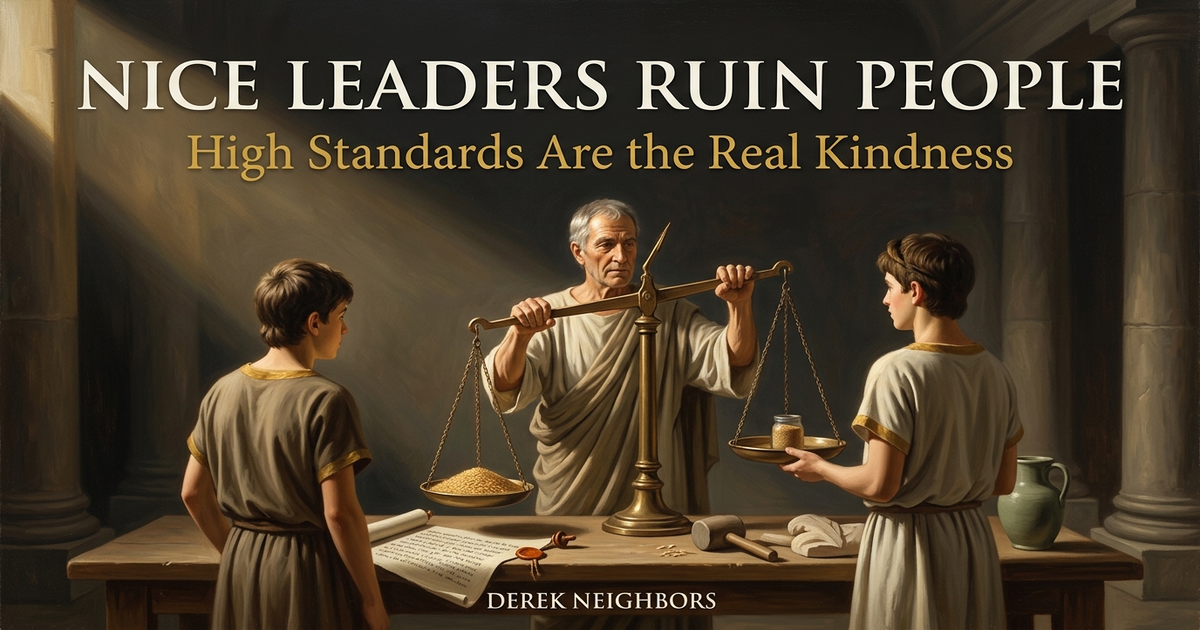
Niceness avoids interpersonal friction; eunoia pursues another person’s flourishing. Niceness is the avoidance of interpersonal friction. Eunoia is the genuine desire for another person’s flourishing, which may require direct confrontation, honest criticism, or the delivery of unwelcome truths. The nice person tells you what you want to hear. The person with eunoia tells you what you need to hear, but they do so because they want good things for you, not because they enjoy delivering criticism. A second error treats eunoia as a strategy for building influence. Genuine goodwill cannot be instrumentalized. The moment you practice it in order to gain trust, it becomes manipulation wearing the vocabulary of care. A third misconception assumes eunoia must be unconditional. You can maintain goodwill toward someone while establishing firm boundaries about their behavior. Wishing someone well does not require tolerating their mistreatment of you. It requires wanting the best for them, which may include the consequence that corrects harmful behavior.
I learned what eunoia means in practice from a leader who fired me. Not in the way firing usually works. She told me, during a candid conversation, that my skills were being wasted in the role I occupied, that the company could not offer me the growth I needed, and that she was going to help me find a position that matched my actual capabilities. She gave me three months, provided references, made introductions, and genuinely invested in my transition to a role that turned out to be far better for me.
At the time, I experienced it as loss. In retrospect, it was the purest act of professional goodwill I have ever received. She wanted what was best for me and had the courage to act on that desire even though it cost her a competent employee and created a hole in her team.
That experience set the standard for how I try to lead. When a team member is underperforming, my first question is not “how do I fix this performance problem?” but “what does this person actually need to flourish?” Sometimes the answer is coaching within their current role. Sometimes the answer is a different role. Sometimes the answer is a different organization. Eunoia means pursuing whichever answer is genuinely best for the person, not whichever answer is most convenient for me.
The hardest part of this practice is that it requires genuine emotional investment in people you may lose. If you hold people at arm’s length to protect yourself from the pain of their departure, you cannot practice eunoia toward them because your self-protection prevents the genuine well-wishing that eunoia requires. I have learned to invest fully in people’s development while accepting that the investment may benefit them in a context I never see. That acceptance is the cost of genuine goodwill.
Frequently Asked Questions
What does eunoia mean?
Eunoia means goodwill or well-mindedness toward another person. It combines eu, meaning good, with nous, meaning mind. The concept names a favorable disposition that genuinely wants another person's flourishing rather than merely wanting their cooperation.
How is eunoia different from niceness?
Niceness often avoids discomfort. Eunoia seeks the other person's good, which may require honest feedback, boundaries, or difficult truth. A person with eunoia can be warm, but the deeper mark is that their actions are oriented toward real flourishing, not surface comfort.
Why does eunoia matter for trust?
People trust competence and character more readily when they sense goodwill. Aristotle treated eunoia as part of persuasive credibility because listeners ask whether the speaker is for them or merely using them. Without goodwill, even good advice feels like control.