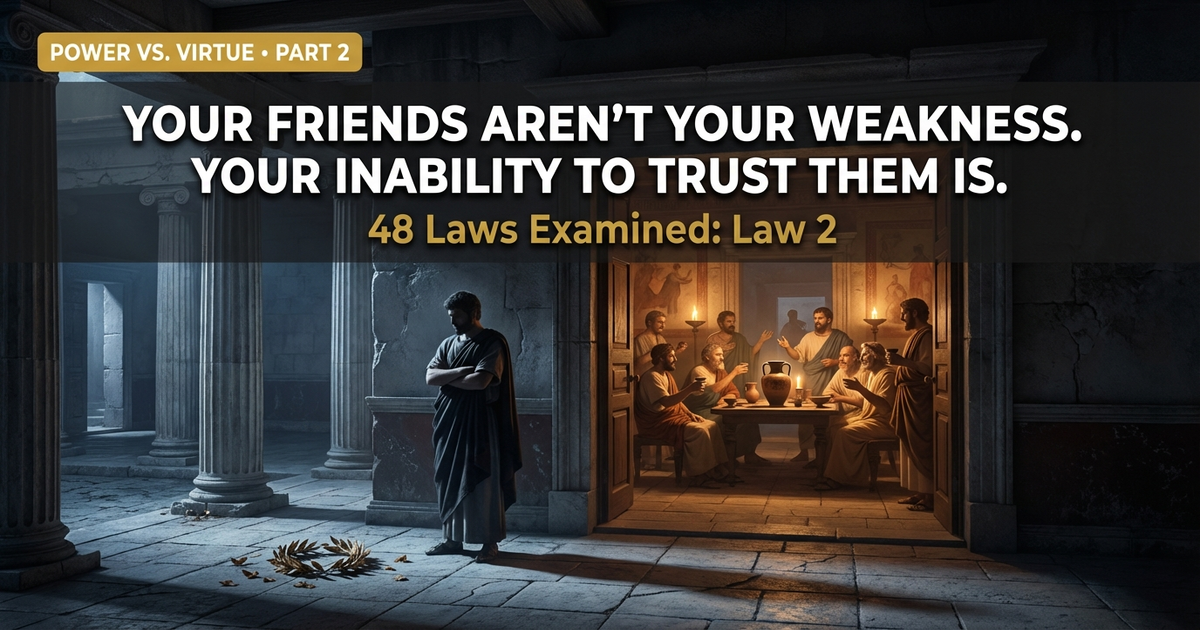
Your Friends Aren't Your Weakness. Your Inability to Trust Them Is.
By Derek Neighbors on January 26, 2026
Power vs. Virtue: The 48 Laws Examined
A year-long examination of Robert Greene's 48 Laws of Power through the lens of ancient virtue ethics. Some laws we affirm, some we reframe, some we reject entirely.
Robert Greene’s second law of power states:
Be wary of friends. They will betray you more quickly, for they are easily aroused to envy. They also become spoiled and tyrannical. But hire a former enemy and he will be more loyal than a friend, because he has more to prove.
The logic has a certain dark appeal. Friends expect favors. They grow complacent. They feel entitled to your success. Enemies, by contrast, must earn your trust. They work harder because they have something to prove.
Greene illustrates this with the story of Michael III, the Byzantine emperor who trusted his friend Basilius over qualified strangers. Basilius eventually murdered Michael and took the throne. The message: your friends will destroy you. Keep them at a distance. Use enemies instead.
It is slow suicide of the soul.
The Tactical Truth
Let’s be honest about what Greene gets right.
Friends can betray you. And when they do, it cuts deeper than any enemy’s attack. You didn’t see it coming. You let them inside your defenses. The violation of trust compounds the injury.
Familiarity can breed contempt. Some friends do take advantage. They expect access they haven’t earned, favors they don’t deserve, and consideration that flows only one direction. Long relationships can create entitlement, and entitlement can poison what was once genuine.
Greene claims former enemies sometimes work harder. They know they must prove themselves. They don’t assume your goodwill. There’s a certain clarity in relationships that begin with suspicion rather than assumption. But this is Greene’s assertion, not established truth. Just as often, former enemies carry resentment, wait for opportunities to settle old scores, or never develop genuine loyalty because the relationship was built on calculation from the start.
Many people have been burned badly by trusted friends. Business partnerships fail over entitlement issues. Confidences get shared with the wrong people. Opportunities get stolen by those who knew where to find them. But just as many have maintained deep trust throughout their lives and thrived precisely because of it. The question isn’t whether trust can hurt you. It’s whether the alternative is better.
If you’ve been betrayed by someone close, the temptation to conclude “never again” is understandable. But understandable is not the same as wise. The wound explains the fear. It doesn’t justify surrendering your capacity for connection. The law isn’t wrong that friendships can be sources of profound pain.
But acknowledging the danger doesn’t mean accepting Greene’s solution.
The Character Cost
Isolation destroys something essential in the human soul.
The Greeks had a word for deep friendship: philia. This wasn’t casual acquaintance or networking. It was the bond between people who recognized virtue in each other and were committed to each other’s flourishing. Aristotle considered philia essential for eudaimonia, genuine human flourishing. Not optional. Essential.
When you treat everyone as a potential threat, you guarantee loneliness. Not the temporary solitude that can be restorative, but the chronic isolation that corrodes character over time. Humans are not built to flourish alone. We need koinonia, community, to become who we’re meant to be.
The capacity to trust is like a muscle. Leave it unused, and it atrophies. Why? Because trust requires vulnerability, and the habit of self-protection becomes the default response. The more you practice guarding yourself, the harder vulnerability becomes to access. But here’s what matters: the capacity is always available. No amount of past betrayal removes your ability to choose trust today. The person who practices strategic distance eventually loses the ability to close that distance even when they want to. They become prisoners of their own protection strategy, not because circumstances took trust from them, but because they stopped choosing it.
Transactional relationships breed transactional people. When everyone is evaluated for usefulness, when every connection is measured by what can be extracted, you become incapable of genuine connection. Why? Because we become what we practice. Treating others as means trains you to see yourself as a means. You train yourself to see people as instruments. And you become an instrument yourself, valued only for what you provide.
There’s a self-fulfilling prophecy at work here. Treat friends like future enemies and watch them become exactly that. People sense when they’re not trusted. They respond accordingly. The paranoid leader creates the disloyal team that justified the paranoia.
And here’s the deepest cut: the person who can’t trust anyone reveals something about their own character. If you assume everyone will betray you given the chance, what does that say about what you would do given the chance? The inability to trust often masks an inability to be trusted.
The ARETE Alternative
The problem isn’t trusting friends. The problem is choosing friends without wisdom.
Aristotle distinguished between three types of friendship. Friendships of utility exist for mutual benefit. Friendships of pleasure exist for enjoyment. But friendships of virtue, what he called complete friendship, exist because both parties recognize and are committed to each other’s excellence. These are the friendships that matter. These are the friendships worth having.
The arete alternative isn’t strategic distance from everyone. It’s philia combined with phronesis, practical wisdom. Choose friends for character. Observe how they treat others. Watch what they do when no one is looking. Evaluate them by their actions over time, not their words in the moment.
Once you’ve chosen wisely, trust deeply. Not naively, not blindly, but completely. The vulnerability required for genuine connection is not weakness. It’s the price of admission to the kind of relationships that actually matter. And even if that trust is eventually betrayed, the capacity you developed, the openness you practiced, the person you became through risking connection, that remains yours.
pistis, the Greek concept of trust or faith, was understood as both a virtue to develop and a gift to give. You become trustworthy by practicing trust. You develop the capacity for deep relationship by risking deep relationship.
The solution to betrayal isn’t isolation. It’s better discernment. If your friends have betrayed you, the question isn’t whether to have friends. The question is whether you chose them wisely, and whether you’ll choose better next time.
Seneca, the great Stoic, valued friendship deeply despite knowing it risked pain. Marcus Aurelius maintained profound relationships while leading an empire full of people who wanted him dead. These men understood something Greene misses: the capacity for betrayal is the price of genuine connection. Refusing to pay that price doesn’t make you safe. It makes you alone.
Ancient Wisdom Connection
The Greeks understood that humans flourish in community, not isolation. Koinonia wasn’t just a nice idea. It was a recognition of human nature. We become who we are through relationship with others. We sharpen each other. We hold each other accountable. We see ourselves reflected in those who know us well.
Aristotle’s complete friendship, the friendship of virtue, requires mutual recognition of excellence and mutual commitment to each other’s growth. This isn’t the shallow connection of networking events or the transactional relationship of business partnerships. This is two people who see what’s best in each other and refuse to let each other settle for less.
This kind of friendship takes time to develop. It requires vulnerability. It demands that you let someone see you as you actually are, not as you present yourself to the world. And yes, it creates the possibility of deep betrayal.
But the alternative, treating every relationship as a chess match, is fear that learned some philosophy.
The Test
Ask yourself some honest questions.
Do you have trouble trusting because you’ve been betrayed, or because you’ve never developed the capacity for trust in the first place? These are different problems requiring different solutions. One is a wound to heal. The other is a muscle to build.
Are your closest friends chosen for character, or convenience? Did you select them through careful observation over time, or did they just happen to be nearby? Proximity is not a selection criterion for the kind of friends who matter.
Would your closest friends say you trust them completely, or do they feel you’re always holding something back? The people who know you best can tell whether you’ve actually let them in. What would they say?
And here’s the mirror test: Are you the kind of friend that someone should trust completely? Would you want someone to treat you the way you treat your friends? If you wouldn’t trust someone who acts like you, why should anyone else?
Final Thoughts
Greene’s second law isn’t entirely wrong. Friends can betray you. That betrayal hurts more than anything an enemy can do.
But the solution isn’t treating everyone like a future enemy. That path leads to isolation, and isolation destroys something essential in who you’re meant to become. The Greeks knew that philia was a requirement for human flourishing, not an optional risk to manage. The deepest value of developing trust isn’t successful relationships. It’s what the practice of trust does to your character, who you become by risking connection rather than hiding from it.
The person who can’t trust anyone reveals their own character more than anyone else’s. If you assume everyone will betray you, ask yourself why that assumption feels so natural.
The ARETE path is harder but leads somewhere worth going. Choose friends for character. Observe them over time. Hold them to high standards. And when you’ve chosen wisely, trust them with everything.
Your friends aren’t your weakness. Your inability to trust them is.
If you’re ready to build the kind of character that attracts complete friendships and the wisdom to recognize them, MasteryLab.co is where people committed to genuine excellence develop virtue in community.