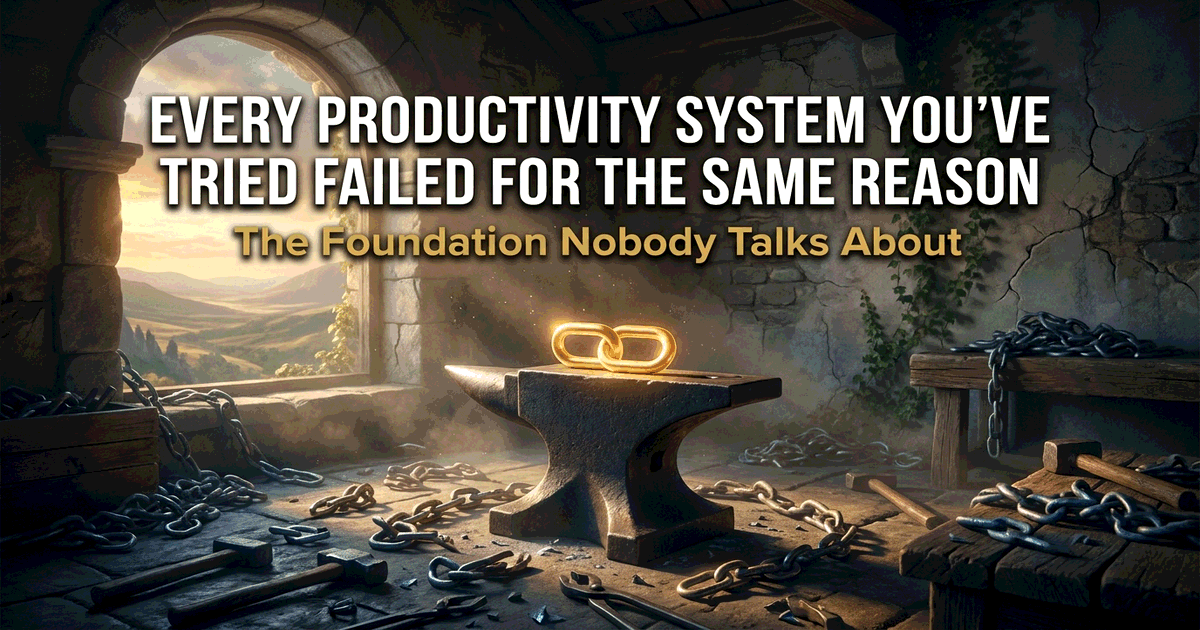
Every Productivity System You've Tried Failed for the Same Reason
By Derek Neighbors on April 19, 2026
I kept a list once of every productivity system I tried over three years. The count reached fourteen. Todoist. Notion. Bullet journals. Time-blocking. GTD. The Pomodoro Technique. A whiteboard. Sticky notes on my monitor. A plain text file. Each one worked for about two weeks. Then the same thing happened. Tasks piled up. The system became a graveyard of undone intentions. I blamed the tool and went looking for the next one.
The productivity industry makes roughly fifteen billion dollars a year selling you this cycle. New app. New framework. New planner with better layouts. The pitch is always the same: the problem is your current system. The solution is a better one.
The problem was never the system. And this isn’t about apps. A farmer who tells himself he’ll fix the fence tomorrow and doesn’t has the same problem as the executive with fourteen task managers. The principle predates software by a few thousand years.
The Surface Problem
Here is what most people believe about their chronic disorganization: they need more discipline, a better tool, or a personality transplant. Maybe they have ADHD. Maybe they’re lazy. Maybe they need to wake up earlier or batch their tasks or install one more browser extension.
None of that is wrong, exactly. But it’s all surface. It treats the symptom and ignores the disease.
Watch the pattern carefully. Someone downloads a new task manager. The first week is electric. They migrate all their tasks, color-code their categories, set up recurring reminders. By day ten, three tasks sit uncompleted. By day fourteen, eight more. By day twenty, the app sends push notifications into the void. The user feels the familiar shame and starts researching alternatives.
The tool changed. The collapse didn’t. Which means the tool was never the variable.
The System Underneath
The ancient Greeks had a word for what’s actually breaking: pistis. It means faithfulness, trust, reliability. But the Greeks understood something about pistis that the productivity industry has never grasped: it starts with yourself.
Every time you write “call the dentist” on a list and don’t call the dentist, something registers. Not as a forgotten task. As a broken promise. The distinction matters because a commitment you made and then abandoned carries the same weight whether the other party was your boss or yourself. A commitment is a commitment. And you broke it.
Do this enough times and a specific kind of erosion sets in. Not laziness. Not lack of discipline. Not low self-confidence, which is about believing you can do hard things. Not low self-esteem, which is about believing you deserve good things. Destroyed self-trust, which is simpler and more corrosive: the loss of belief that you will do what you said you would do.
This isn’t about tasks that got blocked by genuine emergencies or circumstances outside your control. Those aren’t broken promises. Those are life. This is about the tasks you could have done, chose not to do, and left sitting on a list as silent evidence against your own reliability.
After a hundred of those, your relationship with your own word changes. You write “finish the report by Thursday” and part of you already knows it won’t happen. Not because you can’t do it. Because you’ve accumulated overwhelming evidence that your plans don’t convert to action. Your own history testifies against you.
This is why the next system feels less real before you even start. This is why the enthusiasm dies faster each time. Every broken self-promise sends a message that your word doesn’t mean anything. And a person who doesn’t trust their own word can’t organize their life with any tool on earth.
The system underneath the surface problem is straightforward: broken self-trust makes every plan feel like fiction. You’re not disorganized. You’re operating with a bankrupt trust account.
The Leverage Points
If the problem is internal credibility, not external tooling, then the intervention points shift dramatically. Three leverage points matter more than any feature set or framework.
Shrink until you can keep it. The instinct when starting a new system is to capture everything. Write down all forty-seven things that need doing. This is the worst possible move. Forty-seven commitments is forty-seven opportunities to break your word. Instead, write three. Three things you will complete. Not want to complete. Not should complete. Will complete. If three feels like too many, write two. The number doesn’t matter. What matters is the kept promise.
Complete before you create. Most people add tasks faster than they finish them. This creates a growing deficit of unkept promises, and the deficit compounds. The discipline is refusing to add commitment number four until commitments one through three are done. Completion rebuilds the evidence that your word converts to action. Every finished item is a deposit in the trust account.
Track evidence, not intentions. A to-do list is a collection of intentions. A done list is a collection of evidence. The difference between the two determines whether you’re accumulating promises or accumulating proof. When you review your day, don’t look at what remains. Look at what you finished. You’re building a case for your own reliability, and cases are built on evidence, not aspirations.
The Intervention
Rebuilding self-trust requires treating yourself the way you’d treat someone whose trust you’d broken. Carefully. With small, deliberate demonstrations that your word is worth something again.
I call this the micro-promise protocol, though calling it a protocol makes it sound more sophisticated than it is.
The Greeks called this faculty of choice prohairesis, and they considered it the one domain entirely within your power. You can’t control whether the client responds. You can control whether you send the email. Start there.
Tonight, write down three things you will do tomorrow. Make them embarrassingly small. Not “reorganize the garage” but “move one box to the shelf.” Not “write the quarterly report” but “open the document and write the first paragraph.” The smallness is the point. You are not building productivity. You are rebuilding pistis. You are proving to yourself that when you say something will happen, it happens.
Do all three. No partial credit. No “I did two and a half.” Three commitments, three completions, zero exceptions.
Next week, if all three landed every day, write four. The week after, five. But the iron rule holds: never write more than you will finish. If you aren’t sure you’ll do six, stay at five. The number ceiling isn’t set by ambition. It’s set by honesty.
This feels backwards. Small feels pointless when the task list has two hundred items. But those two hundred items are precisely the problem. Two hundred unkept promises sitting in a database, each one whispering that your word is worthless. Three kept promises per day for a month is ninety demonstrations that you do what you say. Ninety pieces of evidence that your plans are real.
I know what the objection sounds like. “But I have real deadlines. I can’t ignore the other forty-four items.” You’re not ignoring them. You’re sequencing them behind a rebuilt foundation. The person who has proven, over thirty days, that they complete what they commit to will move through those forty-four items with a speed and reliability that the person frantically juggling all forty-seven never will. Willpower was never the answer. Building a structure that doesn’t require willpower is.
That evidence changes everything.
What Changes
When self-trust is restored, the predictable thing happens: every productivity system starts working. Notion works. A paper notebook works. A whiteboard works. A sticky note on the bathroom mirror works. The specific tool stops mattering because the person using it believes their own plans. The gap between intention and action narrows because the person writing the intention has a track record of following through.
I’ve watched this happen with people who spent years cycling through apps and methods. The moment they stopped adding and started finishing, something clicked. Not motivation. Not a better framework. Something quieter. They started planning with conviction instead of hope. And conviction, it turns out, is the only productivity hack that actually transfers across every tool and context.
The effects go further than getting your inbox under control. A person who trusts their own word makes decisions faster, because they know the decision will actually get executed. Commitment stops being performative. And the low-grade anxiety about everything you should be doing quiets down, because your relationship with planning has been rebuilt on evidence rather than hope.
Epictetus taught that the faculty of choice, prohairesis, is the only domain where virtue develops. You cannot control outcomes, other people, or circumstances. You can control whether you do what you said you would do. The micro-promise protocol is prohairesis in its simplest form: choosing, each day, to keep the commitments you made to yourself.
The paradox at the center of this is worth sitting with. Doing less rebuilds the capacity to do more. Shrinking your commitments expands what you’re actually capable of delivering. The person who commits to three tasks and completes three tasks is building something the person who commits to thirty and completes twelve never will: proof that their word is solid.
Final Thoughts
You don’t need a better productivity system. You need to rebuild trust with the person who uses it.
Every abandoned app, every collapsed planner, every half-migrated task list is a symptom of the same root cause. Somewhere along the way, you broke enough promises to yourself that your own plans stopped feeling real. The fix isn’t a new tool. The fix is becoming someone whose word, especially the word given to yourself in the quiet of your own planning, actually means something.
Start small. Start honest. And don’t write down a single thing you aren’t going to do.
If you’re ready to rebuild the foundation that discipline, organization, and real mastery all depend on, MasteryLab.co offers the framework and community for people who are done running from the real work.