You Don't Need More. You Need to Strip Your Life Down on Purpose.
By Derek Neighbors on May 28, 2026
A soldier six weeks into deployment owns what he can carry. He eats the same meal. He sleeps in the same boots. He has not chosen a shirt in a month and a half. He has not opened a menu in twice that. By every measure the consumer economy uses to score quality of life, his life is bad.
He will tell you, later, in language he does not quite have ready, that the sunrise landed different over there. The coffee landed different. A letter from home was a whole evening. He will say it carefully, because he knows how it sounds, and he is not romanticizing the violence, and he does not miss the war. He misses something he cannot name. Something to do with how present he was, how loud the small things got, how a stripped-down version of himself seemed to know what mattered without being told.
Then he came home. Five hundred channels, fifty restaurants inside a ten-block radius, the ability to order a new dishwasher at two in the morning. Friends asked him how it felt to be back. He answered the way returning soldiers always answer, the polite way, while a low-grade existential hum settled in behind the answer and refused, for years, to go.
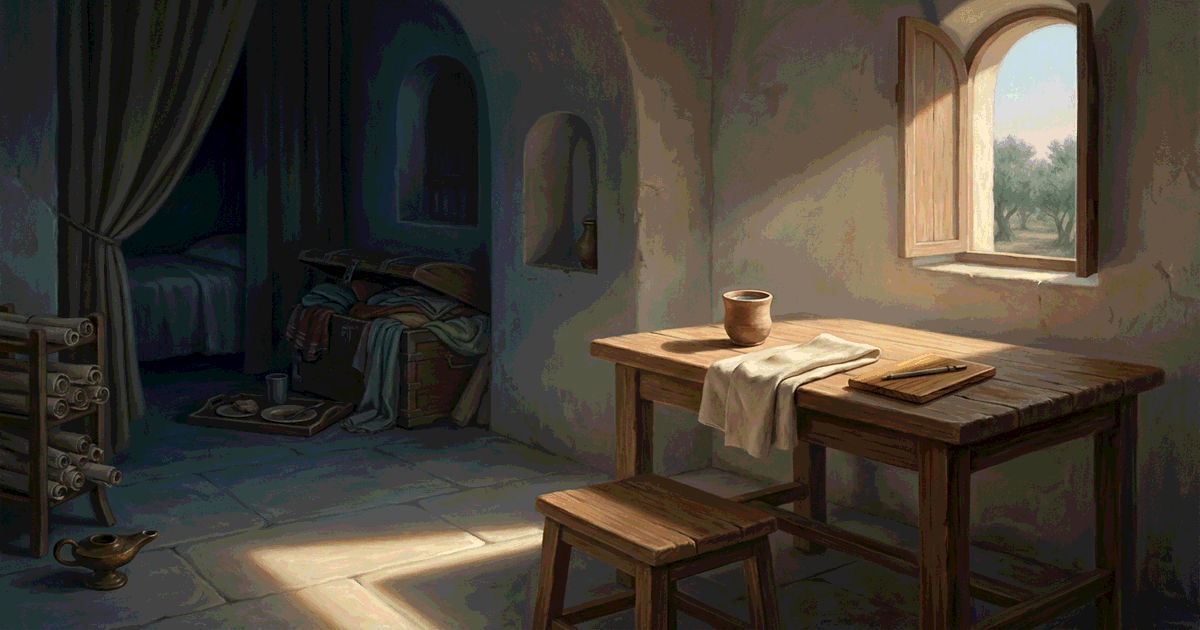
Most people read the combat as the lesson. The combat is not the lesson. The constraint is the lesson, and the constraint is the most teachable piece of what the soldier brought home, though it is not the only piece. He was not happier under fire. He was more present because he had less, and a stripped nervous system was forced to give weight back to small things. The soldier did not choose any of this. He had the discipline imposed on him by a situation he could not have refused, and the wisdom he came back with is, in the strictest sense, on loan from circumstance. The reader does not have the imposition available, and would not want it if it were. The reader has the harder and more honorable version of the same training, which is the chosen one. We have engineered constraint out of ordinary days, and we cannot understand why ordinary days no longer move us.
The Modern Condition Is an Overstocked Cellar
Look honestly at where the directionlessness is coming from. It is not a shortage of inputs. You have more inputs than any human being who ever lived. The dashboards, the feeds, the menus, the channels, the apps, the playlists, the friends, the prospects, the reading list, the watchlist, the wishlist, the cart. You are not informed-poor. You are options-rich, signal-poor, and tired in a way you cannot diagnose.
The reflexive response to this is always to add something. A new app to manage the other apps. A better protocol for the protocol stack. Another framework to organize the overflowing framework shelf. The instinct goes one direction. More curated, more efficient, more refined.
The instinct is wrong. The problem is not what is missing from your life. The problem is what is present in it. Every input you do not need is a small standing tax on the attention you have left to spend on the things that would have moved you. The Greeks had words for what you keep adding (pleonexia, the appetite that wants more of what cannot satisfy it) and words for the discipline that subtracts (askesis, anachoresis, autarkeia). The discipline was always going the other way.
The ancient world understood this and built deliberate practices around it. askesis was not the religious flagellation it later became. The word meant training, the same word a Greek competitor used for the daily preparation that produced an Olympic body. The Sabbath, before it was a brunch slot, was a weekly amputation: no commerce, no labor, no travel, no noise, sundown to sundown, because a person who could not be unplugged from the marketplace one day in seven was a person the marketplace owned the other six. The desert fathers walked into nothing on purpose. The Stoics rehearsed living on less, not because they were poor but because they refused to be afraid.
Modern self-help inverts every one of these. More reps, more inputs, more optimization stacked on the existing pile, sold by people whose income depends on you adding rather than removing. The ancients knew the leverage was the other direction. So did the soldier, when he had no choice. The discipline is to find that leverage on purpose, before circumstances impose it on you in a form you would not have chosen, the way comfort quietly kills more dreams than any of the failures people are actually afraid of.
Why Stripping Works When Adding Does Not
Three threads under the practice, all of them old.
The first is the simplest. Constraint forces meaning back into small things. When everything is available, nothing is occasion. When you can have a steak any night of the week, no night is a steak night, and the steak slowly stops being a steak and becomes another input to manage. The deprivation is what produces the event. A nervous system getting frictionless access to everything in unlimited quantities does not get more pleasure out of it. It gets less, then it gets none, then it gets restless, and then it starts looking for the next thing on the assumption that this round of inputs must be defective. The defect is not in the inputs. The defect is in the abundance, which has flattened the response curve.
The second thread is the discipline the soldier accidentally found. anachoresis, in classical Greek, meant withdrawal: a deliberate stepping back from the polis, the marketplace, the noise. Marcus Aurelius did it daily, on purpose, with an army to run and an empire on his desk. He called the place he retreated to inside himself “the most untroubled and most unburdened of retreats,” and he insisted no one is too busy for it because the trip takes no time, only the decision. The point of the withdrawal was not vacation. It was reducing the volume of the world enough to hear the signal underneath, and the next-best version of the same practice in the ancient world was the explicit training of doing without: a week of bread, a night on the floor, a day in coarse clothes. Seneca told his friend Lucilius to set such days aside on purpose, then to look around and ask, is this what I was afraid of? The answer almost always came back smaller than the fear. That is the whole machinery of eleutheria, freedom: not freedom to acquire, but freedom from the dependency on acquiring.
The third thread is the math underneath the first two. autarkeia was the Greek word for self-sufficiency, and the premise was austere: every external thing you require is a leash. Reduce what you require and you reduce the number of hands that can pull you around. This is the opposite operation of the modern optimization stack, which maximizes optionality on the unexamined assumption that more options are more freedom. autarkeia counted the dependency cost of every option and concluded that the person who needs less is harder to threaten, harder to bribe, and harder to flatten with the wrong news cycle. The freedom is not metaphorical. It is the practical freedom of a man whose state cannot be easily changed by anyone but himself.
Underneath all three threads is the only end the practice actually serves. Subtraction is not its own good. It is the daily work of putting the appetitive part of the soul back under the rule of reason, which is what Aristotle called the human ergon, the function only a person can perform, and what he and the Stoics both took to be the structural condition of eudaimonia, flourishing. The discipline trains the soul to want only what it has decided is worth wanting. Everything else in the protocol is scaffolding around that single internal move.
You will notice none of this is medieval, and none of it requires a monastery. The freedom of needing less is portable. The reason it sounds austere to a modern ear is that the modern ear has been trained, all day every day, by people whose business depends on you not noticing the leashes you are stacking. And the operation underneath the practice is not the subtraction of objects but the withdrawal of attachment. Material subtraction is the scaffold the over-supplied need to perform the operation, because the objects are what their attention is stuck to. The man with nothing to subtract has already finished the scaffold and is doing the same internal work without it.
The Thirty-Day Voluntary Sabbath
Here is the challenge. The structure is three layers, run over thirty days, with the discipline of refusing to fill the gaps as the layers come off. The number of days and the number of layers are heuristic. The gap rule is the principled core. Hold the gap and the protocol works; refill the gap and no calendar of days will save it.
Layer one is sensory subtraction. The first week. Delete one scrolling application from your phone. Not pause, not snooze, not move to the second screen. Delete. You can reinstall on day thirty-one if you still want it. Almost none of you will. Then take all background audio out of your day. No music or podcasts as wallpaper, no audio anywhere you are not actively listening on purpose. Then designate one meal a day as a no-screen meal. No phone on the table, no show in the background, no scrolling between bites. The first three days you will be uncomfortable. That discomfort is information.
Layer two is material subtraction. The second week. Pick one closet, one drawer, or one shelf and remove anything you have not worn or used in a year. Give it away. Do not store it. Storage is a way to add the friction of subtraction without paying the actual cost, and the practice does not work if you keep an escape hatch. Then cancel one subscription. Pick the one that costs you something every month that you have not deliberately enjoyed in the last sixty days. Do not replace it. Then set one night a week to sleep in the simplest version of your bedroom: plain sheets, no devices on or near the bed, the door closed, the room quiet. The point of the night is not better sleep, although you will sleep better. The point is to remind yourself that the room with less in it is not a worse room.
Layer three is temporal subtraction. The third and fourth weeks. Set one full day a week as your voluntary sabbath. The original ran sundown to sundown for a reason, and if a full twenty-four hours is impossible at the start, run it from sundown Friday to noon Saturday and grow the window over time. No commerce, no errands, no optimization, no producing for an audience and no consuming for stimulation. Read something old and slow. Walk somewhere you do not need to walk. Sit on a porch. Cook a real meal. Talk to the person across the table without rehearsing the next thing you have to do. Then take one half-day each week and spend it alone with no input at all. No book, no podcast, no music, no phone in your pocket. Walk, sit, look, breathe. The discipline is that you do not produce it for a feed and you do not narrate it to anyone afterward.
At day thirty, audit. Sit down with a piece of paper and write the answer to one question: what did I stop missing? The answer to that question is the data the rest of your life needs.
The rule under all three layers, the one that makes the protocol work: subtract first. Do not replace what you removed with another input. The whole point is the gap. If the gap fills back up with a different version of the noise you took out, you have done the exercise of moving the furniture and called it the exercise of clearing the room.
What You Will Find on the Other Side
You will be uncomfortable for the first ten days. The anxiety will surprise you. The boredom will be the kind you have not felt since you were a child. You will discover, quietly, that you do not actually enjoy your own company in silence, which is its own piece of information and the beginning of a different conversation. None of this is failure. This is what the dependency feels like when you stop feeding it. The discomfort is not the practice going wrong. The discomfort is the practice working.
After the first ten days the volume of the world goes down. You notice the cup of coffee. You notice the way the light comes into the kitchen at a certain hour. You notice your wife’s voice when she gets home, the specific actual voice, not the voice you were half-listening to from behind the phone for the last three years. Small things start landing because, for the first time in a long time, there is finally room for them to land.
You will discover something almost embarrassing in week three. A real portion of what you thought was your appetite for the apps and the subscriptions and the optimization was not appetite at all. It was availability. You wanted because you could. Remove the availability and the wanting goes quiet. The hunger you thought was permanent turns out to have been mostly a habit of having, and the habit, like all habits, was running on momentum, not need.
And the question the soldier could never quite articulate gets answered. The clarity was never in the war. The clarity was in the constraint. The chosen constraint is available without the war, and that, finally, is the whole point of the discipline.
Final Thoughts
The pop wellness industry will sell you abundance with a meditation track laid over the top of it. The ancients knew that abundance with a meditation track over it is still abundance, and a meditation track is not the cure for a life that has too much in it. Be careful with the word cure here. The cure is the reordered soul that no longer needs the inputs. Subtraction is the discipline that produces that soul. The discipline is older than every product in the wellness aisle, and you cannot outsource it, because the operation it asks of you is the choosing, and the choosing has to be done by the one whose soul is at stake.
The Sabbath was never only about religion. It was also about a structured weekly weakening of the grip the marketplace, the feed, and the noise have on you, and its religious form turned out to be a remarkably durable container for the structural effect on the soul. The original word that the desert fathers used for what they walked into was not “punishment” or “denial.” It was room. They were making room. ponos, the Greek word for chosen toil, was the substance of the practice; autarkeia was the freedom it produced; askesis was the daily form. None of them were sad words. All of them were words for a way of being unowned.
You do not need more. You need less, on purpose, with a structure, kept long enough for the dependency to break. After that you will find out which of your appetites were a real hunger and which one was just a habit of having. You will find out which inputs were carrying meaning and which ones were just carrying volume. You will find out, the way the soldier never quite found out without the war, that the small things had weight all along and were waiting for you to clear the noise that was making them disappear.
The challenge is thirty days. The discipline, if it works on you, is forever.
The work of choosing what to keep and what to subtract, sustained over enough days to change the nervous system, is the quiet practice underneath every meaningful life. It is the work we build at MasteryLab.co, where ancient discipline meets the weight of an ordinary day.