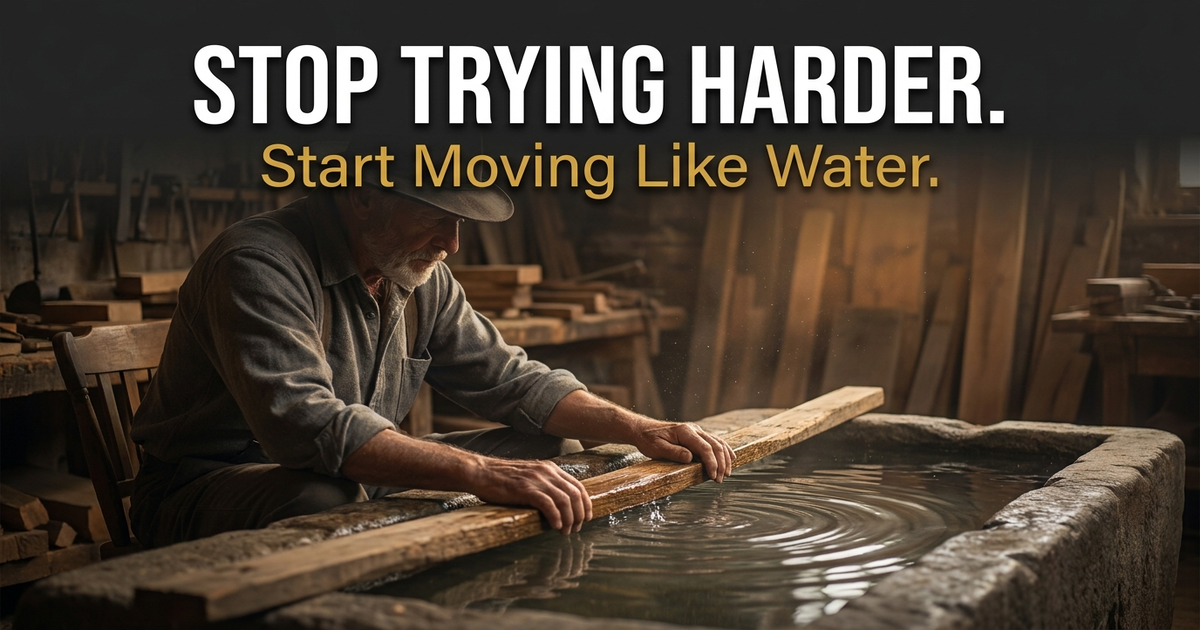
Stop Trying Harder. Start Moving Like Water.
By Derek Neighbors on May 30, 2026
A novice guitar student strangles the neck of the instrument. His knuckles go white at the third fret. His shoulders climb toward his ears. A bead of sweat lands on the soundhole. He is concentrating with his whole body, the way he has been told that real practice is supposed to feel, and the chord he is producing is a small, brittle, choked thing that sounds like it has been hit rather than played.
In the same building, his teacher, who has been playing for thirty years, runs a passage four times harder with his shoulders down, his jaw loose, his breath unchanged. He looks almost bored. The sound that comes out of his guitar is round and warm and unhurried. The novice would tell you, asked directly, that the teacher must be coasting on talent. The teacher is not coasting. The teacher is doing more work per second than the novice is. The work just is not visible.
Everywhere I have looked at this, the same picture comes back, and it does not stay inside the boundaries of credentialed work. A new surgical resident bears down on a suture with his shoulders climbing into the back of his neck. The senior surgeon at the same operating table looks like he is reading the morning paper. A young parent at the bedside of a sick child clutches the chair arm until his knuckles go white. The grandfather in the same chair an hour later has his hand open and his breath slow. A writer wrestling a hard second draft tightens his shoulders against the screen and gets three sentences in an hour. The novelist next door who has been at this for thirty years looks half asleep and lays down a clean page. The pattern repeats wherever skilled humans work, whether the work is paid or not, whether anyone is watching or not. Western popular culture has a strong opinion about what mastery is supposed to look like. The picture in that popular imagination is wrong. The older Western philosophical tradition, from the Stoa to the desert fathers to the monastic contemplatives, already knew it was wrong. They arrived at the same place Musashi did, from the other side of the world, several centuries before he did.
The Investigation Begins in a Cave in Kyushu
Four hundred years ago, in a country that took mastery seriously, a swordsman named Miyamoto Musashi wrote down what Western popular mythology of effort never quite figured out. He had survived more than sixty duels, most of them with sharpened steel and to the death. Late in his life he retired to a cave in the mountains of Kyushu and produced the Go Rin no Sho, the Book of Five Rings, in which he tried to explain, plainly, what he had been doing.
Each of the five chapters takes its name from an element. The second is the Water Book, and the choice was not decorative. Musashi wanted to teach three properties of water to a swordsman about to walk onto a field where being wrong would cost him his life. Water takes the shape of whatever vessel contains it. Water finds the smallest gap available and flows through it. Water cannot be made tense.
The phrase he gave the working stance was mizu no kokoro, water mind. The instruction was that the spirit should be neither tense nor relaxed, neither leaning forward into what was expected nor pulling backward from what was feared, centered without effort, alert without rigidity, fitted to the shape of whatever the moment turned out to actually be.
The instruction had to work under conditions where there were no second drafts. The instruction is also, almost word for word, the working stance of every senior craftsman, every senior surgeon, every senior performer I have ever watched. The West stopped having the vocabulary for it. The vocabulary was sitting in a cave in Japan the whole time.
Why Trying Harder Makes You Worse: Three Failure Modes of the Grip-Tighter Stance
Look at what happens, mechanically, when a working person tries harder by gripping tighter. The tension under inspection here is the unconscious postural performance kind: held shoulders, clenched jaws, white-knuckled grips on tools that need a light hand, breath held against a screen. It is not the honest exertion of the man at heavy labor, whose strain is the load itself and whose body is doing the work it looks like it is doing. Heavy labor has its own demands and its own dignity. The argument here is about the contractions that are not actually working but are paying the same biological cost as the ones that are. Three things go wrong, and the same three things go wrong across every domain that requires skill.
The first is that tension narrows the perceptual field. The novice swordsman whose grip is white-knuckled has spent his entire attention on the sword. He cannot see the opening when it appears because he is not looking; he is squeezing. The senior swordsman, whose grip is light enough to drop the sword if he had to, sees the gap a second before it forms. The same thing happens to the new surgeon, who cannot read the anesthesia readings or the change of color in the tissue at the edge of his field because his attention has collapsed onto the suture in his hand. The Stoics named this same thing from the other direction. They called the trained version prosoche, watchful attention, and they meant the kind that is wide because it is not clenched onto a point.
The second failure mode is that tension prevents kairos. The Greeks had two words for time. chronos was the clock. kairos was the opportune moment, the timing that has to be discerned in motion. It cannot be forced. It also cannot be coasted into. It is the active reading of what the situation is doing while the situation is still doing it, and reading that fast and that accurately is the work of trained judgment, not the absence of effort. A tight grip is a forecast: you have decided in advance what the next move is. When the moment does not behave the way you decided it would, you are already too late, because you are still committed to a move that no longer fits. The water mind is not formless and it is not passive. The repertoire is pre-formed, meaning every possible response has been trained so deeply that all of them are available. The action is not pre-committed, meaning no single one has been selected before the moment arrives to be read. The swordsman waits in active discernment, and the move he ends up using is the one the situation calls for, not the one he picked yesterday.
The third failure mode is that tension burns the fuel the actual work needs. Anybody who has run a long distance knows this one in the body. I run ultras alone in the desert, twenty and thirty miles at a stretch, no signal, nobody coming if it goes wrong, and the desert sends you the bill for every contracted muscle by mile twenty-eight. The runner who clenches his jaw and pumps his arms is spending energy fighting his own body. The senior runner has learned, usually the hard way, that the legs and the lungs are doing all the work, and every other contracted muscle is theft. The same accounting runs across every craft. Tension is overhead, paid against the same finite budget the actual work has to run on. Release the unused muscles and you have effectively doubled the fuel available to the muscles that matter. This is also why willpower-based discipline almost always fails over the long run; the white-knuckled version of discipline is paying the same tension tax it is trying to overcome.
An honest alternative deserves to be named here. The senior performer may also look relaxed because the work has become familiar, and familiarity does in fact reduce visible effort. That part is real and not in dispute. The argument of this article is about a second variable that familiarity does not automatically train. Put two senior performers with equal experience at the same workbench. The one who has practiced releasing unnecessary tension will outwork and outlast the one who has not, even though their familiarity with the work is identical. Familiarity makes the work easier on you. The water mind makes you capable of doing the same work for another forty years without breaking. The article is about the second thing, and the second thing has to be trained on top of the first.
The Three Properties of Water, Mapped to Working Stance
Now the other direction. What does the water mind actually do that the grip-tighter stance cannot?
It takes the shape of the container. Water mind does not arrive at the work with an agenda about how the work is supposed to feel today. It fits itself to whatever the work is actually doing. The senior craftsman does not bring yesterday’s plan into today’s room. He walks in, watches for ninety seconds, and shapes his attention to the actual situation in front of him. The novice walks in carrying yesterday’s plan and tries to execute it against today’s reality. Yesterday’s plan wins on paper. Today’s reality wins in fact. The Greeks called this trained capacity hexis, the disposition that knows how to fit, and they distinguished it sharply from the rehearsed routine that has to be forced against the world’s resistance.
It finds the smallest available gap. The water mind looks for the seam, the small place where the situation will yield, not the dramatic breakthrough. The senior person, in any craft, does the most leveraged move available. The novice does the most heroic-looking move available. The leveraged move is almost always smaller, less visible, and more decisive than the heroic one. This is techne, the practical knowledge of making a real thing happen in the actual world, which is almost never the knowledge of doing a dramatic thing for an audience. The audience watches the heroic move. The work yields to the small one.
It cannot be made tense. This is the part Western popular mythology gets most wrong, and the part Musashi was most insistent about. The water mind is not relaxed. It is not loose. It is impossible to tense up, because the trained stance, once it has been built in over years, holds itself without effort. Relaxation is a state you can fall out of. The water mind is a disposition that no longer requires you to maintain it.
Here the Greeks were precise in a way modern English is not. enkrateia is the discipline the novice exercises against contrary appetite, the ongoing self-mastery of someone still in active fight with himself to do the right thing. hexis is what enkrateia produces after years of patient practice: a settled disposition where the fight is over and the right action is now native. The water mind is hexis, not enkrateia. The novice trains enkrateia on the way toward hexis. The senior performer rests in hexis and no longer has to fight himself to hold the stance. apatheia, the strictly Stoic word for freedom from the disturbing passions, names the same destination: not effortful suppression of agitation, but the working state of a person who has trained beyond the point where agitation can take hold. What sits behind all three Greek terms is the same thing the Stoics and the desert fathers and Musashi were pointing at: a posture of attention that is carried by the soul and expressed through the body, but not made by the body, and not lost when the body fails. There is a useful distinction between being consumed by your work in a fitted way and being consumed by it in a damaging way; the water mind is what the healthy version of full absorption actually looks like from the inside.
The Practice That Gets You Across the Threshold
The investigation does not end at that is true. It ends at here is what you do about it. Three trainings, all of them unglamorous, all of them slow. None of them require a coach, a class, a subscription, or a particular vocation. The kitchen worker at the dish pit can run the first training on his afternoon shift. The slave in Epictetus’s lecture room could have run it without leaving his stool. The water mind is available immediately as a stance of deliberate noticing, and it deepens over years into a settled disposition that holds itself. Both halves matter. You do not have to be senior to start. You become senior by doing this work patiently while almost everyone around you is doing the opposite.
Audit the tension. Three times a day, in the middle of your hardest work, freeze for ten seconds. Notice everything currently contracted that is not actually doing the task. Shoulders. Jaw. The tongue against the roof of the mouth. The toes curled inside the shoes. The belly held in. The tension is the inventory of what your nervous system thinks is currently fighting for its life. Most of it is not actually fighting anything. Release one item and continue working. Half the practice is noticing; the other half is the small dialectical question that keeps the noticing from going mechanical: why am I holding that, and is the fear current or inherited? Most days the question does not need an answer. It only needs to be asked. Repeat for months. The compounding is invisible day to day and substantial year over year.
Work without pre-commitment, once a week. Take the work you normally execute against a plan and run a session of it with the plan put away. Show up. Watch what is actually present in the situation. Shape your response to what you find rather than to what you decided yesterday you were going to do. The goal is not to abandon planning. The goal is to remember that the plan is a guess and the moment is the fact, and to keep the muscle of fitting available so it does not atrophy.
Stop the heroic move. For one week, every time you feel the urge to do the visible, demonstrative, large-gesture version of a move, do the smallest version instead. The smallest version that actually changes the situation. The water move is almost never the big one. The big one is for the audience. The small one is for the work. The week will teach you, embarrassingly fast, how much of your previous effort was being spent on the audience rather than on the work.
I have learned a related lesson in the desert, where there is no audience and nothing to perform for. The mile I stopped clenching my jaw was the mile my ultra times started moving in the right direction. The mile I dropped my shoulders was the mile my legs stopped feeling like they had been borrowed from someone heavier. Nobody coached me out of those things. The desert did. The desert charges you for every contracted muscle and sends you the bill at mile twenty-eight, and the bill is plain enough that, eventually, you start refusing to pay it. The same lesson is available in any honest craft you take seriously enough to lose at, and the lesson keeps showing up in the work the discipline of arete asks for, which is the unglamorous daily work of trusting the practice past the point where the practice has stopped looking dramatic.
Frequently Asked Questions
What is mizu no kokoro? Mizu no kokoro is the Japanese phrase for “water mind,” a working stance described by the swordsman Miyamoto Musashi in the Water Book of his Book of Five Rings. The mind is held neither tense nor slack, neither leaning forward toward what is expected nor pulling back from what is feared. Like water in a vessel, it takes the shape of whatever situation contains it, finds the smallest available opening, and cannot be made tense. Musashi taught it as the optimal posture for sword combat, but the same stance describes the working state of every senior performer in every craft.
Why does trying harder make you perform worse? Effort directed at the work moves the work. Effort directed at performing seriousness about the work is a tax against the same finite budget. Tense shoulders, clenched jaws, held breath, and pre-committed plans are forms of unconscious clenching that drain capacity without improving output. The novice spends most of his energy on the demonstration of effort. The senior performer has trained that demonstration out of his body and has the spared capacity available for the actual task. Visible strain is a junior move because it consumes resources the work needs.
How do you train a calm working stance under pressure? Three trainings, run patiently over months. First, audit the tension: several times a day, in the middle of your hardest work, freeze and notice everything contracted that is not actually doing the task, then release one item. Second, work without pre-commitment one session a week: show up, see what is actually present, shape the response to what you find rather than executing yesterday’s plan. Third, choose the smallest effective move instead of the most visible one. The unglamorous noticing, repeated, eventually becomes the posture itself.
Final Thoughts
The grip-tighter mythology costs the West more than it knows. It produces brittle performers, burned-out craftsmen, anxious surgeons, exhausted runners, and a culture that mistakes visible strain for actual progress. The mistake is so deeply embedded in how we talk about work that most ambitious people will spend the first two decades of their career performing difficulty for an audience that turns out to have been themselves.
Musashi knew at thirty what most ambitious people figure out, if they ever do, somewhere in their fifties. The hardest work does not look hard. It looks fitted. It looks fluent. It looks like the person doing it has stopped fighting the work and is letting the work happen through them. The water mind is available without the cave in Kyushu and without sixty duels. It is available through the daily, unglamorous practice of noticing what you are clenching that does not need to be clenched, and letting it go.
Stop trying harder. Start moving like water. The work will find you the way water finds the gap.
The discipline of working without unnecessary tension is one of the practices we train at MasteryLab.co, where the daily formation work meets the senior posture every craftsman eventually has to find. The water mind is not a personality trait. It is the result of patient practice, and the practice is the point.