Stoicism Doesn't Mean You Stop Grieving. It Means You Stop Performing It.
By Derek Neighbors on May 27, 2026
The popular picture of the Stoic is a man who has trained himself to feel nothing. Bad news arrives and his face does not move. Someone he loves dies and he files it under things outside my control, squares his shoulders, and is back at work by lunch. People reach for Stoicism precisely because they want exactly that. They want armor. They want to be the one at the funeral who holds it together while everyone else comes apart, and they have decided the old philosophers wrote the manual for it.
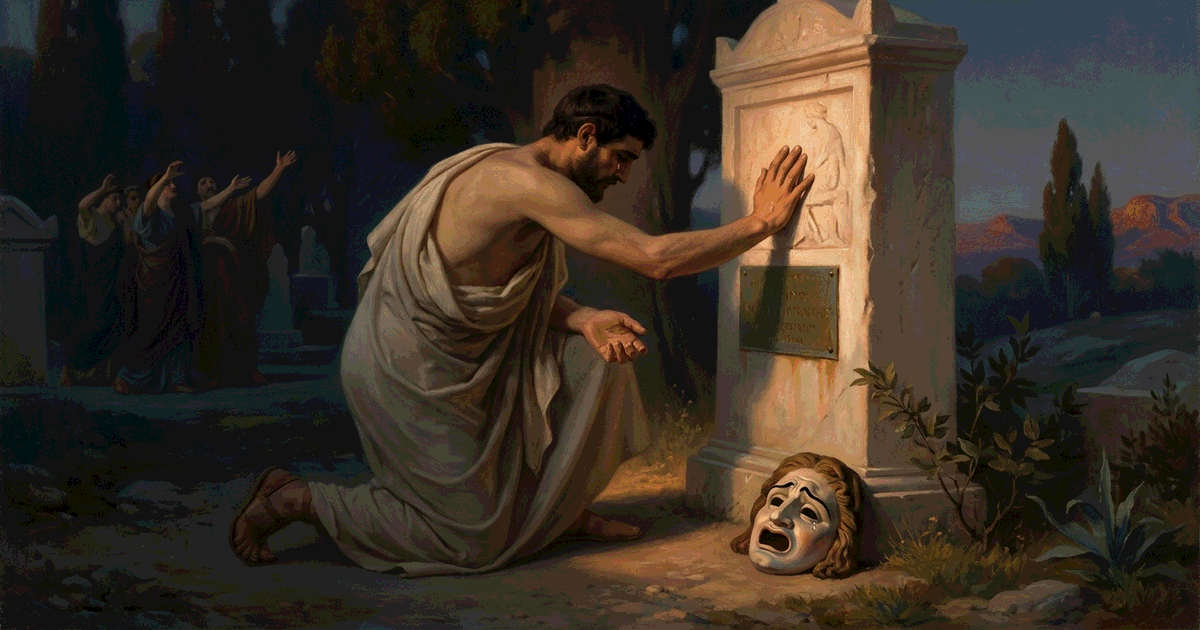
They did not. The man who wrote more about Stoic composure than almost anyone in the ancient world buried a close friend and grieved so hard he was ashamed of himself afterward. Seneca lost Annaeus Serenus, a man he loved and had dedicated his work to, and he fell apart. He did not hide it. He recorded it. Years later, writing to console his friend Lucilius, he admitted that in his mourning for Serenus he had wept past all reason, and that he now had to count himself among the examples of men who let grief win. The author of the emotional-discipline literature failed his own test in public and put the failure in writing.
So whatever Stoicism actually taught about loss, feel nothing was not it. If the discipline meant the absence of grief, its most famous teacher flunked at the first real funeral. The question worth asking is the one people skip when they reach for the armor. What separates the grief that happens to you from the grief you keep manufacturing long after?
The Tears You Do Not Choose
Start with the part Seneca never apologized for. The Stoics had a precise idea for it, propatheia, the first movement. Before any judgment, before the mind has a chance to weigh in, the body reacts. Tears come at the graveside. The throat closes. The chest goes tight at a song that was theirs. The Stoics insisted these first movements are involuntary and pre-rational, that even the sage turns pale when the ship pitches in a storm, and that no philosophy on earth prevents them. They are nature, not weakness.
This matters more than it sounds. The version of Stoicism sold online treats the catch in your throat as a failure of training, something a stronger person would have suppressed. The actual school taught the reverse. The first wave of feeling is not yours to command. Seneca said the tears that fall on their own are honest, and that trying to dam them is its own kind of vanity. A man who refuses to weep at all has not mastered anything. He is pretending, which is the very thing the discipline was built to cure.
And the first movement is not a one-time event tethered to the funeral. It returns. A song catches you a year later, a smell two years out, a photograph nobody warned you about, and the wave hits as involuntarily as the day they died. That returning wave is the same nature working, not a fault and not a performance. The line the Stoics drew is not when the feeling arrives. It is whether the feeling found you or you went looking for it.
The graveside was never the problem. Seneca’s tears for Serenus in that first season were what any human being does. What shamed him came later.
The Grief You Produce
Here is the line the Stoics drew, and it is a sharp one. There is the grief that arrives on its own, and there is the grief you go back and summon. Seneca said it flatly to a father named Marullus, who had lost a young son and wanted the standard letter of comfort. Seneca declined to send it. We weep without meaning to, he told the man, and then, having started, we go on weeping on purpose. The first is human. The second is a decision.
What sits between the loss and that second kind of grief is something the Stoics called phantasia, the impression. Not the event but the story you tell about what it means. The loss is fixed. The narrative you wrap around it is not, and the narrative is where the suffering multiplies. He is gone becomes I will never be whole, becomes a good person would still be wrecked by this a year from now, becomes what would it say about my love if I ever stopped. None of that is the death. All of it is commentary, and the commentary is doing most of the damage.
Once you can see the commentary, you start to notice who it is for. I will put it plainly. Grief that refuses to end is often not about the person who died. It is about the people watching. The prolonged, visible, narrated version of mourning has an audience, and the performer knows it. We perform the depth of the loss to prove the size of the love. Whatever you believe happens after death, the performance does not reach them. It is staged entirely for the living, and the modern stage is a feed that pays out the most attention for the most public grief.
What the Discipline Actually Was
Now the word everyone gets wrong, apatheia. People hear it, catch the root of apathy, and assume the Stoic goal was to feel nothing. It meant close to the opposite. apatheia was freedom from the pathē, the runaway passions that pile suffering on top of a loss the way Seneca piled it on after Serenus. It had nothing to do with killing love or sorrow. It meant being free of the self-generated second story that turns a wound into a standing condition.
The proof sits right next to it. The same Stoics who praised apatheia also taught eupatheia, the good feelings, and they named three: joy, rational caution, and well-wishing. Sorrow was not on the list, and that omission matters. The Stoics did not bless a refined form of grief; they blessed the rational counterparts to the destructive passions, and left grief outside the catalogue entirely. Feeling was never the enemy. Inflated, unexamined, performed feeling was. And in case anyone pictures a school of cold men who simply lacked a pulse, their rivals argued the other side hard. Aristotle’s school answered with what later writers called metriopatheia, feeling in measure rather than mastering the passion outright, and the two camps went at it for centuries. Serious people, fighting about how to grieve well. Not whether a person was allowed to.
So the discipline was never to delete the feeling. It was to examine the impression. Let the first wave come, then turn and look hard at the story arriving right behind it, and ask whether that story honors the person or only advertises the wound. Grieve the loss that is real. Refuse the suffering you are adding on top of it. And underneath even that, Epictetus pressed a harder move: notice that you never owned the person you loved in the first place. Nothing was ever yours to keep. The framing that says I have lost what I had a right to is the impression doing the most work, and the one most worth interrogating before any of the others.
How to Grieve Like You Mean It
Three things follow, and you can use them tomorrow.
First, separate the pang from the story. When the wave hits, let it. Do not perform composure by clenching against it, and do not be ashamed of it either, since the first movement was never yours to approve in the first place. Then watch what comes next. The pang is honest. The narrative behind it, the one about what this proves and what it says about you, is the part to interrogate. The work lives there, not in the tears. It is the same discipline that, in a different arena, keeps you from mistaking your anger for something righteous.
Second, ask who the grief is for. It is a brutal question and it sorts things fast. Honoring is quiet. It needs no witness, no caption, no anniversary post. Performance needs an audience or it has no point. If a private act of remembrance would feel pointless because nobody would see it, that is worth knowing about yourself. Public versus private is the symptom. What you do with the impression you actually control is the principle. The dead are not on the feed.
Third, honor by carrying something forward rather than by suffering longer. The instinct whispers that to stop hurting is to betray the person, that the size of the ongoing pain is the measure of the love. It is a lie. When grief hardens into an identity, it stops carrying the person forward in any sense that matters and starts doing something inward and corrosive. The real tribute is to take what they gave you and live it out. What they gave is what survives them, and the living of it is the only form of remembrance that costs you something real instead of merely looking like it does.
Final Thoughts
The pop version of Stoicism sells emotional armor, and armor is the wrong picture entirely. The man who feels nothing at the grave has not achieved strength. He is absent, and absence was never a virtue. What the Stoics actually left us is harder than numbness and harder than wallowing. Feel the loss all the way down, because the first wave is honest and pretending otherwise is its own small lie. Then refuse to manufacture the second wave for an audience, because that one helps no one and quietly makes you worse.
Seneca got this wrong before he got it right, which is the most useful thing about him. He wept too long for his friend, caught himself doing it, and told us so in writing. The discipline was not that he never broke. It was that he learned to see the difference between breaking and performing the break, and chose to stop performing. Grieve. Honor. Then go live in a way the person you lost would have respected. That is the teaching, and it asks more of you than a stone face ever could.
The discipline of examining your own impressions, the stories you wrap around what happens to you, is the quiet work underneath all the rest. It is the practice we build at MasteryLab.co, where ancient philosophy meets the actual weight of a human life.