You Built That Fortress to Stay Safe. It's the Reason You're Going to Lose.
By Derek Neighbors on May 4, 2026
Power vs. Virtue: The 48 Laws Examined
A year-long examination of Robert Greene's 48 Laws of Power through the lens of ancient virtue ethics. Some laws we affirm, some we reframe, some we reject entirely.
Most of Robert Greene’s laws describe a road. Law 18 describes a destination people walk to without intending to.
Things get hard. People around you start acting unreliable. As the noise grows, you shrink the calendar, tighten the inner ring, and cut interruptions, calling it focus.
Six months later the reports stop being honest. The customer calls stop happening. The friend who used to push back has been edited out of your week.
You feel safer. You are actually defenseless in a way you cannot see yet.
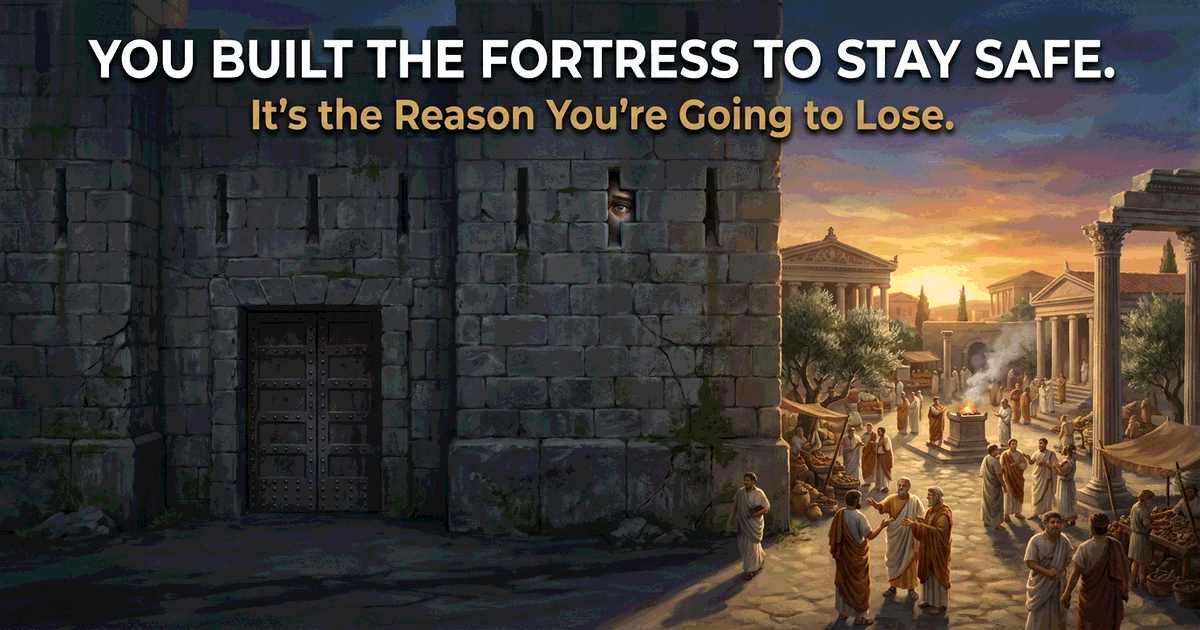
Greene says do not build fortresses because they make you a target. The Greeks would say something deeper: humans were never built for life behind walls. The word for someone who withdrew from public life was idiotes. That is where our word “idiot” comes from. Read it again.
The Law
Greene’s Law 18: “The world is dangerous and enemies are everywhere. Everyone has to protect themselves. A fortress seems the safest. But isolation exposes you to more dangers than it protects you from. It cuts you off from valuable information, it makes you conspicuous and an easy target. Better to circulate among people, find allies, mingle. You are shielded from your enemies by the crowd.”
The historical examples Greene leans on are the ones you would expect. Roman emperors who retreated to fortified palaces and lost the empire while their courts ate them alive. Mao Zedong staying in motion through the Long March while Chiang Kai-shek consolidated in fortress cities. Louis XIV building Versailles to control the court and becoming a prisoner of his own choreography.
The prescription: stay visible, stay accessible, stay in the flow of information.
This is one of the few laws where Greene’s tactical reading and ancient virtue agree on the destination. They disagree about the road that gets you there.
The Tactical Truth
The shallow case for isolation that Greene correctly demolishes goes like this: walls feel like protection. Fewer people in the room means fewer threats, fewer demands, fewer decisions. The math seems obvious.
The math is wrong: walls leave the threats intact and only cut your ability to see them coming.
Information is not a luxury for leaders. It is the raw material of every decision. Every strategic mistake in business history has the same fingerprint: someone in the organization saw it, and the person who needed to know did not hear about it in time.
The fortress builder thinks they are filtering noise. What they are actually filtering is reality.
Greene gets this part right. The leader who walls off becomes legible to everyone except themselves. Competitors can study your patterns. Subordinates can game your blind spots. Customers can leave without warning. Meanwhile you are inside the fortress optimizing for a world that no longer exists.
The tactical case stops at “do not be cut off from intelligence.” That is true and useful and incomplete. Greene treats isolation as a strategic mistake. The Greeks treated it as something darker: a violation of what humans are.
The Character Cost
The deeper failure is anthropological: humans degrade when cut off from the community they were built for.
Aristotle wrote that humans are zoon politikon, the political animal, the creature that lives in community by nature, by design rather than preference.
This is not sentimental. It is a structural claim. A human cut off from community does not just suffer. Judgment narrows, language flattens, and the capacity to take other perspectives atrophies because there are no other perspectives in the room.
The Greek word for the person who refused public life was idiotes. It originally meant “private person”, someone who withdrew from the polis, who did not engage in the shared life of the community. The Greeks considered this a failure at being human. Our modern word “idiot” carries that judgment, fossilized in etymology nobody remembers.
The Greeks were describing the cognitive collapse that follows isolation, not scoring cruelty points. Cognition contracts. They start mistaking their own echo for consensus. They lose the calibration that comes from being challenged by people who see what they cannot see.
Greene’s executive who builds a fortress loses access to information. The Greeks would say they lose access to themselves. The version of you that exists only inside your own head is not your full self. The full self requires friction with other selves.
This is why isolation feels safer and produces dumber decisions. The cognitive cost is invisible from inside the fortress.
The ARETE Alternative
The alternative is not “stay accessible for tactical reasons.” It is koinonia, the discipline of remaining inside genuine community.
koinonia is not networking. It is not maintaining a contact list or showing up at industry events. It is the practice of staying inside relationships where people can actually see you and tell you the truth.
The relationships that produce koinonia have specific properties. The other person can disagree with you without consequence. They can deliver bad news without strategy. They can ask hard questions without first asking permission. The relationship survives the friction. The friction is the point.
These relationships do not scale. You cannot have koinonia with thousands of people. You can have it with a small number, deliberately maintained.
philia (deep friendship) was Aristotle’s term for the friendships that make people more virtuous. He distinguished philia from useful friendships (transactional) and pleasure friendships (entertaining). philia was the kind where the friend’s good was identical to your good, where their honest feedback served you because they served you.
The leader who has built genuine philia has an information advantage no fortress builder can match. They have people whose only agenda is to make them better. Those people will tell them the truth that hierarchy filters out.
The arete alternative goes deeper than staying in the flow. It demands that you build the relationships where truth can survive being told, then keep showing up to receive it.
The Ancient Pattern
Aristotle was emphatic about zoon politikon. The person who can live alone is either a beast or a god, he wrote in the Politics. He was being precise. Anyone outside those two categories who tries to live in isolation is performing a category error against their own nature.
koinonia, as the early Christian and Stoic communities used the term, was the medium humans live in. Not a thing humans do. The thing humans are inside of, like fish in water.
The Greeks distinguished between healthy time alone and idiotes withdrawal. The Stoics built whole practices around solitude. Marcus Aurelius wrote his Meditations alone in his tent on military campaign. Seneca treated solitude as a workshop for self-examination. They valued prosoche (sustained attention) and required quiet to practice it. But the goal was always to return to community better equipped. Solitude was the workshop. Community was the workshop’s purpose.
A philosopher who used solitude to grow stronger was practicing virtue. A man who used solitude to hide from his obligations was an idiotes. The difference was direction, not duration. This is also why genuine self-sufficiency is not the same thing as withdrawal, even when both can look identical from the outside.
The Test
Run this test. Think of the last three significant decisions you made. Who pushed back on them before you executed?
If the answer is “nobody”, not because they agreed but because nobody was in the room to disagree, your fortress is taller than you realize.
If the answer is “everyone agreed” but the decision turned out badly, your inner circle has stopped telling you the truth. The fortress walls are not physical anymore. They are the ones you have trained your team to maintain.
The test of community is not whether people are around you. It is whether the people around you can still surprise you.
Final Thoughts
Greene’s Law 18 is correct on the destination. Do not isolate. The reason he gives, tactical exposure and loss of intelligence, is true and shallow.
The full reason is that humans were never built for life behind walls. The capacity to be alone is real and necessary, and the Stoics treated solitude as a workshop rather than a hiding place. The discipline of remaining inside genuine community is not optional for anyone who wants to keep their judgment sharp and their soul intact.
The fortress feels like protection. It functions like a coffin you walk into voluntarily.
The Greeks gave us koinonia as the framing because they understood that the version of yourself that exists only inside your own head is the smallest version. The version of yourself that exists in the friction of real community is the one that grows.
Tear down the walls. Not because Greene says so. Because you were never supposed to be inside them in the first place.
Excellence is not built behind walls. It is built in the friction of community where real feedback survives. MasteryLab.co is where leaders learn to keep that friction productive, building the relationships that make truth-telling possible and the discipline to receive it when it arrives.