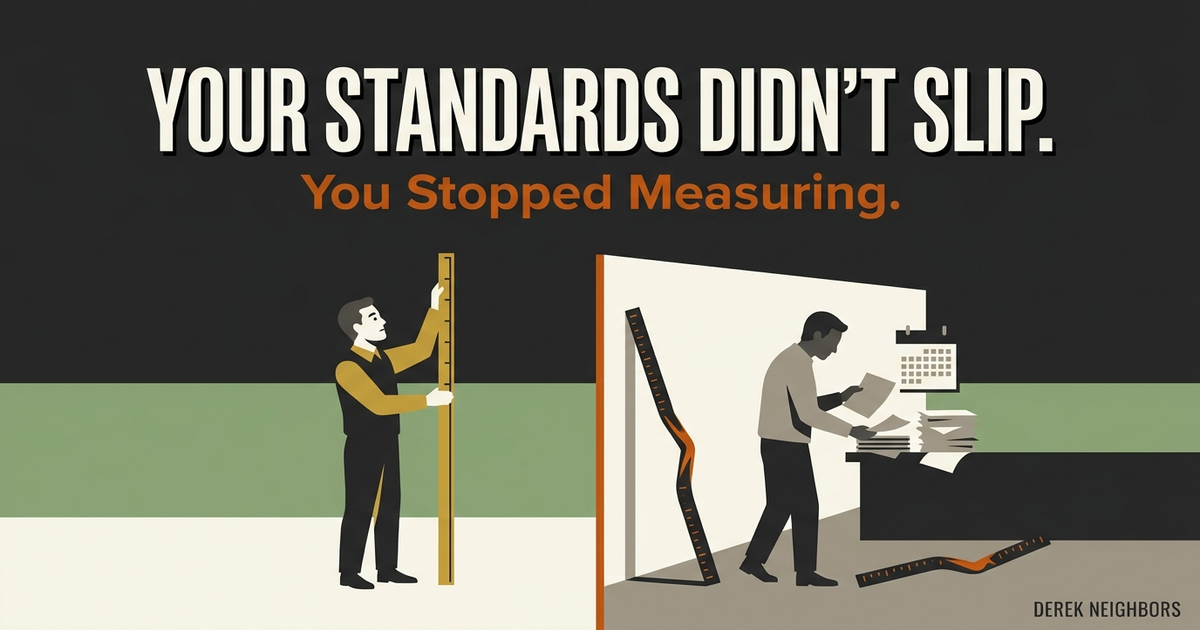
Your Standards Didn't Slip. You Stopped Measuring.
By Derek Neighbors on August 4, 2026
The season I remember did not begin with a decision to get soft.
It began with a win I had chased for months. The number landed, the release shipped, and the room clapped. My calendar stayed full the next Monday, and for two weeks I could have sworn I was still serious. I was in meetings, answering Slack, and talking about the next mountain with the confidence of someone who had just climbed one.
What I was not doing was looking at the measure that used to scare me a little every Friday.
I had not lowered the bar in a meeting. I had stopped measuring, and my reasons for the soft week were excellent: recovery, context, team load, and the always-useful line that this quarter is different. The story was fluent. The craft was quieter than I wanted to admit.
That is how standards usually die, through unexamined absence rather than a vote. The pattern is not reserved for product launches. It shows up after a race PR when the splits disappear, after a hard parenting week when the bedtime bar goes negotiable, after an exam when the study check never returns. Wherever a win makes the next check optional, the same soft week is available.
Rewards End. Standards Renew.
By measure I mean a concrete check that can fail: a number, an attempt count, a written pass/fail against a quality bar. A feeling that you are still serious is not a measure. If it cannot fail in public or on paper, it cannot govern the week.
Rewards are finite engines. Hit the goal and the chase often dies with the prize. The brain got what it came for. The celebration was real. Then Tuesday arrives and nothing outside you is demanding the same quality of attention you gave when the scoreboard was public.
A standard never arrives. It asks again tomorrow.
That difference matters more than most people want to admit. You can complete a reward, but you cannot complete arete. Excellence is a way of functioning, not a trophy you finish and shelve. arete requires continued actualization of the capacity the prize depended on; store the trophy and stop checking, and the function that earned the trophy starts to idle. Treat excellence like a destination and you will confuse the afterglow of winning with permission to stop checking the work.
The clap, the weird quarter, and other people’s softness are outside your hands. What remains yours is whether you keep looking at the measure and whether you assent to an open-ended exception. That is the whole game the Monday after a win.
Coasting feels like strategy because the reasons are usually true. You do need recovery. The quarter is weird. The team is loaded. Rest and reduced load can be right when they carry an explicit return date for the measure. The vice is the soft week with no end condition. Recovery without a restored check becomes a new baseline. Busy without a scoreboard becomes a story about intensity that leaves no evidence of craft, and a full calendar with no failing check is the appearance of excellence mistaken for the thing itself.
Aristotle called the settled shape of repeated action hexis. Softness becomes character the same way courage does: through reps. Skip the measure often enough and the skip stops feeling like an exception. It starts feeling like how you work now.
If you want the fear version of this territory, the cousin piece is “Stop Being Afraid to Fail. Start Being Afraid to Coast.”. That essay is about the wound of never finding out what you can do. This one is about the quieter failure: you already know the standard, and you stopped putting a number or a witness on it.
The Finished Goal
The behavior is simple. You chased a target hard. The target landed. The daily practice that built the landing disappears while the identity of “someone who hits targets” remains.
You still talk like the hungry version of yourself. Your calendar still looks expensive. The Friday check that used to tell the truth is gone.
arete does not care that you won last month. Function is tested in today’s reps. A finished goal can retire a reward loop while the craft still needs tomorrow’s check. When the prize ends and the measure ends with it, you are living on reputation deposited by a former self and calling the afterglow rest.
I have done this after product launches, after body-composition goals, after hard seasons of writing. The pattern is the same. The win feels like arrival, arrival feels like permission, and permission shows up as earned ease long before anyone would call it decline.
The Softened Bar
Nobody schedules “Lower the Standard” for 2pm.
What happens instead is one exception that makes sense, then another that also makes sense, then a third that only makes sense because the first two already moved the floor. The exception becomes the baseline through hexis. No vote was required. Stopping the check taught your hands a softer shape.
This is close to the moral cascade in “Just This Once Is Never Once”, but the content is different. That piece is about character compromise under access pressure. This one is about craft measure under success pressure. The irreversible first yes shows up on both ledgers.
The Greeks also named the gap between knowing and doing: akrasia. You can recite the standard and still fail to enforce the measure when the week gets loud. Knowledge without a check soothes your conscience while your techne softens underneath it.
The Downward Glance
When absolute quality gets expensive to face, relative rank gets cheap to enjoy.
You start glancing at people who are softer than you. You are still ahead of them, so the week must be fine. The glance can feel like discernment while it numbs you to the real bar. phronesis, practical wisdom, would ask what the work itself requires. The downward glance asks only whether anyone nearby will catch you.
Relative rank is a narcotic when absolute quality is the job. Learning from someone harder than you can serve the measure, while glancing down to feel safe corrodes it. You can win the soft comparison and lose the craft in the same afternoon.
Teams do a public version of this when leaders refuse to name contribution differences. That interpersonal failure is the spine of “Nice Leaders Ruin People”. The private version is quieter. No one else has to inflate your review. You inflate it yourself by choosing a soft peer group as the mirror.
The Alone Practice
Self-paced work feels like maturity until it becomes a place to hide.
Without a student, a training partner, or a younger craftsperson asking what “good” means in this room, the measure can blur and nobody flinches. People call that self-direction. Underneath, you often have solitude without askesis, training without the friction that keeps the vow honest.
The old Latin line helps here: docendo discimus, by teaching we learn. Teaching restores the bar because another person can fail it in front of you. The moment you have to explain the standard, vagueness gets expensive. You hear your own soft substitutions out loud. You see the places where “usually” replaced “always.”
If easy seasons have been exposing more than they build in you lately, read “Hard Times Build Character. Easy Times Expose It.” next. Unconstrained weeks do not only test appetite. They test whether your measure survives the absence of external threat.
What Actually Works
The breakthrough for me was embarrassingly plain. I said the slipped standard out loud to one person who would not flatter me for the story. Drift cannot hide once the measure is spoken, because the strategic narrative needs privacy to stay convincing.
Four moves, none of them fancy.
1. Write the hungry standard. Skip the current negotiated version. Write the standard you kept when the cupboard was empty and the scoreboard was public. Put it on one line. If that old bar was vanity, cruelty, or aimed at the wrong craft, revise it on purpose with phronesis. Examined revision is wisdom; unexamined softening after a win is the failure mode under review.
2. Pick one weekly measure that cannot lie. A number, a finished attempt count, or a qualitative bar with a written failure condition. If it can be spun into a vibe with no way to fail, it is not the measure.
3. Teach the standard once this week. To a teammate, a student, a peer. Make someone else try to meet it. Watch where you soften the explanation. That soft spot is the real bar you have been keeping.
4. Kill one good-reason story older than two weeks. Recovery needs a return date. Context needs a re-check. “This quarter is different” needs an end condition. A reason without an expiration date will cover an unmeasured week and still sound responsible.
Diagnostic Questions
What measure did you stop looking at after the last win?
Which exception became your new normal without a conversation?
Who would notice, in concrete terms, if your standard softens for thirty days?
What are you calling strategy that is actually recovery with no return date?
Which peer group are you using as a mirror because the absolute measure would sting?
The Challenge
This week, restore one measure and teach it once.
Not a life overhaul. One check that used to tell the truth, returned to the calendar. One conversation where you explain the bar to someone who might miss it. If you cannot name the measure, the craft is running on mood, and mood will not hold under load.
A reward is a party that ends, while a standard is a vow that renews when nobody is clapping. Measuring is how the vow stays honest after the room goes quiet.
If you want a community that will not let your standard dissolve into a good story, MasteryLab is built for people who still want the Friday check that scares them a little.
FAQ
Why do standards slip even when you never decided to lower them?
Standards rarely die in a formal decision. They die when measuring stops. After a win, the reward engine goes quiet, calendars stay full, and fluent reasons cover the missing check. The bar softens through unexamined exceptions until the soft version feels normal. No vote was required. Looking away was enough.
What is the difference between a reward and a standard?
A reward is a finite engine. Hit the number, ship the release, earn the title, and the drive that chased the prize often dies with it. A standard never arrives. It asks again tomorrow for the same quality of attention, craft, and honesty. Rewards celebrate completion. Standards renew the vow.
How does teaching help restore a slipped standard?
Teaching puts the measure in front of another person who can fail it in public. That friction makes vagueness expensive. The Latin proverb docendo discimus, by teaching we learn, names the mechanism: explaining the bar to someone else forces you to see where you stopped keeping it yourself.
What is hexis and how does it relate to drifting standards?
hexis is Aristotle’s word for a settled disposition formed by repeated action. Soft weeks do not stay soft as exceptions. They train a reliable response. If you repeatedly skip the measure, the skip becomes character. Restoring the standard means restoring the reps that rebuild a different hexis.