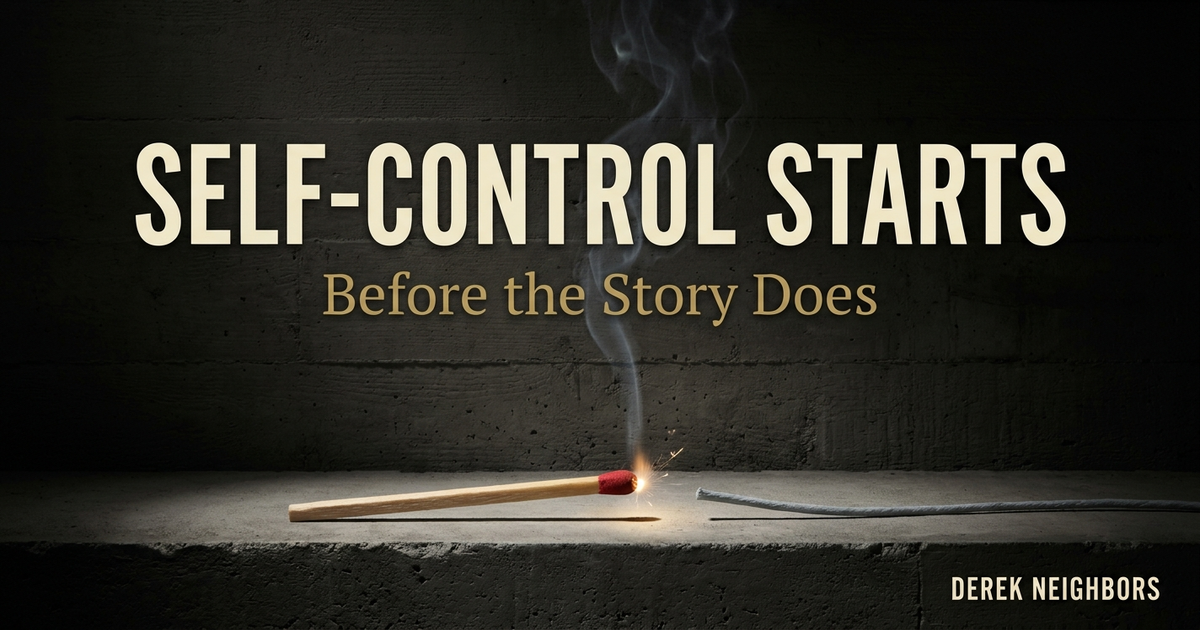
Self-Control Starts Before the Story Does
By Derek Neighbors on October 31, 2026
The Slack lands at 9:40 on a Tuesday night. It is from the CEO. “Can we talk tomorrow about the launch?”
Your chest tightens and your face gets warm before you finish reading. A few seconds later you know what this is about. She heard about the bug from someone else. Somebody on the product side went around you. She has already decided the launch slipped because of your team. By the thirty-second mark you have a reply drafted that explains the bug, names the person who reported it late, and points out that you flagged the risk two weeks ago.
None of that was in the message. The message had nine words and a question mark.
Most advice about keeping your temper tells you to count to ten or sleep on it. That advice starts the clock in the wrong place. By the time you think to count, you are defending a story you wrote in three seconds, and the story feels like a fact because you are the one who wrote it. By story I mean a judgment about what something means, who caused it, and who is to blame, accepted before you have checked it.
The people who studied this most closely, in very different traditions, drew the line earlier. They put it between the jolt in your body and the story in your head. That gap is where self-control lives, and it is small enough that most people never notice it.
Three Movements in Three Seconds
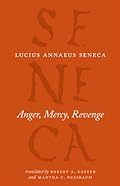
Seneca wrote On Anger for his brother Novatus, and in the second book he does something most writers on anger skip. He slows the event down and takes it apart.
The first movement, he says, is involuntary. It is a shock that hits the mind before any decision, the way you flinch when cold water hits your face or feel dizzy at the edge of a cliff. The Stoics called these first movements propatheia, the pre-emotions that arrive on their own. Seneca is clear that even the wise person gets them. Nobody is blamed for the flinch.
The second movement comes with a judgment. You agree to an idea: I have been wronged, and someone should pay. You are involved in this step, because agreeing is something you do. The third movement is the one that runs away from you. It has stopped asking whether payback is deserved and wants it anyway.
Laid side by side, the three look like this:
| Movement | What happens | Yours to control? |
|---|---|---|
| First | An involuntary jolt: the flinch, the tight chest, the hot face | No, even the wise feel it |
| Second | You agree to a judgment: I have been wronged, and someone should pay | Yes, agreeing is something you do |
| Third | The reaction runs on its own and wants payback whether or not it is deserved | Too late to argue with |
For Seneca, the fight is won or lost at the second movement, and by the third it is too late to argue. That is why his best single piece of advice is about time. The greatest remedy for anger, he writes, is delay. Delay keeps the second movement from closing before you have looked at it.
A Stoic Turns Pale in a Storm
Aulus Gellius, a Roman writer of the second century, tells a story in his Attic Nights that shows how seriously the Stoics took this distinction. He was sailing from Greece to Italy when a violent storm hit at night. On board was a well-known Stoic philosopher, and during the worst of it Gellius saw him go pale and look as frightened as everyone else.
When the sea calmed, a rich passenger needled the philosopher. Why had a Stoic been afraid? The philosopher pulled a book from his bag, the fifth book of the Discourses of Epictetus, and showed Gellius the passage. The impressions that strike the mind, Epictetus taught, are not in our power. When something terrifying happens, even the wise person goes pale for a moment. What the wise person does not do is agree to the impression. They do not add the judgment that this is truly terrible and must be escaped at any cost.
Epictetus gives the everyday version in his Handbook. When someone insults you, he says, it is your own opinion that does the injury, so try not to be carried off by the first impression. If you can gain time and delay, you will find it easier to master yourself. It is the same advice Seneca gave, coming from a man who had been a slave instead of a senator.
The Second Arrow
A very different tradition reaches the same spot. In a short Buddhist teaching called the Sallatha Sutta, the Buddha describes a person hit by an arrow. It hurts. Then, instead of tending the wound, the person grieves, worries, and rages over it, and the Buddha says this is like being hit by a second arrow right after the first. The trained person feels the first arrow just as sharply and skips the second.
In the Slack example, the tight chest was the first arrow. Everything about the CEO going around you came after, and you fired it yourself.
Naming It Changes It
Modern research adds a small and useful piece. In 2007, Matthew Lieberman and colleagues at UCLA published a study called “Putting Feelings Into Words.” They showed people photos of angry and frightened faces while scanning their brains. When people picked a word to label the emotion on the face, activity in the amygdala, the brain’s alarm system, dropped compared with other tasks. Putting a plain name on the feeling took some of the heat out of it.
That matters because a label and a story do different jobs. “Angry” or “chest tight” describes what is happening. “She went around me” explains why and assigns blame, which gives the alarm a reason to keep ringing.
The Story Is Where Self-Control Is Won or Lost
Line these up and a pattern shows. A Roman senator, a Greek teacher who had been a slave, a Buddhist sermon, and a brain scan all draw the line in the same place. The sensation arrives first and is not under your control. Then you add a story about what it means and who did it to you. Then you act on the story.
Most of us try to fix the third step. We work on not sending the angry email or not raising our voice in the meeting. That is hard, because by then the story has been accepted as true, and holding back from acting on something you believe takes enormous force.
The Greek word for that force is enkrateia, self-control, the strength to hold back when desire or anger is pulling hard. Aristotle admired it and still ranked it second. The person who needs enkrateia wants the wrong thing and wins the struggle by force. The person further along has fewer struggles, because their judgments hand them fewer wrong things to want.
So this article uses self-control in a wider sense than Aristotle’s word. enkrateia is the force you need after the story has been accepted. The self-control worth training starts earlier, at what you agree to, and leaves that force much less work.
That is the payoff of stopping earlier. If you catch the moment between sensation and story, there is far less to hold back. The tight chest tells you something here matters to you. The story makes a claim about another person’s motives that you have not checked, and you can take the feeling seriously without signing off on the claim.
Sometimes the story turns out to be right, and the product lead really did go around you. Checking first still wins. If the story is true, the check costs you ten minutes, and if it is false, it saves you a week of answering something nobody said.
I have written about other sides of this before. The Story You Tell About Pain Decides How Much It Hurts is about the meaning you build around pain over months. Stoicism Doesn’t Mean You Stop Grieving applies the first movements to loss. This piece is about the three seconds at work when the story gets written.
Leaders Get Less Delay Than Anyone
This matters more the higher you go, for an uncomfortable reason. Early in a career, the world hands you delay for free. You wait for your manager’s one-on-one. A peer reads your draft and says maybe don’t send that. Your email goes through someone before it reaches anyone important. The system slows you down whether you want it to or not.
Seniority removes that friction. Nobody edits a VP’s Slack message, and nobody asks the CEO to sleep on it. You can turn a three-second story into a team-wide message before anyone has a chance to say wait. And what you send does not stay yours. When a leader reacts to a story, the team inherits the story. By morning six people believe the product team went around engineering, and nobody remembers that the original message was nine words long.
The duty to pause was the same when you were junior. Epictetus taught it as a former slave to students of every rank. What seniority changes is how much a failure costs and how little stands in the way of one, so a leader has to build the delay that the org chart used to provide. The old practices were written for exactly that person. Seneca was writing for a brother headed into public office. Marcus Aurelius was writing notes to himself while he ran an empire. Both had power and very few people who would tell them to wait.
If you suspect your temper is the real issue, I made that case in You Can Be Brave and Disciplined and Still Have a Bad Temper. Today’s question comes earlier, before temper even gets a vote.
How to Pause Before You React at Work
Here is what noticing sooner looks like in a real workweek. None of it needs a tool. The drafts rule and the model check make it faster, and you still decide what to agree to.
Name the body first. When a message, comment, or meeting hits, say what your body is doing in plain words, to yourself or on paper, something like “chest tight” or “jaw clenched.” This borrows from the Lieberman study, which had people label emotions on photographed faces, so it points in this direction without proving your own Slack habit will change. It is still the cheapest move on this list.
Write the facts and only the facts. Copy the exact words of the message, or what the person actually said, and nothing else. “Can we talk tomorrow about the launch?” Then, separately, write the story you told yourself. Seeing the two side by side usually makes the gap obvious, because the story runs ten times longer than the facts.
Put hot replies on a rule. Decide ahead of time what delay you owe a reply written in heat. A simple version: anything you write in the first five minutes after a jolt goes to drafts, and you finish one unrelated task before you reread it. That gives Seneca’s delay a mechanism, so you are not relying on willpower at the moment you have the least of it.
Ask the model to find your story. Paste the original message and your draft reply into Claude, or whatever model you use, and ask one question: what does my reply assume that the original message never said? A good model will list every motive you assigned and every accusation you answered that nobody made. It has no stake in the fight, and it is awake at 9:40 at night when nobody else is around to tell you to wait.
Rehearse the week’s triggers in the morning. Marcus Aurelius opened the second book of his Meditations by telling himself that today he would meet people who are meddling, ungrateful, arrogant, and dishonest. He was preparing, so the day’s irritations would not catch him off guard. Do the work version. Before Monday, write down the three messages, meetings, or people most likely to set you off this week. When one of them shows up, you have already met it once, and the first movement carries less surprise.
Review the day at night. In the third book of On Anger, Seneca describes going over his whole day each night once the lamp was taken away. He asked himself which fault he had resisted and where he could do better. Two minutes is enough. The question that matters most is where the story started, because that is the spot you want to catch tomorrow.
Final Thoughts
You do not get to choose the jolt in the moment it hits. The tight chest and the hot face will show up when the CEO messages at night or a peer says something in a meeting that sounds like a shot at you. Seneca, Epictetus, and the Buddha all agreed that even a trained person feels it. Practice changes how often it comes and how hard it lands, and on any given day it will still show up.
What you do get to choose is whether the next three seconds become a story you defend for a week. If your self-control only kicks in at the reaction, you will lose that fight often, because by then you believe the story. Name what your body is doing and keep the facts apart from the story long enough for the part of you that reasons to get a turn before the part that wants to fight. Once you are the one in charge, nobody else will build that delay for you.
Then answer the nine words she sent.
If you want to build the kind of steadiness that holds when the message lands at night, MasteryLab is where that work happens.
FAQ
How do you pause before reacting in anger at work?
Stop at the body sensation before you explain it. Name what you feel in plain words, like a tight chest or a hot face, then write down only the exact words that were said. Put any reply you wrote in the first few minutes into drafts and finish one other task before you reread it. The delay keeps the story you told yourself from turning into the message you send.
What did Seneca mean by the first movements of anger?
In On Anger, Seneca describes anger in three stages. The first movement is an involuntary shock that hits before any decision, and even the wise feel it. The second comes when you agree to a judgment that you have been wronged and someone should pay. The third is anger that has run out of control. Seneca taught that the fight is won at the second stage, and that delay is the best remedy.
What does propatheia mean?
propatheia is the Stoic term for the first movements that come before an emotion: the flinch, the pallor, the jolt in your chest. Because they arrive without consent, the Stoics did not count them as emotions or as faults. An emotion only forms when you agree to the judgment the jolt seems to suggest.
What does enkrateia mean?
enkrateia is the ancient Greek word for self-control, the strength to hold back when desire or anger pulls hard. Aristotle treated it as admirable but second best, because the person who needs it still wants the wrong thing and wins by force. Catching the moment between sensation and story leaves much less for self-control to fight.