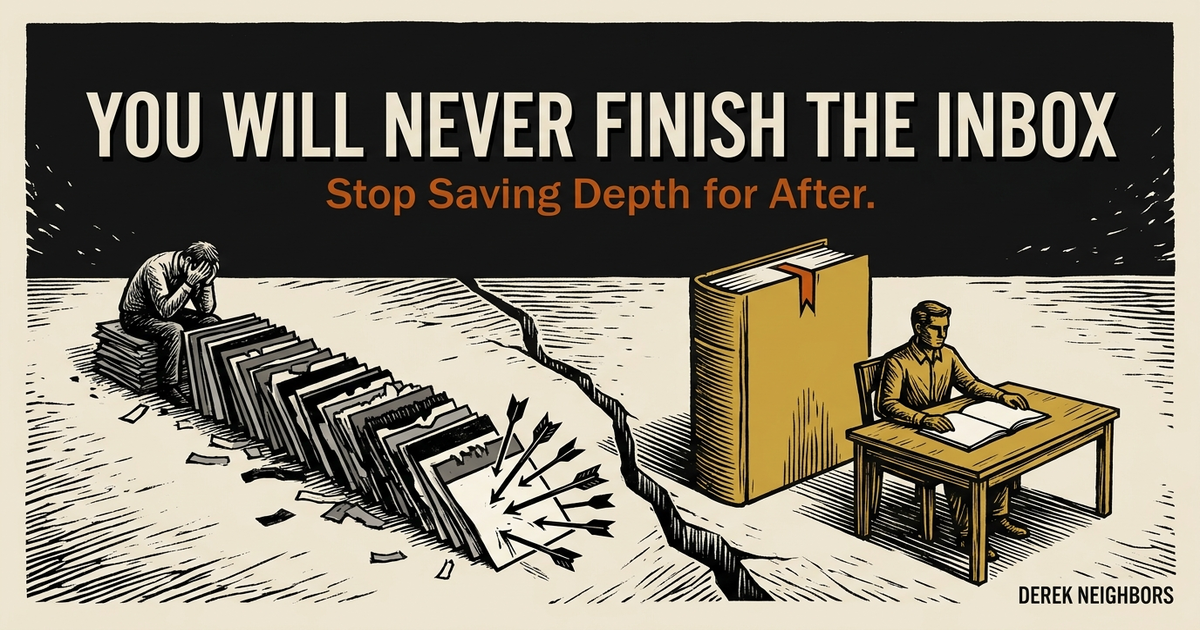
You Will Never Finish the Inbox. Stop Saving Depth for After.
By Derek Neighbors on August 25, 2026
The design was due Thursday.
His calendar through Wednesday was standups, tickets, and review. Thinking time sat on Friday at 4 p.m., the last open square. Friday at 3 a Slack thread about prod ate the square. He told himself he would think after inbox zero.
Inbox zero did not arrive. The design went out as a list of open questions.
I have run the same pattern on my own week. I tell myself I will write after Slack, read after the queue, and talk after the last status. The after never shows up. Incoming work does not clock out.
The Surface Problem
People think they have a discipline problem.
They buy a better calendar app. They move thinking to Friday. They set an earlier alarm and still open Slack first, because the red badge looks like the real job. The leftover slot dies, and they call it a weak week.
The failed fix is more willpower pointed at the same order. People wake earlier, stay later, and treat Friday like a shrine. Friday still loses to a thread that can wait until Monday.
I have watched a VP put “strategy” as the last item on a two-hour staff meeting. Item one through five were updates. Strategy started at 1:52. It lasted eight minutes. She left saying the team could not think. The agenda had told them thinking was optional.
I have also done this as the person with no title to hide behind. I parked a chapter at the end of a consulting day because the client Slack felt more honest than a closed book. The book stayed closed. The Slack did not get cleaner. I went to bed having stayed busy and produced no sentence I would stand on.
arete (ἀρετή) here is the disposition of using a mind before you empty the hose. Closed tickets with nobody home is fluent output and empty judgment. A 45-minute square is one tool for that disposition, not the excellence itself.
Deep work as a rare skill is a real problem. This essay is earlier. If the hour never exists, the skill has nowhere to stand.
The System
Incoming work has infinite supply and no natural stop.
Tickets refill overnight. Slack does not run out of sentences. Approvals arrive because someone else finished something. Email is a hose. That pile is Latin negotium: business, the negation of leisure. Call it a hose, not a villain. It has no off switch, and it will take every empty square you leave it.
Unstructured depth has no ticket. Reading a hard chapter, sitting with a messy product question, writing the first true sentence, talking with someone who will argue: none of that pings you. The Romans called that otium: time used for a mind, not a nap and not a reward beer.
Put otium last and negotium usually eats it. A Friday at 4 that survived once does not refute the hose. Leftover as the default system loses over weeks. The leftover architecture is doing what it was built to do, so your character is not the bug.
Seneca watched busy men congratulate themselves on having no free hour. He said the work never finishes. You do not get depth as residue after obligations. Obligations do not end. If thinking waits until the inbox is clean, thinking waits forever.
The Greek cousin is schole (σχολή), leisure that can think. Aristotle said we work in order to have that leisure, not the reverse. I wrote the rest and Default Mode Network version already. This piece is the calendar: leftover versus first.
Stripping a life down on purpose is a third cousin. That essay subtracts stuff and noise so meaning can show. This one does not ask you to sell the house. It asks you to stop parking the only hour that makes you a person who can still think at the end of a hose that never empties.
phronesis (φρόνησις) is practical judgment about order. The practical question here is simple. What opens first: the inbox, or the work that has no customer?
Protected depth that still answers customers sits between two misses: disappearing from the pile and calling it thinking, and saving the mind for after the hose.
The Leverage Points
You do not need more hours.
You need a different sequence. Depth is owed in the first block you actually control. Missing a title or a locked 8:30 standup limits the artifact. It does not cancel the duty. If standup owns 8:30, take 9:00. If the shift starts at the door, take twenty minutes after you clock out, or a lunch with the phone in a locker. A nurse, a driver, and an intern still owe a mind in the square they can close.
Do not sell 7:30 as extra hours stolen from the only sleep you have. Move an hour you already waste on leftover peeking. If 7:30 is the only rest you have, take the first square after the meeting you cannot move.
Name the job in one sentence. “Read chapters 3 and 4.” “Write the problem statement for the pricing change.” “Walk the design with Priya, no status.” A block labeled “flex” or “thinking” becomes the first thing people steal. A named job is harder to raid without looking like a thief, including to yourself.
prohairesis (προαίρεσις) is the faculty of choice. Opening Slack before the named block is a choice. Calling it “just a peek” does not change the order you voted for.
The Intervention
Put 45 minutes before the inbox, or the longest first square you control. Put the phone in another room and keep Slack and mail closed. If you cannot do morning, pick the first block after the one meeting you cannot move. Same rule: incoming tools stay shut until the block ends. A walk, a notebook on the bus, or a closed door after standup can do the same job as a calendar title. What you are protecting is a mind used before the pile. The square is one instrument.
I do this badly when I “check one thing” at 6:40. One thing becomes twelve. The named block starts late and dies guilty. The peek is the vote.
Live harm interrupts the block. A pager, a down site, a person bleeding in front of you: close the book and resume the next square you control. Do not use the pager as a story for every Slack thread.
Write one sentence for what the block is for. Put it on the calendar title. If you cannot name the job, the square is a hope, not a block.
Kill one leftover meeting. Look at the recurring square that exists so people have “room to think.” If it sits at the end of the day or the end of the week, it is leftover architecture. Cancel it or move it to first. Eight minutes of strategy at 1:52 is not a strategy practice.
Run a Friday raid audit. Write two lines. What was the named block. What stole it. If the thief was a real outage, say so. If the thief was a thread that could wait, say that too. You cannot fix a raid you keep calling bad luck.
Hold one conversation that is not status. Thirty minutes. No dashboard. Ask what we are afraid this product is, what we would cut, and what we do not know. A status update is incoming work with a talking slot. Conversation is how otium stays public so it does not collapse into a private hobby.
I learned this the expensive way on a product I thought I understood. We had six weeks of green standups. In a walk with no slides, the tech lead said the pricing page assumed a buyer who did not exist. That sentence would never have survived a status round. It needed a room that was not reporting.
None of this asks you to ignore customers. Answer the inbox after you have a mind. The queue will still be there. It was going to be there anyway.
The Results
You control whether depth opens first and whether you peek. You do not control whether the pile shrinks, the design ships, or other people stop raiding leftover squares. The inbox still gets answered because you chose to answer it after the block, not because the hose got polite.
When the order holds, the design often gets a first sentence before the thread. A VP’s staff meeting can start with the hard question. An engineer who used to “think on Friday” can write Tuesday morning. Those are common fruits. They are not the receipt that makes the duty real.
I have seen this in a three-person shop and in a company with too many Slack channels. The size of the pile changes. The order does not. First still beats leftover.
Teams stop treating thinking as a luxury item. People still get interrupted. The interruption starts after a human showed up to work, which is uglier and more honest than pretending you can think after the hose runs dry.
Depth first is how the work keeps a person in it. The calendar title is still only a tool.
Final Thoughts
You will never finish the inbox. The hose is built that way, so stop treating an empty queue as the price of admission for a mind.
Stop saving reading, thinking, writing, and real talk for after. After is a story negotium tells so it can keep the whole day. Put otium on the calendar first, name the job, and let the pile wait 45 minutes. The pile can wait. Your mind gets worse the longer you make it wait.
If you want a place where people practice depth as a first-block habit instead of a leftover fantasy, MasteryLab is where that standard gets witnesses.
FAQ
What is otium?
otium is the Latin name for unstructured time used for reading, thinking, writing, and real conversation. It is not idleness and it is not leftover minutes after email. Seneca’s point is that business never finishes, so this time has to be protected first or it does not happen.
How is otium different from rest or deep work?
Rest as recovery is about sleep, walks, and letting the body pay for hard days. Deep work is about holding attention on one hard problem long enough to get a result. otium is the calendar claim that thinking, reading, writing, and conversation go on the schedule before incoming work, because incoming work has no natural stop.
Why does leftover thinking time fail?
Incoming work has infinite supply. Tickets, Slack, approvals, and email do not run out. Unstructured depth has no ticket and no customer ping. If you put it last, the incoming pile will always take the slot. Putting thinking last is the failure. A weak Friday is usually the leftover slot doing its job.
How do you protect thinking time at work?
Put a named 45-minute block before you open the inbox. Write one sentence for what the block is for. Cut one recurring meeting that exists only as flex time. On Friday, write what stole the block. Hold one conversation that is not a status update. Change the order of the day. Extra hours will not save a leftover slot.