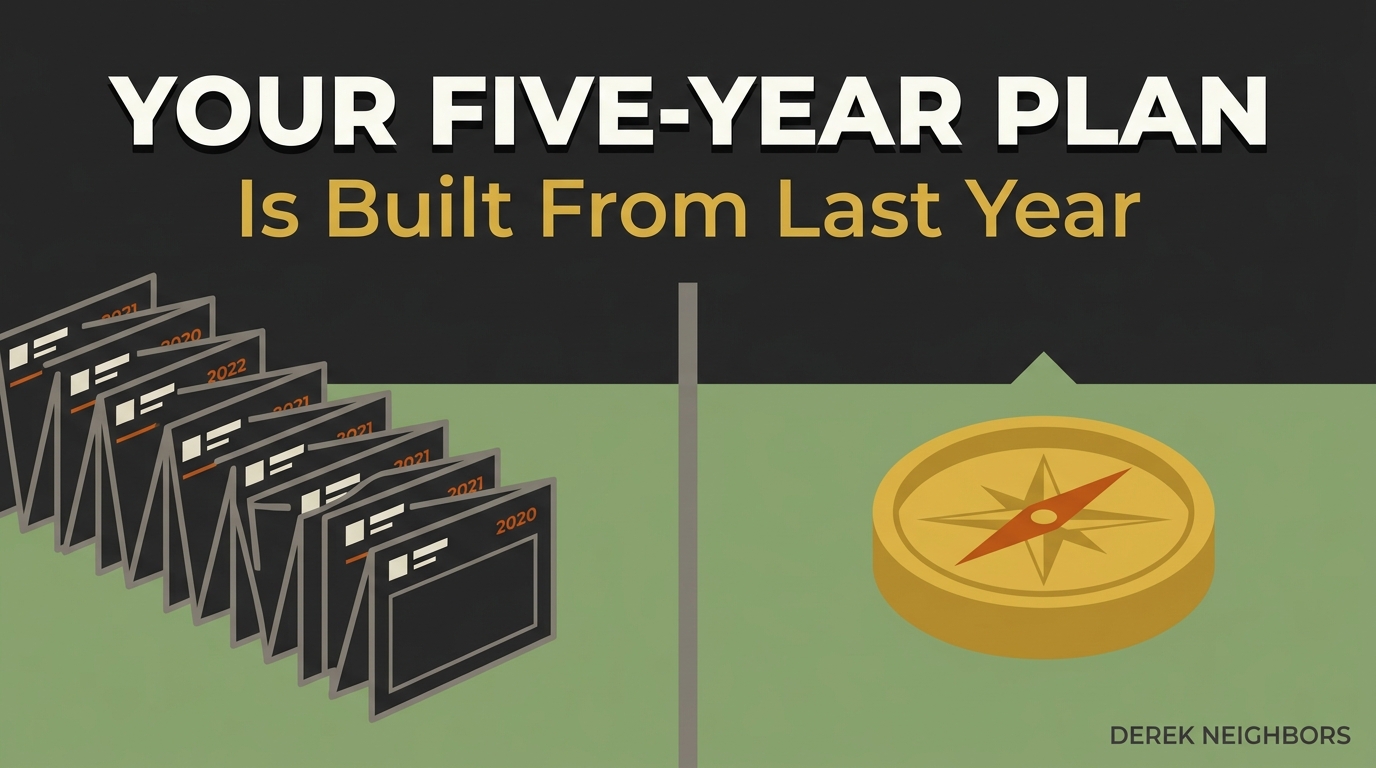
Your Five-Year Plan Is Built From Last Year
By Derek Neighbors on August 20, 2026
We booked two days to write a five-year plan and put 2029 on a whiteboard.
The product line stayed the same, the titles stayed the same, and the customers stayed the same, with “enterprise” written larger. We left proud. Eighteen months later the stack we had planned against was gone. We were still reporting green on a slide nobody believed.
I have written those slides. I have defended them in a room that wanted a path more than it wanted the truth. The truth is ugly and simple. Most five-year plans are last year with a later date.
If you have been around this site, you already know a different planning problem. Naming a stop keeps a bold start from wandering until someone else ends it for you. This piece is the other failure. You named so many years that you stopped seeing what can actually happen next.
The Symptoms
Boards and high performers ask serious people for five-year plans. The request sounds like adulthood.
Watch what the room does with the request. It copies the current org chart into a prettier deck. It keeps the same job titles and moves the years. It lists products that would need a team, a market, and a tool set that do not exist yet. Then it feels relief, because the future has a page number.
You can see it in a smaller room. A founder writes “Series B platform play” and still cannot name the next customer who would pay for the current product.
People who already have goals still say they cannot see the path. The itch is visibility. The culture sells a longer itinerary for that itch.
I used to treat the itch as a character test. If I could not see year five, I was unserious. I made the slide anyway. The work that later changed my life was not on it. The work that was on it copied the job I already had.
The Assessment
Pull the last five-year slide you made, for a company or for yourself. Ask four questions out loud.
What on this slide requires a person, a tool, or a market you do not have? If the answer is most of the page, the slide decorated a wish.
What is copied from the current org chart? Same titles, same reporting lines, same product families with a plus sign. That is last year claiming the future as territory.
What would you still do if the titles changed next quarter? If the answer is nothing, the slide was about identity, not work.
Are you forecasting cash, or writing an identity itinerary?
| Cash and constraint | Identity itinerary | |
|---|---|---|
| Example | Runway, a lease, a hire you can pay in ninety days, a plant or trial with a real lead time | “I will be the kind of leader who…” plus a year that has not earned the skills |
| Can you defend it tomorrow? | Yes, with numbers | No. The year is decoration |
| What to do | Keep the date | Cut the line |
Look for the hours. If the week after the offsite goes to updating the deck, you already have your diagnosis. If the week goes to a skill, a relationship, or a harder room, the slide was a conversation starter and then it got out of the way.
Why Five-Year Plans Copy Last Year
The futures worth living stay invisible because the raw material does not exist yet. Missing people and tools limit what you can ship. They do not cancel the direction. A person with no offsite, no slide, and no spare headcount still owes a compass and the next honest move.
Stuart Kauffman called the nearby set of next moves the adjacent possible. You can only step into rooms that touch the room you are in. A leap still gets built from stacked capacity, not from a line on a slide. A five-year itinerary pretends the far rooms already have people, tools, and customers. They do not. Those come from skills you have not stacked, relationships you have not earned, and rooms you have not entered. The slide reveals a copy habit that was already there.
Aristotle had a cleaner pair for this than most strategy books.
What Is Dynamis?
dynamis is potentiality: the real capacity in a thing to become something it is not yet, drawn from what is already actual, not a hidden destiny you discover by staring at 2029. An acorn has the dynamis of an oak if you grow it. A team has the dynamis of the next product it can actually build from the customers and craft it already has. See dynamis.
energeia is the activity that turns that capacity into a result, which happens in the hours, not on the slide. A plan that never becomes energeia is a picture of an oak taped to an acorn.
This is why the five-year deck feels so adult and produces so little. It treats a picture of year five as if the capacity were already there. Capacity is real. It lives in what you can do from here. It does not live in a title you scheduled.
phronesis is the faculty that can hold a direction without lying about the road. telos is the aim. Keep those. Law 29 used telos as a worthy ending so a start does not wander. Here telos is the compass sentence: who you serve, and what excellence looks like when you get there. The itinerary is the thing that has to go.
kairos is the opening that shows up because you got closer, not because a Gantt chart reached a row labeled “2029.” You do not get kairos by staring at a calendar. You get it by being the kind of person the next room can use.
hexis is how the adjacent possible actually grows. A skill done enough times becomes a disposition. Relationships deepen the same way. Harder rooms stop feeling foreign when you have been in them on purpose. None of that appears as a bullet under “Q3 2028.” It appears as this week’s practice.
A different dating problem lives in old pain that still arrives on time. That essay is about reactions that were accurate once. This one is about ambition slides that were accurate once. Both fail the same way: last year’s picture runs the present. Do not mix the treatments. Date a flinch. Burn a fake itinerary.
Potential that sits unused is the decay version. This is the planning version. You can feel full of potential and still spend a year reporting against a deck that cannot see what you are actually growing.
arete here is becoming excellent from the work in front of you, not arriving at a 2029 title you wrote when you were a different operator.
The Treatment
Write the compass in one sentence. Who you serve, and what excellence looks like. Say it out loud to a smart friend. If you need a paragraph, you have a brochure, not a direction you can remember when the slide is closed. phronesis starts as that sentence.
Name three adjacent moves this month: a skill you can practice, a relationship you can deepen, and a harder room you can enter. A customer call, a stage, a codebase, or a market that stretches you without a fictional org. If a move needs a person you have not met and a tool you have not built, it is not adjacent.
Kill one line on the five-year slide that assumes last year’s org. Cut the title that only exists if the company stays the same shape, the product that needs a team you will not hire, or the “platform” word that has no customer. Cut it in the room so people watch the fiction die.
Each quarter, write what became possible that was not on the plan. Two or three lines. If the list is empty, you spent the quarter decorating last year. If the list is real, that is the plan updating itself through energeia.
Keep dates for cash and contracts. Dump dates for identity. Runway, a lease, and a hire you can pay are dates. “I will be a different kind of leader by 2029” is a wish with a year attached.
None of this says skip planning. The mean is a compass plus the next adjacent work. The excess is a five-year identity you defend after the world moved. The deficiency is refusing all dates, including the cash ones, and treating the blank as a philosophy.
A factory, a drug trial, and a regulated build can have real multi-year lead times. Those dates are the work. The failure is the identity itinerary that copies last year’s titles and products forward. Skip that version. A ninety-day constraint is often more honest than a five-year identity. You still owe people a forecast when money is on the line. You do not owe them a novel about a company that does not exist.
The obligation does not wait on a new planning cycle. You do not control whether a board asks for a five-year file. You control whether last year’s org gets pasted into it. You can run the compass sentence this afternoon. You can cut one fake line before the next staff meeting. arete does not ask the offsite for permission. Headcount limits what you can ship this quarter. It does not grant or revoke the capacity to hold a direction.
The Prevention
A board or a recruiter can still demand the file. The assent is yours. When someone asks where you will be in five years, answer with the compass and the next adjacent move. If they need a slide, give them cash and constraints.
Once a week, one sentence: did this week’s work grow what is possible, or did it decorate last year?
I still keep numbers. I still keep ends. I do not keep a picture of a future that has not earned its materials.
Final Thoughts
A five-year plan feels like courage because it fills the blank. The blank is the point. The next honest room is closer than 2029 and harder than a font change.
Keep the compass. Burn the fake itinerary. Then do the work that makes a different year possible.
If you want a community that will hold a direction without making you fake a five-year slide, MasteryLab is where people practice the next adjacent move in public.
FAQ
Are five-year plans useless?
Cash forecasts, contracts, hiring you can fund next quarter, and real multi-year lead times (a plant, a trial, a regulated build) are useful. A five-year identity itinerary that copies last year’s titles, customers, and product line is last year with a later date. Keep a one-sentence compass. Plan the next adjacent skill, the next relationship, and the next harder room. Update the slide when the possible actually moved.
What is the adjacent possible?
The adjacent possible is the set of next moves that can exist from where you already stand. A future that needs people, tools, or customers you do not have yet is not adjacent. You expand the set by stacking skills, deepening relationships, and entering harder rooms. You do not expand it by writing 2029 in a bigger font.
What does dynamis mean in Greek philosophy?
dynamis is Aristotle’s word for potentiality: the real capacity in a thing to become something it is not yet. An acorn has the dynamis of an oak. A team has the dynamis of the next product it can actually build from the skills and customers it has. energeia is the activity that turns that capacity into a result. A slide is neither. See dynamis.
How do you plan a career without a five-year roadmap?
Write who you serve and what excellence looks like in one sentence. Keep dates for money and contracts. Each quarter, name one skill, one relationship, and one harder room that would make a new kind of work possible. If a line on the old slide still assumes last year’s org, cut it. Review what became possible that was not on the plan. That review is the plan.