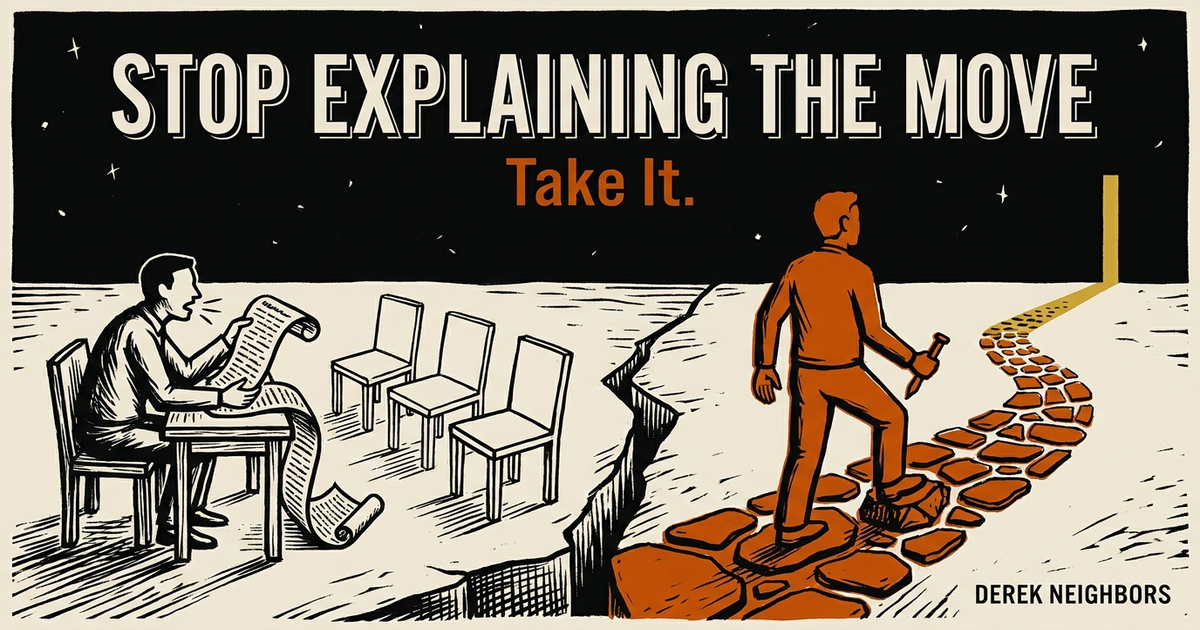
Stop Explaining the Move. Take It.
By Derek Neighbors on August 2, 2026
I used to treat the briefing as the work.
Before I shipped the hard change, I drafted the memo that anticipated every objection. Before I started the training block, I explained why the block mattered to people who had already decided not to train. Before I made the call, I rehearsed the call for an audience that was never going to place it for me.
The same pattern shows up outside offices. You talk the hard conversation to three friends before you have it with the person who needs it. You explain the training plan to the group chat before you lace the shoes. You rehearse the apology for an audience that was never going to accept it for you.
It felt responsible, like leadership, like risk reduction.
What I was doing was spending the fuel the move needed on a courtroom that never adjourned.
The Standard
Excellence protects a simple order: move, then account when an account is owed.
You do not control whether skeptics approve or whether the gallery fills. You control the order of your hour and whether you assent to delay. The high performers I respect do not treat consensus as the ignition. They treat andreia as the willingness to take the next right step while approval is still incomplete. andreia is not fearlessness. Aristotle placed it between cowardice and recklessness. You feel the pull to stall. You act anyway, with judgment, not with a carnival of self-justification.
The bar is concrete. Can you take today’s real step before the room finishes its brief about your step? If the answer is usually no, carefulness has turned into auditioning. The duty to take the next right step still holds when nobody is owed a brief and nobody will applaud. Solitude does not retire andreia.
The Gap
Most of us reverse the order.
We explain first, then maybe move. We call the reverse order professionalism, alignment, stakeholder management, “bringing people along.” Sometimes those words name real craft. Often they name a nervous system that wants the jury sequestered before the first rep.
The gap exists because doxa, opinion, spikes early. Motion feels lonely. The courtroom offers temporary relief. You get nods, caveats, and a schedule for another conversation. Nothing in your craft changed. You burned attention that could have gone into the thing itself.
I have watched strong operators lose weeks this way. The product decision was ready on Monday. By Thursday they had run three alignment loops and still had not touched the work. The operators were sharp. The week still went to protecting themselves from looking wrong in public. The cost was private: fewer reps, weaker judgment, a story that said “we almost started.”
Smart people stall in the processing engine when analysis replaces action. This is the cousin problem. Here the analysis is social. The research phase ended. The defense phase kept running.
The Path
Aristotle helps here if you keep the words practical.
kinesis is motion or change in progress. In Greek philosophy it names unfinished movement toward an end. energeia is being-at-work, activity complete in the doing. Building a house is kinesis until the house stands. Seeing, choosing, acting with courage can be energeia: the excellence is in the act, not in a later verdict from the gallery.
That distinction matters for your calendar. Rehearsing a defense for doxa is a different activity from practicing the craft. Both spend nerve. Only one builds the capacity you claim to want. arete is the actualization of rational agency in the act. Waiting for the gallery to finish is failing that function when the step is already available. An approved story about capacity is still a story. Preferring the approved story to the act is mistaking appearance for what excellence actually is.
Building your reputation as the main project is a related trap. The courtroom of opinion will always take more time than you budget. Character forms in the moves you take while the room is still talking, not in the briefs you deliver to quiet the room.
phronesis keeps this from becoming a license to be rude or reckless. Some people are owed an account because of role, ethics, or shared consequence. A one-sentence reason to the person who will carry the cost is craft. A twelve-slide brief for every spectator is delay with a professional calendar attached. Motion-first does not cancel duties of consent, safety, or justice that require speech before action. Institutional duty can make a short account part of the move when people with authority or consequence must approve the spend. The failure is expanding the jury to spectators who carry none of the cost and have no standing to change the decision. Spectator comfort is not shared reason.
Four challenges for the week:
-
Motion-first hour. Take one real practice step before any explanatory email, Slack thread, or meeting about the step. Ship the draft. Run the set. Make the call. Then, if needed, say what you did.
-
Skeptic budget. Cap defense conversations. Pick a number you will not exceed this week. Every extra briefing after that comes out of practice time, so treat it as a trade, not as free virtue.
-
One-sentence account. When account is owed, give one clear sentence of why, then return to the work. Do not offer a second brief unless someone asks a real question that changes the decision.
-
Courtroom audit. List who you are rehearsing for. Mark which people can actually change the decision or must live with the consequences. Stop performing for the rest. Their comfort is not your curriculum.
Providence is not passive. Neither is courage. Waiting for the metaphysics, the mood, or the majority to settle is still a stall. Higher stakes often force the order because drift finally costs something. Restore the order with a rule before a crisis has to do it for you.
The Test
Run the week, then count.
How many practice steps did you take that changed the state of the work: a draft that exists, a call that happened, a set that got completed? How many briefs did you deliver before those steps? If the briefs outnumber the steps, you know what ate the fuel. A real step leaves a different receipt than more speech.
A useful marker: did one hard move happen before the room was comfortable with it? If every move waited for comfort, you optimized for doxa and called it prudence.
Ask yourself where you confused consensus with courage. Consensus can be wise after motion. Consensus as a precondition for motion is how teams and individuals stay articulate and undertrained.
The Mastery
Mastery keeps speech in its place and motion in its hour.
You still explain when role, ethics, or craft requires it. You still invite feedback from people whose judgment improves the work. You still refuse reckless leaps that phronesis would reject. What changes is the precondition. Approval stops being the price of admission to your own practice.
Ongoing development looks dull from the outside. You protect the first hour. You keep the skeptic budget. You give short accounts to the people who are actually owed them. You let the empty gallery stay empty.
andreia keeps asking for the step. kinesis reminds you that change needs motion. The courtroom will always have another question. Your practice will not grow on answers alone.
Final Thoughts
The briefing can feel like progress because it produces words, meetings, and temporary relief. Progress in arete produces a different receipt: a move taken under incomplete approval, then an honest account to the few who are owed one. Speak where speech is duty. Do not use speech as anesthesia for a step you still refuse. Stop explaining the move as a way to avoid taking it. Take it.
If you want a community that trains motion before theater, MasteryLab.co is where people practice excellence under real stakes instead of rehearsing it for an empty gallery.


