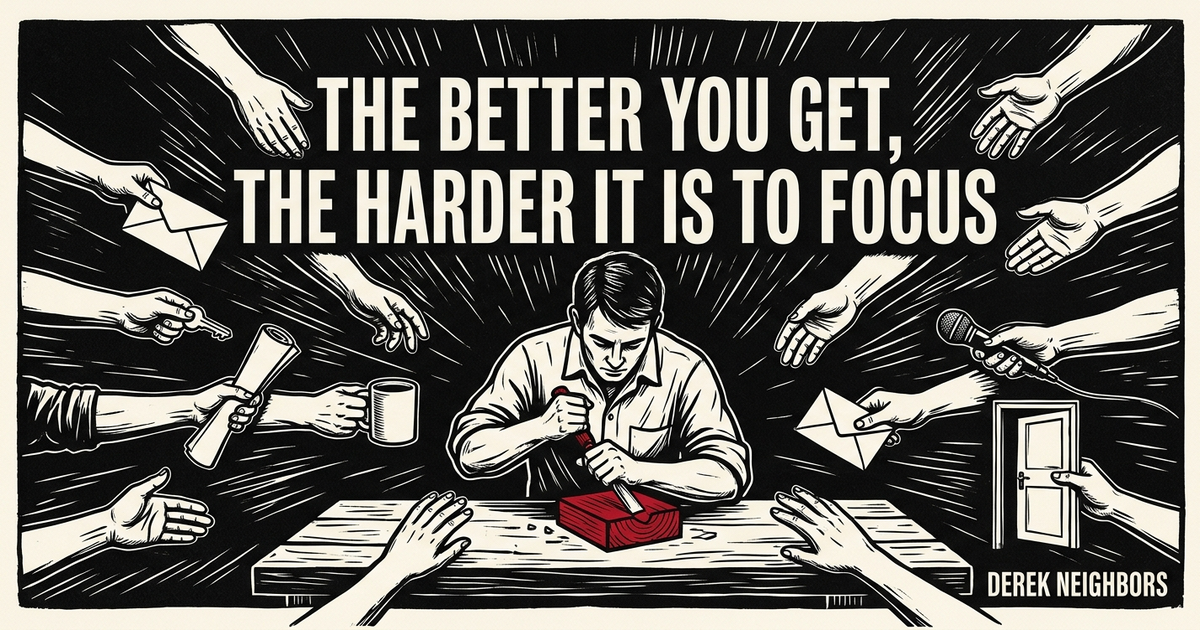
The Better You Get, the Harder It Is to Focus
By Derek Neighbors on October 28, 2026
Your best engineer made the build fast. CI went from forty minutes to six, and the whole company felt it the same week.
Then the asks started. Could she look at the mobile pipeline? Would she sit in on architecture review? The platform team wanted her on their hiring panel. The data team had a question about their tooling, just an hour. Someone wanted her to lead the internal AI guild, and someone else wanted a talk at the all-hands. A founder she knew asked her to advise his startup for a little equity.
Every one of those was reasonable, and most of them were flattering. A couple were good for her career.
Eighteen months later she has fourteen recurring meetings, five Slack channels where people tag her for opinions, and a reputation as the person who knows everything. The build takes twenty-two minutes again. Nobody on the platform team has gone deep on it in a year, because the person who would have is everywhere at once.
She did not say yes to a single bad thing, which is why she never saw her focus go.
Getting Good Was Supposed to Buy You Freedom
Most of us believe that skill buys choice. Do excellent work for long enough and you earn the right to pick what you do next.
That belief is correct. Competence does buy choice, and that turns out to be the problem. The better you get, the more people want a piece of the thing you are good at, and every piece comes as an offer you are free to accept.
People talk about focus as if it means saying no to bad offers. Turning down bad offers takes no discipline. When a recruiter pitches a job you would hate, you delete the email. The offers that hurt are the good ones, like the review where your opinion would save a team a month, or the side project that would be fun to build. Those are hard to refuse because refusing them looks selfish.
By concentration I mean sustained work on one aim, in long uninterrupted blocks, for months at a time. Success gives you a hundred chances to spend it, and you do the spending yourself, one reasonable yes at a time.
None of this waits for success, either. The engineer nobody asks scatters too, usually across side projects meant to get noticed. Offers make the same choice harder to see, because now every option comes with someone’s respect attached.
Built by Concentration, Kept by Diversification
There is an old investing line, one Farnam Street has written about: fortunes are built through concentration and preserved through diversification. Index funds grow savings slowly and well, but the big fortunes inside them were built by people who went heavy on one company they understood, then spread out to protect what they made.
Both halves are true, and they belong to different seasons. The trouble starts when you switch seasons early.
Mark Twain had a version in Pudd’nhead Wilson. The fool, he wrote, says not to put all your eggs in one basket, “which is but a manner of saying, ‘Scatter your money and your attention.’” The wise man puts all his eggs in the one basket and watches that basket.
Twain’s fool scatters attention along with money, and attention is the one that costs you the skill people know you for.
The paradox exists because of how offers are priced. Each one shows up with its own small price tag. “It’s an hour a week.” “Just one review.” Measured that way, every offer is cheap. The cost lands somewhere else, on the long uninterrupted stretches where the hard work happens. An hour on Tuesday at 1pm breaks a four-hour afternoon into two short pieces, and short pieces are where people answer Slack instead of solving the problem.
Gratitude makes it worse. When you were unknown, you would have killed for these invitations. Saying no now feels like forgetting where you came from.
There is also the pleasure of being wanted. Being the person everyone asks feels good, and some yeses are for that feeling more than for the work. Notice which ones, because no calendar audit will fix a craving you have not admitted to.
AI adds a new twist, and I think it is a good one. When I sit down with Claude in a repo, I can start four side projects before lunch. Starting things used to cost hours, and the hours stopped you. The model removed most of that cost. What remains is the older cost: where you point your attention and for how long. That helps anyone who has chosen a target, because the model will push hard wherever you aim it. For someone who never chose, it means nothing slows them down on the way to five half-built things.
One Target at a Time
Aristotle opens the Nicomachean Ethics with a question about aim. If there is some end we want for its own sake, he asks, would knowing it not help us live, “like archers who have a mark to aim at,” so that we are more likely to hit what is right? The Greek word for that mark is skopos, the target, the specific point you aim your effort at. Aristotle was aiming at the good of a whole life, and the logic holds at the smaller scale of a job.
An archer facing three targets still has one arrow on the string. The draw has to commit to a direction before release, so splitting the aim gives you a worse shot at all three.
Seneca made the same point to his friend Lucilius in his second letter. Lucilius was reading widely, skipping from author to author. Seneca warned him that a person who spends his life traveling ends up with many hosts and no friends. His line is usually translated “everywhere means nowhere,” and he meant it for a mind that samples everything and stays with nothing.
Neither of them was against range. Seneca read constantly, and Aristotle studied everything from politics to the anatomy of animals. What they cared about was order: pick a mark, stay on it until it is hit or proven wrong, and then pick the next one.
So when do you concentrate, and when do you spread out?
Concentrate while the skill is still getting better. If the core work still surprises you, if you are still finding problems you did not know existed, you are in the building season. Offers that pull you away during this season cost more than they appear to, because they interrupt compounding.
Spread out when what you built can run without you, or when it depends on you so heavily that it is fragile. If the build only stays fast because one engineer babysits it, the next move is to diversify, and the right way to do that is to teach. Writing the runbook, pairing with two people on the pipeline, and having the agent document why each step exists all spread the skill to more people, so it stops depending on one.
I wrote last year that you’re not less talented, you’re less focused. That piece covered the attention that builds a skill, and this one picks up once the skill starts to pay off.
How to Protect Your Focus After You Get Good
You can do this without becoming a hermit. It takes a few plain habits that good people skip because they are busy saying yes.
Write your target in one sentence. “Make the build fast and keep it fast.” “Ship the billing rewrite by March.” If you cannot write it, you have no basis for judging any offer, so every offer wins by default. Picking the mark also does not mean picturing it in vivid detail. As I wrote earlier this month, picturing the win can make a team work less. Name it and then go do the work.
Price every yes in deep hours. Ask which block of your main work the new thing replaces, which tells you far more than how long it takes. If the answer is “my Tuesday afternoon,” you are trading the most valuable four hours of your week for a recurring meeting.
Say yes only to what feeds the target. One test is enough: will this make the main work better within a quarter? A review of the mobile pipeline might. An advisory role at a friend’s startup almost never does. A few offers that fail the test still deserve a yes, like a teammate in real trouble or a team need that outranks your plan for the quarter. Those should be rare, and you should take them knowing exactly what they cost.
Hand the side asks to someone earlier on the curve. The data team’s tooling question is a great first project for a mid-level engineer who wants to grow into tooling work, so the handoff feeds their own target. Give them the problem, an agent, and one hour of your review. They get a stretch assignment, and you keep your Tuesday.
Count once a quarter. Look at your calendar for the last thirteen weeks. Count how many of your best hours went to the target. The number is usually smaller than people expect.
If you lead people, look at how you reward your best ones. The usual reward for excellent work is more scope, often another team or a seat on another committee. Each of those takes deep hours away from the work you meant to reward. Protect their deep hours and treat that protection as the reward.
Final Thoughts
Getting good at your work brings in offers, and the good ones do the damage. Each comes priced in its own small hour, while the cost lands on the long blocks of concentration that built the skill in the first place.
Aristotle asked for a mark to aim at, and Twain told you to put your eggs in one basket and watch it. Concentrate while you are still getting better. When the time comes to spread out, spread the skill into other people so it outlasts your attention.
If you want to build a practice that keeps you getting better after the offers start arriving, MasteryLab is where that work happens.
FAQ
Why does it get harder to focus as you get better at your job?
Skill produces offers. People who are good at something get asked to review, advise, mentor, speak, and help other teams. Each request is reasonable and small, so it gets priced in its own hour. The real cost lands on the long, uninterrupted blocks of work that built the skill, and those blocks are the first thing a full calendar destroys.
When should you concentrate and when should you diversify your career?
Concentrate while the skill is still improving and the core work still surprises you. Spread out when what you built can run without you, or when it depends so heavily on you that it is fragile. Even then, the best way to spread out is to teach the skill to other people, which protects it instead of thinning it.
How do you say no to good opportunities?
Write your main target in one sentence, then judge each offer against it. Ask which deep block of your week the offer would replace, and whether it will make the main work better within a quarter. If it will not, decline it or hand it to someone earlier in their career who would grow from it.
What does skopos mean?
skopos is the Greek word for a target or mark, the thing an archer aims at. Aristotle opens the Nicomachean Ethics by asking whether knowing the goal of life would help us, like archers who have a mark to aim at, hit what is right. It is the specific point you aim your effort at.