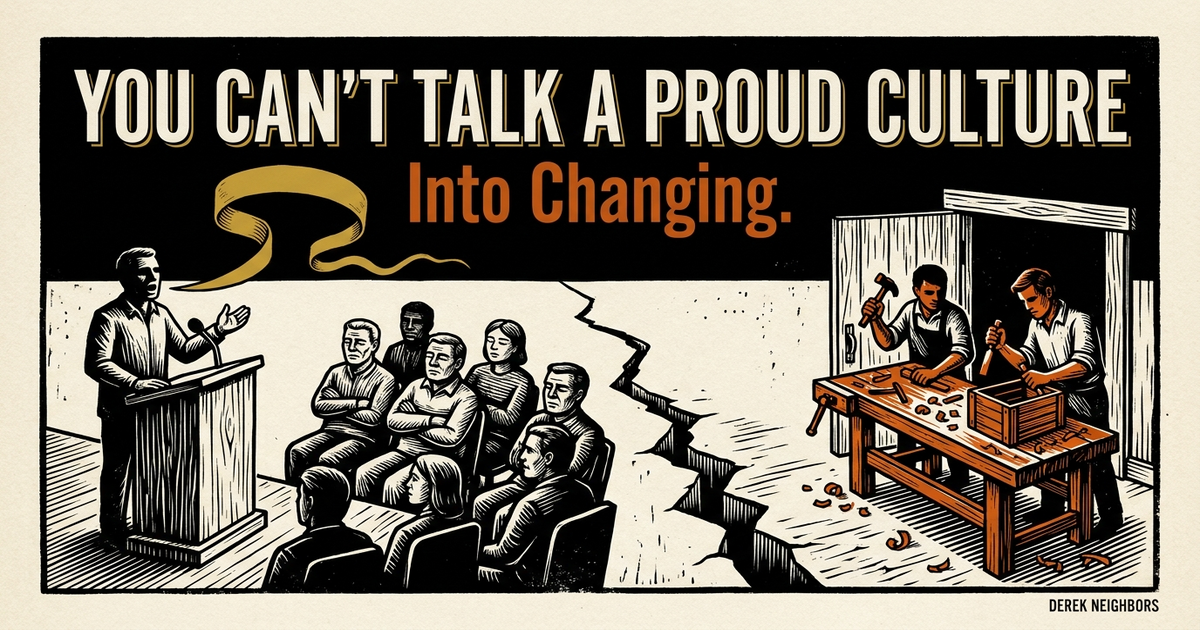
You Can't Talk a Proud Culture Into Changing
By Derek Neighbors on August 15, 2026
I have sat in the conversion meeting.
The slide is cleaner than last quarter’s slide. The case is better. People nod. Then they go back to the process that already made them proud, because pride is how a strong culture knows itself. You won the room and lost Monday.
NASA did not mainly convert Shuttle-era identity by speech. Commercial partners became real work when a protected program office used different contracting rules and let cargo, then crew, become evidence.
Most people with a calendar will not make that move. They keep collecting agreement and treating the nods as the work. You still owe the smaller version if you cannot stand up a program office: one loop, one table, one night with a written exception.
The Eternal Question
Can you talk a proud culture into becoming something it did not already love?
Weak cultures fold under a mandate. Strong ones fight harder, especially when their self-respect is bound up in a past success. The people in the room are not stupid. They are loyal to the method that paid them in competence and status. Your better argument sounds, to them, like an insult to the years that worked.
This is not only a NASA problem. A department can ship on the same Tuesday checklist, a volunteer board can run the same fundraiser, and a family can refuse any holiday except the one that already counts as love. The pattern is the same: you keep scheduling the meeting that already failed.
You do not control whether a proud culture loves the new custom. You control whether you reconvene a meeting that already died, or plant a practice the old custom does not get to smother.
The question underneath is older than org charts. When custom has fused with identity, does speech still have a job, or has the job moved to a plot of ground the old custom does not control?
The Ancient View
Greek cities did not spend their best years trying to turn the mother city into a different city by debate. They planted an apoikia: a colony away from home. People and custom moved onto new ground. The settlement kept its own laws. It stayed related to the metropolis without asking the metropolis to repent in public.
That is a hard sentence if you were raised to treat another alignment meeting as the work. The colony is a bet that a way of life has to be lived before it can be admired, not a sulk.
Plato learned the other half the expensive way. He went to Syracuse to convert a proud court by proximity and speech. Dionysius had power. Plato had philosophy. The Seventh Letter is the hangover: the court did not become a school because a serious man talked well in it. Conversion of a sitting identity by conversation is a romantic theory of power.
What lasted was the Academy. A protected place with different rules, a curriculum the city did not have to vote into existence every week, students formed by practice rather than by one more banquet argument. Athens did not wake up Platonist because Plato won a meeting. A small institution kept aiming at a form of life until that life had weight. Your two weekly numbers are a translation of that aim into a room that only updates on evidence, not a claim that the Good is a dashboard.
Aristotle helps name why the meeting feels busy and changes nothing. energeia is activity complete in the doing. Building the small office is that kind of activity. The conversion series is closer to incomplete motion. It is aimed at a future yes. If the yes never comes, you spent the year traveling toward a door that stayed shut.
phronesis is the judgment that notices the door. kairos is the moment the third conversion meeting has become delay with a deck. arete here is the quality of the work that can exist because someone gave it a room, not a values poster hung in the old one.
The Modern Problem
We keep arguing because arguing still looks like leadership.
A mandate would split the room. A protected office looks like a shadow org, and shadow orgs get accused of disloyalty before they ship anything. So we choose the option that photographs well: another all-hands, another listening tour, another slide that says we heard you. Companies break the same way people do when nerve and identity take the wound. A proud culture that already succeeded will treat your reform as a wound even when you are right.
NASA’s commercial cargo and crew programs did not begin as a vibe. They began as a different contracting and program structure so a partner could fly under rules the old procurement identity would have smothered. Space Act Agreements are boring until you notice what they protected: a place where a new way of working could produce a docking, a splashdown, a crew, without first winning a theological fight about who real aerospace people are.
You do not need a launch pad to copy the shape. A product team that cannot get a checkout change through the platform committee can run one clean path in a contained surface and publish the conversion and the refund rate. A school department that cannot get the faculty to drop a dead unit can teach the replacement in one section with shared exams. A family that fights every Thanksgiving can host one smaller table on a different day and let the afternoon be evidence.
The failure mode I see most is not laziness. It is loyalty to unity as an aesthetic. Leaders would rather lose quietly inside one process than succeed in a second room and then have to explain the second room. Voice before a decision still matters while the plan is soft. After the culture has refused the plan twice, more voice on the same question is a stall you can put on a calendar.
There is a cousin mistake on the other side. Copying someone else’s playbook into the old room usually dies for the same reason conversion dies: the surrounding causes are missing. The beachhead is a small set of different rules plus a scoreboard, not a photocopied binder dropped into the same committee.
And it is not the same as taking a personal move before you finish explaining it. That piece is about your own delay. This one is about a group that will not be talked out of itself. You can move before your own jury is done and still be trapped if the only legal place to work is the room that already voted no.
The Integration
Plant the colony, keep it related to home, and make it earn absorption. Call that a beachhead if you want a war word, or an apoikia if you want the old one: a small legal place with different rules, still related to the parent, scored by results the parent already understands. The excess is a mandate that splits the room with no evidence. The deficiency is a third conversion meeting. The mean is the related office with a scoreboard and a date.
Write a one-page charter: what the small office is allowed to do that the parent process is not, who decides inside it, what it must not dodge. Different rules are the point. Same rules with a cooler name is the conversion meeting in a new building.
Score what the old culture already respects. NASA needed flights, not a manifesto about commercial partnership. Your department needs cycle time, defect rate, revenue, attendance, recovery time, something a skeptic can hate and still have to read. Buy-in is a lagging indicator. If you wait for buy-in first, you will wait until the people who would have staffed the office have left.
Set an absorption date or a kill date. A beachhead that never rejoins the parent becomes a club. A beachhead that rejoins too early gets digested by the old custom before it has a body. phronesis lives in that timing. You are not collecting a rebel identity. You are growing a practice until the parent can use it without pretending it invented the practice in 1998.
Guardrail, and I mean it: you do not open a side door around safety, consent, or justice. Those are load-bearing walls, not a style preference you can talk people out of. If the old system is refusing a change because the change is reckless, the meeting that failed is protecting something real. The colony is for methods that already work in miniature and need a legal place to live. It is not a hideout for a person who lost a vote they should have lost.
prohairesis still sits with you if you have no title. A staff engineer can ring-fence a service. A nurse can run one unit’s handoff the new way with a written exception. A parent can stop trying to convert the whole extended family and host the one table they can actually stand. Obligation does not wait for the org chart to bless the plot of ground.
The Practice
Name the conversion meeting that already failed twice. Write the date of the second failure on a card. If you schedule a third with the same ask, you are refusing the kairos two meetings already spent.
Charter the office on one page: three permissions, one ban, and a name so small it sounds slightly insulting. If you need a steering committee to approve the charter, you are still in the conversion meeting.
Pick two numbers the old culture already uses. Publish them weekly from the small office. Do not publish a narrative about mindset. If the numbers move, the narrative will arrive as gossip, which is how proud cultures actually update.
Put a date on absorption or death. Ninety days is enough to know whether you planted a colony or a complaint. If the work is real and still cannot live inside the parent, extend once, in writing, with a new score. If it cannot survive contact with the parent and cannot justify a longer exile, kill it. Exile without a purpose is a hobby.
Run the role test. Could a person without your title plant a smaller version of this? If the answer is no, you built a personality cult with a conference room. Shrink the charter until a competent person could hold it.
The test is ugly on purpose. You will want one more all-hands because all-hands still feel like hope, and hope still does not ship a docking, a checkout, or a cleaner handoff. A proud culture changes when a small piece of the future already works in daylight, under rules the old process does not get to smother, and the scoreboard is too public to sneer at forever.
Build next door. Then make next door too useful to leave standing as a novelty.
FAQ
What do you do when a company culture refuses to change?
Stop treating the next all-hands as the strategy. If the culture already refused twice, charter a small protected office with different rules, score it by outcomes the old culture can see, and set an absorption date or a kill date. Head-on persuasion usually fails when identity is welded to past success.
What is apoikia in Greek history?
apoikia is a colony planted away from the mother city. Greek cities moved people and custom onto new ground instead of converting the metropolis by debate. The colony kept its own laws while remaining related to home. That is the old name for a protected office that has to earn its place with results.
Did NASA change by persuading Shuttle engineers?
Not mainly. Commercial Orbital Transportation Services and later commercial crew work used different contracting and a protected program office so partners could fly cargo and then crew. The flights became evidence the conversion meeting never produced. The old identity did not vanish overnight. The new work got a place to live.
When is a parallel team a bad idea?
When you are trying to dodge a real standard. Safety, consent, and justice do not get a side door. A parallel team that exists to stay a rebel club, hide a pet project, or split loyalty forever is a stall. The office is supposed to earn absorption or get killed.
If you want a place where people practice building the work instead of winning the meeting, that is the work we do inside MasteryLab. A proud culture updates when a small piece of the future already works in daylight.