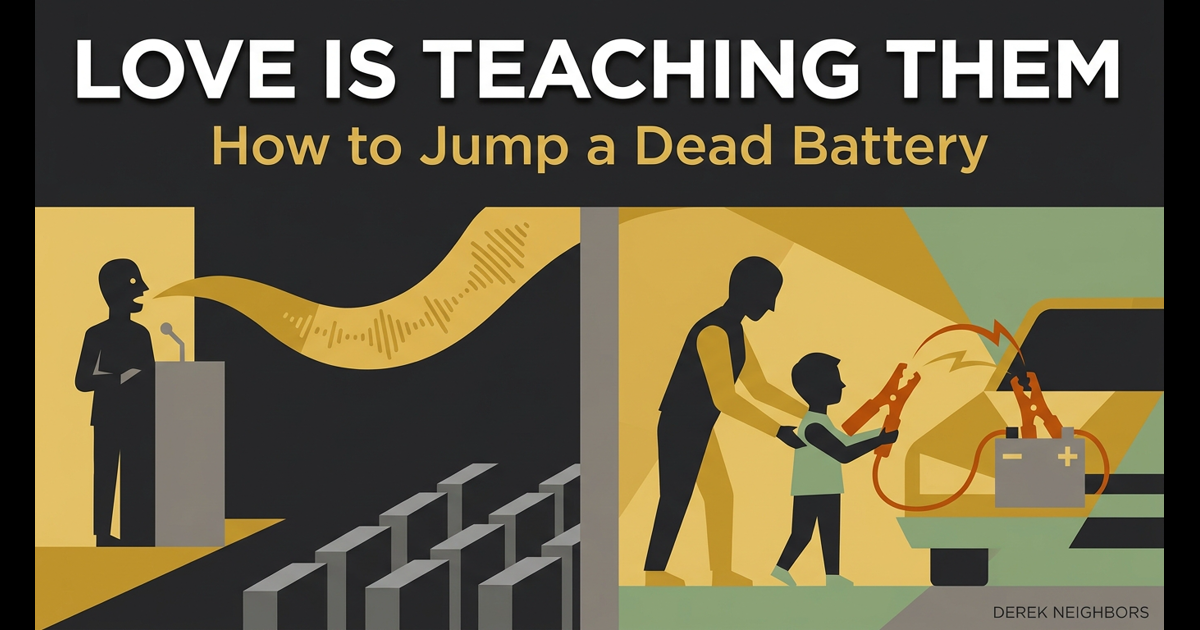
Love Is Teaching Them How to Jump a Dead Battery
By Derek Neighbors on August 14, 2026
I used to think I was being decent when I jumped the battery for them.
They were late. I had cables. I had done it a hundred times. I hooked the clamps, started the engine, waved them off, and felt useful.
What I had done was keep the skill on my side of the driveway.
The same move shows up everywhere I have led. The pool filter that only I would clean. The junior who still Slack-pings me to run the deploy. We talk about independence, then we do the unsexy job because we are faster, and because needing to be needed feels like closeness.
The Standard
Serious care transfers agency. Agency here means they can produce the result without your hands on the tool.
The bar is concrete. Can they handle the ordinary emergency without you: a dead car, a clogged filter, a failed deploy, an angry vendor, a first drive in the rain? If you have no car, no pool, and no children, the objects change: a coworker, a sibling, a neighbor, an apartment fuse box, a form at the county office. Property and parenthood do not create the duty. If the answer is usually no, you have been useful, and you still have not finished the teaching.
The mean of that care is easy to miss. Excess is finishing every task for them as a lifestyle, and deficiency is leaving them alone with a job they cannot yet do. The excellent act is a guided attempt, then withdrawal.
andreia is courage as right action under fear, not a battlefield speech. Aristotle placed it between cowardice and recklessness. Most of the courage that actually forms a person is small: clamps on a battery, a first customer call you do not take for them. The fear is looking incompetent in front of someone who already knows how. The right action is attempting it anyway, with a witness who will not steal the attempt.
paideia is formation. The Greeks did not treat character as a poster. They treated it as training. A values talk can name the standard. Formation happens when someone does the work under correction, then does it again without you hovering on the tool.
techne is craft knowledge you can show. If it cannot be demonstrated, attempted, and corrected, you are broadcasting a preference, not teaching a skill. Experts often cannot narrate the fluency they have. That is why the hands still have to go on the work. Watching you finish it in six minutes leaves them without the techne. They get it by doing it badly, then less badly.
The high performers I respect keep a short list of what still requires them, and they treat that list as a problem to retire. They stay for the ugly first attempt. Then they get out of the way.
The Gap
Most of us give the speech and still do the task.
We call it love, or leadership, or “it will take longer to explain.” Sometimes that sentence is true for one afternoon. As a default, it trains dependence and calls the training care.
Explaining everything can steal the learning. This is the cousin failure in the other direction. You skip the explanation and skip the attempt. You just do it. They stay grateful, and they still cannot do the job.
The gap exists for boring reasons. You are faster. Their first attempt looks like incompetence, and incompetence in front of you feels like a verdict on both of you. Doing it for them produces a clean result. Teaching produces a mess and a person who might not thank you.
I have watched strong parents and strong managers run this loop for years. The kid can quote the family values, and the team can quote the culture deck, and neither can handle the ordinary hard thing on a Tuesday when the person who “cares” is in an airport.
Identity language still matters. Telling someone who they are becoming still leaves them stuck if you never put jumper cables in their hands.
The Path
Name the swap clearly. Doing the task for them keeps you at the center of the work, and teaching the task is what moves the capacity. autarkeia is self-sufficiency, not isolation. Freedom that cannot survive your own company is incomplete. Freedom that cannot survive a dead battery or a vendor who wants a decision is incomplete in a different way. You can be philosophically self-possessed and still helpless in the physical world. That helplessness is a curriculum failure, including when the person who failed to teach you was not you. The obligation to learn, then hand it on, still sits with you.
phronesis keeps this from becoming cruelty. A five-year-old does not jump a battery. A teammate in their first week does not run the production deploy alone at 2 a.m. If they could finish the job with you standing there and not touching the tool, grabbing it is a stolen rep. If they cannot yet do it safely, or the law or the body blocks them, that is incapacity. Being late is not incapacity. The failure is making “I’ll just do it” the resting position because you like being the person who can. If they refuse to try, that refusal is theirs. It does not put the job back on your permanent list. You offer the teaching, and you do not owe them a life of doing it for them.
Leaving the room so a successor can lead is the later move. First you have to put their hands on the work, or your absence is abandonment, not paideia.
Four challenges for the week:
-
One skill. Pick one mundane task they still bring to you. Teach it with hands on the thing, not with a lecture in the kitchen. If you do not have a car or a pool, the list is still local: the fuse box, the insurance call, the contract, the deploy script.
-
Stay for the ugly first attempt. When they hesitate, do not grab the tool. Name the next move. Let them finish. Take over when safety is actually at stake. Leave the tool in their hands when the only thing at stake is pride.
-
Write the dependency list. What still requires you? That list is the curriculum, not a trophy for being indispensable. If the list is long, you have been hoarding the jobs that make you feel needed.
-
Teach-back. The next time the task appears, they run it. You watch. You speak if they are about to hurt themselves or someone else. You stay quiet through clumsiness. Clumsiness is the tuition.
This is arete in a small domain: excellence as enacted capacity, including the capacity you refuse to hoard. You do not control whether they thank you or use the skill the week you taught it. You control whether the skill left your hands.
The Test
Run the next ordinary emergency, then look.
Did they move, or did they call you first? Someone who can jump a battery or run the deploy without you has received something a speech cannot give. Someone who can quote your values and still waits in the driveway got a talk, and still cannot do the job.
A useful marker: did one skill leave your hands this month? If every unsexy job still routes through you, you know what you have been optimizing. You have been optimizing being needed.
Ask where you confused speed with love, and usefulness with formation. Speed can be kindness for an afternoon. As a strategy, it keeps the techne on your side of the work.
The Mastery
Mastery still helps when help is actually required.
You jump the battery when they cannot do it yet, or when the moment is dangerous. You take the call when a teammate would be abandoned rather than trained. phronesis stays in charge of that line.
What changes is the default. “I’ll just do it” stops being how you prove you care. The proof is a person who can do it without you, and who can eventually teach the next person. autarkeia is the receipt. andreia is what they had to practice to get there, in a domain too small to make a keynote.
Ongoing development looks dull. You keep the dependency list short on purpose. Stay for the first attempt, then leave for the second. You become unnecessary in the small domains so they can become free in them.
Final Thoughts
A speech about values is easy to deliver and easy to applaud. The transfer is slower, and easier to skip because you are good at the task and they are not there yet.
Keep the speech if it names a real standard. Then put the cables in their hands. The battery is a picture of the real transfer: the capacity to meet an ordinary hard thing without you, whatever the local object is. If the skill never leaves your side, they will wait in the driveway for a person who will not always be there.
FAQ
Is this only about parenting and cars?
No. The driveway is one picture. The same pattern shows up when a manager still takes every hard customer call, when a partner still books every vendor, when a senior still runs every deploy. Mundane competence is local. A rented room with a fuse box still counts. A sibling or a coworker still counts. Whatever the household list is, the question stays whether they can do the ordinary hard thing without you.
What is paideia if not a values speech?
paideia is Greek for formation, the training of a person through guided practice. A speech can name a standard. Formation happens when someone attempts the work under a witness who will correct them and then let them finish. You do not become able by hearing that ability matters.
When is doing the task for someone still the right move?
When they cannot yet do it safely, when the moment is a true emergency, or when the body or role genuinely cannot carry that task. phronesis, practical judgment, draws that line. The failure is making “I’ll just do it” the default because teaching is slower and their first attempt is ugly.
How do you start if nobody taught you these skills either?
Learn one ordinary skill well enough to hand it on, then teach it. You do not need a perfect childhood or a garage full of tools. You need one task they still bring to you, hands on the work, and a next attempt they run while you stay quiet unless safety is at stake.
If you want a place where people practice handing skill across, not just talking about ownership, that is the work we do inside MasteryLab. If the excellence required you in the room, it will not survive your absence.