Kinesis (κίνησις): Meaning, Definition & Modern Application
KIN-eh-sis
Movement or change in its most fundamental sense—the transition from potentiality to actuality. In Aristotle's philosophy, kinesis encompasses all forms of becoming: growth, alteration, locomotion, and transformation from what something could be into what it is.
Etymology
From kinein, meaning “to move” or “to set in motion.” The root appears in “kinetic,” “cinema,” and “kinesiology.” Aristotle devoted much of his Physics to analyzing kinesis, defining it as the actualization of potential insofar as it is potential. This dense definition captures the idea that movement is the process of becoming, the transition between what something could be and what it is. Parmenides had denied the reality of change; Aristotle’s analysis of kinesis was his answer.
Deep Analysis
Aristotle’s analysis of kinesis in the Physics represents one of his most important contributions to understanding the nature of change. He defined kinesis as “the actualization of what exists in potentiality, insofar as it is in potentiality.” This dense formulation unpacks into a powerful insight: change is real, directional, and always involves the transition from what something could be to what it is becoming. The bronze becoming a statue, the child becoming an adult, the seed becoming a plant, each is kinesis because each involves the actualization of a real potential that already existed within the thing changing.
Aristotle identified four types of change within the broader category of kinesis: change in quantity (growth and diminution), change in quality (alteration), change in place (locomotion), and the most fundamental pair, generation (coming-into-being) and destruction (passing-away). This taxonomy was not merely classificatory. It was diagnostic. When you observe change, identifying which type of kinesis is occurring tells you what kind of potential is being actualized and what kind of endpoint the change is moving toward.
The critical energeia-kinesis distinction is one of the most philosophically productive ideas in Aristotle’s corpus. Kinesis is incomplete until its end is reached. Building a house is kinesis because at every moment before completion, the building remains unfinished. The process aims at something beyond itself. Energeia, by contrast, is complete in each moment. Seeing is energeia because at every instant of the activity, you are fully seeing. You do not “finish” seeing the way you finish building a house. This distinction maps onto two fundamentally different orientations toward activity. When your work is kinesis, your satisfaction depends on reaching the endpoint. When your work is energeia, your satisfaction is in the doing itself.
Dynamis (potentiality) and kinesis are inseparable: kinesis is what happens when dynamis begins to actualize. The acorn’s dynamis for becoming an oak is dormant potential. The process of the acorn growing into a sapling is kinesis. The fully grown oak performing its function as a tree is energeia. The three concepts form a developmental sequence: dormant potential, active process of becoming, and fully realized activity. Understanding where you are in this sequence with respect to any capability helps you set appropriate expectations. If you are in kinesis, the process is by definition incomplete, and impatience with the incompleteness reflects a misunderstanding of where you are in the developmental arc.
The relationship between kinesis and telos (purpose, endpoint) is structural. Every kinesis aims at a telos, and the telos defines the kinesis. Building aims at the completed building. Healing aims at restored health. Learning aims at understanding. Without a telos, motion is not kinesis but random displacement. This is why Aristotle insists that understanding the telos of any process is a prerequisite for understanding the process itself. The person who does not know what they are building toward cannot evaluate whether their current motion is kinesis (purposeful movement toward an end) or mere agitation (motion without direction).
The four types of change Aristotle identified have direct practical applications. Quantitative change (growth and diminution) corresponds to scaling: adding team members, expanding market share, increasing revenue. Qualitative change (alteration) corresponds to transformation: shifting culture, improving skill, developing new capabilities. Change in place (locomotion) corresponds to strategic positioning: entering new markets, relocating resources, pivoting direction. Generation and destruction correspond to creation and dissolution: starting companies, ending partnerships, building and retiring products. Each type has different dynamics and different requirements for management.
The modern relevance of kinesis lies in its ability to explain why goal-oriented work often produces dissatisfaction. If your entire professional life is organized as kinesis, as movement toward endpoints external to the activity, then satisfaction is perpetually deferred. You will be satisfied when you finish the project, get the promotion, reach the revenue target, or retire. But each endpoint, once reached, immediately generates a new one, and the satisfaction that was supposed to arrive at the finish line recedes. The person who has not developed any capacity for energeia, for work that is its own reward in each moment, is trapped in a cycle of deferred satisfaction.
Understanding kinesis also clarifies why some transitions are harder than others. The person in kinesis toward mastery of a skill is, by definition, not yet competent. The intermediate stage, where you are no longer a beginner but not yet proficient, is uncomfortable precisely because kinesis is incomplete. You know enough to recognize your deficiencies but have not yet developed the competence to address them. This stage is where most people abandon their development, mistaking the discomfort of incomplete kinesis for evidence that the pursuit is wrong. The person who understands kinesis recognizes the discomfort as a natural feature of any developmental process and persists through it toward the energeia of full competence.
Modern Application
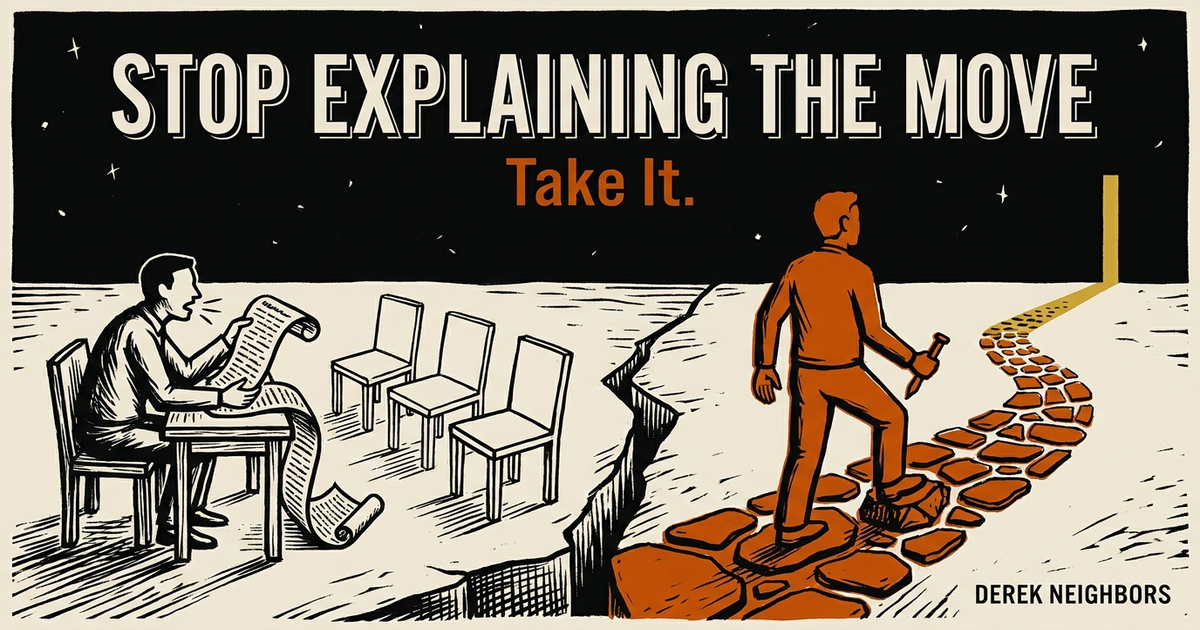
You cannot lead from a position of stagnation. Every day you must ask yourself what potential within you or your team remains unrealized, then initiate the movement toward its actualization. Leadership is not a state you achieve but a continuous kinesis—a deliberate motion toward excellence that you must sustain through intentional action.
Historical Examples
Aristotle’s analysis of kinesis in the Physics was his answer to one of the oldest problems in Greek philosophy. Parmenides had argued that change is logically impossible: what exists cannot come from what does not exist, and what does not exist is nothing, which cannot produce anything. Zeno of Elea supported Parmenides with his famous paradoxes of motion, including the paradox of Achilles and the tortoise, which seemed to prove that motion involves logical contradiction. Aristotle’s response was the concept of dynamis (potentiality): change does not come from nothing. It comes from the actualization of real potential that already exists within things. The bronze has the potential to become a statue. The process of sculpting is kinesis. The potential was real before the sculpting began, so the statue did not come from nothing. It came from the actualization of what was already latent.
The construction of the Parthenon, from approximately 447 to 432 BCE, illustrates kinesis at the civic scale. Under the direction of Pericles and the sculptor Phidias, Athens transformed raw marble from the quarries of Mount Pentelicus into one of the most celebrated buildings in human history. The fifteen-year construction process was kinesis in its purest form: directed motion toward a specific endpoint, requiring sustained effort, precise coordination, and the gradual actualization of a vision that existed first as a plan and then progressively as a physical structure. The completed Parthenon represented the energeia of Athenian civic capability: the city performing its function at the highest level of which it was capable.
Darwin’s development of the theory of evolution by natural selection illustrates intellectual kinesis extended over decades. From his voyage on the Beagle (1831-1836) through the publication of On the Origin of Species (1859), Darwin spent over twenty years collecting evidence, developing arguments, and refining his theory. The process was kinesis in the strictest sense: movement toward a comprehensive account of biological change that was incomplete until the theory was articulated with sufficient evidence and rigor to withstand scrutiny. Darwin’s notebooks reveal the incremental nature of the intellectual kinesis, with ideas developing, being discarded, reformulated, and tested against new evidence over years of sustained investigation.
How to Practice Kinesis
Identify one area where you or your team has stagnated, where potential sits unrealized. This week, initiate movement. Take the first concrete step, however small, toward actualizing that potential. The specific action matters less than breaking the inertia. Once movement begins, sustain it through daily micro-actions. Track momentum: are things moving forward, stalling, or regressing? When stagnation returns, diagnose the cause and restart. Practice treating leadership as a verb rather than a noun. You are never “a leader” in a static sense; you are always leading, always in motion, or you are not leading at all. Parmenides denied the reality of change, arguing that what exists cannot come from what does not exist. Aristotle’s analysis of kinesis was his answer: change comes not from nothing but from the actualization of real potential that already exists within things. Apply this to your own stagnation by recognizing that the capacity for movement is already present. You do not need to create potential from nothing; you need to activate what is already there. Start with the smallest possible action that breaks inertia, then sustain momentum through daily practice.
Application Examples
A company has been ‘in transition’ to a new operating model for eighteen months. The old model has been partially dismantled. The new model has been partially implemented. Teams are confused about which rules apply, and productivity has declined. Leadership describes the situation as ‘transformation in progress.’ The reality is that the company is stuck in the middle of a kinesis without sufficient commitment to reach the endpoint.
Organizational kinesis, like all kinesis, is incomplete until its endpoint is reached. A transformation that stalls midway leaves the organization in a worse state than either the starting point or the destination. The commitment to organizational change must include the commitment to see the kinesis through to completion.
A professional in his mid-forties is learning a new programming language. After the initial excitement of basic competency, he hits the intermediate stage where he can write functional code but not elegant code. He can solve simple problems but gets stuck on complex ones. The discomfort of this stage, being good enough to see how far he has to go, tempts him to abandon the effort and return to the languages he already knows.
The intermediate stage of any skill development is kinesis at its most uncomfortable: you have left the starting point but have not reached the destination. The discomfort is not evidence that you are on the wrong path. It is evidence that you are in the middle of the path, which is exactly where kinesis is supposed to feel incomplete.
A newly promoted VP is struggling in her first six months. She was an excellent director. She is a mediocre VP because the role requires capabilities she has not yet developed: strategic thinking at a higher altitude, influence across organizational boundaries, and comfort with ambiguity. She is in kinesis from one level of leadership competence to the next, and the incompleteness of the transition feels like failure.
Leadership transitions are kinesis. The new role requires capabilities that the previous role did not develop, and those capabilities can only be developed through the experience of operating at the new level. The discomfort of the transition is the sensation of kinesis in progress, not evidence of a wrong appointment.
A software team adopts agile methodology. After three months, the team reports that agile is not working. Daily standups feel ceremonial. Sprint planning produces unrealistic commitments. Retrospectives generate the same complaints week after week. Investigation reveals that the team adopted the ceremonies without changing the underlying work patterns. The kinesis of the methodology adoption stalled at the surface level without reaching the depth required for genuine transformation.
Adopting new practices without completing the kinesis of genuine behavioral change produces methodology theater: the appearance of transformation without its substance. The endpoint of the kinesis is not the adoption of ceremonies but the transformation of how the team works.
Common Misconceptions
Not all motion is kinesis. Not all motion is kinesis. Random movement without a telos is not kinesis in Aristotle’s sense. Kinesis requires direction, which means it requires a purpose. The person who is busy but not developing, active but not progressing, is in motion but not in kinesis. Another error is treating kinesis as inherently less valuable than energeia. Both modes of activity are necessary for a complete life. Kinesis is how you develop new capabilities, complete projects, and build things that did not exist before. Energeia is how you exercise capabilities you have already developed. The person who never engages in kinesis stops growing. The person who never engages in energeia never arrives. A third misconception is that completing a kinesis should produce lasting satisfaction. Kinesis satisfaction is temporary by nature because the purpose of kinesis is the completion of something external. Once the external thing is complete, the kinesis ends and the satisfaction dissipates. Lasting satisfaction comes from energeia, from the ongoing exercise of your capabilities, not from the completion of individual projects.
The concept of kinesis helped me understand a pattern in my career that had been a source of persistent frustration: the sense that I was always becoming something and never arriving. Each new role, each new skill, each new challenge placed me at the beginning of another kinesis. The moment I reached competence in one domain, I would move to another where I was again a beginner. The cycle felt like failure. I was always in the uncomfortable middle of a transition and never in the settled state of mastery.
The Aristotelian framework reframed this experience. Kinesis is not failure. It is the natural state of any person who is developing. The discomfort of incompleteness is not a sign that something is wrong. It is the inherent character of any process that has not yet reached its endpoint. The person who never experiences the discomfort of kinesis is the person who has stopped developing, which is its own form of failure.
What changed my relationship with kinesis was developing a capacity for energeia alongside it. Instead of treating every activity as movement toward a future state, I began identifying the aspects of my work that were complete in each moment. Coaching a team member was energeia: the activity was fully happening in the conversation, not deferred to some future outcome. Solving a complex problem was energeia: the engagement was fully present in the process of thinking, not dependent on reaching the answer. By embedding energeia within my kinesis, I stopped treating my professional life as an indefinitely deferred arrival and started experiencing satisfaction in the process itself.
The practice I recommend is a daily distinction exercise. At the end of each day, identify which activities were kinesis (movement toward an external goal) and which were energeia (activities that were their own reward). If the ratio is heavily skewed toward kinesis, you are deferring your satisfaction to a future that keeps receding. Introducing more energeia activities, work that you value for its own quality rather than for what it produces, changes the experience of being in continuous development from frustration to fulfillment.
Frequently Asked Questions
What is kinesis in Greek philosophy?
Kinesis is Aristotle's concept of movement or change in its most fundamental sense, the transition from potentiality to actuality. It encompasses all forms of becoming: growth, alteration, locomotion, and transformation from what something could be into what it is. Aristotle devoted much of his Physics to analyzing kinesis, defining it as the actualization of potential insofar as it remains potential.
What does kinesis mean?
Kinesis means movement, motion, or change, from kinein (to move, to set in motion). It is the root of kinetic, cinema, and kinesiology. In Aristotle's philosophy, it specifically describes the process of becoming, the actualization of potential. The word captures something more fundamental than physical motion: any transition from what something could be to what it actually is.
How do you practice kinesis?
You practice kinesis by identifying areas of stagnation and initiating deliberate movement toward unrealized potential. Take concrete first steps, sustain momentum through daily micro-actions, and treat leadership as continuous motion rather than a static achievement. When you feel stuck, the most important thing is breaking inertia with any action, however small, because movement generates its own energy.
What is the difference between kinesis and energeia?
Kinesis is movement toward completion, an incomplete process still in progress. Energeia is the complete activity of being fully at work. A builder constructing a house is in kinesis; the completed act of seeing is energeia. Kinesis aims at an endpoint; energeia is its own fulfillment. Understanding this distinction helps you recognize whether you are in the process of becoming (kinesis) or in the state of fully being at work (energeia).