Stop Paying for Sweat. Your Best AI Users Are Learning to Fake It.
By Derek Neighbors on October 27, 2026
A fix that used to take me most of a week now takes an afternoon with Claude in the repo. Anyone who works with an AI model every day sees the same thing, and it raises an awkward question every time: what do you say about it at standup?
You could say “knocked it out with Claude, took a couple hours.” Or you could say “that one was a grind, but it’s done.” In a lot of companies the second answer is the safer one. The person who says it gets a nod for grinding. The person who says the first one gets more work and, sometimes, a look that asks whether they cut a corner.
That is a problem with what the company rewards, and the leader is the one who can fix it.
The Standard
Here is the bar for a leader in 2026. You know what each piece of work was for. You judge it by whether it did that job, which means it works, it is correct, it is safe to run, and the next person can maintain it. Speed only counts after that is true. Then you ask what it cost, and when the same result came in cheaper, you count that as a win and want to know how.
That sounds obvious, and in my experience most teams do not run that way. Most still run on a second, unwritten scorecard that tracks how hard the work looked: who stayed late, whose deck was thickest, who answered Slack within a minute at 10pm, who had the most commits this week. Nobody puts that scorecard in the review template, and everyone on the team knows it exists.
A leader who meets the standard has thrown the second scorecard out. Their team knows that finishing early with the model is something to show off.
The Gap: Why Leaders Still Reward Effort
Leaders grade effort because quality is hard to see and effort is easy to see.
Behavioral economist Dan Ariely tells a story about a locksmith. When the locksmith was new and slow, it took him a long time to open a lock, and he sometimes broke it and had to replace it. Customers paid without complaint and sometimes tipped. As he got good, he could open a door in a minute. Then customers complained about the price. They were paying for the struggle they watched, not for the open door.
Researchers Ryan Buell and Michael Norton found something similar in 2011 and called it the labor illusion. People rated an online travel search more highly when the site showed them it was working, even when that meant a longer wait than getting the answer instantly. We like to see the work. If we cannot judge the result, we judge the visible effort instead.
Cal Newport calls the workplace version pseudo-productivity: using visible activity as a stand-in for useful work. It shows up as long hours, fast replies, full calendars, and long documents. It made a kind of sense when it started, because for most knowledge work hours and output moved together. A person who put in twice the hours on a report usually produced more report.
AI broke that link. One engineer with an agent and a clean repo can now ship in an afternoon what used to take a sprint. A product manager can get a first draft of a spec, a competitor scan, and three customer interview summaries before lunch. Hours and output have come apart, and they are coming further apart every few months as the models get better.
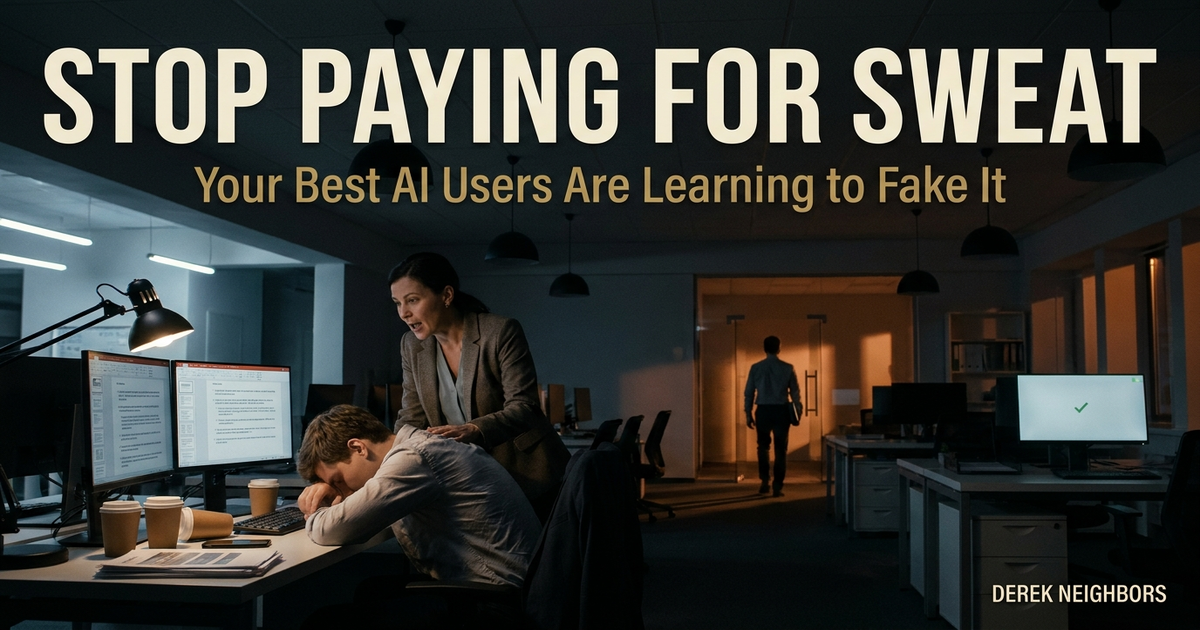
So the old scorecard now does something its designers never meant. It pays for sweat and fines speed. Watch what your best people do when they figure that out:
Some pad the deck. A correct one-page answer grows into twenty slides, because twenty slides is what a serious answer looks like here.
Others sit on the pull request. The fix is done Tuesday and ships Thursday, because shipping Tuesday invites the question of what they did for the rest of the week.
Plenty stay visibly online. The green dot stays green until 9pm, and the work was done by 2.
The most expensive response is silence about the model. The person who figured out how to get Claude to write the migration safely keeps it to themselves, and the other eight people on the team keep doing it by hand.
And some leave, for a company that pays for results.
These people are doing what the scorecard tells them to do, and you wrote that scorecard, even if you never wrote it down.
If you are the one padding the deck, the scorecard explains it and does not excuse it. Making work look harder than it was is a small lie, and it is yours. Say how the work got done at standup, including the afternoon with the model, even when the scorecard punishes you for it. Someone has to go first, and the person telling the truth about their own work is in the best spot to do it.
There is one more reason leaders hold on to effort, and it is personal. A lot of us built our careers on all-nighters before launches and weekend rewrites. When someone gets the same result in an afternoon, part of us wants to say it does not count. That reaction is about us, and the team pays for it.
The Path
Closing the gap takes a few concrete moves, and none of them requires buying anything.
Ask what it cost, and cheer the cheap win in public. When work lands, ask two questions: did it do the job, and what did it take? Count the whole cost, including the reviewer’s time and whoever has to maintain it. An afternoon that hands a teammate a week of review was not cheap. When the answer is “an afternoon with the model,” say out loud that this is the best outcome on the board this week. Then ask the person to show how they did it, and ask what they want to do with the time they got back. The point of the saved hours is better work: the harder problem, the thing nobody had time to think about, the skill they want to grow next. The first time a leader does this in front of the team, the second scorecard starts to lose its grip.
Make show-and-tell normal. Put fifteen minutes a week on the calendar where someone walks through how a piece of work got built: the prompts, the agent run, what they threw away, what they kept. This spreads the fastest methods across the team, and it makes hiding pointless. Nobody hides a trick they get applauded for.
Cut effort signals out of reviews. Go through your review template and your promotion packets and remove anything that measures sweat: hours, response time, lines of code, commit counts, document length, “always available.” Replace them with what the work did. Jerry Muller’s The Tyranny of Metrics warns about the next mistake: if you swap the hours dashboard for a token-usage dashboard, you have built a new effort scorecard. Judge the outcome and the judgment behind it.
Ask for one page before forty. Make the short answer the default. A decision memo that fits on one page and is right beats the forty-page version every time, and the model makes the long version so cheap to produce that its length tells you nothing anymore. If someone needs more pages to make the case, they can ask.
Price outcomes when you sell work. If your company bills clients by the hour, the model cuts your revenue every time your people get faster, which is a strong incentive to stay slow. Billing a client forty hours for work the model helped finish in eight is not honest, whether or not they ever find out. Price the result instead: a fixed fee for the migration, the audit, the feature. Then the speed the model gives you is margin instead of lost billing, and your team has every reason to use it.
Effort still has a place. Hard practice is how a person gets good, and a junior engineer who struggles through a problem by hand is building something real for themselves. That is part of how they learn, it is worth protecting, and it is a separate thing from what the company pays for. The company should pay for the result, and the leader should protect the practice on purpose, as practice, instead of grading everyone on how tired they look.
The Test
Think about the last person on your team who finished something big much faster than you expected. What did you say to them? Did they get more work, a raised eyebrow, or a chance to show everyone how they did it?
Look at the last promotion you approved. Was any of the case built on hours, availability, or how much the person shipped by volume?
If an engineer on your team found a way to do their job in half the time with the model, would they tell you? Be honest. If you are not sure, they probably would not.
Open your review template. Count the lines that measure what the work did, and the lines that measure how hard it looked.
And the one that decides: if your best AI user worked four focused hours a day and their results were the best on the team, would your culture call them a star, or a problem?
Final Thoughts
Leaders grade effort because effort is easy to see and quality is hard to judge. That shortcut held up for decades because hours and output moved together. The model pulled them apart, and a scorecard that still pays for sweat now teaches your best people to pad, stall, look busy, and keep their best methods to themselves.
Fix the scorecard. Ask what the work did and what it cost, and cheer the cheap win in public. Make show-and-tell a habit, take the sweat out of your reviews, ask for one page, and price outcomes when you sell. The people who use the model well are already working this way. Whether they tell you about it depends on what you reward next week.
Building a team that gets paid for results and learns from its fastest people is part of the craft. That is what MasteryLab is for.