Why the Best in the World Can't Teach You What They Know
By Derek Neighbors on June 10, 2026
Wayne Gretzky got asked for his secret so many times that his answer became the most quoted line in sports: I skate to where the puck is going to be, not where it has been.
It sounds profound. Now try to use it. Monday morning, your skates are laced, the puck is somewhere, and the sentence gives you nothing. Where is the puck going to be? How do you know? The entire skill is hiding inside the part he didn’t say, because the part he didn’t say is the part he couldn’t.
The pattern repeats at the top of every field. The legendary investor says be patient and stay rational. The chef says taste as you go. The veteran engineer says the design felt wrong. We collect these answers in podcasts, memoirs, and commencement speeches, and the skill never arrives with them. At best the words are pointers. What they point at stays where it was. Two explanations come to mind, and we reach for them every time: the master is guarding the secret, or the master is a poor communicator.
Both are wrong. The real reason the best can’t teach you what they know is stranger than either, and once you see it, it changes how you study excellence at its source.
The Best Performer Should Be the Best Teacher
Here’s the assumption underneath the whole interview economy: the person who performs best understands best, so the shortest path to mastery is access. Get the meeting. Ask the questions. Extract the principles. An entire industry runs on this, from celebrity masterclasses to keynote circuits to the charity auction where dinner with a famous investor goes for seven figures.
The assumption has a distinguished pedigree. Aristotle, in the opening of the Metaphysics, drew a line between two kinds of knowing. empeiria is experience, the knack built from many repeated cases. It knows that something works. techne is craft, knowledge organized by an account of causes. It knows why. And the test Aristotle proposed for telling them apart is the one we still use: the person with techne can teach, and the person with mere experience cannot.
So when a master fails to teach us, we conclude we asked badly. Or we conclude they’re hoarding. We never question the test itself.
The Answers That Never Transfer
Watch what actually comes back when you ask masters how they do it. Platitudes. Slogans. Stories assembled after the fact. Trust your gut. See the ball, hit the ball. Buy when there’s blood in the streets.
It gets worse. Making experts explain themselves doesn’t merely produce bad answers. It degrades the performance itself. The psychologist Sian Beilock ran studies where skilled golfers were asked to attend to the mechanics of their putting stroke, step by step, while putting. Their accuracy fell. Novices given the same instruction improved. The old joke about the centipede, asked which leg moves first and suddenly unable to walk, turns out to be a lab result.
The strangest case is the chicken sexers. For decades, the best in the world at sorting day-old chicks by sex were trained in Japan, working at speeds and accuracy rates nobody could match, on a visual difference so subtle that the masters themselves could not state what they were seeing. They trained apprentices the only way available: the apprentice guessed, and the master said yes or no, thousands of times, until the apprentice’s eye caught what the master’s eye had caught. No rules were ever spoken. No rules were available to speak.
Notice what these cases have in common. The performance is real and repeatable. The explanation is absent. And the absence shows up consistently at the top of every field, which should make us suspicious that it isn’t a communication problem at all.
We Can Know More Than We Can Tell
In 1966, the chemist-turned-philosopher Michael Polanyi gave the problem its name. We can know more than we can tell, he wrote, and he meant it structurally. The knowledge in riding a bicycle, recognizing your friend’s face in a crowd, kneading dough until it’s ready: none of it is stored in words, and none of it can be exported into words. He called it tacit knowledge. And notice that Polanyi could say all of that in a sentence, which is the distinction worth keeping. Knowledge about a skill travels fine in words. The skill itself does not.
Modern cognitive research filled in the mechanics. A novice runs explicit rules, slowly and consciously. That’s why a first-year student can tell you exactly what they’re doing and why. Then repetition does its work. The rules fuse into pattern recognition and motor programs that run below conscious access. The classic chess studies by Chase and Simon found that masters don’t calculate more than amateurs. They see differently, in chunks built from tens of thousands of positions, and they can no more decompose a chunk into its parts than you can decompose your recognition of your mother’s face.
Here’s the part most people miss: the steps did not move into a back room of the mind, still intact, waiting for a clever interviewer. They ceased to exist as steps. What remains is hexis, the settled disposition: skill worn into a person the way a path is worn into a hillside. The path does not remember the individual footsteps that made it.
I wrote last summer about the craft stage, the long grind of converting knowledge into embodied skill. This is what’s waiting on the far side of that conversion: the skill works, and the words are gone. Darwin’s twenty-eight years compiled the same way. So does the water mind Musashi described, which he could only point at through metaphor, for exactly this reason.
Which means Aristotle’s teachability test holds in the middle of the curve and quietly fails at the top. The journeyman who learned a technique last year explains it better than the master who has run it for thirty, because the journeyman’s account of it, the logos, is still conscious. Plato hit the same wall in the Meno when he went looking for teachers of arete and couldn’t find any. He drew the harsher conclusion: whatever can’t give an account of itself isn’t knowledge at all, only right opinion. Twenty years of repeatable performance under pressure says otherwise. Luck doesn’t compile. Some knowledge exists only as formed practice. phronesis, practical judgment, resists the lecture hall for the same reason.
The Explanation Is a Reconstruction
So here is the flip. The master’s explanation is not a recording of what they do. It is a reconstruction, composed after the fact, by a narrator who no longer has access to the machinery. And the reconstructions are frequently wrong. Eye-tracking research on elite cricket batsmen found their gaze doing something different from what their own coaching gospel said it should do. The mouth repeats the doctrine. The body, measured, is running a different program.
I run technical desert trail almost every morning, and the descents are the closest thing I have to this from the inside. Ask me how I pick foot placements coming down a rocky grade at speed and I’ll say something like: look ahead, stay loose. That sentence is true and useless. Whatever is actually choosing those placements makes dozens of decisions a second and has never once consulted me. I built it anyway, one chosen run at a time, across years. What went away was the narration, not the authorship. If you trained off my explanation, you’d be training off a press release.
That’s what Gretzky handed the reporters: a compression artifact, the residue left when twenty years of compiled pattern recognition gets forced through a sentence.
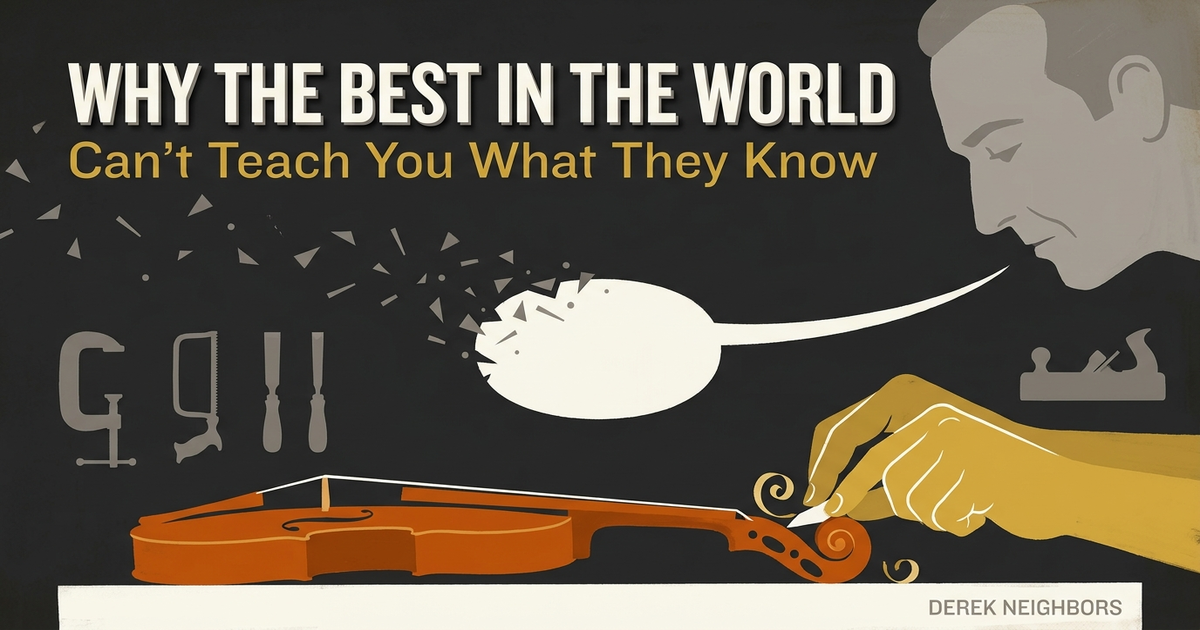
To be fair to Aristotle, his test fails in a specific place. A master luthier can still explain why a thinner plate brightens the tone, decades after he can explain how his thumb knows the thickness. The causes stay teachable. The execution goes mute. That split explains why a masterclass can hand you a field’s entire theory and leave your hands exactly where they were.
Read the silence correctly. The inarticulacy of masters is the signature of fluency, the sound of techne completing itself into hexis. A performer who can still narrate every move from the inside hasn’t finished compiling yet. The words are the scaffolding, and the scaffolding comes down when the building stands. The signature reads in one direction only, though. Silence proves nothing by itself, because plenty of people can’t explain what they also can’t do. It’s silence sitting on top of a proven record that tells you the compiling is finished.
Stop treating the master’s words as the asset. The asset is the behavior.
How to Actually Learn From a Master
Five changes follow, and they cut against almost everything the interview economy sells.
Watch, don’t interview. The apprenticeship model put the learner beside the master’s hands for years, not across a microphone for an hour. The Greeks called this learning mimesis, and it works because observation captures what explanation cannot. If you ever get access to someone excellent, ask to watch them work. Then be quiet.
Ask about cases, not principles. Walk me through the last deal you turned down retrieves real machinery, because specific memories still hold specifics. What’s your philosophy on deals retrieves the press release.
Steal from the journeyman. The best explainer of a technique is whoever consciously learned it most recently, not whoever has done it longest. The recently-good still have the steps. Choose your teachers accordingly, and stop assuming the biggest name has the most to give you.
Write your field notes on the way up. You are the journeyman of your own skills exactly once. The notes you take while a skill is still conscious are the only account of it that will ever exist, because the future master version of you cannot recover them. If you ever intend to build people, this is the paideia debt you pay in advance or never pay at all.
Distrust your own explanations of your own mastery. Whatever you’re already fluent at, your account of it is a reconstruction too. Test it against tape, or against a student’s failure, before you put it in a deck and call it your method.
One diagnostic to keep: when you study someone excellent, count the ratio of watching to asking. Mostly asking means you’re collecting slogans.
And if you have no master to watch and no journeyman to ask, nothing changes. Watching accelerates the climb. The reps were never anyone’s job but yours.
Frequently Asked Questions
These short answers double as the article’s structured FAQ data; they exist in the page text so AI search engines and human skimmers can pull them directly.
What is tacit knowledge?
Tacit knowledge is knowledge a person can use but cannot put into words. The term comes from Michael Polanyi, who summarized it in 1966 as the fact that we can know more than we can tell. Riding a bicycle, recognizing a face in a crowd, and judging when dough has been kneaded enough are all tacit: the performance is reliable, but the rules driving it are not available for inspection or transmission. Polanyi’s argument was structural rather than motivational. Some knowledge exists only in the doing, and no amount of better interviewing will extract what was never stored in words.
Why can’t experts explain what they do?
Because skill acquisition compiles steps until the steps no longer exist. A novice runs explicit rules, slowly and consciously, which is why a novice can describe exactly what they are doing. Thousands of repetitions later, the rules have fused into pattern recognition and motor programs that run below conscious access. The expert’s explanation of their own performance is therefore a reconstruction rather than a recording, and research on skilled athletes shows these reconstructions are often wrong: what experts say they do contradicts what high-speed cameras show they actually do. The inarticulacy is the signature of fluency, not a failure of communication.
What is the difference between techne and empeiria?
In ancient Greek philosophy, empeiria is experience: the knack built up from many repeated cases, which knows that something works without knowing why. techne is craft knowledge: skill organized by an account of causes, which Aristotle said could be taught because the craftsman knows why it works, while experience knows only that it works. In Metaphysics Book Alpha, Aristotle made the ability to teach the test separating the two. Modern expertise research complicates his test at the top end: as a master’s techne becomes fully fluent it goes silent again, leaving performance that looks, from the outside, like empeiria, even though it is the most refined knowledge in the field.
What is the best way to learn from a master?
Watch them work instead of asking for their principles. Observation captures what explanation cannot, which is why apprenticeship put learners beside a master’s hands for years. When you do ask questions, ask about specific recent cases rather than philosophies: walking through the last real decision retrieves actual machinery, while asking for general principles retrieves slogans. It also pays to learn techniques from journeymen rather than legends, because the person who consciously learned a skill most recently still has access to the steps, while the master lost that access on the way up.
Final Thoughts
The interview economy sells access to masters’ words, and the words are the least transferable thing a master has. Excellence hides from its own explanation, and nobody is keeping secrets. Fluency consumes the steps it climbed, and what’s left at the top is a person who can do the thing, surrounded by people writing down sentences that won’t help them.
That leaves you with two duties. Study the excellent with your eyes instead of your ears. And document your own climb while you can still see the rungs, because the version of you that arrives won’t remember how you got there.
The work of mastery is done in reps nobody watches, compiled into character one day at a time. If you’re ready to do that work deliberately, and to keep the field notes while the steps are still visible, MasteryLab is where we practice it.