Techne (τέχνη): Meaning, Definition & Modern Application
TEKH-nay
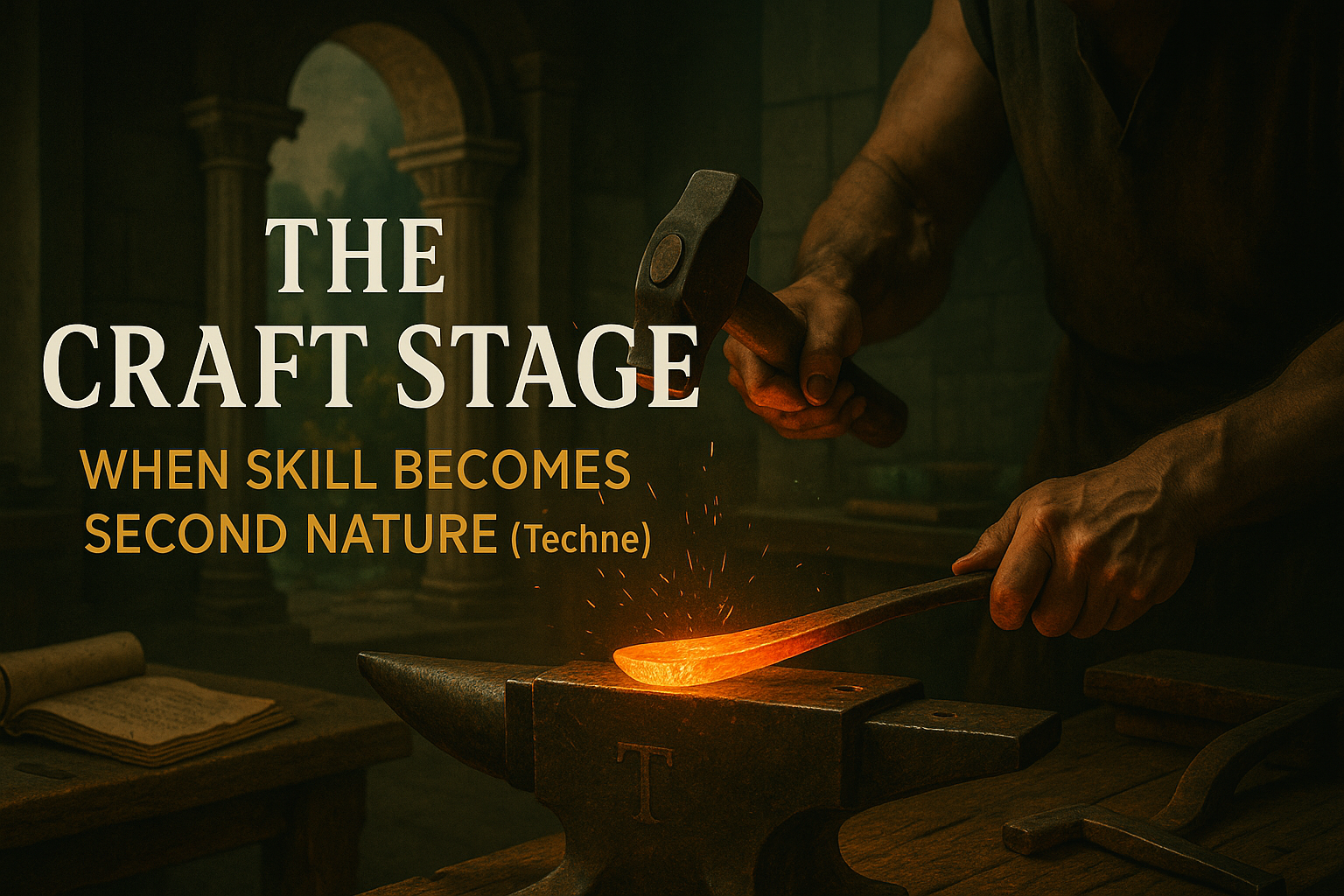
The systematic knowledge and skill required to produce something well—craft, art, or applied expertise. For Aristotle, techne bridges theoretical knowledge and practical action, representing the reasoned capacity to make or create according to true understanding.
Etymology
From the Greek techne, meaning “art,” “craft,” or “skill.” The root gives us “technique,” “technology,” and “technical.” In Greek thought, techne described any systematic knowledge applied to production, from shipbuilding to medicine to rhetoric. Aristotle ranked it between mere experience (empeiria) and theoretical knowledge (episteme): the craftsman knows both what works and why it works, enabling them to teach others and adapt to new situations.
Deep Analysis
Aristotle’s classification of knowledge in Nicomachean Ethics Book VI gives techne a precise place in the intellectual landscape. Episteme is knowledge of what is necessary and unchanging. Sophia is the highest form of theoretical knowledge, combining nous and episteme. Phronesis is practical wisdom about what to do in particular situations. Techne is productive knowledge: knowing how to make or produce something, grounded in understanding of why the production process works. The person with techne does not merely follow a recipe. They understand the principles that make the recipe work, and this understanding enables them to adapt when conditions change.
Plato’s Gorgias draws a sharp distinction between techne and empeiria (mere knack or experience). The cook who produces tasty food through trial and error has empeiria. The physician who produces health through understanding of the body’s functioning has techne. The difference is not in the effectiveness of the outcome, since a good cook may produce more immediately pleasing results than a physician, but in the rational foundation. Techne can explain why its methods work. Empeiria cannot. Techne can be taught systematically because it is grounded in principles. Empeiria can only be transmitted through apprenticeship and imitation because it lacks explicit rational foundation.
This distinction between techne and empeiria illuminates a fundamental problem in modern organizations. Many practitioners operate through empeiria: they know what works through accumulated experience but cannot explain why it works or predict when it will stop working. The experienced manager who makes good hiring decisions by “gut feel” has empeiria. The manager who can articulate the specific factors that predict success in a role, why those factors matter, and how to evaluate them systematically has techne. The first is effective under familiar conditions. The second is effective under novel conditions because the underlying principles transfer to new contexts.
The relationship between techne and phronesis reveals an important boundary. Both involve knowing how to do something in particular circumstances. But phronesis is about action (praxis), while techne is about production (poiesis). The leader exercising phronesis is acting wisely in a situation where the action itself is the point. The craftsman exercising techne is producing a product where the product, not the process, is the point. The architect exercising techne designs a building that fulfills its function. The statesman exercising phronesis makes a decision that serves the common good. Both require understanding of principles and sensitivity to particulars, but they operate in different domains.
Ergon (function, characteristic work) is the telos of techne. Every craft is oriented toward producing something that fulfills a function. The ergon of medicine is health. The ergon of architecture is habitable buildings. The ergon of shipbuilding is seaworthy vessels. Techne without a clear ergon degenerates into technique, activity that follows procedures without serving a purpose. The danger in modern organizations is the proliferation of technique, sophisticated processes and procedures, divorced from the ergon they were originally designed to serve. When the procedure becomes an end in itself, techne has been corrupted.
The modern loss that occurs when technique replaces craft is both practical and existential. The craftsman who understands their techne has a relationship with their work that the technician who follows procedures does not. The craftsman exercises judgment, makes adaptations, and takes pride in the quality of the product. The technician executes steps. The difference is not snobbery. It is a difference in the quality of human engagement with work, and it has direct implications for the quality of the product. The craftsman’s product carries the mark of intelligent engagement. The technician’s product carries the mark of compliance.
Askesis (disciplined training) is the method through which techne is developed. You acquire techne through sustained practice under conditions that develop both the skill and the understanding. The apprenticeship model, in which a novice works alongside a master over years, is the traditional method of transmitting techne because genuine craft knowledge cannot be fully captured in manuals or courses. It requires the lived transmission of judgment, taste, and standards that only direct mentorship provides.
Modern Application
You develop techne when you move beyond mere competence to true mastery of your craft. Study the principles underlying your work, not just its procedures—understand why excellence looks the way it does. Your leadership gains authority when others recognize you've paid the price of deep skill, not just accumulated credentials.
Historical Examples
The construction of the Parthenon, completed in 432 BCE under the architects Ictinus and Callicrates with sculptural oversight by Phidias, represents techne at its most refined. The building incorporates subtle optical corrections, including slightly curved columns and a convex floor, that compensate for visual distortions. These corrections demonstrate that the builders understood not only how to construct a building but why the human eye perceives straight lines as curved at certain scales. The Parthenon’s enduring beauty is the product not of mere craftsmanship but of techne: the integration of theoretical understanding (optics, geometry, proportion) with practical skill.
Hippocrates of Kos, the fifth-century BCE physician, established medicine as a techne by grounding it in observation, rational explanation, and systematic method. The Hippocratic texts explicitly distinguish medical techne from the folk remedies and religious healing practices that preceded it. The Hippocratic physician observes symptoms, forms rational hypotheses about causes, and tests those hypotheses against outcomes. This method transformed medicine from a craft of the temple to a craft of rational inquiry, and the principles Hippocrates articulated, particularly the emphasis on observation and the rejection of supernatural causation, remain foundational to medical practice.
The Bauhaus school, founded by Walter Gropius in Weimar in 1919, represents a modern attempt to unite techne with artistic vision. The Bauhaus curriculum required students to study both craft (woodworking, metalworking, weaving, typography) and theory (color theory, composition, materials science). The principle was that genuine craft knowledge requires understanding both the material and the principles that govern its use. Bauhaus graduates, including Marcel Breuer, Ludwig Mies van der Rohe, and Anni Albers, demonstrated that the combination of technical mastery and theoretical understanding produces work of extraordinary quality and lasting influence.
How to Practice Techne
Select one skill central to your work and commit to understanding its underlying principles, not just its techniques. Read the foundational texts in your field, study the masters who shaped your craft, and practice deliberately at the edge of your current ability. Teach what you learn to someone else; teaching reveals the gaps between procedural knowledge and genuine understanding. Set a six-month skill development goal that stretches beyond your current level and track your progress weekly. Mastery is not a credential; it is a relationship with your craft that deepens through sustained, principled practice. Aristotle ranked techne between mere experience (empeiria) and theoretical knowledge (episteme): the craftsman knows both what works and why it works, enabling them to teach others and adapt to new situations. Test whether your skill has reached the level of techne by asking two questions. Can you explain to a novice why your methods work, not merely that they work? Can you adapt when familiar techniques fail in novel situations? If either answer is no, your knowledge has not yet reached the level of genuine craft.
Application Examples
A software development team follows Agile methodology to the letter: daily standups, sprint planning, retrospectives, and user stories. Their process compliance is perfect. Their software is mediocre because no one on the team understands the design principles that would make the architecture elegant and maintainable. They have technique without techne.
Process compliance without craft knowledge produces mediocre outputs efficiently. The team that follows Agile ceremonies without understanding software design principles is like a cook who follows recipes without understanding cooking. They can reproduce known solutions but cannot create new ones. Techne in software development means understanding why certain architectural choices work, not merely knowing which processes to follow.
A home cook decides to move beyond recipes and understand why cooking techniques work. They study how heat transfers to food, why certain flavor combinations succeed, and what chemical reactions produce desired textures. Their cooking transforms from recipe execution to genuine craft because they can now adapt and improvise based on principles rather than following instructions.
The transition from empeiria to techne in cooking, or any domain, is the transition from following instructions to understanding principles. The cook with techne can walk into an unfamiliar kitchen with unfamiliar ingredients and produce an excellent meal because they understand the underlying principles. The cook with only empeiria is lost without their recipe book.
A leadership coach notices that their client can perfectly describe the feedback model taught in their executive program but delivers feedback in a way that consistently alienates the recipient. The model is correct. The execution lacks the craft knowledge of how to read the recipient’s emotional state, calibrate the message, and time the delivery for maximum receptivity.
Leadership as techne requires more than frameworks. It requires the craft knowledge of how to apply frameworks to particular people in particular moments. The coach who knows the model has knowledge. The leader who can deploy the model effectively with this specific person in this specific situation has techne. The gap between knowing the model and deploying it skillfully is the gap between theory and craft.
Two violin teachers use the same curriculum. One produces competent players who can perform assigned pieces accurately. The other produces musicians who understand phrasing, dynamics, and interpretation at a level that allows them to bring genuine artistry to any piece they encounter. The first teaches technique. The second transmits techne.
The difference between a technician and a craftsman is visible in the product but rooted in the quality of the education. Teaching technique produces people who can follow procedures. Transmitting techne produces people who understand principles well enough to exercise judgment. The second requires a teacher who possesses techne themselves, because you cannot transmit what you do not have.
A medical school replaces its traditional anatomy lab, where students dissect cadavers, with a virtual reality simulation that is more efficient, less expensive, and produces equivalent test scores. Practicing surgeons who trained in both environments report that the cadaver-trained students develop a tactile understanding of tissue that VR-trained students lack, and that this understanding matters in the operating room in ways that no test measures.
The efficiency of VR training captures what can be measured while losing what cannot: the embodied knowledge that develops through direct physical engagement with material. Techne in its fullest sense includes this embodied dimension. The surgeon who has felt the difference between healthy and diseased tissue with their own hands possesses a form of knowledge that no simulation can transmit.
Common Misconceptions
Reducing techne to “technique” or “technology” strips the concept of its most important dimension: understanding. Modern technique is often procedural knowledge divorced from the rational foundations that make the procedures intelligible. The person who follows a checklist has technique. The person who understands why each item on the checklist matters, and can modify the checklist when circumstances change, has techne. Another misconception opposes techne to art, as though systematic knowledge and creative expression are incompatible. For the Greeks, techne encompassed both. The sculptor, the poet, and the musician all possessed techne: systematic knowledge of principles combined with the skill to apply those principles in the creation of something excellent. The modern separation of “technical” and “creative” work would have been unintelligible to the Greeks.
The distinction between knowing how to do something and understanding why it works has been the defining theme of my professional development. Early in my career, I was effective through accumulated experience. I knew what worked in software development because I had done it enough times to recognize patterns. But I could not explain to someone else why my approach worked, which meant I could not teach it, and I could not adapt it when conditions changed.
The breakthrough came when I started studying the underlying principles of the domains I worked in. Not management books, which are mostly empeiria labeled as techne, but the fundamental disciplines: psychology for understanding people, systems theory for understanding organizations, and epistemology for understanding how knowledge itself works. Each of these gave me principles that explained why certain practices worked and predicted when they would fail.
The practical difference has been profound. When I operated from empeiria, I was effective in familiar contexts and lost in unfamiliar ones. When I developed genuine techne, principles-based understanding of my craft, I could enter new contexts and make sound judgments because the principles transferred even when the specifics did not. A principle of organizational design applies whether the organization makes software, sells insurance, or teaches children.
I now distinguish sharply between practitioners who have techne and practitioners who have empeiria, and I seek to learn from the former. The person who can explain why their approach works is worth studying because their explanation reveals transferable principles. The person who can demonstrate that their approach works but cannot explain why is worth observing, but what you can learn from observation alone is limited to the specific context you observed them in.
Frequently Asked Questions
What is techne in Greek philosophy?
Techne is the Greek concept of systematic skill or craft knowledge, the reasoned capacity to produce something well. For Aristotle, it bridges theory and practice, representing expertise that understands both what works and why, enabling adaptation and teaching. Aristotle ranked it between mere experience and theoretical knowledge, because the person with techne can both perform and explain their craft.
What does techne mean?
Techne means art, craft, or systematic skill. It is the root of technique, technology, and technical. It describes not mere competence but the deep, principled understanding of a craft that enables consistent excellence and the ability to teach others. In Greek thought, techne applied to any domain of skilled production, from shipbuilding and medicine to rhetoric and governance.
How do you practice techne?
You develop techne by studying the principles underlying your craft, practicing deliberately at the edge of your ability, and teaching what you learn to others. Move beyond procedural knowledge to genuine understanding of why excellence looks the way it does in your domain. Test your mastery by attempting to adapt your methods to novel situations; if you can only follow procedures but cannot improvise, your knowledge has not yet reached the level of true techne.
What is the difference between techne and episteme?
Techne is productive knowledge aimed at making or creating things well. Episteme is theoretical knowledge aimed at understanding why things are the way they are. A carpenter has techne of woodworking; a physicist has episteme of material properties. Both involve understanding, but their aims differ. Techne asks "how do I make this excellently?" while episteme asks "why does reality work this way?"