Schole (σχολή): Meaning, Definition & Modern Application
skoh-LAY
Leisure as the highest form of human activity. Not idleness or entertainment, but the intentional, unrushed pursuit of wisdom, reflection, and the cultivation of excellence.
Etymology
From the Greek schole, meaning “leisure” or “rest from labor.” The word became Latin schola and eventually English “school,” revealing the Greek conviction that education and intellectual development required freedom from productive obligation. Aristotle used the term in the Politics to argue that work exists to create the conditions for schole, not the reverse. The concept carried moral weight: leisure spent on triviality was a failure of character.
Deep Analysis
The etymology of schole delivers one of the sharpest ironies in the history of language: the English word “school” derives from a Greek word meaning leisure. The modern institution most associated with compulsory activity, rigid schedules, and relentless evaluation takes its name from the Greek concept of free, self-directed contemplation. Understanding how this inversion occurred reveals what modern culture has lost.
Aristotle’s treatment of schole in the Politics is unambiguous: leisure is the purpose of work, not the reward for it. “We work in order to have leisure,” he writes, inverting the modern assumption that leisure is what you earn after you have worked enough. For Aristotle, the laborer who works to survive has not yet reached the fully human life. The person who works in order to play or be entertained has mistaken amusement for leisure. Only the person who works in order to engage in contemplation, philosophical inquiry, and the cultivation of wisdom has understood the proper ordering of human activities.
The distinction between schole and mere amusement (paidia or anapausis) is critical. Amusement is rest from labor, the recovery period that allows you to return to work. It serves work. Schole is the activity that work serves. When you watch television after a long day, you are engaging in amusement, rest that prepares you for tomorrow’s labor. When you read philosophy, engage in genuine dialogue, practice an art form at a level that challenges your understanding, or contemplate questions about the nature of reality, you are engaging in schole. The first is restorative. The second is constitutive: it constitutes the good life rather than merely supporting it.
Aristotle ranked contemplative activity (theoria) as the highest form of schole and, by extension, the highest form of human activity. In Book X of the Nicomachean Ethics, he argues that the contemplative life is the most self-sufficient, the most continuous, the most pleasant, and the most divine activity available to human beings. This ranking is controversial, and Aristotle himself elsewhere gives significant weight to the practical life of ethical and political action. But the high ranking of contemplation within schole reflects a conviction that the human mind, when freed from necessity and directed toward understanding for its own sake, is operating at its highest capacity.
Eudaimonia (human flourishing) and schole are intimately connected. If eudaimonia is activity of the soul in accordance with arete (excellence), and if the highest arete involves contemplative activity, then schole is the temporal and psychological space in which eudaimonia is most fully achieved. The person who has no schole, whose life is consumed by labor, amusement, or compulsive busyness, has no space in which to exercise their highest capacities. They may survive. They may even prosper materially. But they cannot flourish in the full Aristotelian sense.
Phronesis (practical wisdom) requires schole to develop. Practical wisdom involves reflection on experience, consideration of competing values, and deliberation about the right course of action in complex situations. None of this can occur when your attention is fully consumed by immediate tasks. The leader who moves from meeting to meeting without pausing to reflect on what is happening, why it is happening, and what it means is operating on autopilot. They are efficient but unwise. Schole is the practice of creating space for the reflection that practical wisdom requires.
Sophrosyne (self-mastery) connects to schole through the discipline required to protect contemplative time from the constant intrusion of activity. In a culture that celebrates busyness and treats idleness as laziness, choosing to set aside time for reading, thinking, and reflecting requires genuine self-mastery. The compulsion to be constantly productive is itself a failure of sophrosyne: an inability to regulate the desire for activity and achievement in favor of the quieter, slower, and ultimately more important work of contemplation.
Modern Application
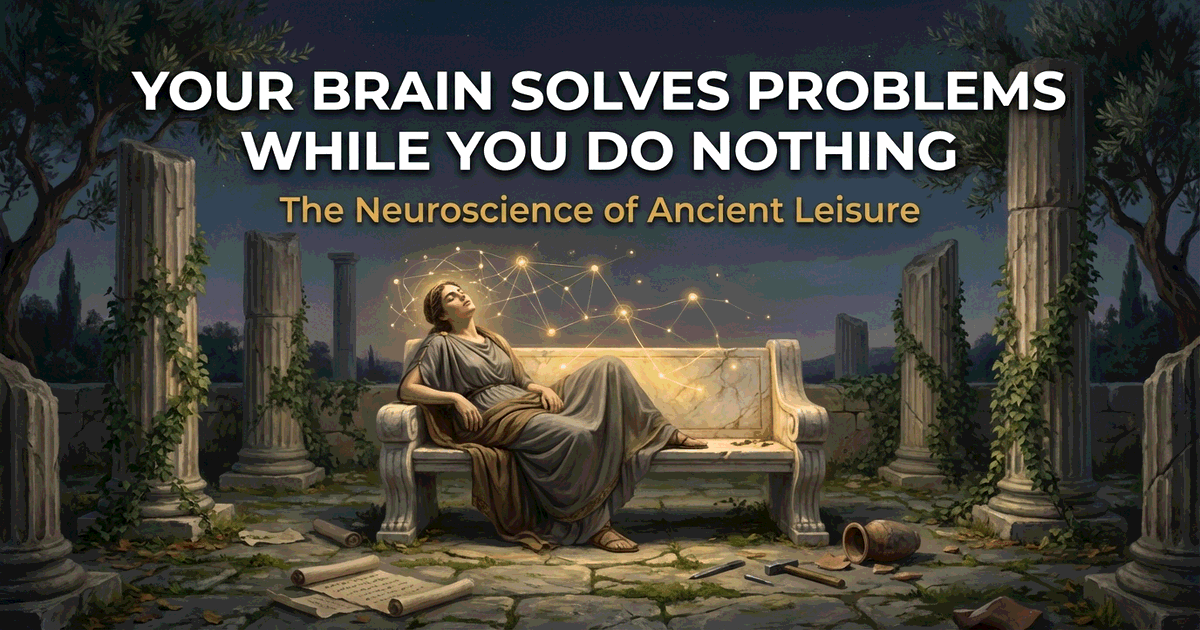
You practice schole when you create intentional space for reflection, integration, and deep thinking, free from the pressure to produce. It challenges the modern assumption that rest is the reward for work. The neuroscience of the Default Mode Network confirms the Greek insight: your brain's most sophisticated processing happens during deliberate disengagement, not during constant activity.
Historical Examples
Aristotle’s Lyceum, founded in 335 BCE, was organized around the practice of schole. The name “Peripatetic” school derives from the covered walkway (peripatos) where Aristotle and his students walked while discussing philosophy. The physical design of the institution supported the practice: spaces for walking, gardens for contemplation, and a library for study. The Lyceum was not a place where students went to receive information. It was a place where the practice of schole, free intellectual inquiry guided by genuine curiosity, was the primary activity.
The Roman senator and philosopher Seneca, despite the extreme demands of his political career and his role as advisor to Emperor Nero, wrote extensively about the necessity of schole. In his essay “On the Shortness of Life,” Seneca argued that most people waste their lives on busy activities that produce nothing of lasting value, while the philosopher who dedicates time to contemplation and study is the only person who truly lives. Seneca practiced what he prescribed: his philosophical output, produced during whatever hours he could protect from his political duties, includes some of the most enduring works in the Stoic tradition.
Blaise Pascal, the seventeenth-century French mathematician and philosopher, made the observation that “all of humanity’s problems stem from man’s inability to sit quietly in a room alone.” Pascal’s insight, recorded in the Pensees, echoes the Greek understanding that the compulsion to be constantly active is a failure of the human capacity for contemplation. The inability to practice schole, to be present with one’s own thoughts without distraction, drives the restless pursuit of amusement and activity that prevents genuine reflection.
How to Practice Schole
Start by protecting one block per day where you do nothing productive. No phone, no input, no agenda. Walk, sit, or simply allow boredom. Notice the urge to fill the space and resist it. Use this time not to relax but to let your mind process what it has absorbed. After a week, audit the quality of your thinking on days with protected space versus days without. Extend the practice to your work rhythm: after every ninety-minute focused work block, step away from all input for at least ten minutes. Keep a log of insights that arrive during these gaps. Over time, you will notice that your best ideas, your clearest decisions, and your deepest understanding emerge not from effort but from the space around it. The discipline is not in doing more but in trusting that stopping is where the real cognitive and philosophical work happens.
Application Examples
A CEO blocks four hours every week with no meetings, no email, and no operational tasks. Her team initially resists, arguing that her time is too valuable to be ‘wasted’ on thinking. Over six months, the strategic quality of her decisions measurably improves because she has time to consider second-order effects, examine assumptions, and think beyond the current quarter.
Schole in a business context is not downtime. It is the time in which the most valuable work happens, the thinking that cannot occur when your attention is fragmented by operational demands. The CEO’s blocked hours are not idle time. They are the time in which her leadership capacity is developed and deployed at its highest level.
A professional quits all social media, cancels their streaming subscriptions, and replaces three hours of daily screen time with reading, journaling, and walking without headphones. After initial restlessness, they notice a significant improvement in the quality of their thinking, the depth of their conversations, and their ability to sustain attention on difficult problems.
Most of what modern culture calls ‘leisure’ is actually amusement, restorative activity that serves the capacity for more work. Replacing amusement with genuine schole, self-directed contemplation that develops your intellectual and moral capacities, produces changes in cognitive function that are noticeable within weeks. The discomfort of the transition reveals how deeply the habit of passive consumption has displaced the practice of active contemplation.
A university reduces course requirements and introduces an ‘intellectual exploration’ period where students choose what to study based on genuine curiosity rather than degree requirements. Faculty initially worry about rigor. Graduates from the program consistently demonstrate stronger analytical thinking, broader intellectual range, and greater capacity for independent learning than graduates from the traditional curriculum.
Structured schole in education, time for self-directed inquiry driven by genuine curiosity rather than credential requirements, develops intellectual capacities that structured curricula cannot. The paradox is that giving students more freedom to explore produces more capable thinkers than giving them more requirements to fulfill.
A leadership team that prides itself on being ‘execution-focused’ notices that their strategic decisions have become increasingly reactive. Every meeting is consumed by operational issues. No one has time to think about where the company is heading. A consultant recommends monthly half-day retreats dedicated to strategic reflection with no operational agenda permitted.
Organizations that eliminate schole in favor of continuous execution eventually stop being able to think strategically. The execution focus becomes a trap: the more you execute, the less time you have to evaluate what you are executing and why. The retreat is not a luxury. It is the minimum viable schole required for organizational wisdom.
A technology company mandates that all employees spend twenty percent of their time on self-directed projects unrelated to their primary responsibilities. Initially viewed as wasteful, the policy produces several breakthrough innovations that would never have emerged from the regular product development process. The unstructured time created the conditions for creative thinking that structured work schedules eliminated.
The twenty-percent policy is institutional schole: protected time for the kind of exploratory thinking that operational demands crowd out. The innovations that emerge from this time are not accidental. They are the predictable result of giving talented people the leisure to think without the constraint of immediate deliverables. Aristotle would have recognized the policy as a modern application of his principle that leisure is the purpose of work.
A retired executive who spent decades in constant motion finds that retirement, rather than bringing the peace they expected, brings restless anxiety. They discover that they never developed the capacity for genuine contemplation. Without the structure of work, they are unable to sit with their own thoughts for more than a few minutes. The retirement reveals a lifelong deficit of schole.
The executive’s restlessness reveals that the capacity for schole is a skill that atrophies without practice. Decades of constant activity trained a mind that depends on external stimulation and cannot generate its own engagement. The retirement does not cause the problem. It reveals a problem that was always present but masked by the relentless pace of professional life.
Common Misconceptions
Schole is not idleness. This confusion is the most damaging misconception because it provides a ready excuse for eliminating contemplative time in favor of productive activity. Aristotle was explicit: schole is the highest form of human activity, not the absence of activity. The person engaged in genuine philosophical inquiry is working harder, in a meaningful sense, than the person performing routine tasks. What distinguishes schole from idleness is purpose and direction. A second misconception equates schole with recreation. Watching entertainment, playing casual games, and socializing are forms of amusement (anapausis) that serve the recovery of energy for further work. Schole is self-directed contemplative activity that develops your highest capacities. The two serve fundamentally different purposes, and confusing them causes people to believe they are engaging in schole when they are actually consuming entertainment.
The busiest period of my career was also the least productive. Not in terms of output, which was high. In terms of insight, growth, and the quality of the decisions I was making.
I was running from meeting to meeting, managing multiple projects simultaneously, and responding to messages within minutes at all hours. I was performing productivity with impressive consistency. I was also making increasingly poor decisions, missing patterns that should have been obvious, and burning through relationships because I had no time to invest in them properly. The output metrics looked excellent. The wisdom metrics, if anyone had been measuring them, would have been catastrophic.
The correction came not from a book or a mentor but from exhaustion. When I finally stopped long enough to think, not because I chose to but because my body forced the issue, I saw the damage that my compulsive busyness had caused. The strategic decisions I had made during my busiest months were measurably worse than the ones I made during periods when I had time to reflect.
I now protect time for genuine schole with the same discipline I once reserved for meeting deadlines. Two mornings each week are blocked for reading, thinking, and writing. No meetings, no email, no operational tasks. The resistance to this practice, from my own compulsion to be productive and from the organizational expectation that leaders should always be available, has been significant. The results, in the quality of my thinking and the depth of my strategic judgment, have been transformative.
Frequently Asked Questions
What is scholé in Greek philosophy?
Scholé is the ancient Greek concept of leisure understood as the highest form of human activity. For Aristotle, scholé was not rest from work but the very purpose of work. He argued in the Politics that 'we work in order to have leisure,' meaning that productive labor existed to create the conditions for philosophical reflection, civic participation, and the cultivation of virtue. The word eventually became our word 'school,' reflecting the Greek conviction that intellectual development required freedom from economic necessity.
What does scholé mean?
Scholé means leisure, but the Greek understanding of leisure differed radically from the modern sense. It described the active, unrushed pursuit of wisdom, philosophical dialogue, contemplation of ethical questions, and participation in civic life, all without the pressure of economic necessity. It was not passive relaxation but the condition in which the most important human capacities could be exercised. The Greeks considered scholé morally obligatory: you were expected to use leisure for the cultivation of excellence, not entertainment.
How do you practice scholé?
You practice scholé by creating intentional, protected space for reflection and deep thinking, free from the pressure to produce or consume. This means walking without your phone, sitting with a problem before sleep, allowing boredom, and resisting the urge to fill every cognitive gap with stimulation. The practice requires discipline because modern culture treats constant activity as virtuous. Start with five minutes of genuine disengagement per day and notice how your thinking changes when given space to process.
What is the difference between scholé and laziness?
Scholé is intentional cognitive space for integration, reflection, and the pursuit of wisdom. Laziness is avoidance of challenge. Scholé feeds eudaimonia (human flourishing) by creating conditions for the brain's deepest processing. Laziness depletes it. The Greeks drew a clear moral distinction: scholé carried an obligation to use leisure for the cultivation of excellence and character. Wasting leisure on triviality was a failure of virtue, not a lifestyle preference.