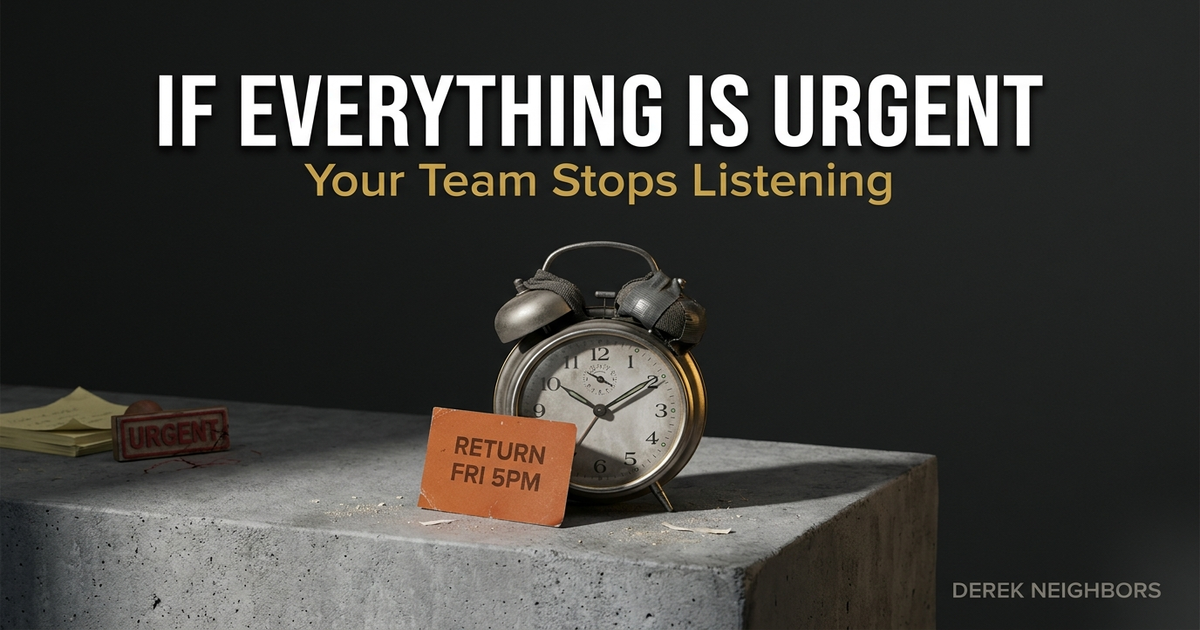
If Everything Is Urgent, Your Team Stops Listening
By Derek Neighbors on August 12, 2026
Your team heard “this is critical” four times last month.
Three of those times, the sky stayed up. The fourth time, something actually burned. Nobody moved at the same speed. They had learned a quiet skill: wait and see if this alarm is real.
That skill is pattern recognition you trained, not laziness.
The same inflation happens when you have no direct reports. You can call every personal deadline critical, interrupt peers with false fires, or narrate your own week as permanent crisis. If you spend the urgent word, you owe measure whether or not you hold a title.
The Surface Problem
Leaders think they have an energy problem.
They see glazed eyes in stand-ups, half-finished “all hands” pushes, and people who save their best attention for private work. So they raise the volume with red labels, late Slack messages, and speeches about how this quarter matters more than the last one.
The symptoms look like a motivation gap. The failed fixes are louder motivation speeches that spend the same empty alarm again.
Louder language, longer hours, and a pep talk after three false alarms will not restore belief. You cannot shout a signal back into existence after you spent it on ordinary load.
I have watched competent teams go numb under a manager who treated every Tuesday like a landing. The work was fine. The temperature reading was broken.
The System
Urgency is a scarce resource in a social system.
Call something urgent and you are spending trust. You are asking people to rearrange sleep, focus, and other promises. Do that for real constraints and the spend is clean. Do that for your anxiety about a normal deadline and the spend becomes debt.
Under the noise sits a simple price list. Real urgency costs the leader credibility if they waste it. Fake urgency costs the team attention if they believe it. Most organizations invert that map. Leaders pay nothing for crying wolf. Teams pay everything for answering.
Repeat the false alarm and you build a hexis (ἕξις), a disposition formed by repetition. The disposition here is discounting. People stop treating your temperature as data. They start treating it as weather they wait out. Scarce honest alarms build the opposite hexis: belief. People rearrange nights because the last ten calls earned that response.
That is how chronos (χρόνος), clock time filled with permanent crisis language, kills kairos (καιρός), the appointed moment when pressure should concentrate force. If every hour is a special hour, no hour can be.
phronesis (φρόνησις), practical judgment, is the faculty that decides which loads deserve the urgent label. Without it, pressure becomes climate instead of a tool, and people scatter their attention across every red label. The spend itself belongs to prohairesis (προαίρεσις), the faculty of moral choice. You choose the label. The room does not choose it for you.
Higher stakes can compress wasted time. This piece is the cousin problem. Stakes without a believable alarm still fail to focus people. Believable alarms without real stakes are the disease here. They teach the room to mute you.
The Leverage Points
Softer leadership that hides a real crisis is still a lie. The useful move is clearer measure, not quieter standards.
The move is sophrosyne (σωφροσύνη): soundness of mind, measure, proportion. Your language temperature matches the work temperature. Calm urgency can still sound firm and urgent. Calm names proportion and honesty, not whisper volume, and not an easier week for anyone. The opposite vice matters too: refusing to declare a true crisis because you fear spending trust. Soft silence during real danger fails measure the same way fake fire fails it.
The urgent label should track necessity in the work, not intensity in your nervous system. Anxiety is not a constraint.
Five leverage points matter more than another motivational all-hands.
Make urgency scarce again. If everything can wear the red badge, nothing should. Protect the word the way you protect a production credential.
Name when the sprint ends. Pressure without a return date becomes identity. People cannot plan recovery, other work, or honest effort if “until we get through this” has no Friday on it.
Share the load in public. Martyr urgency (“I’ll handle it, you sleep”) creates secret heroes and quiet resentment. Shared ownership makes the push a team fact, not a personality tax.
Match confidence language to reality. Fake cheer during a real miss trains cynicism. Fake doom during ordinary delivery trains numbness. Name the hard parts and the fine parts in plain words without padding either one.
Give pressure a slope. Milestones turn fog into a path. A team can hold a hard two weeks if they can see checkpoint one, checkpoint two, and the exit. Endless “almost there” is how you burn the trust you need for the next real fire.
How you made the decision often matters as much as the decision. The same is true for pressure. The process of declaring urgency is part of the message.
The Intervention
Start with an audit, not a speech.
Urgency audit. List every time you called something critical in the last thirty days. For each one, ask: would I still use that word if I could only spend it once this month? Keep the rare yes. Retract the habitual yes out loud where you can. Public correction rebuilds signal faster than silent improvement.
End-date charter. Every hard push gets a spoken return-to-normal date on the calendar invite. “We push through Friday 5pm. Saturday we are back to normal priority unless we reopen with a new end date.” The date is a discipline of will, not a magic object. If a true emergency has no clean Friday yet, you still control honest updates and refusal to pad ordinary work with crisis tone. If you slip the exit, say you are slipping. Quiet extensions are how fire drills become seasons.
Shared load map. Write names next to the work. Who owns the bottleneck. Who is covering the quieter lanes. Who is allowed to say no to side requests until the end date. Unnamed load becomes uneven load.
Language check before the next all-hands. Read your draft message once for facts and once for filler. Cut the fake victory lap. Cut the apocalypse metaphor if the issue is a delayed vendor. Keep the concrete constraint and the ask.
Milestone cadence. Break the push into short visible checks. Skip vanity dashboards. Use real “done / not done” marks the team can see. Progress is what makes pressure feel like craft instead of weather.
None of this requires a new framework binder. It requires phronesis about when to spend the alarm.
The Results
When the signal returns, real emergencies get speed again.
People stop waiting to see if you mean it. They move on the first clear call because the last ten calls earned that response. Recovery becomes possible because the calendar includes an exit. Attention compounds again because ordinary weeks are allowed to be ordinary.
You also get a quieter win: leaders stop using crisis as a substitute for prioritization. If everything is urgent, you never had to choose. Calm urgency forces the choice back onto the person with the badge.
That is closer to arete (ἀρετή) than another heroic weekend. Excellence under load is activity aimed well, while panic under fog is motion that trains distrust.
Teams that make honesty routine install a named practice so courage is not required for basic facts. Calm urgency is the sibling install for pressure. Make real urgency ordinary in its scarcity. Make fake urgency expensive for the person who declares it.
Practices
Weekly urgency ledger. Every Friday, write the three things that earned “urgent” this week. If the list is empty, good. If the list is long, you are printing inflation.
One public “not urgent.” In a meeting this week, name a piece of work that matters and is not a fire. Practice the sentence out loud. Teams need to hear the leader protect ordinary priority.
Return-date review. After any push, ask one question in the retro: did we keep the end date, or did panic get a quiet extension? Treat slipped exits as a leadership miss, not a team stamina story.
Temperature match drill. Before you send the next crisis message, write the constraint in one plain sentence a sharp teenager would understand. If you need dramatic words to feel serious, the work may not be as hot as your nerves.
You do not need more intensity. You need a temperature the room can trust.
If you want a place where leaders practice pressure with witnesses, end dates, and standards that do not inflate when the calendar gets loud, that is the work we do inside MasteryLab. Excellence holds under load when the signal still means something.
FAQ
What is calm urgency in leadership?
Calm urgency is positive pressure that stays believable. You name what is truly time-critical, share ownership of the load, set visible milestones, and state when the sprint ends so the team can return to normal. Keep the real constraint and drop the fake crisis tone.
Why do teams stop believing constant urgency?
Urgency is a scarce signal. When leaders call ordinary work critical week after week, the team learns a habit of discounting the alarm. By the time a real emergency arrives, attention is already spent. Inflated language taught them to wait and see. Lazy people are the wrong diagnosis.
How do you create pressure without fire drills?
Run an urgency audit, keep the urgent label rare, put a return-to-normal date on every hard push, map who owns what, and use confidence language that matches reality. Short milestones give pressure a slope. Fire drills without an end date turn pressure into climate, and climate burns people out.
What does sophrosyne have to do with urgency?
sophrosyne is soundness of mind and measure. Applied to leadership pressure, it means the temperature of your language matches the temperature of the work. Panic for ordinary load is a failure of measure. Fake cheer during a real crisis is also a failure of measure. Proportion restores trust.