Just Because AI Can Do It Doesn't Mean You Should
By Derek Neighbors on May 26, 2026
For every generation before this one, two walls made the automation decision for us. Could a machine even do the thing, and was the labor cheap enough to bother replacing. Most work survived not because anyone chose it, but because the alternative did not exist or did not pay. AI knocked both walls down in about three years.
Open a chat window and ask the honest question. Can this be automated? Drafting, summarizing, analyzing, coding, designing, deciding, even consoling. The answer is converging on yes for nearly all of it. Which means the old question has quietly stopped being useful. “Can AI do this” no longer separates anything from anything, because it sorts almost everything into the same pile.
The burden flipped while most people kept asking the dead question. You used to need a reason to automate something. Now you need a reason to keep doing it yourself. And the people who get hollowed out by this decade will not be the ones who automate. They will be the ones who automate everything without ever asking the only question left worth asking: if I hand this over, what happens to me.
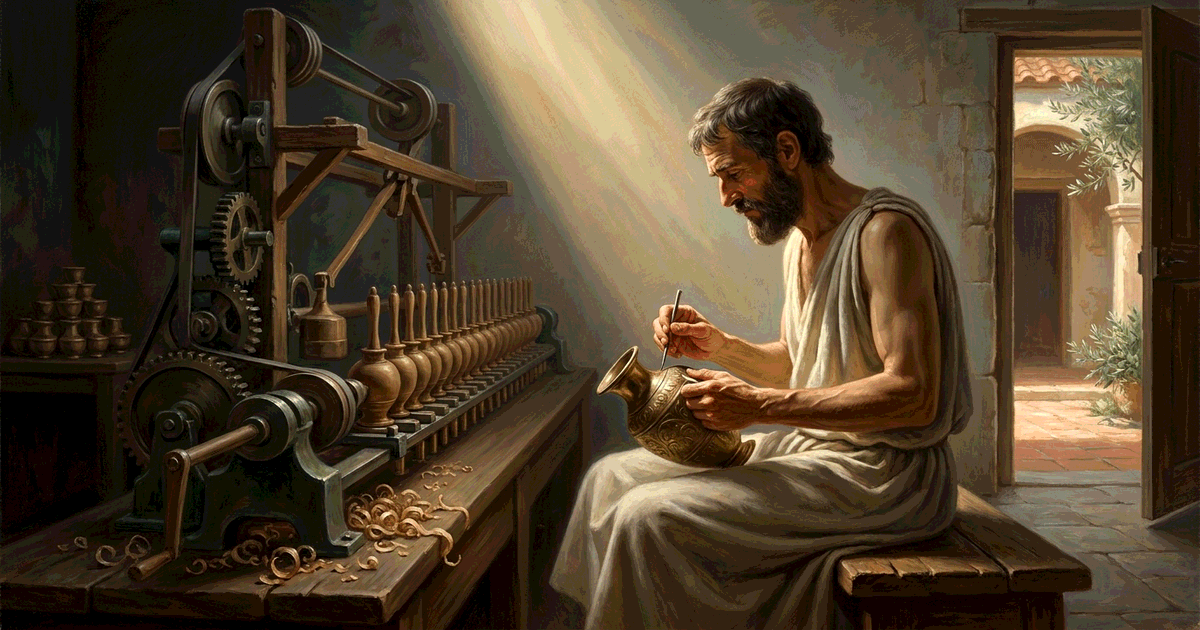
The ancient makers had words for both halves of this. techne is craft knowledge, the practical art of someone who makes things well, and it always carried the maker’s sense of what could be handed to an apprentice or a jig and what could not. But the deeper call, deciding which work is worth keeping in your own hands because the doing of it makes you, is not craft-knowledge at all. That is phronesis, practical wisdom, the judgment of which activities are worth choosing for their own sake. Craft knows how to make the thing. Wisdom knows which making to keep and which to release. That second judgment is the scarce skill now. Not the doing. The deciding what is still worth doing yourself.
Two Kinds of Work That Look Identical From Outside
Aristotle drew a line twenty-three centuries ago that turns out to be the most practical tool we have for this exact problem. He separated poiesis, making, from praxis, doing.
poiesis is work whose entire point is the product. The end is detachable from the act. When the table is built, the building is over and only the table matters. No one is improved or diminished by whether a human or a machine planed the boards, as long as the table is good.
praxis is work whose end lives inside the act itself. The point is not a separable output. The point is what happens in the doing, and to the person doing it. A conversation that repairs a friendship. A hard problem worked by hand until you understand it in your bones. The end there is not a transcript or an answer you could have been handed. The end is the understanding, the relationship, the formed judgment that exists only because you went through the work instead of around it.
Here is the trap that catches almost everyone. From the outside, poiesis and praxis can look like the exact same task. Writing a memo can be pure making, where you only need the document to exist, or it can be deep doing, where the writing is how you discover what you actually think. Two identical-looking tasks, opposite answers. Sort them into the wrong category and you either waste your life hand-crafting things nobody needed you to touch, or you automate away the precise acts that were forming you and never feel the theft until much later.
The Work to Automate Without Mercy
Start with the good news, because there is a great deal of it.
I am not a romantic about labor. Toil for its own sake is not a virtue, and treating it like one is its own kind of weakness. The entire promise of techne, going back to the first lever, was that a maker extends his reach by offloading what does not require him. This is the category where the product is genuinely the point and the doing builds nothing you need to keep.
You can recognize it by a few honest signals. You want the output and would be just as happy if it arrived by magic. Doing it a thousand more times yourself would make you no wiser. The skill involved is not one you need sharp to do your real work. Failure is cheap and easy to catch. The task sits between you and the work you are actually here to do, like a toll.
Formatting. Transcription. The boilerplate first draft you will rewrite anyway. Scheduling. Data cleanup. The seventeenth variation of something you mastered years ago. Automate all of it, without guilt and without limit. A craftsman who refuses the wheel out of pride is not being noble. He is being slow, and slow is not the same as deep.
The mark of this category is simple. Handing it over makes your real work more possible, not less. It clears the bench so the work that matters has room to happen.
The Work to Protect With Everything
Now the dangerous category, and it is dangerous precisely because it looks exactly like the first one.
This is work where the doing was the point, and where handing it over means you quietly surrender the thing the work was building in you. The tool does not take it from you. You give it away, one reasonable handoff at a time. It is more tempting to automate than the first kind, because it is usually the hard part, and the hard part is what the easy tool is best at making optional. The struggle felt like friction. It was the mechanism.
The signals run the other direction. The difficulty is doing something to you, building taste or judgment or character you will need later. You can tell whether the output is any good only because you earned that discernment by hand. The act is the relationship, or the thinking, or the formation, and the artifact is the residue. And it is how you stay able to evaluate the very tools you keep wanting to hand it to.
The thinking you do by writing. The hard conversation you would rather route through a screen. The judgment call you make by sitting in the discomfort of a real decision instead of asking a model to resolve it for you. The early reps in any craft you actually want to own. The parenting moment you are tempted to outsource because it is inconvenient. Protect the morning you spend grinding on a problem until it finally cracks open.
This is the phronesis the whole decision rests on, and it is built one way only, by making real decisions in real conditions and living with the results. Automate your decisions long enough and you do not become a wise person holding a powerful tool. You become a person who can no longer tell when the tool is wrong, which means you are no longer commanding it at all. You just cannot feel that yet.
There is an honest problem buried here, and pretending it away would be its own dishonesty. The judgment that tells you which struggle forms you and which is wasted toll is built by doing the work, so the beginner cannot run this test cleanly. They have not yet earned the discernment the test requires. That is the oldest argument there has ever been for mentors, apprenticeship, and tradition. Until your own judgment is built, you borrow someone else’s about what to keep. And you can learn by watching a master work, or even by watching the machine, but only if the watching turns into doing. Consume the output and nothing transfers. Do the work yourself after you have seen it done, and the capacity becomes yours.
One Question, Asked Honestly
When you cannot tell which category a task belongs in, stop asking whether AI can do it. Ask whether the product is the point or the doing is the point. If a perfect result delivered by magic would fully satisfy you, it is making, so automate it. If a perfect result you had no hand in producing would leave something missing, the doing was the point, so keep it. The product belongs to the world. The formation belongs to you. That line is the entire decision.
Then ask a second question. Will I still need to be able to do this when the stakes are real or the tool fails. If the answer is yes, you cannot fully hand it off, because the day you need the skill is the day you find out you traded it for convenience. You keep the muscle by using it.
There is a reason underneath the useful one, and it is firmer. Some work is worth keeping even if the tool never fails and you never need the skill again. The understanding you earn by working a problem by hand, the conversation you actually sit inside, the decision you make with your own judgment, these are not deposits against some future withdrawal. They are part of a life worth living, good in themselves, whether they ever pay off or not. Keep that work because it is good, not only because it is useful. The day you can defend it only by its usefulness is the day you have already begun to lose it.
The discomfort you feel running your own work through these questions is roughly proportional to how much of your own formation you have already given away.
Why the Stakes Are Higher Than They Look
Automating the wrong category never announces itself. It bills you later, the way every atrophy does.
The first generation to automate a skill can still catch the machine’s mistakes, because they built their discernment by hand before the tool existed. The generation that never did the work inherits the tool with no way to know when it lies to them. They are not commanding the automation. They are trusting it blind, and they do not feel the difference yet.
There is a quieter cost too. Hand over enough of the doing and you start to believe the output was the whole point the entire time. The relationship becomes a scheduled message. The thinking becomes a generated summary. The craft becomes a prompt. Each substitution is defensible on its own. Stacked together over a few years, they remove most of what a formed life was actually made of, and the dashboards never once show it, because efficiency has no column for what you are becoming.
How to Actually Draw the Line
Do the audit on paper. List the work that fills your week and sort each item honestly into making, where the product is the point, and doing, where the act is the point. Be ruthless about the items you have been filing under making only because the doing version is hard.
Then act in both directions at once. Hand the machine everything in the first column and reclaim the hours without a shred of guilt. Spend a real share of those reclaimed hours on the second column by hand, on purpose, including the parts that are slower than the tool, because slow was never the actual problem.
And keep at least one hard thing deliberately un-automated, as a discipline, specifically because doing it by hand keeps a capacity alive that you refuse to let die. Choose it on purpose. Guard it like it matters, because it does.
Final Thoughts
The machine can do it. For more and more of the work in front of you, that is simply going to be true, and pretending otherwise is a losing posture. But whether something can be done was never the question that decided who you become. The old makers understood this in their hands. techne gave them the skill to make the thing. The wisdom to know which making to keep in their own hands, and which to let the machine have, was the rarer gift, and it is the one this moment asks of you.
So sort your days like a maker and not a consumer. Automate the making until your bench is clear. Guard the doing like the formation it is. And the next time you reach to hand off something hard, ask the only question that still sorts anything. Not whether AI can do it. Ask what happens to you if it does, and whether you can live with the answer.
If you have started to feel the difference between the work that sharpens you and the work that only produces output, and you want to build a practice around protecting the first kind, that is the work I do at MasteryLab.co. The goal was never to do everything by hand. The goal is to keep your hands on the work that is still making you.