Poiesis (ποίησις): Meaning, Definition & Modern Application
poy-AY-sis
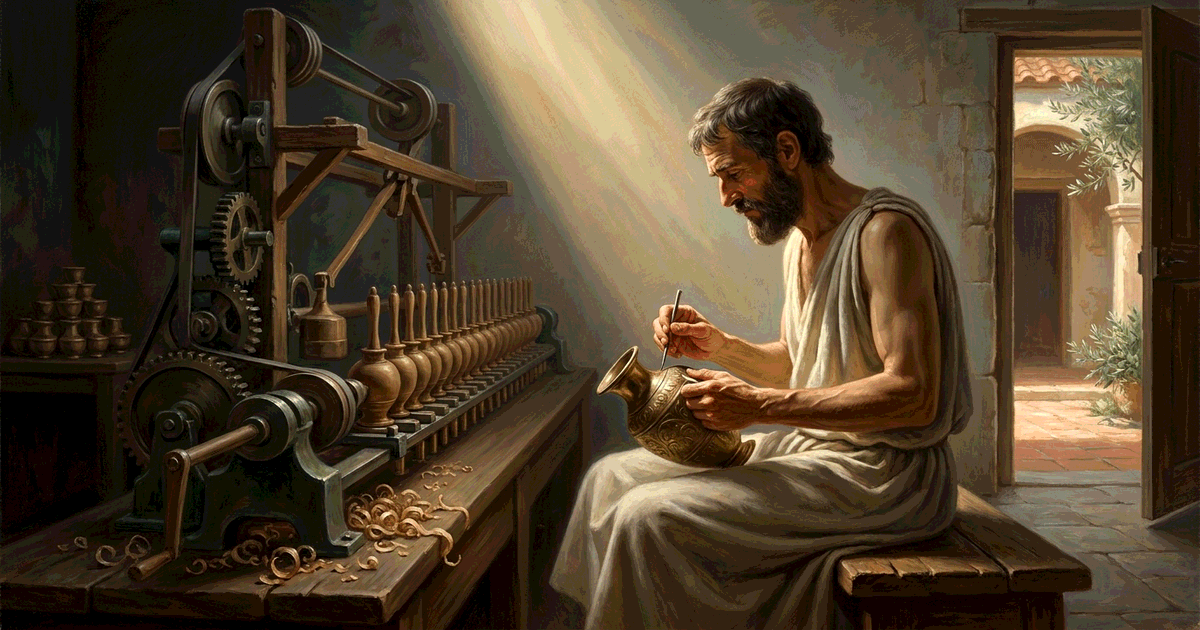
The act of bringing something into being that did not exist before—creative production that transforms raw material into meaningful form. For Aristotle, poiesis represents making or crafting, distinguished from mere action (praxis) by its focus on producing an external work or artifact.
Etymology
From poiein, meaning “to make” or “to create.” The root gives us “poetry” (originally “making” in the broadest sense) and “poetic.” Aristotle distinguished poiesis (productive activity that creates an external product) from praxis (action whose end is the action itself). Heidegger later expanded the concept, describing poiesis as any bringing-forth from concealment into presence, from the craftsman’s artifact to the flower’s blooming.
Deep Analysis
Aristotle drew a line through the center of human activity that most modern thinkers have forgotten. On one side he placed praxis, action whose purpose lives within the doing itself. On the other he placed poiesis, productive activity whose purpose lives in the thing produced. A musician playing for the love of music is engaged in praxis. A luthier building the instrument is engaged in poiesis. The distinction matters because it reveals something about the relationship between the maker and the made. When you engage in poiesis, you pour yourself into an external artifact that will exist independently of you. The artifact carries your standards, your decisions, your character into the world where others can encounter it, use it, judge it. This is why Aristotle linked poiesis so tightly to techne, the systematic knowledge of how to make well. Creation without skill produces noise. Skill without the creative impulse to bring something new into existence produces mere reproduction. Poiesis requires both: the vision of what does not yet exist and the craft to bring it into being with quality. Heidegger expanded this understanding in a direction Aristotle might not have anticipated. For Heidegger, poiesis described any bringing-forth from concealment into presence. The craftsman’s table, the poet’s verse, even the blooming of a flower all participate in poiesis because each involves something moving from hiddenness into the open. This broader reading rescues poiesis from the narrow box of artistic production and places it at the center of how reality discloses itself. For leaders and builders, the practical consequence is this: every act of creation is also an act of revelation. What you build reveals what you value. The quality of the artifact exposes the quality of the maker’s attention, care, and standards. A hastily assembled product reveals a team that prioritizes speed over substance. A carefully crafted system reveals a builder who understands that their ergon, their essential function, includes the responsibility to bring excellent things into the world. The modern workplace has largely collapsed the distinction between poiesis and mere production. Assembly lines, content mills, and feature factories all produce outputs, but they often lack the intentionality that separates genuine creation from mechanical repetition. Poiesis demands that you approach the act of making as a craftsman, not a factory worker. It asks you to care about the thing being made, not only about the metrics attached to its delivery. This is where poiesis intersects with telos, purpose. Aristotle would argue that every act of genuine creation aims at something beyond mere existence. The builder does not simply produce a house; the builder produces a dwelling, a place where human life unfolds well. When your creative work serves a purpose beyond its own production, it participates fully in poiesis. When it serves nothing beyond your quarterly targets, it may be output, but it is not creation in the philosophical sense. The recovery of poiesis as a concept matters now more than it has in centuries. In a world saturated with algorithmically generated content and mass-produced artifacts, the human capacity to bring something genuinely new and carefully crafted into being has become both rare and valuable. The question is whether you will exercise that capacity or surrender it to processes that optimize for volume over meaning. The Greeks would add a further challenge. Poiesis is not value-neutral. The person who brings something into being is responsible for what they have made. The artifact carries the maker’s intention into the world, and that intention produces consequences the maker must own. A weapon is an act of poiesis. So is a hospital. The philosophical question is not whether you are creating but whether what you are creating deserves to exist. Aristotle’s connection between poiesis and the good requires that the maker consider not only the quality of the making but the worth of the thing made. This ethical dimension separates the Greek understanding of creative production from the modern celebration of innovation for its own sake. Not every act of creation serves human flourishing. The maker who does not ask whether their artifact contributes to or diminishes the common good has failed to practice poiesis in its fullest philosophical sense.
Modern Application
You are not merely managing—you are creating something new in the world. Whether building a team, shaping culture, or crafting strategy, recognize yourself as a maker whose work will outlast the moment of creation. Channel your leadership energy into producing tangible artifacts of excellence that others can see, use, and build upon.
Historical Examples
Phidias, the Athenian sculptor who oversaw the construction of the Parthenon and created the statue of Athena Parthenos, embodied poiesis at its most ambitious. He was not merely executing a commission. He was bringing into being a physical expression of Athenian identity, civic pride, and theological conviction. The Parthenon itself remains one of the most powerful examples of poiesis in human history: a structure that has outlasted its makers by two and a half millennia because the quality of its creation transcended its immediate political context. In the Renaissance, Filippo Brunelleschi solved the engineering challenge of constructing the dome of Florence Cathedral without the centering framework that conventional building required. No one had built a dome of that scale without full scaffolding support. Brunelleschi invented new techniques, designed custom tools, and brought into existence a structure that the available knowledge said could not be built. His poiesis was not merely artistic; it was a confrontation with the limits of what was considered possible, resolved through creative ingenuity and technical mastery. Johannes Gutenberg transformed European civilization through his development of movable type printing in the 1440s. His act of poiesis was not the invention of a machine but the creation of an entirely new system for producing and distributing knowledge. The artifact he brought into being, the printed book, restructured how humanity stores, shares, and accumulates understanding. Gutenberg’s example illustrates a critical dimension of poiesis: the most transformative acts of creation often produce not a single artifact but an entirely new category of artifact that reshapes what humans can do.
How to Practice Poiesis
Identify one thing you want to bring into existence that does not yet exist: a document, a system, a team culture, a product, a habit. Commit to creating it this month. Approach it as a craftsman approaches raw material: with respect for the process and attention to quality. When you finish, evaluate the artifact honestly. Does it embody excellence? Could you sign your name to it with pride? Practice treating your leadership outputs as creative works, applying the same care and intention a sculptor gives to stone. What you create reveals who you are. Heidegger expanded the concept of poiesis to describe any bringing-forth from concealment into presence, from the craftsman’s artifact to the flower’s blooming. Apply this broader sense by recognizing the creative dimension in every aspect of your leadership. When you shape a team’s culture, design a process, or craft a communication, you are engaging in poiesis. Keep a creation log where you record what you brought into being each week and assess whether each creation reflects the quality you aspire to. Over time, this practice builds a portfolio of work that embodies your standards.
Application Examples
A product team receives a mandate to launch three new features per quarter to satisfy investor metrics. The team knows that one deeply considered feature would serve users better than three rushed ones, but velocity is being measured by count, not impact.
Poiesis asks what you are actually bringing into being. Shipping three half-formed features is production. Building one feature that genuinely solves a problem users could not solve before is creation. The difference shows up in whether the artifact serves a real purpose or merely satisfies an internal metric.
A writer sits down to produce a daily blog post as part of a content schedule. The pressure to publish on time competes with the desire to say something worth reading. The temptation is to fill the page rather than craft the argument.
Poiesis is not about output volume. It is about the quality of the bringing-forth. A single paragraph that changes how someone thinks carries more creative weight than a thousand words that fill space. The discipline is choosing craft over completion when the two conflict.
A new engineering director inherits a team with no shared engineering culture. Rather than importing a framework from a previous company, she spends three months listening, observing, and collaboratively building engineering principles with the team from scratch.
The best acts of organizational poiesis do not copy and paste. They bring something new into being that reflects the specific materials at hand. Culture cannot be manufactured from templates. It must be crafted from the people, context, and purpose actually present.
A teacher assigned a standardized curriculum notices that students disengage during scripted lessons but come alive when asked to build their own projects. She redesigns her class around student-created artifacts that demonstrate mastery through making.
Poiesis is how humans naturally learn. Creating something that did not exist before forces you to confront what you actually understand versus what you can only repeat. Making reveals gaps that consumption conceals.
A neighborhood association that has been debating park improvements for two years without progress decides to stop discussing and start building. Volunteers spend a single weekend constructing a community garden with whatever materials they have. The imperfect garden draws more participation in one month than two years of planning meetings produced.
Poiesis breaks the paralysis of analysis. The act of creating something tangible, even imperfect, generates energy, feedback, and community in ways that planning alone cannot. The artifact becomes a gathering point. The discussion was a barrier.
Common Misconceptions
An engineer designing a database schema is engaged in poiesis as genuinely as a sculptor carving marble. Both are bringing something from nonexistence into existence through skill and intention. The restriction of poiesis to artistic or creative fields misreads Aristotle, who applied the concept to any act of bringing something into being. Do not confuse poiesis with techne, either. Techne is the knowledge of how to make. Poiesis is the making itself. A skilled carpenter who never builds anything possesses techne but does not engage in poiesis. Knowledge without creation is potential without actualization. Speed and poiesis are also not opposites. Carelessness diminishes creation. Speed does not. The quality of poiesis is measured by the artifact produced, not by the time invested in producing it.
The moments in my career that mattered most were not the meetings I attended or the strategies I debated. They were the things I built. Early in my work with agile teams, I realized that the act of making, whether it was a product, a team practice, or a culture, taught me more than any amount of planning or analysis. There is something irreplaceable about the feedback you get from bringing an idea into physical form and watching it encounter reality. I have built software products, team cultures, and coaching frameworks. Each time, the process of creation forced me to clarify my thinking in ways that pure discussion never could. When you build something, you discover what you actually believe versus what you only thought you believed. The artifact does not lie. It shows your real priorities, your real standards, your real level of care. This is why I push the teams I work with to build quickly and build with intention. Not to ship fast for the sake of speed, but because the act of creating something tangible and putting it in front of people accelerates learning in ways that planning cannot match. Poiesis, for me, is the engine of understanding. You do not truly know something until you have made something with that knowledge. One practice that has served me well is what I call the artifact test. Before ending any week, I ask: what did I bring into being that did not exist on Monday? If the answer is nothing, the week was consumed by maintenance and reaction rather than creation. Some weeks that is necessary. But if it becomes a pattern, I know I have drifted from the maker’s stance that produces my best work. The teams I have seen thrive are the ones that ship something they can point to and evaluate every single week. The teams that struggle are the ones lost in process, planning, and discussion without ever producing an artifact that encounters the real world.
Frequently Asked Questions
What is poiesis in Greek philosophy?
Poiesis is the Greek concept of creative production, the act of bringing something into being that did not exist before. Aristotle distinguished it from praxis (action for its own sake) by its focus on producing an external work or artifact that outlasts the moment of creation. Heidegger later expanded the concept to describe any process of bringing-forth from concealment into presence, applying it far beyond traditional craftsmanship.
What does poiesis mean?
Poiesis means making, creating, or bringing forth. From poiein (to make), it is the root of poetry and poetic. In its broadest philosophical sense, it describes any process that transforms raw material into meaningful form. The Greeks originally understood "poetry" in the broadest sense as "making," reflecting the insight that all creative production shares a common nature.
How do you practice poiesis?
You practice poiesis by identifying what you want to bring into existence and committing to creating it with craft and intention. Approach your leadership outputs as creative works, applying care and quality. What you create is a tangible expression of your character. Choose one project this month that you will treat as your artifact of excellence, giving it the attention and craft that a sculptor gives to stone.
What is the difference between poiesis and techne?
Poiesis is the act of creation itself, bringing something new into being. Techne is the systematic knowledge and skill that guides that creation. Poiesis is the making; techne is the know-how that makes excellent making possible. You need techne to practice poiesis well, because creation without skill produces crude artifacts rather than works of genuine quality.