Stop Worshiping Finished Heroes. Study the Ones Still Becoming.
By Derek Neighbors on August 5, 2026
You picked a hero and studied the wrong thing.
The person may have been right. The unit was wrong. You studied the finished surface: the record, the composure, the origin story cleaned for public use. Then you looked at your own week, still unfinished, still ugly in the middle, and decided you were failing a test nobody serious ever passed on day one.
That is the assumption most ambitious people never name. The people worth following look complete. Inspiration comes from polish. If your life still shows seams, you are not ready to count yourself in their company.
The assumption feels respectful. It is also how formation dies quietly. It shows up after a race when you only study medal ceremonies, after a hard parenting week when you only study “perfect parents,” after an exam when you only study finished geniuses. Biography culture is one lane. The freeze is wider than that.
The Assumption
By finished hero I mean an end-state surface: the record, the calm interview, the cleaned story with no visible practice left in it. By usable model I mean a person whose struggle, correction, and reps are still visible enough that you can steal a method for tomorrow morning.
Finished-product hero-worship sounds like high standards. You collect examples of excellence. You put their quotes on the wall. You replay the interview where they sound certain. You tell yourself you are learning from the best.
What you are actually doing is comparing a mid-build self to an end-state museum piece.
That comparison shapes behavior fast. You wait until you feel “ready” enough to move like them. You hide your misses because they fail the museum test. You treat other people’s early drafts as evidence they are unserious, while treating your own early drafts as proof you should quit. The highlight reel becomes the entrance exam.
arete (ἀρετή), excellence as a way of functioning, cannot be studied as a finished monument. A monument is what remains after the work, and the work is the part you still need. Excellence is actualized in repeated right action. Studying only completed outcomes fails to show the activity by which that excellence was made.
The Crack
Then the cracks show up, and if you are honest they relieve you.
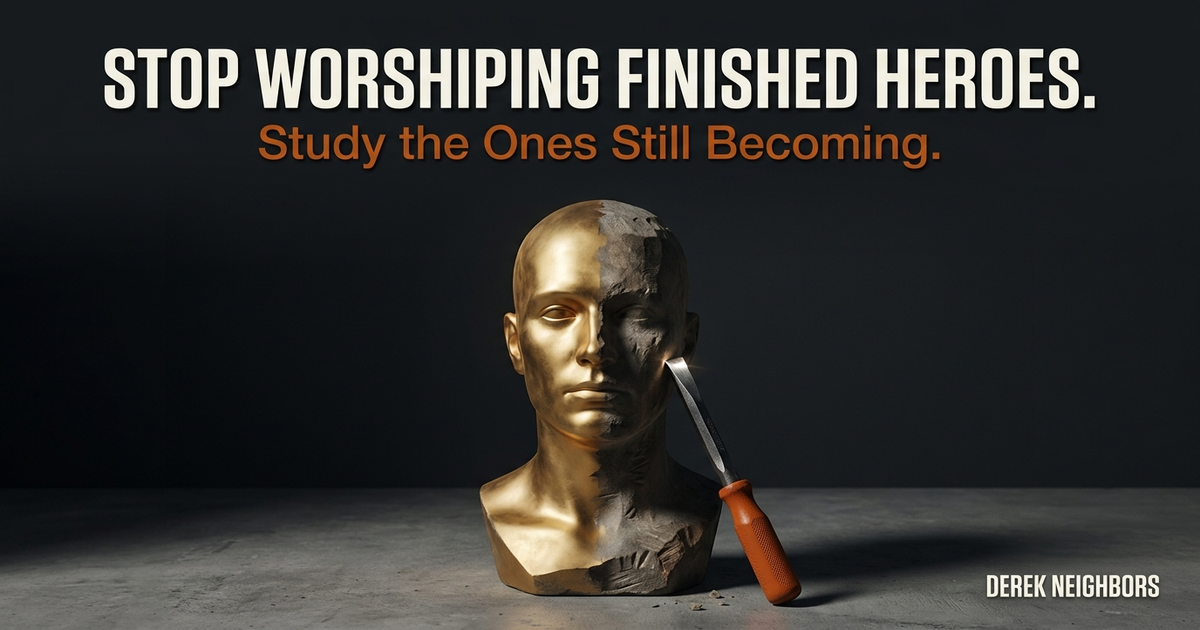
Cato lost his temper. The man later generations flattened into moral marble was still a human with a fuse. Marcus Aurelius wrote the Meditations because he was not done becoming himself. Those pages read as private corrections from someone mid-path who needed the notebook, not as a victory lap for a finished emperor. Jackie Robinson was not born as the finished symbol later textbooks needed. Restraint under pressure was trained. Intensity had to be governed. The usable story is the becoming, not the bronze.
If finished heroes were the useful unit of study, admiration would convert into skill more often than it does. It does not. People stare at statues and freeze. The anomaly is sitting in plain sight: the models that change behavior are the ones whose struggle is still visible.
The Investigation
The Stoics already had a better category than “hero.”
They sorted people into beginners, the prokopton (προκόπτων), the progressor making moral progress, and the sage. Ideals can still orient. The failure mode is treating a pathless finished image as the daily unit of imitation. Useful philosophy was never built only for people who had already arrived. It was built for people still catching themselves before the same mistake, still training the same faculty, still unfinished on purpose.
That is why prokopton matters more than another motivational biography. The progressor is the working unit. You can still see the reps, the miss, and the correction in the same life. The path has not been compiled out of existence yet. prokopton does not lower the bar. It names the category of people still meeting a hard standard through correction rather than through a fantasy of already being finished.
A finished surface erases that path. You cannot steal a practice from a result that no longer shows how it was made. Related territory, different angle: “Why the Best in the World Can’t Teach You What They Know” is about expert explanation failing at the top. This piece is about idol selection. You can pick the wrong unit of study even when the person is worth studying.
Marcus is useful when you read him as a man arguing with himself at night, not as an emperor of permanent calm. Cato is useful when his temper stays in the record, because it proves virtue was a practice under strain rather than a fixed personality trait. Robinson is useful when you keep the early pressure in view: the public restraint was trained, not a default setting. It was askesis (ἄσκησις), deliberate training under load.
paideia (παιδεία), formation, needs handles. Statues do not educate. Struggle does.
Statue-worship has a predictable cost. You delay action until you feel finished enough. You go quiet about your own misses, then wonder why nobody around you shows theirs. You develop a private contempt for mid-form work, including your own. The room fills with people protecting an image of completeness while nobody admits they are still becoming. What looks like excellence culture becomes museum culture: polished surfaces, hidden practice, and no usable path between them.
If you lead people, the same failure shows up when you hide the sweat. The cousin piece is “Hide the Sweat and You Hide the Path.” Leaders who polish themselves into statues train followers to wait for a finished feeling that never arrives. The progressor leader leaves the path visible on purpose.
The Revelation
The only useful exemplar is one that can be seen struggling.
Struggle is not fashionable decoration. It is the only part you can copy. The highlight is a result, and the unfinished practice is the method underneath it.
prokopton is the category that returns permission to keep swinging. Awe of pathless polish breeds waiting. Study of the progressor breeds Tuesday. Admiration serves formation when it points at practice, and dies into delay when it stops at polish. You stop asking whether you already look like the statue. You start asking whose unfinished path still has usable marks on it.
You do not control how polished other people’s public stories become. What remains yours is which slice you study and whether you assent to waiting for a finished feeling before you act.
A polished public story with no visible practice is appearance mistaken for excellence. The Good here is excellence as ongoing actualization, not the shine that remains after the path has been erased.
That turn is metanoia (μετάνοια), a change of mind with consequences in action. You do not need a new hero list. You need a new way of reading the heroes you already have.
This is also distinct from “You’re Not a Blank Slate. You’re a Block of Marble.”. That essay is about discovering your own grain. This one is about who you study while you carve. Both refuse the fantasy of a finished self. One looks inward at the stone. The other looks outward at which models still show the chisel.
And it sits next to “Why Getting Better Feels Like Getting Worse” without repeating it. Bigger ponds re-rank you. Finished-hero worship does something meaner: it tells you that feeling mid-rank mid-path means you do not belong in the story at all.
You belong as a progressor. Finished was never the entry fee.
The Application
-
Statue audit. Name three people you study. For each, write one documented bad day, early failure, or unfinished practice. If you cannot find one, you are studying a myth, and myths inspire without training.
-
Progressor swap. Replace one polished biography this month with a source that shows process: journals, early drafts, training logs, letters, rough first seasons. Steal from the version that still had seams.
-
Visible miss ledger. Once a week, record one miss of your own where a trusted peer can see it. Keep the standard. Drop the museum act. If you refuse to be a statue, people around you get permission to practice in public too.
-
Steal the struggle, not the pose. When you imitate, copy the practice under pressure: the morning reps, the correction after the miss, the restraint trained under load. Do not copy the interview voice of someone describing a win after the fact. Steal struggle and correction. Refuse cruelty, dishonesty, and other vices even when they show up mid-path in someone you admire. phronesis (φρόνησις), practical wisdom, chooses which unfinished marks are curriculum and which are refuse.
-
Permission sentence. Write it where you will see it: “I am a progressor. Finished is not the entry fee.” The sentence keeps the next hard rep from being stolen by awe.
Final Thoughts
Excellence is a way of becoming, not a wing in a museum.
The people who help you most are still in the work with tool marks showing. Study them there. Keep your own marks visible enough that someone behind you can find the path. arete does not require you to arrive before you begin. It requires you to keep becoming in public enough that the becoming stays honest.
If you want a place where unfinished work is the point, not a secret, MasteryLab is built for progressors who keep swinging together.
FAQ
Why do perfect role models make people stuck?
A finished surface erases the path. When you compare your mid-struggle week to someone else’s end-state highlight reel, your unfinished work looks illegitimate. Inspiration without a visible practice turns into waiting. People freeze because they think they must already look complete before they are allowed to act.
What is prokoptōn in Stoic philosophy?
Prokoptōn is the Stoic name for the progressor, the person making moral progress who is neither raw beginner nor finished sage. The category matters because the sage is nearly useless as a daily model, while the progressor still shows struggle, correction, and training. That is the unit of imitation that actually teaches.
How should I study heroes without freezing?
Run a statue audit. For each hero you study, find one documented bad day or unfinished practice. Replace one polished biography with journals, early work, or training logs. Steal the practice under pressure, not the highlight posture. Keep a visible miss ledger so you refuse to become a statue for yourself.
Did Marcus Aurelius present himself as finished?
No. The Meditations read as private progress notes written by a man correcting himself in real time. He journaled because he was not done. Treat Marcus as a bronze emperor of calm and you get a statue. Treat him as a progressor and you get a usable path.