Kairos (καιρός): Meaning, Definition & Modern Application
kai-ROSS
The opportune or decisive moment, the critical point in time when conditions align for effective action. Unlike chronos (sequential time), kairos represents qualitative time: the right moment that demands recognition and response.
Etymology
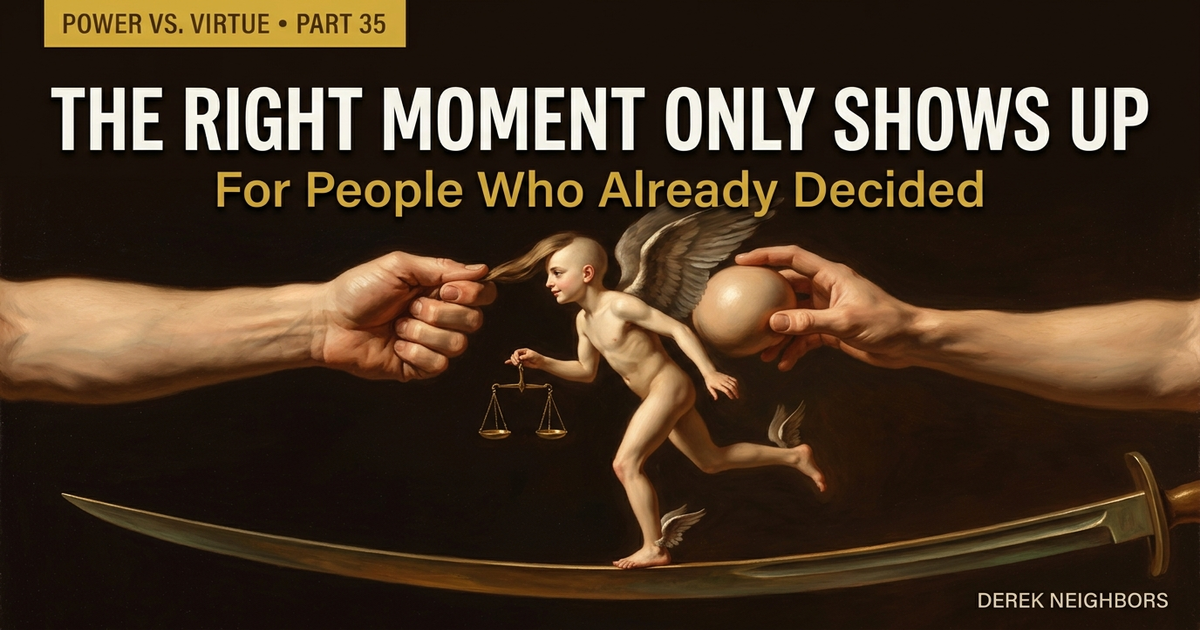
The exact origin of kairos is debated. In archery, it referred to the precise opening in armor through which an arrow must pass. In weaving, it described the critical moment when the shuttle must pass through the threads. Both usages capture the idea of a narrow window demanding precise action. Greek rhetoricians adopted the word to describe the right moment for the right argument. The personified god Kairos was depicted with hair only on his forehead, symbolizing that opportunity can only be seized as it approaches.
Deep Analysis
The physical depiction of the god Kairos, attributed to the sculptor Lysippus in the fourth century BCE, encodes the concept’s essential nature in visual form. Kairos was shown as a youth with a full forelock of hair but bald behind the head. You could grasp him as he approached, but once he passed, there was nothing to hold. He stood on tiptoe atop a sphere, indicating the instability of the moment. He held a razor, signifying that the moment of decision is as sharp and narrow as a blade’s edge. This image was not decorative. It was philosophical instruction: opportunity presents itself briefly, requires immediate recognition, and cannot be seized in retrospect.
The rhetorical tradition gave kairos its most developed philosophical treatment. Gorgias and the Sophists recognized that the effectiveness of a speech depended not only on its content but on when it was delivered. The right argument at the wrong moment fails. The adequate argument at the precisely right moment succeeds. Isocrates formalized this insight into a principle of rhetorical education: the skilled speaker must develop sensitivity to the moment, reading the audience, the political context, and the emotional atmosphere to determine not just what to say but when to say it. This sensitivity could not be reduced to rules. It required the kind of trained perception that only phronesis (practical wisdom) could provide.
The relationship between kairos and phronesis is one of mutual dependency. Phronesis is the practical wisdom that enables you to recognize the right action in particular circumstances. Kairos adds the temporal dimension: practical wisdom must include sensitivity to timing. The right action performed at the wrong moment becomes the wrong action. The leader who recognizes that the team needs a change of direction but pushes the change during a period of extreme stress will produce resistance that the same change, introduced at a calmer moment, would not generate. Phronesis without kairos awareness produces correctly identified actions with poorly chosen timing. Kairos awareness without phronesis produces well-timed actions that are themselves ill-conceived.
The impossibility of scheduling kairos is one of its most important features. Chronos can be managed: you block time on your calendar, create deadlines, and schedule activities. Kairos cannot be managed. It can only be prepared for. The archer cannot determine when the target will present itself. The archer can only train so thoroughly that when the target appears, the response is immediate and accurate. This preparation-without-scheduling model challenges modern productivity culture, which assumes that all valuable activities can be calendared and that unscheduled time is wasted time. The person who is never unscheduled has eliminated the space in which kairos can be recognized and seized.
Prosoche (self-attention, present awareness) is the practice through which kairos sensitivity develops. The person who is fully present to the current moment is more likely to recognize when conditions have ripened for decisive action. The person whose attention is consumed by past regrets, future anxieties, or the constant stimulation of digital devices will miss kairotic moments because they are not present when the moments arrive. This is the practical link between Stoic mindfulness practices and effective timing: the more fully you attend to the present, the more reliably you recognize when the present contains an opportunity that demands action.
The distinction between kairos and urgency is critical for leadership. Not every moment that feels urgent is kairotic. Urgency is often manufactured by artificial deadlines, social pressure, or the adrenaline of crisis. Kairos is the genuine alignment of conditions for effective action. The ability to distinguish between “this feels urgent” and “this is the right moment” is one of the most valuable leadership capabilities. It requires both the prosoche to notice the difference and the andreia (courage) to act when the moment is genuine and to refrain when the urgency is artificial.
Kairos in Greek medical practice was used to describe the critical moment in a disease when treatment would be effective. Hippocrates wrote that the physician must recognize the kairos for intervention: too early and the treatment cannot work because the disease has not progressed to the point where it is vulnerable; too late and the disease has passed the point where treatment can alter its course. This medical usage captures the general principle: kairotic moments are bounded. They open and they close. The person who hesitates too long or acts too early has missed the narrow window in which their action could have been effective.
Modern Application
Leadership requires you to recognize when circumstances have ripened for action: when your team is ready for change, when the market demands a pivot, or when a difficult conversation can no longer wait. Cultivate your sensitivity to kairos by staying attuned to context and resisting both premature action and paralysis. When the moment arrives, act with conviction; opportunities seized at the right time require far less force than those pursued too early or too late.
Historical Examples
The Battle of Salamis in 480 BCE is perhaps the most consequential kairotic moment in Western history. The Athenian general Themistocles recognized that the narrow straits of Salamis would neutralize the Persian fleet’s numerical superiority. But the kairos was not merely tactical. Themistocles had to convince the allied Greek commanders to fight at Salamis rather than retreating to the Peloponnese. According to Herodotus, when the Corinthian commander Adeimantus moved to withdraw, Themistocles reportedly sent a secret message to Xerxes, goading the Persians into attacking in the narrow strait. Whether or not this stratagem is historical, the result was decisive: the Persian fleet was destroyed, and Greece’s independence was preserved. Themistocles’ genius was not in devising the strategy but in recognizing the moment when the strategy could be executed.
In rhetoric, Demosthenes’ Philippics demonstrate kairotic timing applied to political speech. Demosthenes began warning Athens about the threat posed by Philip II of Macedon years before the danger became obvious to most Athenians. His early speeches were largely ignored. His later speeches, delivered as Philip’s conquests made the threat undeniable, mobilized Athenian resistance. The content of the later speeches was not substantially different from the earlier ones. The kairos was different: the audience was now ready to hear what Demosthenes had been saying for years. The lesson is that being right too early is functionally equivalent to being wrong, and part of political wisdom is the patience to wait until the audience’s experience has prepared them to receive the message.
Rosa Parks’ refusal to give up her bus seat on December 1, 1955, in Montgomery, Alabama, was a kairotic act prepared by years of strategic planning. Parks was not the first person to refuse to yield a seat on a segregated bus. Claudette Colvin had done the same nine months earlier. But the NAACP and the Montgomery Improvement Association recognized that Parks, with her impeccable reputation and quiet dignity, presented the ideal test case for a legal challenge at a moment when community frustration had reached the point where a boycott was sustainable. The kairos was the convergence of the right person, the right moment of community readiness, and the organizational infrastructure to sustain the action. The boycott lasted 381 days and led to the Supreme Court ruling that bus segregation was unconstitutional.
How to Practice Kairos
Train your sense of timing by keeping a decision log. For each major decision, record when you acted and whether the timing proved right, premature, or late. After three months, review the log for patterns. Which signals did you read correctly? Which did you ignore? Practice situational awareness in meetings: before speaking, ask whether this is the right moment for this point. Develop the discipline to distinguish between urgency and importance. True kairos requires both readiness and patience, acting neither too soon from anxiety nor too late from hesitation. Study your past successes and failures specifically through the lens of timing. How many good ideas failed because the moment was wrong? How many mediocre ideas succeeded because the timing was right? Cultivate the habit of scanning your environment for ripeness before committing to action. When multiple signals converge, pointing to the same opportunity, that convergence is often kairos announcing itself.
Application Examples
A startup founder has been developing a product for two years. Market conditions shift: a major competitor exits the space, a regulatory change creates new demand, and a potential distribution partner reaches out simultaneously. The founder recognizes the convergence of conditions as a kairotic moment and accelerates the launch, securing the partnership and capturing the market position within three months. Six months later, two well-funded competitors enter the space. The window has closed.
Kairos in business is often signaled by the convergence of multiple favorable conditions simultaneously. A single favorable development may not constitute kairos. The convergence of several at once almost always does. The discipline is recognizing the convergence when it occurs and having the preparation to act immediately.
During a quiet walk with his father, a man senses that the moment is right for a conversation they have both been avoiding for years: an honest reckoning with a family conflict that has gone unaddressed since childhood. The setting is calm, both are relaxed, and something in the quality of the silence invites depth. He begins the conversation. It produces a reconciliation that neither had believed possible.
Relational kairos cannot be manufactured. You cannot schedule the moment when someone is ready to hear a difficult truth or engage with a painful subject. You can only prepare for it by building the relationship, cultivating the trust, and maintaining enough present attention to recognize when the moment arrives.
A manager has been waiting for the right moment to propose a reorganization that she believes is necessary but politically sensitive. After a surprisingly candid leadership retreat where several executives acknowledged that the current structure is not working, she presents her proposal. The proposal is received well because the ground has been prepared by the collective acknowledgment that preceded it. Had she proposed the same plan a week earlier, before the retreat, it would have been perceived as political maneuvering.
Organizational kairos often follows a moment of collective honesty or shared recognition of a problem. The leader who has prepared their proposal and waits for the moment when the organization is ready to hear it will achieve more than the leader who pushes the proposal according to their own timeline.
A teacher notices that a normally disengaged student asks a question that reveals genuine curiosity about the subject for the first time. The teacher recognizes this as a kairotic moment and adjusts the entire lesson plan to pursue the student’s question, creating a discussion that engages the whole class. The student begins to participate regularly.
Teaching is fundamentally a kairotic art. The curriculum provides the chronos structure, but the moments when genuine learning occurs are kairos: unpredictable, brief, and responsive to the teacher’s ability to recognize and seize them.
Common Misconceptions
Watch someone seize the right moment and you will hear bystanders call it luck. The person who seizes a kairotic moment may appear fortunate, but the seizure requires preparation, perception, and courage that luck does not explain. The prepared person encounters the same moments as the unprepared person. The difference is in the capacity to recognize and act. Another error treats kairos as something you can create through force of will. You cannot manufacture the moment when conditions align. You can only prepare yourself so thoroughly that when the alignment occurs, your response is immediate. The third misconception is that missing a kairotic moment is always a catastrophe. Some windows close permanently. Others reopen. The discipline is to distinguish between the two and to grieve the genuinely missed moments while remaining alert for those that may return in a different form.
I have missed more kairotic moments than I have seized, and the pattern of my misses has taught me what prevents recognition. The most common obstacle is not inattention. It is being too committed to the plan. When I have a strategy in place, a timeline mapped out, and a process underway, I become invested in executing the plan rather than remaining open to the possibility that circumstances have created a better path. The kairos arrives, and I miss it because I am busy following the schedule.
The most significant kairos I seized was unplanned and uncomfortable. I was midway through a consulting engagement when a conversation with the client’s COO revealed that the real problem was not the one I had been hired to solve. The organizational issues I was addressing were symptoms of a leadership dysfunction that nobody had been willing to name. I had two choices: continue the engagement as scoped, deliver the contracted work, and bill the remaining hours, or pivot the entire engagement to address the root problem, which would require renegotiating the scope, confronting the CEO with uncomfortable truths, and potentially losing the client.
I recognized the moment. The COO’s candor had opened a window that would close within days as organizational defenses reasserted themselves. I pivoted the engagement. The conversation with the CEO was difficult. The outcome was a restructuring that addressed the actual dysfunction rather than the presenting symptoms. The client remained a client for years. Had I followed the plan instead of recognizing the moment, I would have delivered competent work on the wrong problem.
The practice I now maintain is what I call “kairos readiness”: I prepare proposals, strategies, and difficult conversations well in advance of when I expect to use them, then I wait for the moment when conditions align rather than forcing the conversation according to my timeline. The preparation is chronos work. The deployment is kairos work. Both are necessary.
Frequently Asked Questions
What is kairos in Greek philosophy?
Kairos is the Greek concept of the opportune or decisive moment. It represents qualitative time, the critical instant when conditions align for effective action. Greek rhetoricians and philosophers used it to describe the right moment for the right word or deed. The personified god Kairos was depicted with hair only on his forehead, symbolizing that opportunity can only be grasped as it approaches, not after it passes.
What does kairos mean?
Kairos means the right or opportune moment. Its origins relate to precise openings, whether the gap in armor for an arrow or the instant a weaver's shuttle must pass through threads. It describes time not by its quantity but by its quality and significance. Greek rhetoricians adopted the word to describe the right moment for the right argument, recognizing that even the best speech fails when delivered at the wrong time.
How do you practice kairos?
You develop sensitivity to kairos by training your awareness of context and timing. Keep a decision log tracking when you acted and whether the timing was right. Practice patience alongside readiness, learning to distinguish genuine opportunity from mere urgency. Before any major initiative, ask yourself whether the conditions are ripe or whether you are forcing action out of impatience. Review your log quarterly to sharpen your instincts.
What is the difference between kairos and chronos?
Chronos is sequential, quantitative time measured by clocks and calendars. Kairos is qualitative time, the significant moment when conditions demand action. Chronos passes regardless of meaning; kairos arrives laden with opportunity and disappears if not seized. The Greeks maintained separate words for these concepts because they understood that not all moments carry equal weight, even though the clock treats them identically.