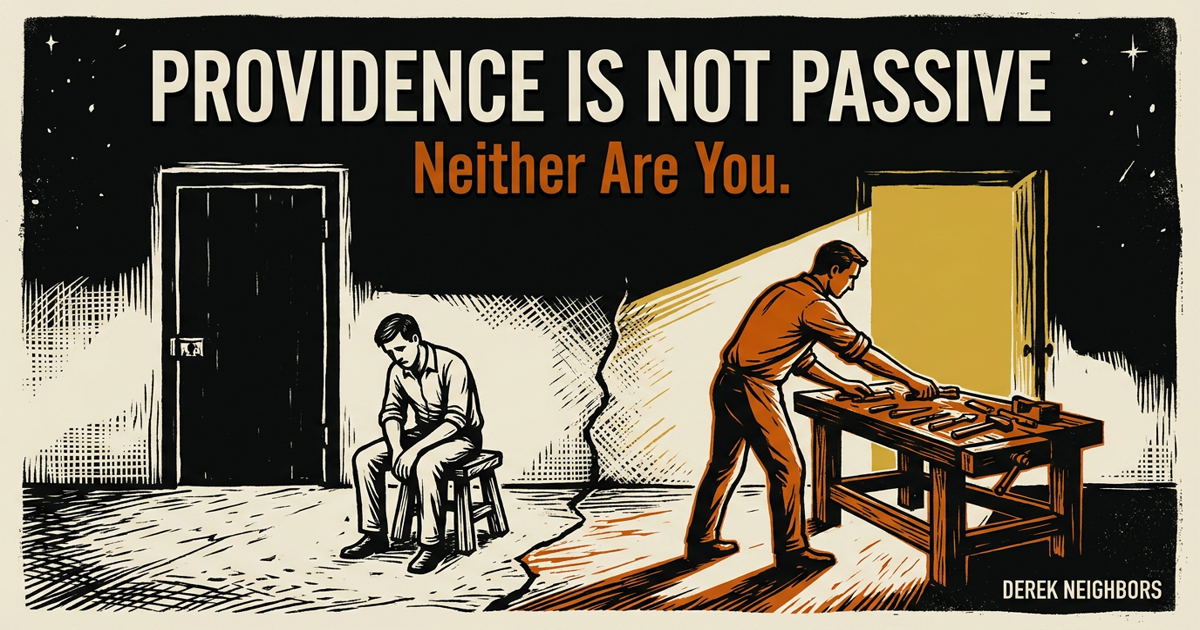
Providence Is Not Passive. Neither Are You.
By Derek Neighbors on July 14, 2026
I wrote earlier about the prior: the suspicion that the universe is on your side, and how that suspicion changes what you attempt. This is the other half. The half most people skip because it costs more than a belief.
Trust that never leaves the couch is not pronoia. It is superstition that learned new words.
The Standard
Excellence on this question looks specific. The person trusts the field will offer workable material, and then they provision for it as if the offer depends on them showing up ready.
Marcus Aurelius is the cleanest picture. He wrote about providence in a notebook meant for no one. He also staged supply lines, prepared for plague, and did the work of an emperor who expected the day to demand something of him. The trust and the preparation arrived welded. Separate them and you get either a mystic who waits or a cynic who grinds without hope. The standard holds both.
I have watched this in operators for twenty years. The ones who last do not wait for permission from the market. They draft the deck before the meeting is booked. They build the skill before the role opens. They ship the thing while the timing still looks wrong. Their trust shows up as preparation density, not as affirmations.
The bar is blunt: your trust is measured by what you prepare, not by what you affirm.
The Gap
Most people fall short in a way that feels virtuous.
They read the optimism chapter and stop. They adopt the workable prior, then treat the prior as the whole practice. “The universe will provide” becomes permission to wait for a cleaner invitation, a perfect partner, a season that feels less inconvenient. Manifestation culture sold a version of this at scale: rearrange your thoughts, and the furniture of life will rearrange itself. The thoughts matter. The furniture does not move without hands.
The gap exists because passive faith feels like character and costs nothing today. Active faith costs sweat today and pays later. The discount rate favors the couch. You can spend a decade “trusting the process” while the process never meets a Tuesday that demanded output.
There is a related failure I have named before: preparation that is actually hiding. That is the opposite costume. Endless readiness with no ship date. Active providence is not that either. It is preparation aimed at a near attempt, not preparation as a lifestyle that postpones the attempt forever.
The gap also shows up after a closed door. The person who claimed trust reads the setback as proof the universe reneged, then retreats into bracing. That is paranoia reclaiming the room. Real trust treats the closed door as material and asks what work the redirection now requires.
The Path
The Greeks did not leave this as a mood. They left vocabulary that forces the pairing.
pronoia is forethought and, in the Stoic sense, providence: the rational care running ahead of events. energeia is Aristotle’s word for being-at-work, actuality, the capacity fully in use. Potential without energeia stays a brochure. askesis is the training that makes the pairing durable under pressure. ponos is the unglamorous toil that every real thing is built from. Together they describe a disposition, a hexis, of someone who works as if helped and prepares as if responsible.
You do not need the cosmology. You need the weld.
Four practices. None of them are the drills from the first piece. That piece trained the prior. This one trains the wage.
Run the receipt test. Name one outcome you are currently “trusting the universe” for. Write the work you did toward it in the last seven days. If the second list is empty, the trust is costume. No debate. The receipt is the calendar, not the journal entry where you felt aligned.
Practice armed anticipation. Take the opportunity you expect next: the client, the role, the launch window, the conversation that might open a door. Prepare the deliverable before the invite arrives. Deck drafted. Outreach list ready. Skill already practiced under low stakes. When the door opens, you walk through carrying something. Waiting until the invite to start is how people miss the opening they claimed to trust.
Keep a redirection log. When an obstacle lands, log the redirected action within twenty-four hours. Not a silver lining. A next move. The closed funding round that becomes a tighter product. The lost hire that forces you to build the system yourself. Fear will ask the wrong question here. Answer with work. The log trains you to treat setbacks as material for energeia instead of as verdicts that cancel the prior.
Protect offense hours. Every day, block time for work that only makes sense if you expect the field to open. Not maintenance. Not inbox. Work that assumes a door exists somewhere ahead of you. Ship into uncertainty on purpose. The grunt work of a caught dream is what this feels like from the inside: unglamorous, scheduled, and oddly clarifying once you stop waiting for the summit feeling.
The Test
You will know you are progressing when three checks start returning different answers.
Calendar audit. Open next week. Does it contain offense hours, or only maintenance and hope? Hope does not appear on a calendar. Work does. If the week is full of “waiting to hear back” and empty of “shipping while I wait,” you are still in the gap.
The embarrassment check. Would a skeptic watching your week accuse you of superstition or of over-preparation? Superstition waits. Over-preparation ships early. You want the second accusation. It is the only one compatible with honest trust.
The thirty-day count. After a month, tally attempts made under the workable prior versus waits justified by “timing.” Timing is real sometimes. It is also the most polite alibi available to people who have not done the work. If waits outnumber attempts, your pronoia is still a mood.
The Mastery
When the pairing holds, two failures end at once.
Paranoia’s defense game ends: you stop bracing for a hostile field and start playing offense. Optimism’s waiting room ends too: you stop treating belief as a substitute for output. You play offense because you trust the field, and you train because trust without training is theater.
What you gain is a specific capacity. You can take a closed door without losing the work ethic that makes the next door usable when it opens. Most people lose one or the other. They either quit preparing when disappointed, or they keep grinding with a prior so dark that every attempt arrives already half-defeated. The mastery is both: workable reading, relentless askesis.
This does not graduate. pronoia and energeia stay welded for as long as you claim the trust. The day you separate them, you are either a mystic on a couch or a cynic in a cube, and neither is the standard.
Frequently Asked Questions
What does it mean that providence is not passive?
It means trusting that the universe, or the rational order the Stoics called pronoia, is workable does not license waiting. Stoic providence was always paired with preparation and duty. Forethought and trust arrived as one discipline. Passive optimism that sits still while calling itself faith is not the ancient practice. It is a modern costume.
What is energeia and how does it relate to trusting providence?
energeia is Aristotle’s word for being-at-work, actuality, the full exercise of a capacity. Potential without it stays inert. Applied here: believing good things can arrive is talk about capacity. Showing up to do the work that meets the opening is energeia. Pronoia sets the prior. energeia pays the bill.
Is “trust the universe and work” the same as the law of attraction?
No. The law of attraction claims belief alone rearranges outcomes. Active faith claims belief changes what you attempt, prepare, and persist through, and those behaviors change outcomes through ordinary means. If your metaphysics were wrong tomorrow, the work would still have been the right move. Superstition fails that test. The Stoic pairing passes it.
How do you practice active faith without becoming reckless?
Size bets with forethought, then work them. Recklessness skips preparation. Passive faith skips work. Active faith does both: name the opportunity you expect, prepare the deliverable before the invite, protect daily offense hours, and treat obstacles as redirections that still require a next action within twenty-four hours. Trust opens the stance. Preparation sizes the wager.
Final Thoughts
The first article asked you to suspect the universe of plotting in your favor. This one asks what that suspicion costs in sweat.
If the answer is nothing, you do not have trust. You have a slogan. pronoia without energeia is a costume that flatters the wearer and fools no one who watches the calendar.
Provision the ship. Then sail it. The field does not owe you an opening you refused to prepare for, and the openings that arrive unused are the most expensive kind of luck: the kind that found you ready for nothing.
Building the daily work that makes trust honest is the character practice we run at MasteryLab.co. Bring your receipt.