Loud Before, Gone During: How to Tell the Bold From the Brave
By Derek Neighbors on July 13, 2026
Power vs. Virtue: The 48 Laws Examined
A year-long examination of Robert Greene's 48 Laws of Power through the lens of ancient virtue ethics. Some laws we affirm, some we reframe, some we reject entirely.
Every law in this series so far has ended with a warning. This one mostly ends with an assignment.
Law 28 is one of the few places where Robert Greene and the ancient world agree, and where I agree with both of them. Hesitation ruins more good plans than incompetence does. But Greene builds his case for boldness on con artists, and that choice tells you exactly where the law cracks. There is a version of boldness that compounds into a life, and a version that burns off in one loud flash. The Greeks left us a field test for telling them apart, and it has nothing to do with how much noise you make.
The Law
Law 28: “Enter Action with Boldness.”
Greene’s instruction is clean. If you are unsure of a course of action, do not attempt it. Your doubts and hesitations will infect your execution. Timidity is dangerous: better to enter with boldness. Any mistakes you commit through audacity are easily corrected with more audacity. “Everyone admires the bold,” he writes. “No one honors the timid.”
His psychology runs deeper than the slogan. Hesitation puts obstacles in your path, because people sense doubt and move to exploit it. Boldness eliminates obstacles, because full commitment leaves no gap for opposition to enter. The timid half-attempt digs a deeper grave than the failed full attempt, since it collects all the exposure of acting with none of the force. And boldness is not a gift of birth. Greene insists it can be learned, practiced, and built.
So far, the Stoics would sign it. The problem is his evidence locker.
The Tactical Truth
The law works, and this series says so without flinching.
Hesitation is legible. A negotiator prices your uncertainty before you finish your first sentence. A room full of skeptics smells a hedged recommendation the way a dog smells fear, and treats it the same way. When you act at half strength you do not halve your risk. You double it, because you have announced the attempt and withheld the force that might have carried it.
The con artists understood this before the psychologists measured it. In 1925, Victor Lustig read a newspaper story about the Eiffel Tower’s maintenance problems, printed government stationery, and sold the tower for scrap to a dealer named André Poisson. The ask was so enormous that doubting it felt absurd, and Lustig, mid-scam, demanded a personal bribe on top, because a corrupt official asking for a kickback was more believable than an honest one asking for nothing. Poisson was too humiliated to report the crime. Lustig came back and ran the scheme a second time. The audacity itself was the camouflage.
Boldness also compresses time. The hesitant pay for every decision twice, once in the weeks of worry and once in the eventual execution, and the worry installment buys nothing. I have watched people spend more energy circling a decision than the decision itself ever demanded, asking fear’s question on a loop while the window quietly closed.
All of that is true. Now look at what it cost the man who proved it.
The Character Cost
For most laws in this series, this section documents what the practice does to you. Law 28 is different. Boldness itself does not corrode character. Greene’s version of it does, in three specific places.
First, his boldness is aimed at an audience. Read the chapter closely and the bold act is always performed at someone, to intimidate or to overwhelm. Train that version long enough and you become a person who is brave only when watched. That is a serious defect, because the moments that actually decide a life are mostly unwitnessed. The diagnosis at three a.m. The resignation letter no one knows you are drafting. The conversation with your kid that has no spectators and no scoreboard. Audience-directed boldness also warps selection: you start choosing the move that looks bold over the move that is right, which means the performance is now making your decisions.
Second, Greene welds boldness to deception. “The bolder the lie, the better” is his phrase, and Lustig is his kind of exhibit. Every win teaches you that the audacity carried the lie, so the next lie gets bigger. Lustig’s boldness worked exactly once per victim, which is why his life was a chain of aliases and burned cities until it ended in federal prison. Deception-backed boldness cannot compound. It has to start over every time, somewhere the reputation has not arrived yet. Boldness backed by truth is the only kind that accumulates, because the action itself becomes your argument.
Third, “correct audacity with more audacity” is the doubling-down engine, and it is the most dangerous sentence in the chapter. When you are wrong small, escalation can genuinely save you. When you are wrong big, escalation is how a bad quarter becomes a dead company and a bad bet becomes a ruined decade. Reality does not respond to posture. The law gives you no instrument for telling the two situations apart, because the instrument would be judgment, and judgment is the thing the chapter keeps waving away.
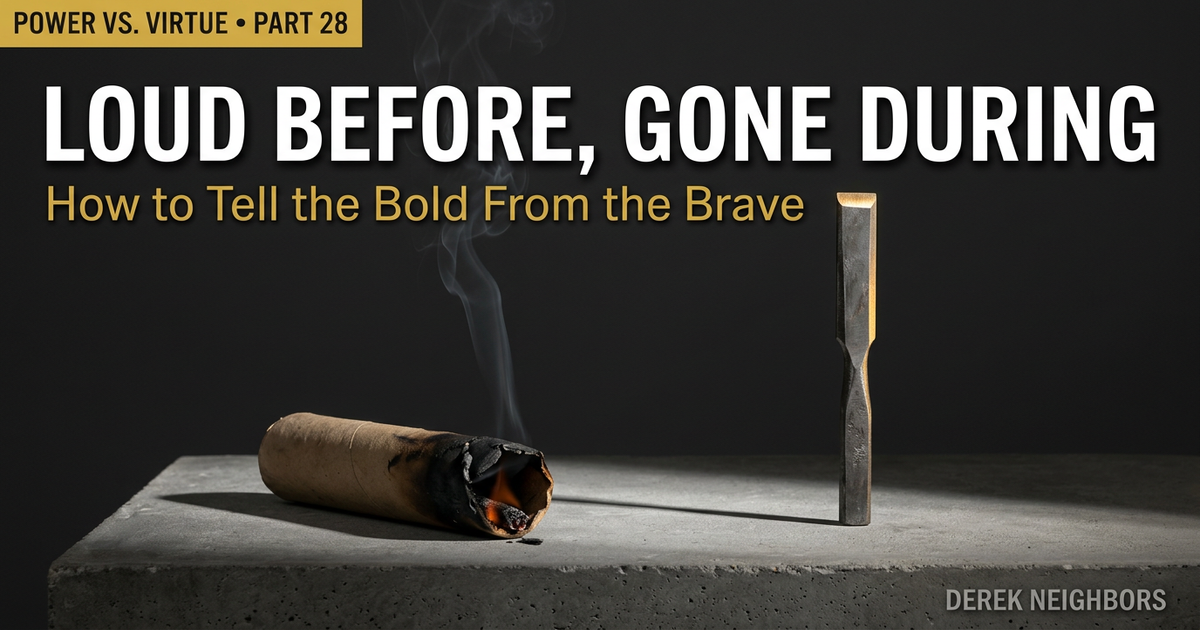
Aristotle saw the composite failure coming and gave it a name. The Greeks called overboldness thrasytes, rashness, and Aristotle called the rash man a pretender to courage. Then he recorded the tell: the rash are eager for danger before it arrives and draw back once it does, while the brave are quiet beforehand and keen in the moment of action. Loud before, gone during. Watch any organization under real pressure and you will see the sorting happen live. The person who talked the biggest game in planning goes quiet in the crisis, and someone who barely spoke walks toward the problem.
The ARETE Alternative
The Greek word for courage is andreia, and Aristotle located it as the mean between two failures: deilia, cowardice, the excess of fear, and thrasytes, the deficiency of it. Courage was never the absence of fear. It is fearing the right things, in the right measure, and acting well anyway.
That definition contains the correction Law 28 needs, and the correction fits in one sentence: boldness comes after judgment, never instead of it.
In practice the sequence looks like this. Deliberate like a coward. Before you commit, give fear the floor and make it specific: what does failure actually cost, who absorbs it, what is the honest probability, what is the win worth. Run the inventory all the way down. Then decide. Then execute like a fanatic, because from the moment of commitment forward, fear is no longer information. It already voted. Every reopening of a settled decision mid-execution is exactly the infection Greene warned about, and he is right about it.
Notice that Greene concedes the entire correction in his own first sentence: if you are unsure of a course of action, do not attempt it. Boldness was never supposed to replace judgment even inside his system. It was supposed to follow it. He spends one line on the judgment and a chapter on the swagger, and most readers remember only the swagger.
Two more pieces make the alternative complete.
Courage is a hexis, a trained disposition. Aristotle’s formula is almost insultingly practical: we become brave by doing brave acts. You do not wait for boldness to arrive as a mood. You build it with repetitions at stakes you can afford: the hard conversation you have postponed twice, the real price quoted without a discount and without an apology, the work shipped before it feels ready. Confidence follows the same sequence, courage first, competence second, and the feeling arrives last. Most people wait for the feeling, which is why uncertainty stops more of them than difficulty ever will.
And the object has to be worth it. Aristotle required brave acts to aim at the noble, the kalon, something actually worth the fear being spent. Boldness pointed at a trivial target is noise. Boldness pointed at a crooked one is Lustig. Before you admire anyone’s daring, including your own, ask what it is being spent on. The courage of the act cannot be graded higher than the worth of its object.
Ancient Wisdom: Two Generals Who Could Not Define It
Plato staged this whole argument in a short dialogue called the Laches. Two fathers want their sons trained in courage, so they ask the two most qualified men in Athens: Laches and Nicias, both decorated generals, professionals of the subject.
Laches goes first. Courage is endurance, standing your ground. Socrates dismantles it in minutes: a man who stands his ground out of stupidity, or because he cannot count the enemy, is not brave. Endurance without wisdom is only boldness, and harmful. Nicias tries next with a better answer: courage is knowledge of what is genuinely to be feared and what is genuinely to be hoped for. Closer, but he cannot defend it either. The dialogue ends with two generals unable to define the virtue they practice for a living.
Plato’s readers knew the brutal epilogue. Laches died at Mantinea, fighting. Nicias, the man who defined courage as knowledge of what to fear, commanded the Sicilian expedition years later. With the campaign lost and escape still possible, a lunar eclipse frightened the camp, and Nicias let the soothsayers talk him into delaying the retreat. Thucydides records the price: the fleet destroyed, the army enslaved in the quarries, Nicias executed. The general with the best definition failed the execution half. His fear did not lack information. It lacked a deadline.
Hold the two failures side by side and you have the whole law. Greene documents the people who execute without judging. Nicias shows what judging without executing costs. andreia is the refusal of both.
The Test
Six questions. Answer them somewhere honest.
Where does your boldness live, before the moment or inside it? Recall the last three times something genuinely risky reached you. Were you louder in the planning or steadier in the event?
As a real risk gets closer, does your voice get bigger or quieter? Aristotle says the brave get quieter.
Would you still take the action you are currently celebrating if nobody could ever know you took it?
Name the last time your boldness cost you something real. If every bold move you have made was applauded and none of them drew blood, you have been performing boldness, not spending it.
What are you currently correcting with more audacity? Somewhere in your life there is probably a position that judgment has already voted against and posture is still defending. Name it.
And the object: is the thing you are being bold about actually worth the fear you are spending on it?
Final Thoughts
Law 28 is the rare Greene law this series can hand you nearly intact. Enter action with boldness. Hesitation infects execution, half-measures are the most expensive measures, and timidity has never once been mistaken for wisdom. The ancients would add one clause and strike one habit. The clause: judgment first, then full commitment, in that order, every time. The habit: performing your daring for the room. The bold man needs the audience. The brave one needs the reason. One of them burns loud and finishes fast, and the other holds an edge for thirty years, and the difference was never the size of the flame.
Boldness without judgment burns out. Judgment without boldness never lights. If you are ready to train both, deliberately and in that order, MasteryLab is where we do the work.