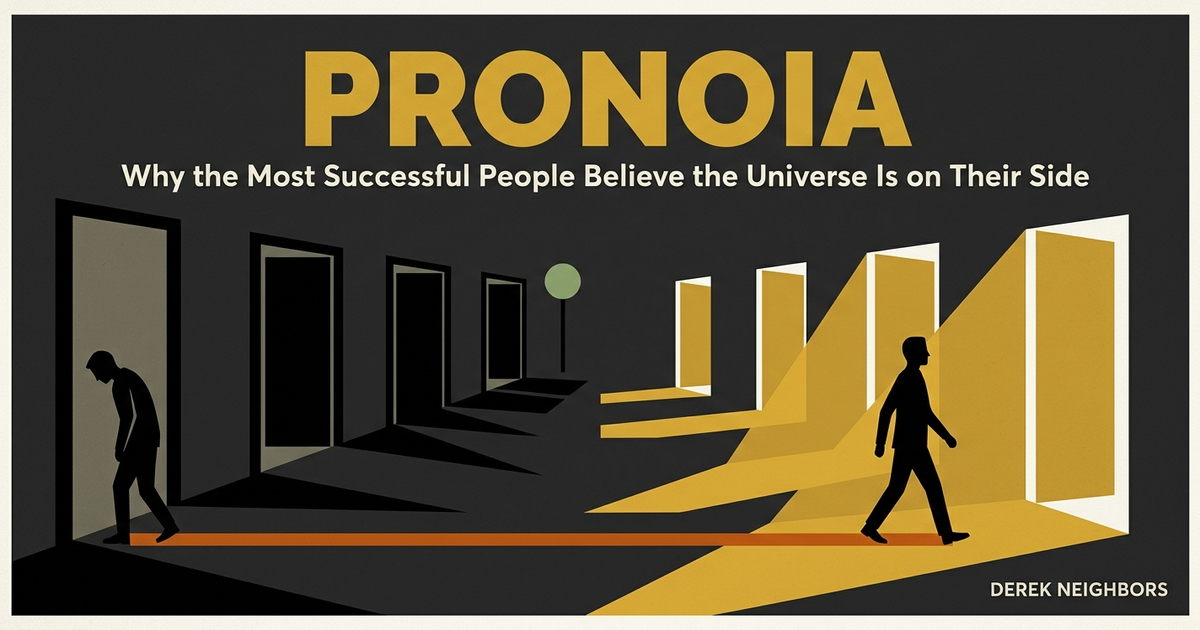
Pronoia: Why the Most Successful People Believe the Universe Is on Their Side
By Derek Neighbors on July 12, 2026
J.D. Salinger gave the condition its finest description decades before anyone named it. In Raise High the Roof Beam, Carpenters, Seymour Glass says: “I’m a kind of paranoiac in reverse. I suspect people of plotting to make me happy.”
Read that twice. A paranoiac in reverse. The condition has a name, pronoia, and it runs the same pattern-hunting machinery that finds ambushes everywhere, pointed at the opposite hypothesis.
I have watched two operators with equal talent build wildly unequal careers on exactly this difference. One assumed every market shift was aimed at him, every silence meant rejection, every partner would eventually take advantage. He hedged, waited, and shrank. The other assumed the same shifting world kept leaving doors unlocked. He knocked on everything, took the meeting, shipped the thing. The world did not treat them differently. They read the same world differently, and the reading did the rest.
So here is the old question, and it deserves a straight answer. Is trusting that things will work out a form of wisdom, or a comfortable delusion?
Forethought Before It Was Faith
The Greeks had the word long before the self-help industry found it. pronoia, from pro (before) and nous (mind). Forethought. In everyday Greek it meant nothing mystical at all: the care you take in advance of an event. Provisioning the ship before the voyage. Thinking ahead.
Plato promoted the word in the Timaeus, using it for the intelligence behind the cosmos. Then the Stoics made it the load-bearing wall of their entire system. For them, pronoia meant providence: the rational forethought of the logos, the ordering principle that runs through everything, arranging the universe toward the good. Nothing in nature happens without providential reason, they argued. The universe thinks ahead.
You do not have to buy the cosmology. What matters is what Marcus Aurelius did with it.
Alone at night, in a notebook meant for no one, the emperor kept returning to the same fork: providence or atoms. Either the universe operates by rational order, or it collides along blindly. He was too honest to pretend he had proof either way. And then he made the move the whole tradition hangs on: under either hypothesis, the right response is the same. Whatever arrives, arrives as material. Work with it.
That move deserves more attention than it gets. Marcus refused to let the metaphysics decide his posture. Providence or chaos, the man intended to treat every event as workable. Which means the trust was never really a claim about the universe. It was a decision about himself.
Notice the objection this invites: if the right response is identical under either hypothesis, why bother suspecting the friendly one? Because the two hypotheses are even only on paper. In a live human being, the reading you carry changes what you attempt, and that difference is the entire second half of this argument. The fork does not make the suspicion true. It makes it available, free to adopt for what it does rather than for what it proves.
And notice what Stoic pronoia never meant: sitting back. The word kept its everyday root the whole time. Forethought. The emperor who trusted providence also staged supply lines and prepared for plague. Trust and preparation arrived welded together, and the tradition considered them one discipline, never two.
When Pessimism Started Sounding Smart
The modern word arrived through a stranger door. In 1982 a sociologist named Fred Goldner coined “pronoia” for a pathology he observed: the delusion that others think well of you. The mirror image of paranoia, filed under the same heading of being wrong about the world. Two decades later Rob Brezsny grabbed the term and flipped its charge, defining pronoia as the suspicion the universe is conspiring on your behalf, and prescribing it. Say plainly what the modern stance does with the ancient word: it keeps the optimism, drops the theology, and earns the name only when it keeps the third piece of the inheritance, the forethought the word began as.
Notice the assumption buried in Goldner’s version: expecting good things must be the delusion, because expecting bad things is realism. That assumption now runs most rooms I sit in.
Somewhere along the way, pessimism became the professional’s accent. The investor Nat Friedman put the resulting irony in one line: “Pessimists sound smart. Optimists make money.” The analyst predicting failure sounds rigorous. The founder insisting it will work sounds like she drank something. When the project dies, the pessimist collects his credibility. When it lives, we call the optimist lucky and move on. Heads, cynicism wins. Tails, cynicism was being appropriately cautious.
Your feeds finish the job. A mind marinated all day in threat, outrage, and collapse does what minds do with training data: it updates. Assume hostility, and you start playing the game hostility requires. Defense. Hedge everything. Keep the powder dry and the commitment withheld. Uncertainty stops far more people than hard work ever has, and a hostile prior turns every uncertainty into a threat to hide from rather than a door to try.
Paranoia, it turns out, is a strategy, and it plays like one: a whole life spent guarding a lead you do not have.
How Pronoia Actually Works
Here is where the skeptic in you deserves satisfaction, because the case for pronoia does not rest on the universe having intentions.
Run the chain. The person who believes things tend to work out attempts more things. Attempting more things produces more failures and more shots that connect. She persists past the point where the pessimist rationally folded, because she reads the resistance as a phase rather than a verdict. Persisting longer means being present when conditions turn. And being present when conditions turn is most of what we retroactively call luck. The Greeks gave that turning its own name, kairos, the opportune moment, and the brutal thing about kairos is that it only ever arrives for people still standing in the field.
Martin Seligman watched this play out in one of the least mystical arenas on earth: insurance sales. Optimistic explanatory style predicted who sold more and who was still employed after the industry’s meat-grinder first year. The optimists did not receive better leads from a benevolent cosmos. They dialed the next number after the ninth rejection, because they expected the tenth call to be different.
Expectation, in other words, is operational. It sets posture. Posture sets behavior. Behavior compounds. The belief that the world is workable makes you act in ways that make the world more workable. pronoia is a self-fulfilling prophecy that pays out through utterly ordinary machinery, which is precisely why dismissing it as delusion costs so much.
The two priors run the same facts through different machines:
| The event | The paranoid read | The pronoiac read |
|---|---|---|
| A closed door | Proof the game is rigged | A redirect worth investigating |
| Silence | Rejection arriving slowly | A full inbox, ask again next week |
| Uncertainty | A threat to wait out | A field nobody has claimed yet |
| A setback | The verdict | The material |
| Your hours | Spent hedging and guarding | Spent attempting and following through |
One more thing, because it decides whether any of this survives your first bad year. The stance does not become wrong on the day a bet fails. Read events as workable and some of them will refuse to be worked; ships go down provisioned. What the reading pays even then is the person it has been making the whole time: someone still choosing, still in motion, still reading for openings. The win rate was always the second reward.
Be careful, though, because there is a counterfeit in circulation. The manifesting industry sells the belief without the forethought: visualize the outcome, trust the universe, wait. The Stoics would have called that superstition, and so should you. Their pronoia kept both halves of the word. Trust the order, and provision the ship. The provisioning also sizes the bets: a pronoiac attempts more things because forethought keeps each attempt survivable, while the reckless man attempts more things and gets to be wrong once. Same appetite, very different lifespan. What you believe about the universe matters far less than what the belief makes you do before noon. The fall itself wounds you once; the reading you give it decides everything after, and the pronoiac reading is the one that keeps you in motion.
That distinction is large enough to deserve its own argument, and it will get one: part two of this pair takes up why trusting providence demands relentless work rather than excusing you from it.
Training the Prior
You cannot argue yourself into a new prior overnight. You can train one. The faculty doing the training is what the Stoics called prohairesis, the choosing part of you that decides what an event means before your mood votes. Four drills.
Run the morning forethought drill. This is pronoia in its oldest, plainest sense. Name the one situation most likely to test you today. Decide, in advance, how a person of character meets it. You are not predicting the day. You are provisioning for it, and the drill asks for ten minutes and nothing you do not already own. This optimism was never a luxury for the resourced. It gets built, by anyone, before breakfast.
Apply the providence reading. When something breaks, ask one question before the post-mortem: what does this make possible that was impossible yesterday? Ask it even when it feels absurd. Some days the answer is nothing, and honesty matters. But you will be startled how often the closed door was load-bearing for a better opening, and the question fear asks will never show you that.
Keep the hostility ledger. Every time you assume malice, rejection, or a rigged game and turn out wrong, write it down. The silence that meant nothing. The competitor who became a partner. The setback that aged into a favor. Review the ledger when you catch yourself bracing. Most people keep a vivid file of every betrayal and no record at all of the fears that came to nothing. You are correcting a biased dataset.
Trace one setback each evening. Before sleep, take the day’s worst moment and look for the seed in it. Not silver-lining theater. An actual audit, the way Marcus audited the purple. Most seeds turn out real. I have run enough long years to know that the stretch that felt like punishment was usually the apprenticeship, visible only from later.
Out on a desert trail before dawn, hours from any signal, I get the cleanest version of the choice. The mountain does not care which prior I carry up it. But one prior gets me up it, and the other talks me out of the attempt at the trailhead. Same mountain. Same legs. The belief decides which conversation happens.
Frequently Asked Questions
What is pronoia in Greek philosophy?
pronoia comes from pro (before) and nous (mind): forethought. In ordinary Greek it named the practical care taken before an event. Plato used it in the Timaeus for the intelligence behind the cosmos, and the Stoics elevated it into providence, the rational forethought of the logos ordering the universe toward the good. For the Stoics it was never passive: trust in the rational order came welded to your own preparation.
Is pronoia the opposite of paranoia?
In its modern usage, yes. Paranoia holds that the world conspires against you; pronoia suspects the universe of conspiring in your favor. Sociologist Fred Goldner coined the modern term in 1982 for a delusion, and Rob Brezsny later flipped it into a deliberate stance. The practical difference is posture: expecting hostility puts you on defense, while expecting opportunity keeps you attempting, persisting, and positioned for the moment things turn.
Is pronoia naive positive thinking?
No. Positive thinking claims belief alone changes outcomes. pronoia changes behavior: you attempt more, persist longer, and read setbacks as material rather than verdicts, and the behavior changes outcomes through ordinary means. The Stoic version also demanded forethought. Marcus Aurelius trusted providence and still planned like a general. Belief without provisioning would have struck him as superstition.
How do you practice pronoia?
Train the prior. Each morning, name the day’s likeliest test and decide in advance how character meets it. When something breaks, ask what it makes possible that was impossible yesterday. Keep a ledger of every time you assumed hostility and were wrong, and review it when you brace. Each evening, trace one setback for its seed of advantage. Posture plus preparation, daily, until the workable reading becomes your default.
Final Thoughts
Marcus never settled the question of providence or atoms, and neither will you. That turns out to be the liberating part. The prior you carry was never going to be proven. It was only ever going to be chosen, and then paid for or paid by.
Paranoia bills you in unattempted things: the calls not made, the work not shipped, the decades spent guarding against an attack that never arrived. pronoia bills you too, in occasional embarrassment, in trust sometimes spent on the wrong people. I know which invoice I would rather frame.
Suspect the universe of plotting in your favor. Then provision the ship anyway. The suspicion gets you to the field, the forethought keeps you standing in it, and the field is where the opportune moment has always done its choosing.
Training the priors you carry into hard things is the daily character work we practice at MasteryLab.co. Bring your ledger.