Eleutheria vs Parrhesia: Key Differences in Greek Philosophy
In Athenian democracy, the right to speak your mind was considered inseparable from the condition of being free. Eleutheria is freedom in its fullest sense, not merely the absence of external constraint but the positive capacity for self-governance. Parrhesia is fearless, frank speech, the practice of saying what you believe to be true regardless of the personal cost. The Athenians understood that these two concepts exist in a reciprocal relationship that most modern discussions of free speech fail to capture. Eleutheria creates the conditions for parrhesia. Only the free person, the one who governs themselves rather than being governed by fear, appetite, or compulsion, can speak frankly. A person enslaved to their anxieties cannot practice parrhesia, even if no external authority prevents them from speaking. Internal freedom is the prerequisite. You must first be free within yourself before you can speak freely to others. Parrhesia, in turn, protects eleutheria. When citizens stop speaking truthfully to power, the community loses the feedback mechanism that prevents tyranny. Foucault’s analysis of parrhesia emphasized that frank speech is the canary in the mine for political freedom. The moment people begin self-censoring, choosing safety over honesty, the conditions for genuine freedom have already begun to erode. This reciprocal dependency creates a fragile but essential cycle. Freedom enables courage. Courage preserves freedom. Break either link and both degrade. A society that guarantees legal speech rights but cultivates a culture of risk-aversion and conformity has eleutheria in name only. A society of outspoken individuals living under authoritarian constraint has parrhesia without the political framework to sustain it. The relevance extends beyond politics into organizations, teams, and relationships. Any system that depends on honest feedback for self-correction requires both the structural freedom for people to speak and the personal courage for them to actually do it. The Stoic tradition added another dimension to this relationship. For Epictetus, a former enslaved person, eleutheria was entirely internal: you are free when you govern your own judgments and desires, regardless of external circumstances. On this account, parrhesia becomes possible even under political oppression, because the freedom it requires is a freedom of character, not of legal status. This internalization of freedom raises the bar. It means you cannot blame institutional constraints for your silence if the real constraint is your own fear of consequences. The question both concepts pose to you is whether your silence reflects genuine limitation or voluntary surrender.
Definitions
Eleutheria
(ἐλευθερία)
eh-lef-theh-REE-ah
True freedom understood not as license to do whatever one wishes, but as the capacity for self-governance and liberation from internal tyranny. For the Stoics, authentic freedom meant mastery over one’s judgments, desires, and reactions—the only domain truly within human control.
Parrhesia
(παρρησία)
par-ray-SEE-ah
The courage to speak truth freely and frankly, especially to those in power, regardless of personal risk. In ancient philosophy, parrhesia was considered both a moral duty and a democratic virtue—the speaker accepts danger in service of truth.
Key Differences
| Aspect | Eleutheria | Parrhesia |
|---|---|---|
| Scope | Eleutheria is a broad condition encompassing political independence, personal self-governance, and freedom from domination by others, by appetites, or by fear. | Parrhesia is a specific practice: the act of speaking the truth openly and completely, particularly to those in positions of power. |
| Nature | Eleutheria is a state of being. It describes the condition of the free person, whether exercised in any particular moment or not. | Parrhesia is an act. It occurs in a specific moment when a person chooses to speak truthfully despite the risk of consequences. |
| Requirement | Eleutheria requires self-governance, the capacity to direct your own life according to reason rather than being directed by external forces or internal compulsions. | Parrhesia requires courage, specifically the moral bravery to voice truth when silence would be safer, easier, or more socially acceptable. |
| Political Dimension | Eleutheria defines the political status of the free citizen in contrast to the enslaved person. In Athens, it was the foundational condition that made political participation possible. | Parrhesia was a specific right of Athenian citizens, the right to address the assembly with complete frankness. Foucault identified it as a defining feature of democratic political life. |
| Philosophical Tradition | Eleutheria was developed across multiple schools. The Stoics internalized it as freedom from passions. Aristotle connected it to the virtuous life of the citizen. The political tradition defined it as civic independence. | Parrhesia received detailed attention from Foucault, who traced its evolution from a political right in democratic Athens to a personal ethical practice in later Hellenistic and Roman philosophy. |
Scope
Eleutheria is a broad condition encompassing political independence, personal self-governance, and freedom from domination by others, by appetites, or by fear.
Parrhesia is a specific practice: the act of speaking the truth openly and completely, particularly to those in positions of power.
Nature
Eleutheria is a state of being. It describes the condition of the free person, whether exercised in any particular moment or not.
Parrhesia is an act. It occurs in a specific moment when a person chooses to speak truthfully despite the risk of consequences.
Requirement
Eleutheria requires self-governance, the capacity to direct your own life according to reason rather than being directed by external forces or internal compulsions.
Parrhesia requires courage, specifically the moral bravery to voice truth when silence would be safer, easier, or more socially acceptable.
Political Dimension
Eleutheria defines the political status of the free citizen in contrast to the enslaved person. In Athens, it was the foundational condition that made political participation possible.
Parrhesia was a specific right of Athenian citizens, the right to address the assembly with complete frankness. Foucault identified it as a defining feature of democratic political life.
Philosophical Tradition
Eleutheria was developed across multiple schools. The Stoics internalized it as freedom from passions. Aristotle connected it to the virtuous life of the citizen. The political tradition defined it as civic independence.
Parrhesia received detailed attention from Foucault, who traced its evolution from a political right in democratic Athens to a personal ethical practice in later Hellenistic and Roman philosophy.
When to Apply Each Concept
When to Choose Eleutheria
Cultivate eleutheria when you recognize that external constraints are not the primary obstacle to your agency. If you have the legal right to speak, the organizational position to influence decisions, or the relational standing to voice concerns, but you still hold back, the freedom you lack is internal. Eleutheria demands that you examine what is actually governing your choices: fear, comfort, approval-seeking, or genuine self-direction.
When to Choose Parrhesia
Practice parrhesia when you see a truth that needs to be spoken and the cost of speaking is real but bearable. Parrhesia is not reckless provocation. It is the deliberate choice to tell the truth in a situation where silence would be complicit and where your speech might actually change the outcome. The question parrhesia asks is: ‘If I do not say this, who will?’
Frequently Asked Questions
What is the difference between eleutheria and parrhesia?
Eleutheria is freedom, the broad condition of self-governance and independence from domination. Parrhesia is fearless speech, the specific practice of speaking truth openly and at personal risk. Eleutheria is the foundation; parrhesia is one of its most important expressions. A free person who never speaks truthfully has not fully realized their freedom. A frank speaker who lacks internal self-governance may be reckless rather than courageous.
How are freedom and free speech connected in Greek philosophy?
The Athenians considered parrhesia a defining right of the free citizen. You could not be truly free without the ability to speak your mind in the assembly. Conversely, the practice of frank speech preserved political freedom by ensuring that power was subject to public scrutiny. Foucault argued that this connection reveals something fundamental: freedom is not merely the absence of constraint but the active exercise of truthful engagement with the world.
Eleutheria vs parrhesia in democracy?
In Athenian democracy, eleutheria defined who could participate in political life, while parrhesia defined how they participated. The free citizen had both the status (eleutheria) and the right (parrhesia) to address the assembly with complete frankness. The health of the democracy depended on citizens actually exercising both. When citizens had freedom but lacked the courage to speak honestly, democratic governance degraded even without formal changes to the political structure.
Can you have parrhesia without eleutheria?
Foucault's later work explored precisely this question. He argued that parrhesia could be practiced even under conditions of limited political freedom, as seen in the Cynic and Stoic traditions, where philosophers spoke truth to emperors at great personal risk. However, sustained parrhesia without eleutheria is heroic and precarious. It depends entirely on individual courage and offers no structural protection. The Athenian model, where parrhesia was a civic right embedded in democratic institutions, provided more durable conditions for frank speech.
Articles Exploring Eleutheria or Parrhesia (26)
Telling Your Hardest Story Is Not the Same as Being Vulnerable
The polished story about your worst year gets a warm room and changes nothing by Monday. Vulnerability has three levels: what happened, what it cost, and who you became because of it. Most people stop at the first one, because it is finished and costs nothing to tell. The third is the part people can use.
Blend In Long Enough and There Is Nothing Left to Hide
Law 38 of the 48 Laws of Power tells you to think as you like but behave like others. Seneca gave nearly the same advice, for a better reason and with a line Greene never draws. Aristotle explains the bill: there is no inside that survives ten years of an outside that conforms.
Make Someone Untouchable and the Failure Is Already Yours
A founding architect nobody was allowed to question. A senior engineer who questioned him once and got moved. Two years of pull requests with zero comments that everyone called quality. Then the migration that took the platform down, with a root cause that had been raised in the one review that got silenced. Athens ran the same story with Alcibiades in 415 BC and lost a fleet. The moment an organization decides someone is beyond reproach, the failure that follows belongs to everyone who agreed, and there is an old Greek word for the thing they got backwards.
Unspoken Expectations Are Premeditated Resentments
The ticket was green. I still sat in the review angry about a customer note, a rollback, and a demo that were never on the page. She asked when I had put those in writing. I had not. I was collecting a bill for a test I never handed out.

You Wait for Consensus and Call It Thinking
The original thought is already in the room. What is missing is the person willing to say it while it can still lose. Consensus is a tool. It is a poor substitute for a first speaker.
Stop Treating Yourself Like an Enemy You Have to Defeat
A rest day sat on the plan and I snuck a session anyway. Sitting still felt like losing the person I was becoming. I was occupying a part of myself that had a job: recover.
Play to Their Fantasies and You Train Them Off Reality
Law 32 of the 48 Laws of Power tells you to play to people's fantasies: become the oasis of romance in a harsh world, avoid ugly truth, and gain power from the hunger for soft stories. The tactical truth is real. Pleasant pictures gather crowds, and disenchantment makes people angry. The character cost arrives when fantasy becomes your operating system. You train judgment off reality. When the mirage breaks, you earn the rage. The ARETE alternative keeps hope aimed at a hard path people can walk, and restores frank speech that can still lead.

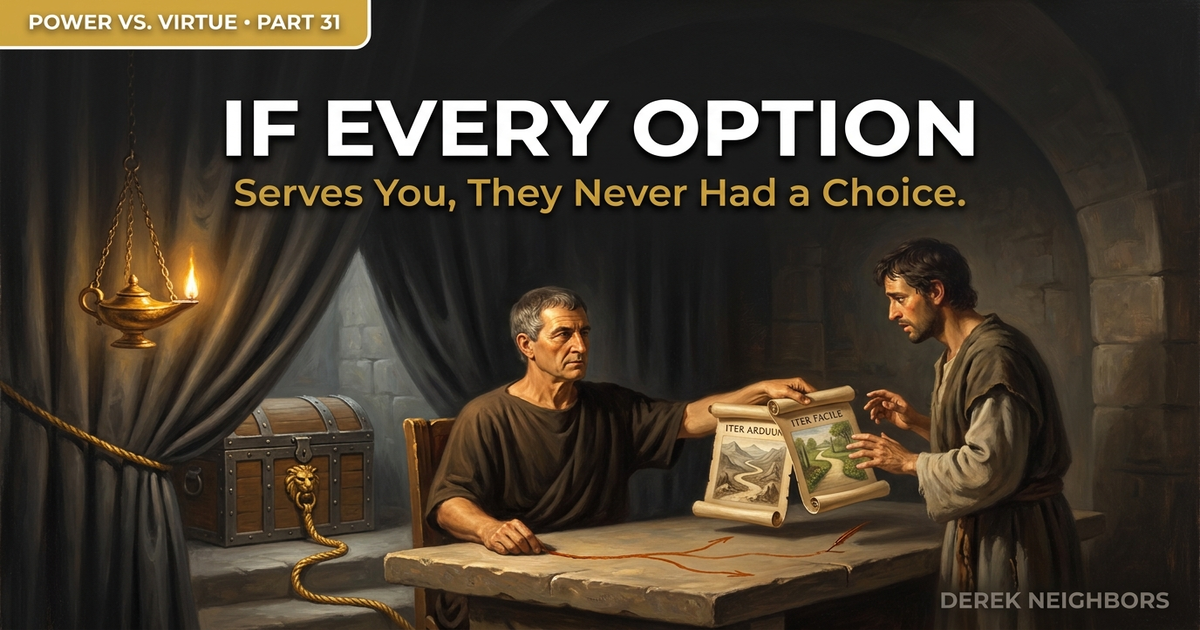
If Every Option Serves You, They Never Had a Choice
Law 31 of the 48 Laws of Power tells you to control the options: get others to play with the cards you deal. The tactical truth is real. Unstructured choice stalls rooms, and people defend outcomes they believe they chose. The character cost arrives when the menu is a rigged deck. Every door already belongs to the dealer. Discovery bankrupts trust. The operator trains contempt for other people's judgment. The ARETE alternative keeps framing as craft and restores real prohairesis: honest constraints, a shared end, and at least one exit that is not already yours.
Your Team Isn't Fighting the Decision. They're Fighting How You Made It.
Leaders keep blaming the decision when the fracture started earlier. People can carry hard outcomes they disagreed with when they were heard first. Being treated as audience to a sealed call is what they refuse.

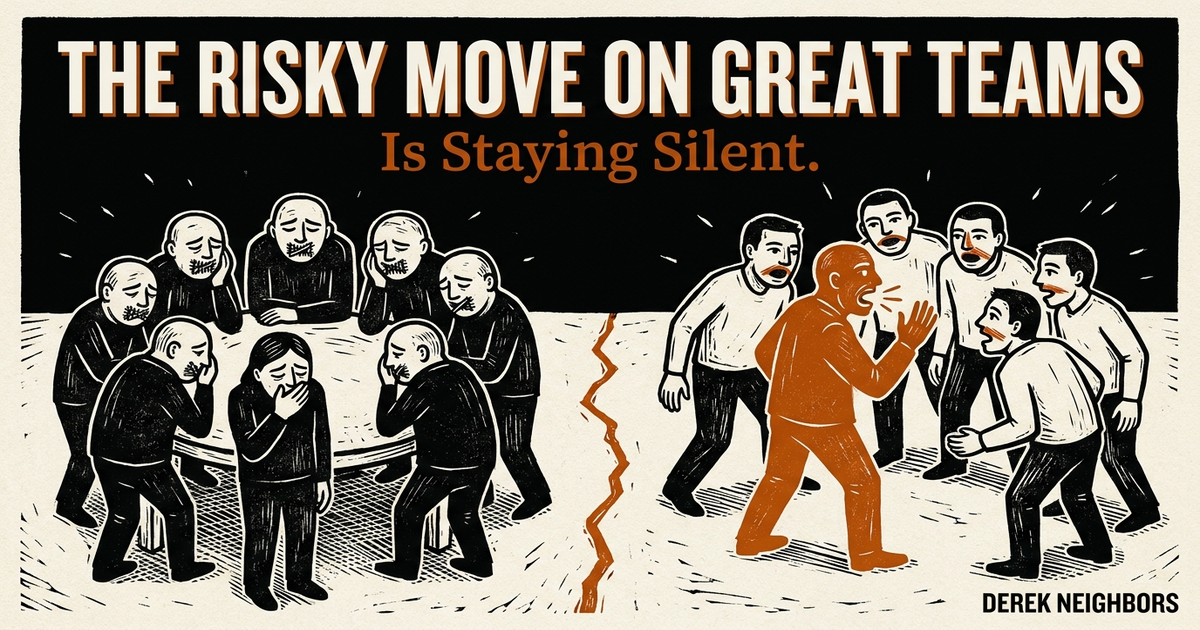
The Risky Move on Great Teams Is Staying Silent
Great teams do not wait for braver people. They install a ritual where declaring the miss is expected and staying quiet is the move that stands out. Calling a Safety is the pattern. Your calendar is the test.
People Want Something to Believe In. Don't Make It You.
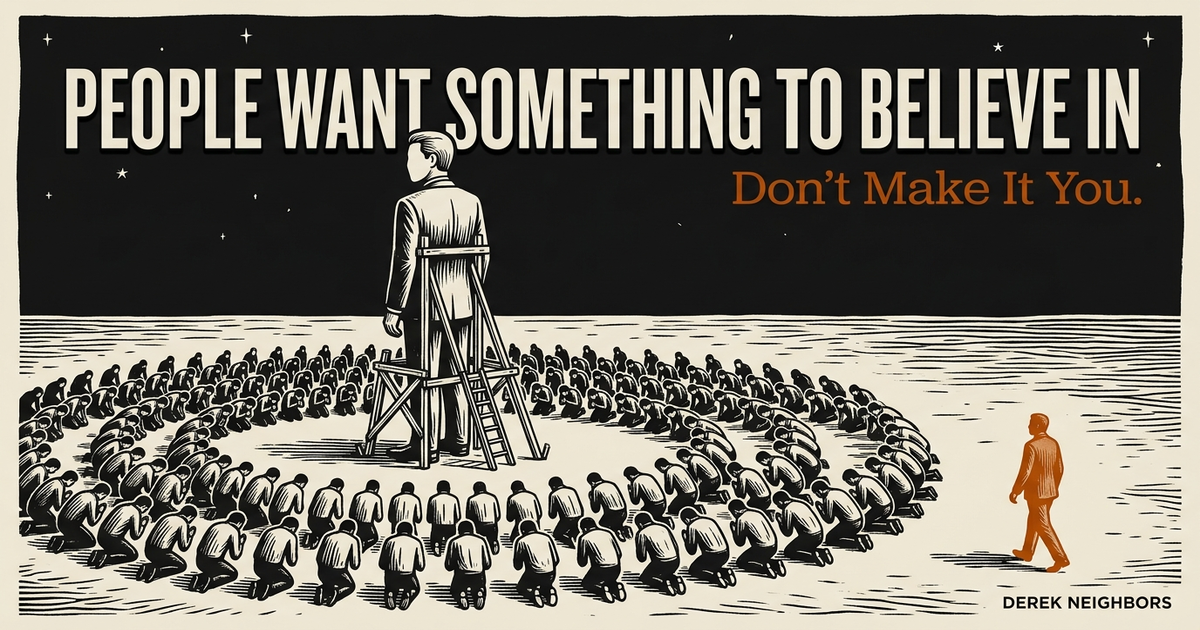
Law 27 of the 48 Laws of Power tells you to play on people's need to believe and create a cultlike following. Keep your words vague, favor enthusiasm over thinking, hand out rituals, collect the devotion. The need Greene identified is real. People are starving for something worth believing in. The law fails at the harvest. The Greeks called his method goeteia, the enchanter's craft that bypasses judgment instead of building it, and they left us a portrait of exactly where it ends: a con man with a puppet snake god who opened his rites by expelling every skeptic in the crowd, because one honest question would have brought the whole thing down.
Polish Got Cheap. That's Why Trust Got Expensive.
A flawless apology used to mean someone sat with the weight. Now it often means someone was not in the room. AI made sounding right cheap, and audiences rewired what they trust: hesitation, disclosed uncertainty, and speech that could have embarrassed you.

Social Intelligence Doesn't Mean Knowing What They Want to Hear. It Means Refusing to Say It.
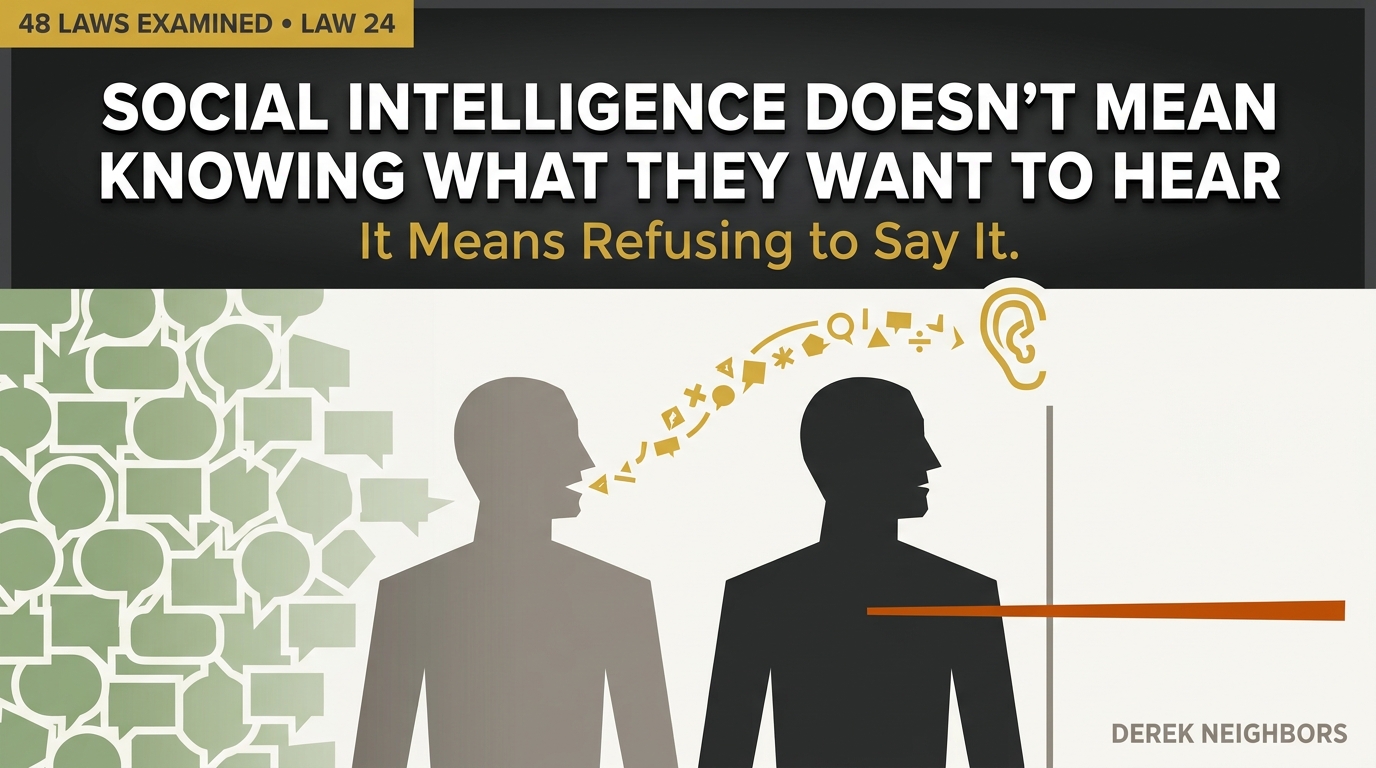
Law 24 tells you to become the perfect courtier: master indirection, flatter without obvious flattery, never deliver uncomfortable truths directly. The Greeks had a word for that kind of social facility. They called it kolakeia. They condemned it. Not because flattery fails tactically, but because it corrupts both the giver and the receiver. The alternative is charis: social grace rooted in genuine goodwill, deployed with the courage to say what needs to be said.
You Don't Need More. You Need to Strip Your Life Down on Purpose.
We have engineered constraint out of ordinary days and cannot understand why ordinary days no longer move us. The ancient world knew the answer. They built deliberate practices around removing inputs, not adding them. The Sabbath was an amputation. Askēsis was training. Autarkeia was the freedom of needing less. This is the protocol for a thirty-day voluntary sabbath that gets the meaning back into the small things you have stopped noticing.

Stay Uncommitted Long Enough and No One Comes Looking for You
Greene's Law 20 sounds like freedom. Refuse to commit. Stay above the fight. Keep your options open. Run it as your default operating system for a few years and watch what stops happening to you. The Greeks called the resulting condition by a different name.

You Knew It Was Over Years Ago. You Just Couldn't Say It Out Loud.
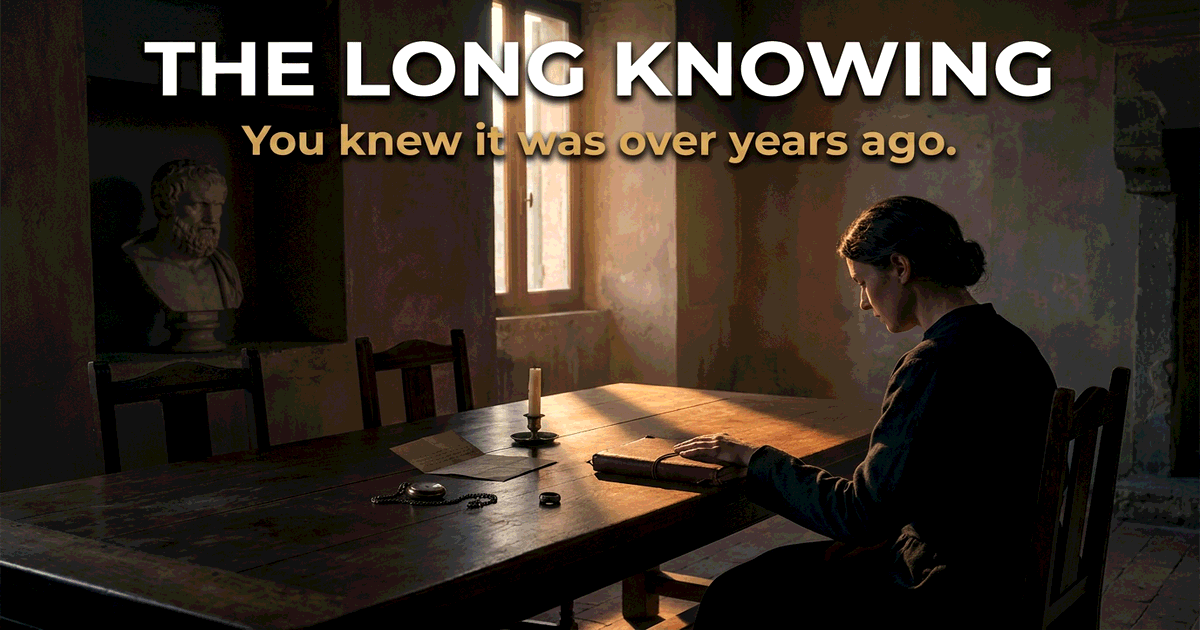
The truth shows up in a thirty-second moment with no audience. Most people register it, file it, and spend the next five years pretending they didn't. The years of pretending are the actual cost.
The People You're Afraid to Offend Already Run Your Life
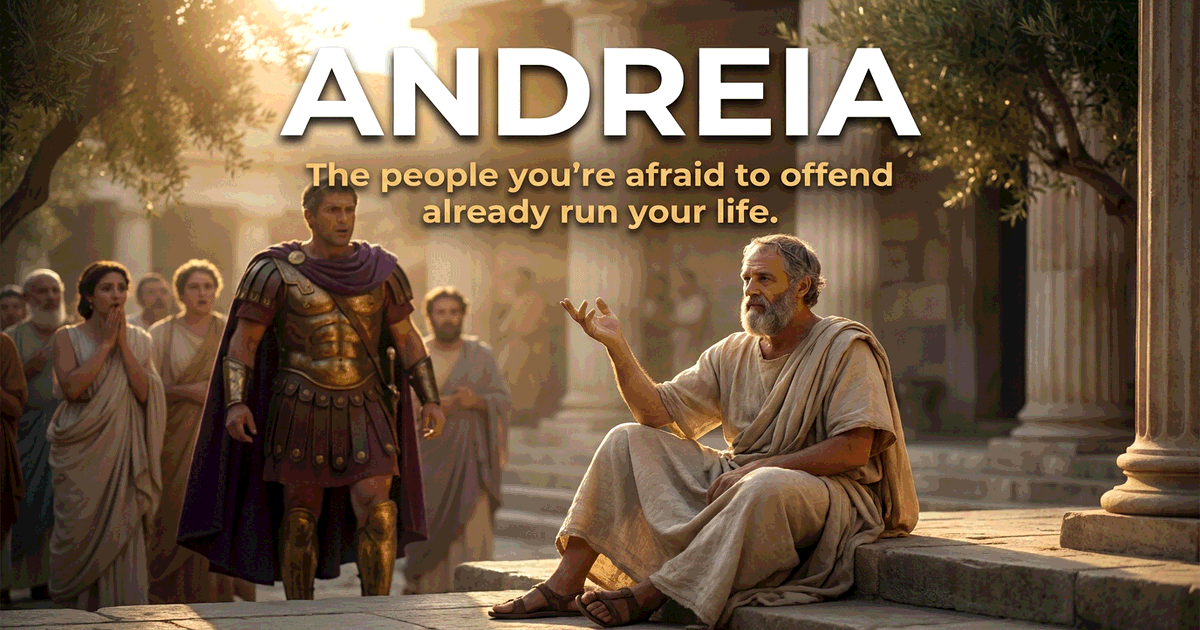
Greene says study people before you act, and never offend the wrong one. Run that as your operating system for a few years and watch what it does to your honesty. The Greeks had a sharper answer.
Your Self-Doubt Is a Tax on Everyone Around You
We treat self-deprecation as humility. Aristotle saw it as the same failure of self-knowledge as arrogance, just from the opposite side. The cost lands on the people around you.

The Gladiators Are Becoming the Emperors. Respect the Arena, Not the Audience.
Last week the Daily Stoic guy lost his composure on YouTube because Ivanka Trump praised Marcus Aurelius. The same week, SpaceX offered sixty billion dollars for a company whose 25-year-old CEO does every podcast himself. These are the same story.
Fear Makes People Obey. It Never Makes Them Follow.
Law 17 says keep others in suspended terror through unpredictability. The Greeks had a name for leaders who ruled through fear: tyrants. And they had a clear record of how every tyranny ends.

The Most Dangerous Liars Tell the Truth
Greene says use selective honesty and generosity to disarm your victim. The Greeks say truth spoken from calculation corrupts the speaker, the listener, and every honest conversation that follows. One creates a short-term advantage. The other creates a permanent disability.

Why Staying Silent Is the Most Expensive Thing You'll Ever Do
Every swallowed truth is a down payment on becoming someone you don't recognize. The Greeks had a word for what's missing: parrhesia.
Why Authenticity Has Nothing to Do With Being Yourself
Authenticity has become a personal branding buzzword. The Greeks knew better. True authenticity isn't about expressing your real self. It's about refusing to fragment into different versions for different audiences. Wholeness, not performance.
The Most Dangerous Thing You Can Do Is Become Excellent
Your pursuit of excellence isn't neutral. It's an act of rebellion against every force that profits from your weakness, distraction, and mediocrity.

Character Isn't What You Post. It's What You Practice.
Social media has convinced us that visible virtue is real virtue. Aristotle knew better. Character is the pattern of what you do when no one's watching, not the highlight reel you curate for strangers.

The Independence Paradox: Why Freedom Requires More Structure, Not Less
True independence isn't the absence of structure—it's the mastery of structure. Here's why the most free people are often the most disciplined, and how to build systems that create authentic freedom.