The Most Dangerous Thing You Can Do Is Become Excellent
By Derek Neighbors on December 5, 2025
We’ve been sold a story about self-improvement. It goes like this: you decide to get better, you put in the work, you advance your career or your health or your skills, and nobody else is affected. Personal development is personal. Private. A transaction between you and your potential.
Nobody at the gym cares about your transformation. Your morning routine doesn’t ripple out into the world. Your commitment to excellence is an individual pursuit, politically neutral, socially harmless. You’re just trying to be the best version of yourself.
This is the assumption almost everyone holds without questioning it. And it’s wrong.
The Crack in the Story
Watch what happens when you actually start excelling.
Not the encouragement you might expect. Something else. A cooling. A distance. Subtle resistance from the people who claimed they wanted you to succeed.
The colleague who stops inviting you to lunch after you decline happy hour to train. The family member who gets uncomfortable with your new discipline, who starts making jokes about your “obsession.” The coworker who mocks you for studying during breaks. The friends who begin calling you “no fun” or “too intense” or suggest you’re “taking yourself too seriously.” This is the madness of excellence in action.
If personal excellence were truly neutral, why would anyone react at all? Your early workouts don’t steal their sleep. Your night classes don’t cost them anything. The certification you’re grinding for on weekends doesn’t diminish their credentials. Your refusal to drink on weeknights doesn’t empty their glass.
And yet.
Something activates when you start pulling away from the pack. The friction appears. The “who do you think you are?” questions start circulating, sometimes spoken, often not. The social invitations contract. The passive-aggressive commentary increases.
Sometimes the concern is legitimate. Sometimes people who love you worry about imbalance. The task is discernment, not assumption. But when the pattern repeats across contexts, when unrelated people react the same way, pay attention.
This is simply what happens. The pattern reveals what your excellence actually threatens.
Why Systems Need Your Mediocrity
Once you start looking, you see it everywhere: multiple forces benefit from keeping you comfortable, distracted, dependent, and just mediocre enough to need what they’re selling. Mediocrity here isn’t average performance. It’s the chronic refusal to develop what you’re capable of becoming. The settling. The “good enough” that never quite is.
Start with consumer culture. The entire advertising industry operates on two assumptions: that you’re dissatisfied and that you act on impulse. Disciplined people are terrible consumers. They don’t buy solutions to problems they’ve solved through their own effort. They don’t need products to fill voids that deliberate practice has already addressed. The person who owns their morning routine doesn’t need another productivity app. The person who can cook doesn’t need another meal delivery service. The person who can sit with discomfort doesn’t need constant entertainment. That discipline, repeated on purpose, is askesis.
Corporate structures share the preference. Compliant workers are easier to manage than excellent ones. People who define success through external validation are easier to motivate. Dangle the carrot, watch them run. Those dependent on the company for their identity won’t rock the boat. But excellence creates options, and options create leverage. The excellent employee can leave. The mediocre one is trapped. One of these is easier to manage.
Then there’s your social circle. People at your level validate each other’s choices. Your discipline is an implicit judgment on their comfort, whether you intend it that way or not. Many need you to stay where you are so they don’t have to face their own decisions. When you rise, it forces a question they’d rather not answer. Not everyone. The true mentor challenges you to rise. The real friend celebrates your growth even when it leaves them behind. But these people are rarer than the culture admits.
These forces operate differently. Advertising exploits impulse. Corporations exploit dependency. Social circles exploit belonging. But they converge on the same outcome: keeping you just weak enough to need what they offer.
Aristotle understood this dynamic over two thousand years ago. He observed that tyrants feared excellent citizens because such people couldn’t be controlled. The virtuous person pursuing arete becomes ungovernable. This wasn’t abstract philosophy for the Greeks. It was political threat assessment.
Your Excellence Is Subversive
Here’s what becomes clear once you see the pattern: personal excellence isn’t neutral. It’s inherently subversive.
Excellence here means the disciplined actualization of your capacity toward virtue and craft. Not achievement. Not acclaim. The relentless development of what you could become. This isn’t excellence at anything. Excellence at manipulation or destruction isn’t arete. The Greeks understood that true excellence serves human flourishing, your own and others’. The discipline that makes you dangerous to corrupt systems should never make you dangerous to the people you love.
Every time you choose discipline over comfort, you become harder to manipulate. Every skill you master makes you less dependent on any single employer or system or relationship. Every morning you show up when you don’t feel like it, you’re practicing a kind of freedom that can’t be granted or revoked by anyone else.
The Greeks had a word for this: eleutheria. True freedom. Not freedom as permission from external authority, but freedom as internal sovereignty.
And internal sovereignty isn’t just resistance to manipulation. It’s the alignment of your soul’s parts under reason. Appetite governed by will, will governed by wisdom. The goal isn’t to become ungovernable. It’s to govern yourself rightly so that no lesser authority can override what you know to be true and good.
Consider what happens as you develop. The person who can delay gratification cannot be rushed into bad decisions. The person with deep skills has options beyond any single institution. The person with practiced discipline doesn’t need external validation to stay the course. The person committed to truth won’t accept comfortable lies to maintain social peace.
And this isn’t only physical discipline. The morning workout matters less than the morning clarity. The capacity to think carefully, to see through manipulation, to know what’s actually good rather than merely pleasant or popular. Wisdom is the discipline that matters most.
This is why the Greeks also valued autarkeia, self-sufficiency. Not isolation. Not refusing all connection or help. Rather, the condition of not being controllable through your dependencies. When you need less, you can be manipulated less. When you can provide for yourself, you can say no to bad deals.
We live in an age of manufactured distraction and engineered dependency. Every force competing for your attention profits from your weakness. The algorithms want you scrolling. The corporations want you consuming. The culture wants you comfortable enough to keep buying, compliant enough to keep showing up, and dissatisfied enough to need what they’re selling next. Good vibes only will keep you weak forever.
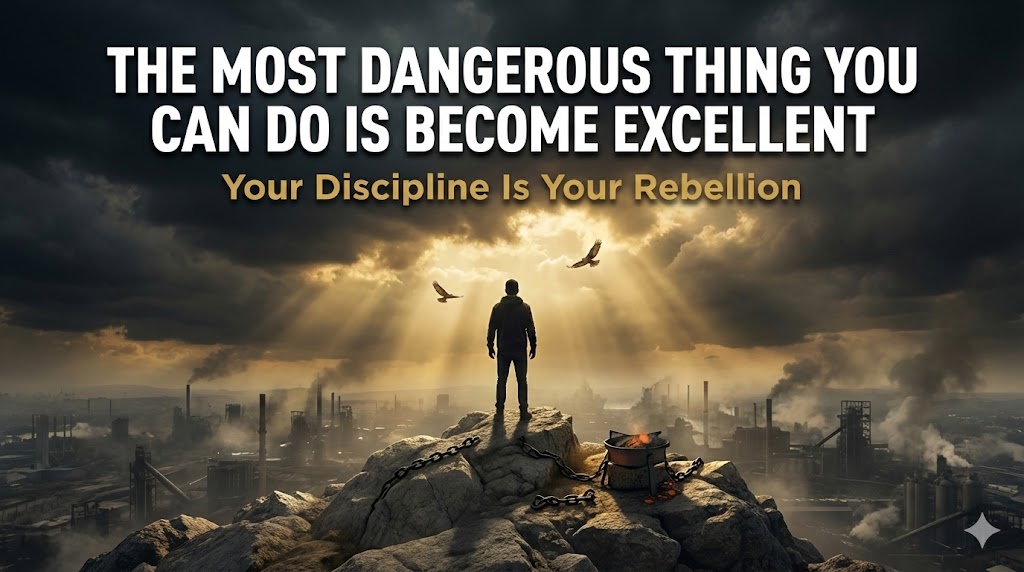
Your decision to pursue excellence is a refusal of all of it.
Epictetus wrote that no man is free who is not master of himself. He understood this from experience. Born a slave, he became one of the most influential Stoic philosophers precisely because he recognized that external circumstances matter less than internal sovereignty. The person who has mastered their own impulses cannot be enslaved by anyone else’s agenda. Their chains have already been broken from the inside.
This is why excellence sometimes feels lonely. Not because you’ve become arrogant. Not because you’ve outgrown your relationships. But because you’ve become dangerous to systems that needed your compliance. The discomfort you create in others has nothing to do with you and everything to do with what your choices reveal about their own.
What This Means for Your Pursuit
This reframes everything about why you’re doing the work.
Your excellence isn’t a private hobby. It’s a statement about what you refuse to serve. The discipline you practice is the independence you build, and excellence is rented, not owned, so the rent is due every single day. The skills you develop are the leverage you create. Every act of self-mastery is simultaneously personal flourishing and quiet rebellion against forces that would prefer you weak.
Start asking different questions. What systems depend on my weakness? Who profits from my distraction? What would change if I became truly excellent at what I do? What forces would I stop serving?
Every morning you get up when you don’t want to, you’re practicing eleutheria. Every time you choose the harder right over the easier wrong, you’re building arete. Every skill you develop that makes you less dependent on any single source of income or approval or meaning, you’re cultivating autarkeia.
You’re not just building a better version of yourself. You’re becoming the kind of person who can’t be easily manipulated. You’re creating options where others have only obligations. You’re practicing the freedom that no external authority can give you or take away.
But this isn’t just armor. It’s also nourishment. The Greeks called it eudaimonia: human flourishing. Excellence isn’t only about what you’re free FROM but what you’re free FOR. The capacity to create, to contribute, to become fully what you’re capable of being. The pursuit hardens you against manipulation AND opens you to meaning.
A warning here: discipline can become its own prison. The pursuit of excellence that costs you everything worth pursuing isn’t arete. It’s obsession wearing virtue’s mask. If your discipline isolates you from everyone who matters, if your self-mastery makes you incapable of surrender and connection, if your excellence serves nothing beyond itself, you’ve traded one cage for another. The examined life includes examining your pursuit.
Final Thoughts
The next time excellence feels hard, remember: it’s supposed to. The resistance you feel isn’t only internal. It’s the friction between who you’re becoming and the forces that needed you to stay weak. Understanding why you sabotage what you know is right is the first step to overriding it.
Here’s the question worth sitting with: What would change in your life if you stopped needing permission? Not from your boss. Not from your family. Not from the culture that keeps whispering that you should relax, take it easy, stop pushing so hard.
What would you build if you truly believed that your discipline was freedom, not sacrifice?
The systems counting on your mediocrity have no power over someone who has mastered themselves. This doesn’t mean unjust systems stop being unjust. Epictetus was still a slave. But they couldn’t reach his will. They couldn’t corrupt his character. They couldn’t make him betray what he knew to be true. Internal sovereignty is the only freedom that can’t be taken.
Keep going. They’re counting on you to quit.
Ready to build the discipline that makes you ungovernable? MasteryLab provides the framework and community for people who are done playing small.