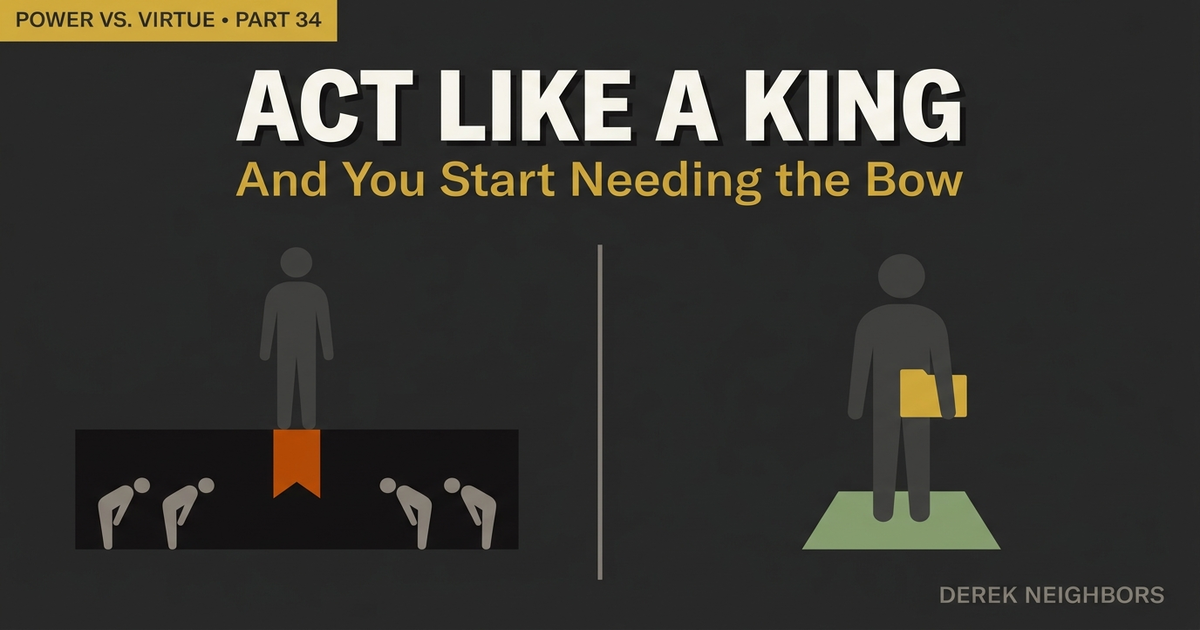
Act Like a King and You Start Needing the Bow
By Derek Neighbors on August 24, 2026
Power vs. Virtue: The 48 Laws Examined
A year-long examination of Robert Greene's 48 Laws of Power through the lens of ancient virtue ethics. Some laws we affirm, some we reframe, some we reject entirely.
Law 33 was what you do with a private fear after someone trusts you. Law 34 is how you walk into the room so they treat you like you already wear a crown.
Robert Greene wants you to act royal so the room copies the act. The ancient world cared more about whether you still knew your own worth if nobody bowed. Both instincts show up in real rooms, and the royal one falls apart the minute the room is empty.
The Law
Law 34: “Be Royal in Your Own Fashion: Act Like a King to Be Treated Like One.”
Greene’s instruction is blunt. He says the way you carry yourself determines how you are treated. Appear common and people treat you as common. Respect yourself and others follow. Act as if you are destined for a crown and the room starts treating the crown as a fact. He warns against cheap familiarity. He wants distance and a refusal to look desperate.
The whole law treats bearing as a request the room is supposed to grant. Acting royal can look like inner sufficiency while you are still waiting for the room to confirm it.
The Tactical Truth
Parts of this are ordinary human fact, and pretending otherwise is naive.
Rooms read you in the first two minutes. If you treat your hour as leftover, they schedule you as leftover. If you apologize for the invoice before you send it, they ask for a discount. I have watched consultants sit in the side chair and then wonder why they were treated as an extra. I have watched a senior engineer laugh off a scope cut, then spend the next month doing the cut work for free.
Greene is also right that cheap familiarity can collapse the work. Become “one of the guys” with a client and the hard conversation gets harder. Laugh off your own rate and they remember the laugh, not the rate. The same pattern shows up in a standup when a lead jokes away a missed commit so nobody feels tense.
So yes: bearing is information. Do not confuse that with a license to extract a bow. You can hold a standard for how you are treated and still refuse to need the room to confirm a crown. The duty binds a freelancer the same way it binds a manager. Being untitled, underpaid, or newly titled does not license needing the bow. The intern who wants the new title spoken aloud and the CEO who wants the bow owe the same restraint. Circumstance does not change the duty.
The Character Cost
Greene does not stop at bearing. He turns bearing into a standing practice whose point is the treatment you extract.
Once you act like a king as a method, you start needing the bow. A missed title on a calendar invite becomes an insult, and a client who texts instead of booking a call becomes disrespect. You spend the meeting managing your rank instead of the problem.
You also start treating warmth as a leak. Asking how their week went starts to feel like you gave something away. You keep people at a distance so they cannot see you as ordinary. Ordinary is where the work actually happens.
The people across from you become a court. Courts exist to confirm the crown. They stop bringing you the ugly news because ugly news is not what you do with a king. You keep the posture and lose the information that would have let you lead. If every option already served you, they never had a choice. When every greeting has to prove your rank, they stop being colleagues.
There is a self-cost next. autarkeia is the Greek name for being enough without the confirmation. Aristotle treated it as a feature of a flourishing life: you lack nothing essential, and you still have friends. Run Law 34 long enough and you invert it. Your sense of worth now lives in other people’s manners. Miss a bow and your day is wrecked, which means you gave the room a job it should not have.
Self-sufficiency is not isolation. Law 8 used autarkeia to separate standing on your own from hiding so people have to chase you. Law 34 uses the same word for a different failure: standing on a block so people have to look up.
hubris is the other failure, and it is common in people who have had a few wins. The crown starts to exceed the work. You claim a rate, a title, or a tone the last twelve months cannot support. Rooms can smell that. They may still nod, and they still will not trust the work.
The opposite failure deserves one hard line. Shrinking so hard that you train the room to treat you as leftover fails the test too. Your modesty is costing everyone around you already owns that door. This piece is the other one: running a crown so you never have to sit in the cheap feeling of being ordinary.
The ARETE Alternative
Inner sufficiency is autarkeia. In leadership that means you still hold a price. You still refuse the leftover chair when the work needs a real conversation. You still send the invoice without the apology. The question is what the bearing is for.
Measure is sophrosyne. The mean sits between the royal act and the cheap collapse. You can ask how their weekend went and still hold the fee. You can sit at the table instead of the head and still own the decision. Warmth is not a discount if the work stays priced.
Accuracy is the check Aristotle called megalopsychia, greatness of soul as a match between claim and work. Law 6 already spent a full essay on that virtue. Use it here as a test, not a second thesis. If a peer would say the tone exceeds the last year of output, you are running hubris. If a peer would say you keep giving the work away, you are running the leftover chair. The mean is a price the work can carry.
You control the number you quote, the chair you take, and whether you stay warm. You do not control whether they bow, cc you first, or use the title you prefer. Their manners are indifferent. Text, Slack, a first name, a booked call: the channel is indifferent relative to whether you needed the form. Wrecking the hour over how they reached you still fails the duty, even if the room never notices. Score this by whether you needed the bow. Using distance to stay liked still fails the duty.
arete in this domain includes leaving people able to work with you without managing your rank. A mind that needs the bow cannot judge the work, because it is busy managing rank. Rational judgment in a team needs true premises, including the true premise that a hard update will not be read as disrespect. People cannot think with you once that premise dies. A culture that only functions when everyone acts like a court fails to develop people. The work still exists. It just goes around you.
A price the last year of work can carry is autarkeia, and a tone that same year cannot support is hubris. Using a title the role requires (attending physician, aircraft captain, counsel of record) is the work; needing extra deference beyond the role is Law 34. Take the chair the meeting actually requires, and leave the extra chair that only exists to extract a bow. A fee the work cannot carry is still hubris, not inner sufficiency.
In practice the sequence looks like this.
First, quote the number without the speech. Send the fee. Skip the biography of how important you are. The number is the standard, and the speech is the royal act.
Second, stay warm without cutting the fee. Ask how their week went. Still send the invoice on time. If warmth only feels safe when you also discount, you are buying liking with the work.
Third, refuse one cheap ask without the lecture about who you are. “That is outside the scope, here is the change order” is enough. A paragraph on your stature is the bow-request.
Fourth, after the meeting, ask whether you needed them to treat you a certain way, or whether you needed the work to land. If a missed title wrecked the hour, you were running Law 34.
Fifth, run an accuracy check with a peer. Show them the last twelve months. Ask if the bearing matches the work. Listen. Write your own review first is the sibling move for evaluation. Here the same honesty applies to the tone you walk in with.
Then go back into the room without needing the bow. Let people work with you because the last hard thing they said did not become a rank problem.
Ancient Wisdom: Enough Without a Court
Aristotle’s Nicomachean Ethics will not let you pick independence or other people as if those were the only two chairs. autarkeia is a feature of eudaimonia: the flourishing life lacks nothing essential. He also says you still need friends. Self-sufficiency is a life whose core does not collapse when the room forgets to flatter you, and it still leaves the door open.
The Diogenes story is the sharp version of the same test. When Alexander asked what he could do for him, Diogenes asked him to stand out of the sunlight. The most powerful man in the room had nothing the self-sufficient person needed. You do not have to live in a jar to use the point. If the most important person in your industry walked in and you still knew the price of your Tuesday, you are closer to autarkeia than to Law 34.
Seneca is practical from another angle. He was rich and still argued that the wise person uses goods without depending on them. Status, titles, and good manners are goods. Use them, and do not hand them the keys to your day. The test is whether a missed “sir” can wreck an afternoon that still had real work in it.
Greek tragedy named the excess hubris: a claim that has outrun the facts. The royal act becomes that claim the moment the last year of work cannot carry the tone. The styrofoam cup is the exit-side cousin. The title was never yours to lose. Law 34 is the entry-side error: acting as if the title has to be forced into existence.
Epictetus is blunt about the remaining choice. Other people’s manners are not yours to steer. Your job is your own faculty of choice. Needing a bow is a confession that you cannot sit in the work without a court.
The Test
Five questions. Answer them somewhere honest.
In your last hard meeting, did you spend more minutes on how they addressed you than on the problem?
If they forgot your title and still shipped the work, would your day be wrecked?
Which cheap ask have you been refusing with a speech about who you are, when a change order would have been enough?
Where have you confused “I held a price” with “I needed them to feel my rank,” and where have you confused warmth with a discount?
When people stop bringing you the ugly news, is it because they got stronger, or because you became a court?
Final Thoughts
Law 34 contains a skill this series will not mock. Rooms copy how you price yourself. Leaders who collapse their own rate train the collapse. The ancient correction is simple and expensive: autarkeia has to hold the price, and sophrosyne has to keep the warmth. Become someone they can work with without managing your crown. If you act like a king as a habit, you start needing the bow, and that fails arete.
If you want rooms where the work can land without a court, MasteryLab is where we train leaders to hold a price without needing the bow.