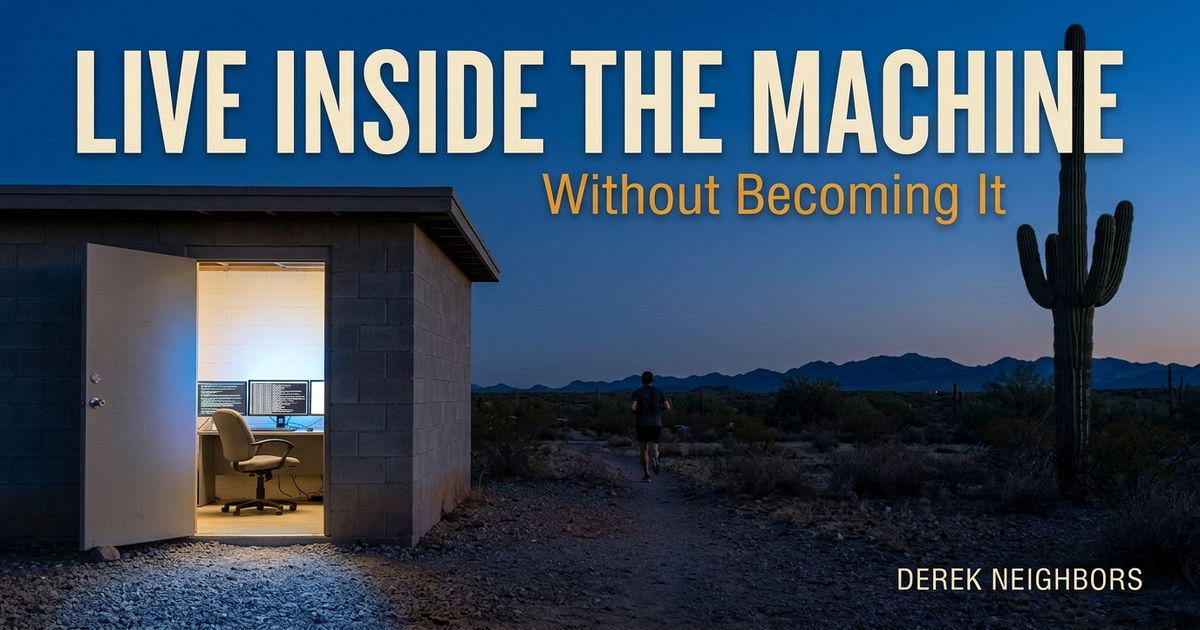
Live Inside the Machine Without Becoming It
By Derek Neighbors on November 19, 2026
There is a scene in Charlie Chaplin’s Modern Times where the Tramp spends his shift tightening bolts on an assembly line. When he finally steps away from the belt, his arms keep going. He walks off still making the same twisting motion with both wrenches, because the line has been in his body so long that his hands no longer know how to stop.
I think about that scene more than I expected to. Most days I have AI agents working in the repo while I do something else. They open pull requests, run the tests, write up what they found, and come back for the next instruction. It is the best way I have ever worked, and I am not going back. But some mornings I am an hour into a desert run with no signal, and I catch my hand reaching for my phone to see what came back. Nothing is wrong and nothing needs me, and the hand goes anyway.
A machine never needs you to stop. It will hand you the next result for as long as you are willing to take it, which is what makes it useful. The danger is that you start working the way the model does and lose the one thing it does not have. Live inside the machine and go all in, and keep the part of you it cannot run.
The Beginning State: You Ask, It Answers
Almost everyone starts in the same place. You open a chat window and ask it to draft an email or explain an error message. The model answers fast, and you decide what to do with the answer.
In this stage the relationship is simple. You are the one who wanted something, and the model works for that want. When you close the window, the work stops. The worst outcome is a bad answer you have to throw away.
A lot of people think this is the whole relationship and judge AI on it, when it is only the first of three stages.
The Progression: The Work Runs While You Are Gone
The second stage starts when you hand the model a job instead of a question. An agent picks up a task, works through it, tests its own output, and reports back. You give it five jobs before lunch and it finishes all five while you are in meetings. Work ships overnight. The weekend stops being dead time for the codebase.
This stage is the win. Run more agents, point them at harder work, and let them go through the night. I wrote about what that does to your habits in Your Agents Are Training You, where the way you manage agents turns into the way you lead.
Then the drift starts, and it is quiet enough that most people never see it. The agents finish at random times, so you check at random times. You approve a pull request between two calls and read a summary at a red light, and because every return is small, every check feels free. A month later your day has the shape of the queue, and you work on whatever came back most recently because it came back most recently.
When Karel Čapek’s play R.U.R. put the word “robot” into English in 1920, the word came from the Czech “robota,” which means forced labor. Čapek credited his brother Josef with it. The machines in that play were built to work without stopping and without wanting anything. Nobody forces you to work like that; you volunteer for it one check at a time.
The Advanced State: Letting the Queue Decide the Day
The third stage is a drift you can climb back out of, and it is the one nobody plans for. You still run the agents, and now you let them run your attention. Three signs tell you that you are there.
You open the queue before you know what you want from the day. The first thing you read in the morning is what the agents did, and your first decision is a reaction to it.
Your plan for the week turns into whatever the agents can do next. The work you thought mattered most gets pushed out by the work that is easiest to hand off, because handing work off feels like progress.
When something goes out wrong, the sentence in your head is “the agent sent that,” even though it went out under your name. I made the longer case in The Human in the Loop Is Not Driving: clicking approve on work you never thought about decides nothing.
Epictetus called what goes missing here prohairesis, the faculty of choice: the part of you that decides what to want, what to agree to, and what to aim at. In the first chapter of his Discourses he says it is the only faculty that can examine itself and the others, and that someone can chain your leg but not even Zeus can overpower your choice. Later he tells a student that what he is, more than his flesh or his hair, is his choice, and that if he makes that beautiful, he will be beautiful. (The concept page on prohairesis has the longer history of the word.)
A model makes thousands of small selections, like the next word or the next file to open, and it never picks what it is for. That comes from the prompt and the queue, and inside those it works extremely well, which is exactly why you want it. The trouble starts when the person running it works the same way, reacting to inputs and finishing whatever arrives next without ever deciding anything. At that point you have handed the machine the one thing Epictetus said was truly yours, and the machine never even asked for it. The queue only ever offered the next thing. Each yes was yours, which is the good news, because what you gave away one yes at a time you can take back the same way.
The Integration: Keep Three Things Outside the Machine
Pulling back would only buy you the stage one problems again, slower work and less shipped, so keep going. The fix is the one I give for building systems in Start With the Model. Harness What You Cannot Afford to Guess.: let the model do everything it does well, and put a small, hard boundary around the few things that cannot be left to a guess. For a person’s day, there are three, plus one weekly check.
Write the aim before you read anything. Before you open the queue, write one or two sentences in your own words about what you want from today and why. Take a minute first to think about what matters most this week and what you can move today, so the sentences come from a decision instead of whatever wish shows up first. Skip the task list. The model is better at task lists than you are, and it can turn your sentences into tasks once you have written them. The hand that reaches for the phone wants the next small finished thing, the little hit of a job done, and writing first puts your thinking ahead of that want. If you read the output first, the output writes your aim for you.
Put your name on every promise. Anything that reaches another person goes out as yours: a customer email, a commitment to your team, a date you gave a client. Let the model draft it, track it, and remind you when it is due. You are still the one who promised, so you are the one who says “I told them Friday.”
Keep hours with no queue. The agents can run all night and all through your workout. Check them on your schedule instead of theirs. Turn off the alert for every finished job, and have the model write one summary of everything that came back since you last looked. Seneca opened his first letter to Lucilius by telling him to claim himself for himself and to gather up the time that had been taken from him or had slipped away. He wrote that two thousand years before push notifications. Your desk can keep working while you are gone, and you do not have to sit at it. Spend those hours on the work nobody can hand to an agent: deciding what is worth building next, and the people who are counting on you. Another screen does not count.
Check the week against a blank page. Once a week, have the model list everything you approved. Go down the list and mark the items you would have chosen if you had started from nothing. If most of the list goes unmarked, you have been saying yes to whatever the queue offered. Write next week’s aim before Monday’s first check.
None of this slows the machine down. The agents run the same hours and ship the same volume, and you are the one who decided what they worked on.
Final Thoughts
The Tramp’s trouble in Modern Times is that the line got into his arms and stayed there after the whistle. The work you do now has no whistle at all.
The machine you work in is faster than any assembly line, and it gets faster every few months. Live inside it, and hand it more work than feels reasonable. Then ask yourself one thing each morning before you open the queue: do you know what you want from today before it tells you what is next? If you can answer that, go as fast as the machine will let you.
Keeping your own aim at machine speed is easier with people who ask what you wanted before they ask what shipped. That is what MasteryLab is for.
FAQ
What does prohairesis mean?
prohairesis is the Greek word Epictetus used for the faculty of choice: the part of a person that decides what to want, what to agree with, and what to aim at. Epictetus taught that it is the only thing fully in your control, and that a person is their choices more than their body or their circumstances. Aristotle used the same word earlier for a choice made after thinking it through.
How do you use AI agents without burning out?
Let the agents run as long as you like, and stop matching their hours. Check results at set times instead of every time a job finishes, have the model summarize everything that came back since you last looked, and keep part of every day with no queue at all. Write your aim for the day before you read any output, so the work serves what you want instead of deciding it.
Should you check AI agent output as it comes in?
For most work, no. Checking every result as it lands turns your day into a reaction to whatever finished last. Review in batches at times you choose, turn off per-job alerts, and read a single summary. The exception is work where a mistake reaches a customer or costs money right away. Review that before it goes out, on purpose.