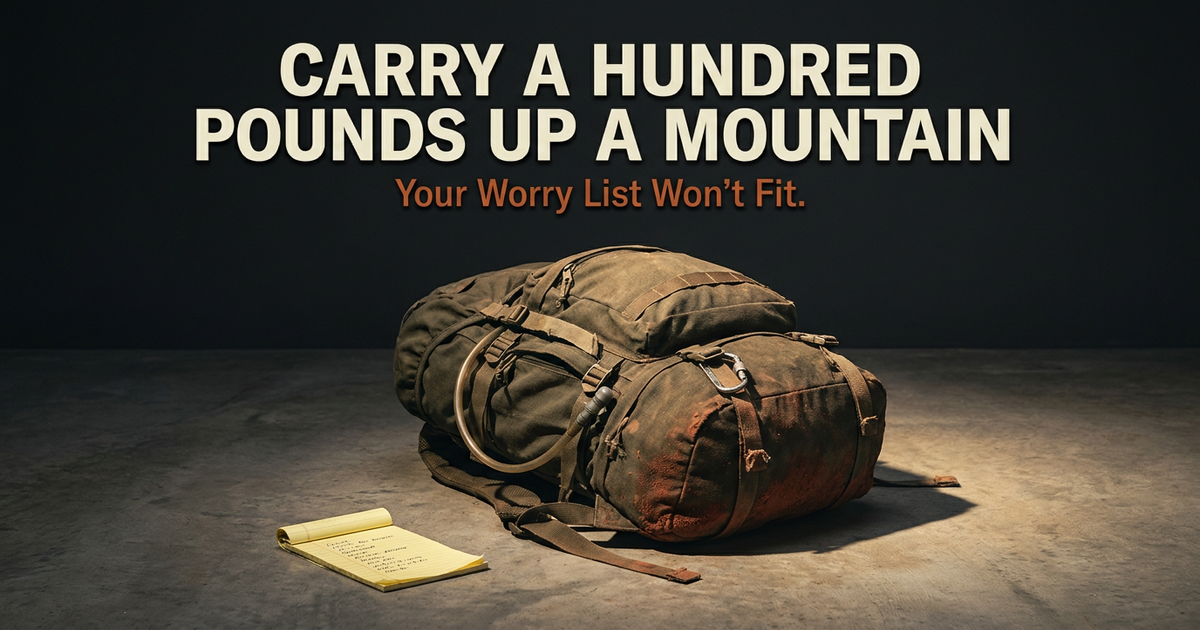
Carry a Hundred Pounds Up a Mountain. Your Worry List Won't Fit.
By Derek Neighbors on June 6, 2026
Six in the morning. Desert. A light hydration vest, water for three hours. Fifteen miles of trail in front of me with no phone signal. Cactus, basalt, and the particular silence of high desert before the sun is over the ridge.
I cannot remember a single anxiety from any of those mornings.
The worry list exists. The work that still matters to me. Adult kids whose lives are now their own to track from outside. A marriage with a wife who is a more disciplined minimalist than I am. A body that has crossed deep into the back half of life and notices the crossing. None of it has gone anywhere.
The list cannot fit on the run.
This is not a metaphor. It is a structural feature of human cognition. The brain is a limited-capacity organ. When the body makes a sufficiently large demand on the limited capacity, the psychological garbage that was running in the background gets evicted. There is no room for the worry because there is now three hours of breath and fifteen miles of uneven trail in front of it, and the body is fully occupied with the small ongoing question of whether the next step goes where the foot expected it to.
The Greeks knew this. malakia was their word for what happens when the practice is absent. Softness, understood not as deficiency in the moment but as accumulated permission to avoid the kind of effort that would have evicted the anxiety in the first place.
Raw Truth One: You Are Not Anxious. You Are Soft.
The most common avoidance pattern available to a comfort-saturated person is calling softness anxiety.
The person who has not voluntarily made a physical demand of themselves in three years describes themselves as overwhelmed. They are not overwhelmed. They are vacant. The mind has been left running in idle for so long that the idle has built itself a daily inventory of things to worry about, and the inventory has become indistinguishable, from the inside, from a real burden.
A real burden has weight. The weight of an actual project, a real obligation to a real person, the labor of building a real thing. Real burdens fit the architecture of the mind because the mind evolved to handle them. The mind did not evolve to handle the surplus capacity that modern comfort has gifted it. That surplus capacity does not stay surplus. It fills itself with simulated burdens, which feel exactly like real burdens to the person hosting them.
The cure for the simulated burdens is not therapy, although therapy may help with what is left after the simulated layer is gone. The cure is to put a real burden back on the architecture. Not metaphorically. Literally. Carry the pack. Run the hill. Stand at the squat rack until the loaded bar is on your shoulders and the question of whether you can stand back up is in your hands and not in your head.
The Stoics called this askesis, training. They were not talking about cardio. They were talking about the deliberate, repeated imposition of difficulty on the body and mind, for the purpose of building the capacity to be unmoved by the difficulties life imposes without consent. Their argument was that the soft person, the malakos, was not less anxious than the trained one. They were more anxious, because they had not built the architecture to hold what life sends. The architecture is built by askesis. There is no other way to build it.
Raw Truth Two: Physical Demand Evicts Psychological Junk
Name the mechanism. It is not motivation. It is not endorphins. It is not “exercise reduces stress.” It is displacement.
The brain has roughly a working-memory budget. When the body issues a sufficiently loud demand, that demand consumes the budget. The psychological garbage that was running in the background does not get processed and resolved, the way the wellness industry pretends. It gets paused. It gets evicted from working memory because there is no remaining capacity to host it. The pause is real and the eviction is real, and after sixty or ninety minutes of sustained physical demand, the inventory that the mind was running has been quietly purged of most of its contents.
What remains after eviction are the few items that survived the purge. Those are the real ones. The ones that came back when the body’s demand subsided are the ones worth attending to. The forty other items on the morning’s worry list are now nowhere to be found. They were simulated burdens generated by surplus cognitive capacity. The demand exposed them as such.
This is the Greek insight that the wellness industry has never been able to package, because it cannot be packaged. The product the wellness industry sells is “feel calm despite your circumstances.” The Greek protocol is “make a circumstance large enough that the trivial circumstances can no longer fit.” These are opposite mechanisms. The first cushions the soul against the inventory. The second is the inventory’s structural cure.
Two clarifications honest to the argument. The protocol does not produce calm. It produces displacement and clarity. The reader who comes to this expecting Stoic serenity should know that the trained body is not the meditatively quiet mind; it is the busy-in-the-body mind, edited by physical demand down to the items that survived. The serenity, if it comes at all, is the byproduct of an underlying life well ordered, not of the eviction itself. And the protocol is necessary, not sufficient. The trained athlete whose underlying life is misaligned with anything of consequence is still anxious. Askesis clears the residue. It does not write the underlying life. The reader has to do that part separately, and the article is honest that it is not the article’s subject.
ponos is the Greek word for productive toil. The labor that builds capacity rather than merely depleting it. Hesiod, writing in the eighth century BCE, said the gods placed sweat on the road to arete. He did not mean as a regrettable obstacle. He meant as the mechanism. The sweat is the path. The toil is the curriculum. The body’s demand on the mind is the structural eviction notice the modern person needs and never delivers to themselves.
Raw Truth Three: Comfort Is the Problem, Not the Reward
Most adults treat comfort as the reward at the end of effort. Work hard, then rest. Build the career, then retire. Run the company, then sell it and travel. The premise is that effort is the price of comfort and comfort is what effort is for.
One distinction worth marking before that premise carries the rest of the section. There is a legitimate ease the Greeks called eu-prattein, doing well and living well: the rest after labor, the meal with friends, the afternoon of contemplation in the cool. That kind of ease is the byproduct of a well-ordered life and the article is not in the business of attacking it. The comfort under indictment is the other kind, the idle and slothful sort that fills the day with avoidance, atrophies the architecture of mind, and produces the inventory the rest of this section is about.
With the distinction in hand, the Greeks would have called the comfort-as-reward premise malakia in its most pernicious form. Not soft in the moment. Soft as a life arrangement. Soft as a settled disposition that organizes the whole structure of a person’s days around the avoidance of effort and the maximization of ease.
The cost of treating comfort as the reward is that the comfort is the disease. The longer the person stays in it, the more the architecture of mind atrophies for the kind of load it was built to carry. The atrophy produces the anxiety that the comfort was supposed to cure. The person buys more comfort, and the anxiety grows. The cycle accelerates. After enough years of soft life, the person cannot understand why every measurable circumstance is favorable and every internal experience is dread.
This is the modern cycle. It is the cycle the Spartans organized their entire educational system, the agoge, to prevent. It is the cycle the Stoics organized askesis to interrupt. It is the cycle Hesiod warned about in the eighth century BCE and that every honest tradition since has named, in different vocabulary, as the same trap.
The reframe required to escape the cycle is structural. Comfort is not the reward at the end of effort. Comfort is the slow loss of the capacity that effort was building. Voluntary hardship is not a punishment for not being good enough. It is the daily preservation of the capacity that makes the rest of life possible. The pack on the back is not penance. It is the cure for the part of the mind that was about to be eaten by the surplus capacity comfort produces.
The Protocol
You do not need to do an ultra. You do not need to deadlift twice your body weight. You do not need to climb mountains. You do need to introduce a sufficient, repeated physical demand into your week to evict the simulated burdens from your mind on a regular basis.
The mechanism that does the work is the body’s demand fully occupying working memory, not the absolute weight on the back. The principle scales to the body the reader has, not to the body the author has. For a healthy forty-something it looks like a loaded ruck on uneven terrain. For an older or recovering body it looks like a graded walk that empties the breath. For a wheelchair user it looks like sustained pushing on a hill, or heavy upper-body resistance work, or the slow patient breathwork that takes the diaphragm to genuine fatigue. Epictetus had a lame leg from his master and trained anyway, and his askesis was as real as any athlete’s. The protocol is calibrated by what the specific body can be asked to do at its honest edge, not by a number lifted from someone else’s program.
The minimum effective protocol has three properties. It must be physically real, which means it must require the body to actually struggle, not just move. It must be sustained, which means it must run long enough to fully occupy working memory, which for most people is at least sixty minutes. It must be repeated, which means it must happen on most days, because the simulated burdens regrow inside about forty-eight hours of being evicted.
Three specific applications, ordered from minimum to substantial.
Minimum: a loaded ruck, twenty-five to thirty-five pounds, walked briskly for sixty minutes on uneven terrain, three to five times per week. Cheap to start. Hard to fake. The pack weight forces the demand. The uneven terrain forces the attention. The sixty minutes forces the eviction.
Substantial: a sustained athletic project that takes the body to genuine fatigue four to six days per week. Running, cycling, swimming, climbing, heavy strength training, martial arts. The specific medium matters less than the genuine fatigue, which is what produces the working-memory consumption.
Aspirational: a long event held on the calendar, six to twelve months out, that requires daily preparation and that you are not certain you can finish. The looming difficulty restructures the days leading up to it. The preparation displaces the worry list on a daily basis, not just inside the workouts. The event is the agon, the contest, that the Greeks treated as the structural good for the same reasons modern athletes return to it.
One qualification, in the spirit of honesty about the argument. The displacement mechanism works on the cognitive surplus that comfort produces. It does not erase real grief, real loss, real injury, real circumstances that genuinely require attention. A person whose marriage is collapsing, whose parent is dying, whose company is failing has real burdens that the body cannot evict, nor should it. The protocol is for the residue that remains after the real burdens have been counted, which is the residue that comfort produces and that nothing else can clear. Most adult worry, in the absence of acute crisis, is residue. The protocol is for the residue. The real burdens are a separate matter for separate work.
Final Thoughts
Six in the morning, in the desert, with the next fifteen miles of trail in front of you and no signal anywhere, you do not have a worry list. You have a run. The run is large enough to occupy the cognitive budget that the worry list had colonized. When you come back, the items that survived the run are the ones worth attending to. Most of them did not survive. They were not real. They were surplus capacity acting as burdens.
The Greeks were not romantic about hardship. They were structural about it. They organized their cities, their schools, their philosophies, and their training around the empirical observation that the mind atrophies when the body is not asked to bear real load, and the atrophy becomes a daily inventory of anxieties that look real from the inside and disappear under physical demand.
It is worth naming what the protocol is for. The end is not less anxiety, treated as a productivity metric. The end is eudaimonia, the flourishing of a soul properly ordered, with the body trained as the architecture in which logos (reason) does its work rather than as the storeroom where epithymia (appetite) accumulates the day. Askesis serves eudaimonia. The pack on the back is the means. The well-formed soul is the end. The reader who does the protocol without the end in view will end up fit and still lost; the reader who keeps the end in view will find the protocol does only the work it can do, which is the eviction of residue so the soul can attend to what is actually in front of it.
One more honest distinction belongs here. Some anxiety is residue. Some anxiety is signal. The soul of a person whose life is genuinely misaligned with the Good produces real disquiet at four in the morning, and that disquiet is not residue and the protocol will not evict it. Nor should it. The legitimate signal is the soul calling for moral course-correction, and the right response to it is moral course-correction, not another loaded ruck. The protocol clears the residue so the signal can be heard. After the residue is gone, the signal is what is left. Most of what wakes a comfortable person at four in the morning is residue. Some of it is not, and the difference matters more than any of the other distinctions in this article.
The cure for the residue is not exotic. It is a pack and a hill and an hour, or whatever your body’s honest equivalent of those is. Five days a week. Repeated until the body’s authority over the cognitive budget is restored. The worry list will not fit. The climb is the cure for what the climb can cure, which is most of it, and not all of it, and the distinction is the whole point.
This is the same family of arguments that runs through Why Voluntary Struggle Prepares You for Involuntary Battles and through the subtraction-shaped sibling, You Don’t Need More. You Need to Strip Your Life Down on Purpose. The rehearsal frame, the stripping frame, and the displacement frame are three doors into the same room. The room is the structural answer to malakia. Yesterday’s piece on Darwin’s twenty-eight years is the same architecture applied to mental endurance across decades; this one is the same architecture applied to the daily eviction of psychological residue. The deeper philological work on the term itself lives on the malakia concept page, and the wider treatment of the comfort cycle is in AI Is Making Life Easier. That Might Be the Worst Thing That Ever Happened to Us.
MasteryLab.co holds the daily practices for the people who have already decided to put real load back on the body and the mind. It does not perform the askesis for you. It exists alongside the practice, not in place of it.