You Fixed What Was Missing. The Ache Just Moved.
By Derek Neighbors on July 5, 2026
You spent years wanting the thing. The partner, the company, the house, the title, the finish line. Its absence organized your calendar and narrated your drives home.
Then you got it.
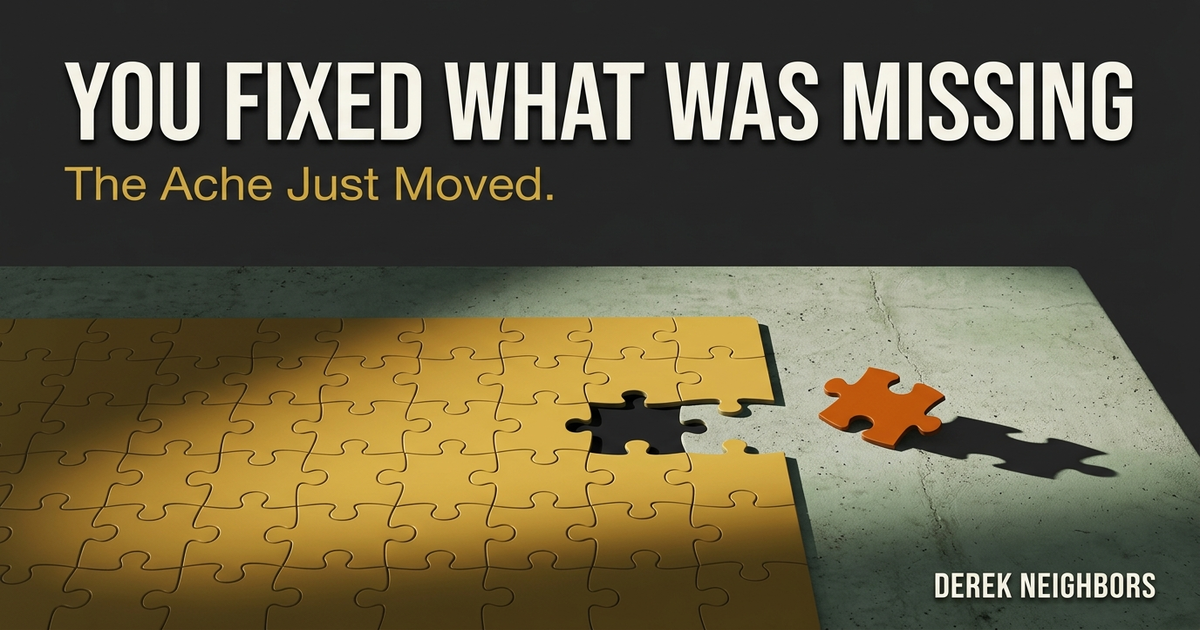
And for a while it was everything the wanting promised. A season later, maybe two, you caught yourself mid-sentence describing what’s missing now. A different thing. The ache hadn’t died. It had moved.
Single people ache for partnership. Partnered people ache for solitude. The overworked ache for rest, the rested ache for purpose, the settled ache for adventure, and the adventurers, on some anonymous night in some spectacular place, ache for a kitchen that knows them.
You’ve noticed this. And if you’re like most people, you drew exactly the wrong conclusion from it.
The Three Wrong Conclusions
“I chose wrong.” The most expensive misread. The ache moved, so the marriage, the career, the city must have been a mistake. People detonate good lives over this inference all the time, then discover the ache standing in the wreckage, already pointing somewhere new.
“I’m bad at gratitude.” The most common misread. You conclude the problem is a discipline deficit, that a better person would journal harder and feel whole. So you add gratitude practice to the pile, feel guilty when the ache persists, and now carry the gap plus the guilt.
“One more acquisition and I’m done.” The best-funded misread. Entire industries run on selling the current gap as the final one. Buy the house, reach the number, find the person, and the aching stops. It has never once worked as advertised, and the customer concludes the product was wrong rather than the promise.
All three readings share an assumption: that scarcity is a bug, and the right configuration of a life eliminates it. That assumption is false, and the Greeks knew it was false twenty-four centuries before the first lifestyle influencer promised you completeness.
Desire Was Born This Way
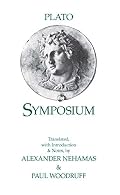
In Plato’s Symposium, Socrates reports what the priestess Diotima taught him about eros, desire itself. She tells a myth. At the feast celebrating Aphrodite’s birth, poros, the god of resource and way-finding, drunk on nectar, falls asleep in the garden of Zeus. penia, poverty personified, has come to the door to beg, as lack always shows up where abundance is celebrating. She lies down beside poros and conceives a child: eros.
Read the parentage carefully, because the myth is doing precision work. Desire’s mother is lack. Desire’s father is the pathway toward what is lacked. So desire inherits both: it is always poor, Diotima says, always homeless like its mother, and always scheming, resourceful, hunting like its father. Desire is not a feeling that visits a complete person. It is the permanent offspring of absence and pursuit.
Socrates then makes the argument straight, no myth required: you can only desire what you lack. A tall man does not wish to be tall. Even wanting to keep what you have is wanting its future presence, which you do not hold yet. Wanting is made of absence the way a hole is made of missing ground.
Now follow the logic one step further than it usually gets followed. If desire is built out of lack, then closing a particular gap cannot retire desire. There is no configuration of a life that starves the machinery, because the machinery does not eat circumstances. It eats absence, and absence is always in stock. Fix what was missing and desire does not die. It re-aims.
Modern psychology found the same mechanism and gave it a duller name: hedonic adaptation. The lift from any gain fades as the gain becomes baseline, and wanting recalibrates to the next absence. The researchers call it a treadmill. Diotima would say you finally met penia’s son properly.
When the ache moves, the system is running exactly as built.
Two boundaries before we go on, because this argument gets misused in both directions. First: penia in the myth is poverty proper, and there is a version of the missing piece that has nothing to do with any of this. If what’s missing is rent, food, or your health, that gap is a wolf, and you feed wolves before you philosophize about them. Everything that follows is about the ache that survives provision, the one that keeps moving after the necessities are handled. Second: not every gap is chosen or closable. The dead parent, the ruined knee, the friend who stopped calling. The chase framework doesn’t apply there, but the division underneath it holds for every gap in this piece, chosen or not: the gap’s arrival and its address were never your jurisdiction. Everything after arrival is.
The Rotation
Once you see the mechanism, the pattern in your own history gets almost embarrassing to read.
I’ll read mine. In my thirties I ran a company through a bad economy and lived lean, and what ached was everything material we’d deferred. The missing piece had a price tag on it, and I could tell you to the dollar. Eventually the lean years ended and I refilled hard: vehicles, remodels, the whole catalog of caught-up-ness. And I remember, standing in the middle of all that completed acquisition, feeling the ache re-aim with zero downtime. It wanted margin now. Quiet. Fewer things asking for maintenance. The gap had been material for a decade, and the moment the material closed, it moved. These days my wife and I run a deliberately minimal life, and I hold that arrangement honestly: it didn’t end the ache either. It relocated it somewhere I respect more.
That’s the rotation. Solitude and relationship take turns. Work and rest take turns. Stability and adventure take turns. Being deeply known and being left alone take turns. The gap tours your life like a restless tenant, and every domain it leaves looks suddenly fine, and every domain it enters looks suddenly like the problem.
So be precise about what the gap is telling you. Its address is real information: something is genuinely absent there. Its adjectives are the lie. Every gap presents itself as terminal, the one fix that ends fixing, and that part has never been true once. The trade test below exists to separate the report from the sales pitch.
Notice what the rotation does to the people selling completeness. They need the current gap to feel terminal, because terminal gaps open wallets. Chasing gap after gap as each one presents itself as final has a name the Greeks also had ready: pleonexia, the grasping that always needs more and metabolizes every acquisition into the next demand. pleonexia is desire with the myth stripped out: wanting that has forgotten its own mother and so believes the next win will finally be enough.
What Changes When You See It
The gap stops being an emergency. An open gap is the shape of a living desire. You will have one at every net worth and in every relationship status, until you die. There was never a way to close it for good. The live question is whether the current one deserves your pursuit.
Chasing becomes choosing. You don’t get zero scarcity. You get to pick which scarcity you can respect. A founder scarce on leisure, a parent of young kids scarce on solitude, an athlete in a build scarce on comfort: these can all be chosen gaps, held on purpose for a season. I made the prescriptive version of this argument in Why Greatness Demands Imbalance. This is the descriptive floor under it: since something will be scarce regardless, the only real options are choosing your scarcity or having it assigned by drift.
The gap stops discrediting what you hold. This is what gratitude is actually for. It never closes the gap, and it was never supposed to. It stops the one missing piece from making the nine hundred present pieces invisible.
And you stop confusing the gap with a verdict. The rotating ache says something is absent from your life right now. It says nothing about whether you are enough, which is a different wound with different machinery. The gap is information about your season. It was never a grade on you.
The Practice
Name the current gap in one sentence. “Right now, the missing piece is ___.” Say it out loud. An unnamed gap operates as free-floating dissatisfaction and colors everything; a named gap becomes a fact you can examine.
Run the trade test before you chase. Ask what you would actually surrender from what you currently hold to close this gap. Name the specific cost: the hours, the relationship slack, the money, the solitude. If you wouldn’t trade anything real for it, the gap is a mood passing through, and you can let it pass. If you would, now you know the price and can pay it on purpose. Strip the question down until the trade is visible.
Declare a chosen scarcity for the season. Pick the gap that stays open on purpose this year and say so, to yourself and to the people who share your life. A declared gap reads as strategy and stops leaking guilt. An undeclared one reads as failure every time you notice it.
Audit your last fix. Write down the last significant gap you closed and what the ache did in the following six months. Your own record will teach you the rotation faster than any philosopher can, because it’s your handwriting.
Frequently Asked Questions
Why do I always feel like something is missing?
Because desire is built on lack. You can only want what you don’t securely have, so the sense of something missing is desire operating normally, never a defect in you. Close one gap and the wanting re-aims at the next absence. The feeling rotates across domains; treating each stop as an emergency is what turns a normal mechanism into a lifelong chase.
What is penia in Greek philosophy?
penia is poverty or lack personified. In Plato’s Symposium, she conceives eros with poros at Aphrodite’s birth feast, which makes lack the literal mother of desire. Every want you feel carries her in its lineage, which is why acquisition never ends wanting.
Does getting what you want make you happy?
Briefly, yes. Durably, no. Hedonic adaptation returns you to baseline and desire re-aims. The move that actually helps is choosing which gaps stay open on purpose instead of expecting any acquisition to be the last one.
What is poros in Greek philosophy?
poros is way, passage, resource: eros’s father in Diotima’s myth, contributing the scheming, path-finding half of desire’s inheritance. The word survives inside aporia, being without a path, and euporia, having found one. Desire lacks like its mother and hunts like its father.
Final Thoughts
Here is the part nobody selling completeness will say. If the chase ever actually worked, if some final acquisition closed the last gap for good, what you’d have isn’t peace. A person with nothing absent has nothing to move toward, and a life with nothing to move toward has stopped being a life and started being a museum of one.
The Greeks aimed at eudaimonia, a flourishing that was always understood as activity, and activity needs somewhere to go. The open gap is where.
And I’ll be honest about where I cut Diotima off. Her teaching doesn’t end with desire’s parentage. She climbs: desire followed honestly ascends, from bodies to souls to practices to wisdom, toward something no finite good ever was. On her account, the ache that settles nowhere is pointed at something none of its stops contain. You don’t have to climb the whole ladder tonight. But if the gap has toured every room of your life and rented none of them, that itinerary is itself a clue.
You were never broken. The piece was never missing. The hole moves because you’re alive, and the only real decisions are which hole deserves your pursuit this season and which ones get to stay open while you go.
Take the inventory. Choose your scarcity. Let the rest of the puzzle count.
Naming the gap honestly and choosing it on purpose is the daily character work we practice at MasteryLab.co. Bring your inventory.